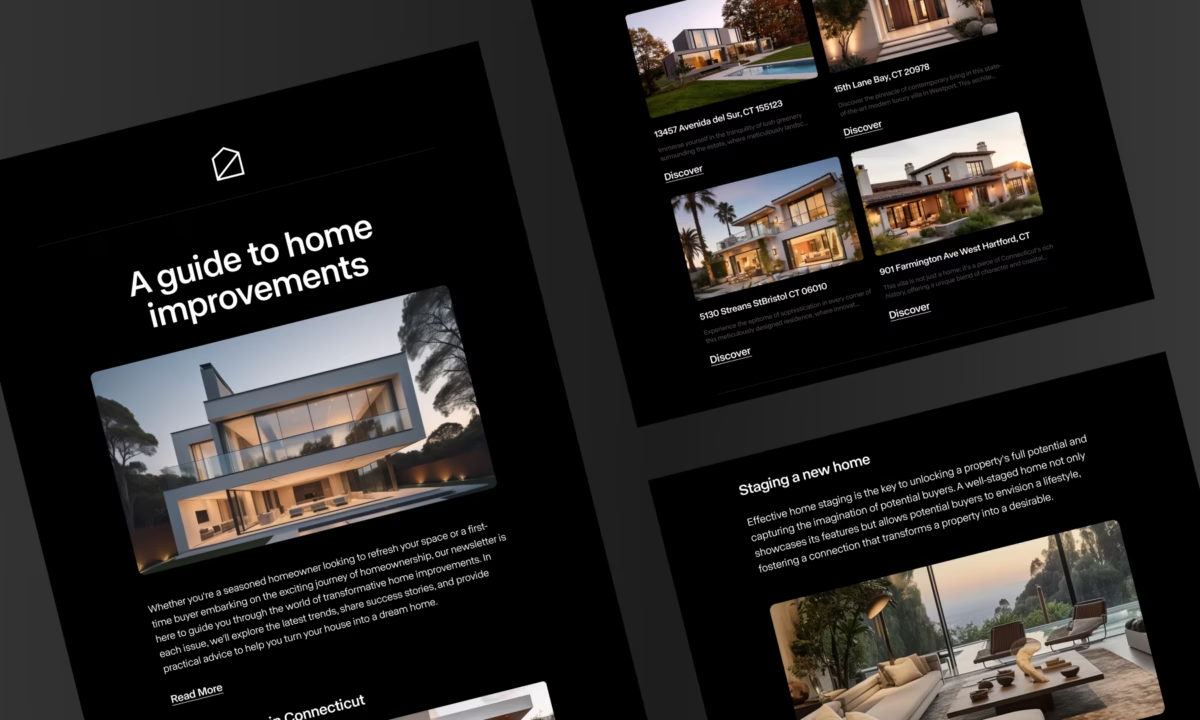
Off-market listings are properties sold privately without appearing on the multiple listing service (MLS), and in 2026, they represent one of the most talked-about strategies in residential real estate. Also called pocket listings or quiet listings, these off-market listings give agents a way to serve sellers who want privacy and buyers who want access to inventory no one else can see. Following NAR’s November 2019 adoption and subsequent 2025 amendment of its Clear Cooperation Policy, which generally requires MLS submission within one business day of any public marketing, the conversation around off-market strategies has intensified. This guide breaks down what off-market properties are, how to source and market them, the advantages and risks, and the compliance guardrails every agent needs to follow in 2026.
Find It Fast
Key takeaways
- Off-market listings are properties sold privately without MLS exposure, giving sellers control over who sees their home and when.
- Agents who build systems for sourcing pocket listings can offer buyers access to inventory that never hits the open market, creating a clear competitive edge.
- The tradeoff is real: limited exposure can result in a lower sale price or longer marketing timeline compared to MLS-listed properties, and sellers must understand that tradeoff in writing before proceeding.
- Compliance is non-negotiable. As of 2026, agents must secure written seller consent, follow fair housing laws, disclose dual agency, and align with their brokerage’s internal policies on office-exclusive listings.
- NAR’s 2025 amendment to the Clear Cooperation Policy has renewed interest in off-market strategies, making this a timely skill set for agents at every production level.
What are off-market listings?
An off-market listing is a property that is for sale but has not been publicly listed on the MLS. Instead of broad syndication to major real estate portals, the property is marketed privately through the listing agent’s network, direct outreach, or office-exclusive platforms. You may hear these called pocket listings, quiet listings, or private listings. The terms are often used interchangeably, though “pocket listing” specifically refers to a property an agent holds within their own network rather than sharing through any cooperative system.
What does off-market mean in practical terms? It means the seller has chosen to limit who knows the home is available. The sale process is more controlled: fewer showings, a smaller buyer pool, and a marketing approach that relies on relationships rather than algorithms. For the right seller and the right property, that tradeoff makes sense. For others, it does not. Your job as the agent is to help clients understand the difference.
Off-market listings vs. MLS listings: a comparison
| Factor | Off-market listing | MLS listing |
| Exposure | Limited to agent’s network, office, or private platform | Syndicated to all MLS-connected portals and agents |
| Buyer competition | Typically fewer competing offers | Higher likelihood of multiple offers in strong markets |
| Seller privacy | High: no public photos, no days-on-market count | Low: listing details are publicly visible |
| Sale price potential | May be lower due to reduced demand | Generally higher due to broader buyer pool |
| Time on market | Can be longer without wide exposure | Often shorter with full syndication |
| Compliance requirements | Written seller consent, fair housing adherence, brokerage policy alignment | Standard MLS rules and cooperative compensation disclosures |
How agents can use off-market listings in 2026
Knowing what a pocket listing is and knowing how to build a business around off-market inventory are two different things. Here is how to turn the concept into a repeatable system.
Build and activate your private network
Off-market listings live and die by the strength of your relationships. If you do not have a deep network of agents, past clients, and local contacts, you will not hear about these properties, and you will not have anyone to show them to. Start by organizing your contact database into segments: active buyers, past buyers who might move again, agents you co-broker with regularly, and local professionals (attorneys, CPAs, financial advisors) who hear about life changes before anyone else. Attend industry events, join local agent masterminds, and make a habit of calling five agents per week to ask what they are working on. The agents who consistently surface off-market deals are the ones who stay in conversation with the largest number of people.
Market with precision, not volume
The marketing playbook for off-market properties is the opposite of a public listing launch. Instead of maximum exposure, you want targeted outreach to a curated audience. Use targeted email campaigns to send property details to qualified buyers in your database. Send direct mail to neighboring homeowners who may know someone looking to move into the area. Host private showings by invitation only. The goal is to create a sense of controlled access: the right buyers see the property, and the seller’s privacy stays intact.
Position off-market access as a client benefit
For buyer clients, off-market access is a concrete differentiator. When you can show a buyer a home that is not on any portal, you are delivering something no algorithm can replicate. For seller clients, the ability to test the market quietly before committing to a full public launch can reduce stress and protect their timeline. Agents who work in the luxury segment or in markets with limited inventory find that off-market capabilities strengthen their brand positioning and deepen client loyalty. Frame it clearly in your listing presentations and buyer consultations: “I have access to properties you will not find online, and I can market your home to a vetted audience before it ever hits the MLS.”
How to find off-market listings
Sourcing off-market inventory is a skill, not luck. Here are the most reliable methods agents use in 2026.
Agent-to-agent outreach
The fastest path to off-market deals is direct communication with other agents. Call listing agents in your target neighborhoods and ask if they have anything coming soon or being marketed privately. Join office-exclusive listing networks within your brokerage. Participate in agent Facebook groups, Slack channels, and WhatsApp threads where pocket listings are shared before they go public.
Sphere of influence and past clients
Your past clients are one of your best sources. A homeowner who is not ready to list publicly may be willing to sell if the right buyer comes along. Reach out quarterly with a simple message: “I have buyers looking in your neighborhood. Have you thought about what your home might be worth in 2026?” That conversation opens doors that no portal search can.
Social media and content marketing
Use social media to signal that you work with off-market inventory. Post about recent off-market transactions (with client permission), share market updates that reference private listing activity, and position yourself as the agent who knows about properties before they hit the MLS. This attracts both sellers who want discretion and buyers who want early access.
Door knocking and direct mail in target neighborhoods
Old-school prospecting still works. If you have a buyer looking for a specific street, school district, or building, go knock on doors or send a targeted mailer. A simple message like “I have a qualified buyer looking for a home on your street” can surface a seller who was not planning to list but is open to a conversation.
Advantages of off-market listings
Privacy and seller control
Many sellers have legitimate reasons to avoid the public spotlight. High-profile individuals, families going through a divorce, homeowners facing financial difficulty, or anyone who simply does not want strangers walking through their home every weekend. Off-market listings let these sellers control who sees the property, when showings happen, and how much information is disclosed. There is no public days-on-market counter ticking, no price-reduction history visible to the world, and no neighborhood gossip fueled by a “For Sale” sign in the yard.
Reduced buyer competition
For buyers, off-market properties often mean fewer competing offers. In a market where MLS-listed homes in desirable areas can attract five, ten, or more offers within days, the ability to negotiate without a bidding war is a meaningful advantage. Buyers working with agents who have off-market access can often secure properties on more favorable terms, including longer inspection periods, seller concessions, or below-asking prices that would be impossible in a multiple-offer situation.
Inventory creation for agents
Here is the part most agents overlook: off-market listings let you create inventory that would not otherwise exist. A homeowner who is “not ready to list” may be willing to entertain an offer if you bring a qualified buyer directly. That is not a listing that would have appeared on the MLS. It is a transaction you made happen through relationships and initiative.
When you think about off-market strategy through that lens, it stops being a niche tactic and becomes a core business driver. Every conversation you have with a homeowner is a potential listing. Every relationship you maintain with another agent is a potential deal.
Disadvantages of off-market listings in 2026
Limited exposure and pricing risk
The most significant downside of off-market listings is reduced exposure. When a property is not on the MLS, it is not seen by the full universe of active buyers and their agents. That smaller buyer pool can translate directly into a lower sale price. Sellers need to understand this tradeoff clearly before agreeing to an off-market approach. According to the U.S. Department of Justice, the Fair Housing Act prohibits discrimination based on race, color, religion, sex, disability, familial status, or national origin, and limiting exposure must never be used as a mechanism to restrict who can bid on a property.
The privacy-versus-price tradeoff
Maggie Gold Seelig, a real estate agent who works with high-value properties, frames the tension clearly for her seller clients.
“If you want to be discreet and private, you’re necessarily choosing as a seller to not be out in front of 100% of the marketplace,” Seelig has said. That is the honest conversation every listing agent needs to have. Privacy has a cost, and the cost is measured in dollars left on the table when fewer buyers compete for the property.
Network dependency
Off-market listings require a deep, active network to work. Agents who are new to a market, new to the business, or who have not invested in relationship-building will struggle to source off-market inventory or find buyers for it. This is not a strategy you can execute with a CRM full of cold leads. It demands warm relationships, consistent communication, and a reputation for bringing real opportunities to the table.
Ethical and fair housing concerns
Because off-market listings restrict who sees a property, they can raise fair housing questions. If the marketing approach, intentionally or not, excludes certain groups from the opportunity to bid, the agent and seller face legal risk. Every off-market marketing plan must be reviewed against fair housing standards. As of 2026, this is an area of increasing regulatory attention, and agents who treat compliance as optional are putting their license and their clients at risk.
Compliance and legal considerations
Off-market listings carry specific legal and ethical obligations. Here is what you need to have in place before marketing any property outside the MLS in 2026.
Seller consent requirements
As of 2026, agents must obtain explicit, written consent from sellers before marketing their property off-market. That consent document should clearly explain the potential drawbacks: reduced exposure, the possibility of a lower sale price, and the limitations on buyer reach. Do not rely on a verbal agreement. Get it in writing, keep it in your file, and make sure the seller acknowledges they understand the tradeoffs.
Fair housing compliance
Off-market marketing must comply with the Fair Housing Act. Your outreach cannot target or exclude buyers based on race, color, religion, sex, disability, familial status, or national origin. This applies to every channel: email lists, direct mail, social media posts, and private showing invitations. If your off-market marketing strategy reaches only a narrow demographic, you have a compliance problem.
Dual agency disclosure
In cases where the listing agent also represents the buyer in an off-market transaction, full disclosure of the dual agency relationship is required. Dual agency is heavily regulated in some states and outright prohibited in others. As of 2026, agents must know their state’s specific rules and disclose the relationship in writing before any offers are submitted.
Brokerage policy alignment
Many brokerages have their own internal policies governing off-market and office-exclusive listings. These policies may be stricter than MLS rules or state law. Before marketing any property off-market, confirm your brokerage’s requirements around documentation, internal listing submission, and cooperative compensation disclosure.
Documentation and record-keeping
Keep records of everything: the seller’s written consent, all marketing materials used, every communication with potential buyers, showing feedback, and offer details. If a dispute arises months or years after closing, your documentation is your defense. Treat record-keeping for off-market transactions with the same rigor you would apply to any MLS-listed sale.
Using Off-Market Listings Strategically in 2026
Off-market listings can be a powerful way to serve clients who value privacy, access, and a more controlled sales process, but they only work when the strategy fits the property and the seller’s goals. The best results come from strong relationships, targeted outreach, and a clear understanding of the tradeoffs involved. Just as important, every off-market transaction in 2026 needs to be handled with careful attention to written consent, fair housing rules, and brokerage policy.
FAQs
Insider insights
on private
listings
Get the strategies you need to succeed and stay in compliance in a changing market.
About the author

Marketing Manager
Kate Evans is a content marketing strategist at Luxury Presence, the leading growth platform for high-performing real estate professionals. She develops data-driven editorial content and supports SEO strategy and brand voice frameworks that help agents attract qualified leads and establish market authority. Her published work covers topics including CRM strategy, social media marketing, and digital growth, supporting thousands of agents in scaling their businesses through modern marketing.