How much does a real estate website cost in 2026? The answer depends on the type of site you build, the features you need, and who builds it. As of 2026, a template real estate website runs roughly $200 to $1,000, a semi-custom build falls between $1,000 and $5,000, and a fully custom real estate website starts around $5,000 and can exceed $25,000. Those ranges shift based on IDX integration requirements, hosting, ongoing maintenance, and whether your developer specializes in real estate. This guide breaks down every cost factor so you can make a confident investment decision for your business.
Key takeaways
- Real estate website cost in 2026 ranges from $200 for a basic template to $25,000 or more for a fully custom build with IDX search, branding control, and lead capture.
- The three main pricing tiers are template, semi-custom, and fully custom, and each tier carries different tradeoffs in design flexibility, IDX compatibility, and long-term maintenance costs.
- IDX integration is one of the largest cost variables. Working with a developer who already has IDX infrastructure in place can save thousands compared to building it from scratch.
- Hidden costs like plug-ins, widget subscriptions, and MLS data compliance fees often push semi-custom builds closer to fully custom pricing over time.
- A purpose-built real estate website consistently outperforms generic builds on lead generation, as documented in case studies showing agents going from zero organic leads to double-digit weekly leads after switching platforms.
Real estate website pricing overview for 2026
Before we get into the details, here is a side-by-side look at what each website tier typically costs. These ranges reflect 2026 market pricing and will vary by vendor, MLS region, and feature set.
| Cost category | Template | Semi-custom | Fully custom |
| Initial build cost | $200 – $1,000 | $1,000 – $5,000 | $5,000 – $25,000+ |
| Monthly hosting | $10 – $50 | $30 – $100 | $50 – $300 |
| IDX integration (setup) | Often unavailable | $500 – $1,500 | Typically included |
| IDX integration (annual) | N/A | $600 – $1,200 | $600 – $1,500 |
| Estimated year-one total | $320 – $1,600 | $2,460 – $8,900 | $6,200 – $30,000+ |
The gap between tiers is real, but so is the gap in performance. A $500 template and a $15,000 custom build serve very different business goals. The rest of this article explains what drives those differences so you can match your investment to your growth stage.
Decide what your priorities are
Start with two questions. First: is speed or budget your bigger constraint? Second: do you want hands-on control over your site, or would you rather hand design and development to a specialist?
Your answers shape everything that follows. An agent who needs a web presence within a week and has $500 to spend is in a different position than a team leader planning a brand overhaul with a $20,000 budget and a 90-day timeline. Neither is wrong. But the cost, the vendor, and the website type you choose should follow directly from those priorities.
One pattern worth noting: agents who invest in a purpose-built real estate website, designed by developers who specialize in the industry, consistently see stronger lead generation results than those who go the generic route. Better Homes and Gardens Real Estate Lifestyles Realty spent six months working with generalist developers who could not properly integrate property search. After switching to a platform built for real estate, the brokerage generated 10 organic leads in its first week, compared to zero leads over the previous 13 years on their old site (Source: Luxury Presence Case Study: Better Homes and Gardens Real Estate Lifestyles Realty).
That does not mean every agent needs a $25,000 website on day one. It means the right answer depends on your budget, your goals, and how quickly you need your site to generate business. Here is how each tier stacks up.
Templates vs. semi-custom vs. fully custom real estate websites
How much does a template real estate website cost?
Template real estate websites typically cost $200 to $1,000 to set up, as of 2026. These are pre-built designs where you plug in your own copy, photos, and branding elements. For agents who are bootstrapped and need a basic web presence quickly, a template can serve as a starting point.
The tradeoffs are significant:
- You cannot move sections, images, or content blocks freely. Layout control is minimal.
- Font and color options may be limited to the theme’s built-in choices.
- Mobile responsiveness is often locked to the template’s default behavior, which you cannot adjust. According to Statcounter GlobalStats, 2026, mobile devices account for over 60% of global web traffic, so a site that does not display well on phones will lose visitors before they ever see a listing.
- Most template platforms do not support IDX integration. If they do, you will likely still need a developer to brand and configure your IDX tools.
A template works if you need something live within days and plan to upgrade later. It does not work if you need property search, lead capture, or any meaningful branding differentiation.
How much does a semi-custom real estate website cost?
Semi-custom real estate websites generally run $1,000 to $5,000 for the initial build, as of 2026. These platforms combine drag-and-drop templates with limited areas where you can add custom CSS or HTML. You get more control over branding and layout than a pure template, but the flexibility comes with a catch.
The real cost of semi-custom sites often hides in the details:
- Plug-ins and widgets for basic functions like email capture, contact forms, or SEO tools frequently require separate paid subscriptions.
- Theme upgrades and premium features may carry additional licensing fees.
- IDX integration, if available, typically requires a third-party provider at $50 to $100 per month on top of setup fees.
What looks like a $2,000 build can quietly become a $5,000-plus annual commitment once you add the tools you actually need. Before committing to a semi-custom platform, add up every subscription, plug-in, and widget fee for a full 12-month projection. That number is your real cost.
Pricing transparency matters because it eliminates the hidden-cost problem that plagues many semi-custom platforms. When you evaluate vendors, ask specifically about post-launch modification fees, billing start dates, and what is included in the monthly subscription versus what costs extra.
How much does a fully custom real estate website cost?
Fully custom real estate websites start around $5,000 and can exceed $25,000, as of 2026. The range depends on the number of pages, the complexity of your IDX requirements, custom design work, and whether your developer specializes in real estate.
This tier gives you full control over design, functionality, and branding. IDX property search, lead capture forms, neighborhood pages, and CRM integrations are built into the site architecture from the start rather than bolted on after the fact.
The single most effective way to keep fully custom costs down is to work with a real estate website developer who already has IDX infrastructure in place. General web developers must build the entire back-end architecture, databases, and MLS integrations from scratch. That means a bigger bill and, frequently, a lower-quality result.
Holly Burt, broker-owner of Better Homes and Gardens Real Estate Lifestyles Realty, described the difference directly: her team spent six months with generalist developers who could not get the property search plug-ins to filter correctly, resulting in “a whole slew of problems, legalities, the plugins not being able to filter, so we basically had no proper property search function.” The switch to a real estate-specific platform resolved those issues and produced measurable leads within the first week.
You should also pay attention to how your vendor maintains your site over time. Older vendors who built their development systems entirely on legacy open-source CMS platforms can make updates expensive when the underlying code goes out of date. Newer vendors who use service-based software tend to maintain and upgrade your site on an ongoing basis so it does not fall behind.
After 23 years of comparing options, the factors that stood out were speed of delivery, a clear approval process, and no hidden fees. Those are the same criteria you should use when evaluating any fully custom vendor, regardless of price point.
How the real estate website market has changed in 2026
The website landscape for real estate agent websites looks different in 2026 than it did even two years ago. Three shifts are worth understanding before you commit to a platform.
AI-assisted website builders have entered the market. Tools powered by large language models can generate page layouts, draft copy, and suggest design elements in minutes. However, most of these tools still lack native IDX integration, MLS compliance handling, and the real estate-specific lead capture workflows that agents need. An AI builder can get you a good-looking homepage. It cannot connect you to your local MLS feed or route leads into a CRM without significant additional development.
Open-source CMS platforms remain common but carry growing overhead. Many real estate websites still rely on open-source website platforms, but their architecture requires constant security patches, plug-in updates, and compatibility checks. For agents who do not have a dedicated developer on retainer, those maintenance costs add up. A site built on this kind of platform that costs $3,000 to launch may cost another $1,000 to $2,000 per year just to keep secure and functional.
SaaS-based real estate platforms have become a strong alternative. These platforms bundle hosting, IDX, design, and maintenance into a single monthly subscription. The tradeoff is less granular control over code-level customization, but the benefit is that updates, security, and MLS compliance are handled by the vendor. For most agents and small teams, this model reduces total cost of ownership compared to managing a self-hosted site.
Factor in the cost of your IDX tools
Because IDX tools are what allow visitors to search active listings directly on your site, they are not optional for a high-performing real estate website. They are a core cost you need to plan for from the start.
Here is what IDX costs typically include:
- Vendor setup fees: The MLS charges developers for access to its data. These fees vary by MLS region and can range from $200 to $1,000 for initial setup.
- Data compliance costs: Data standards differ between MLS systems. Adhering to those standards during integration adds development time and cost, especially if your developer is not already familiar with your local MLS.
- Ongoing maintenance fees: MLS data fields change periodically. Your developer or platform provider must update the integration when those changes occur. Expect $50 to $150 per month for ongoing IDX maintenance, depending on your vendor.
The most common mistake agents make is budgeting for the website build but not for IDX. A $5,000 custom site with no IDX budget is an incomplete investment. Add IDX setup and 12 months of maintenance to your year-one projection before you sign any contract.
Real estate website cost breakdown by line item (2026)
This table breaks down what you can expect to pay for each component of a real estate website, organized by tier. Use it to build a realistic budget before you start talking to vendors.
| Line item | Template | Semi-custom | Fully custom |
| Design | $0 (pre-built) | $200 – $1,500 | $1,500 – $10,000 |
| Development / build | $200 – $1,000 | $800 – $3,500 | $3,500 – $15,000 |
| IDX setup fee | Often unavailable | $500 – $1,500 | Typically included |
| IDX monthly fee | N/A | $50 – $100/mo | $50 – $125/mo |
| Hosting (monthly) | $10 – $50/mo | $30 – $100/mo | $50 – $300/mo |
| Ongoing maintenance | $0 – $50/mo | $50 – $200/mo | Often included in subscription |
Two things to notice. First, the “fully custom” column often shows lower IDX and maintenance costs because those services are bundled into the platform subscription. Second, the “semi-custom” column can approach fully custom pricing once you add 12 months of plug-in fees, IDX subscriptions, and maintenance. Always compare total year-one cost, not just the upfront build price.
How to choose the right real estate website investment
Matching your website investment to your business stage is more useful than chasing the cheapest or most expensive option. Here is a simple framework:
- New agents with limited budget ($500 or less): Start with a template. Get a clean, mobile-friendly site live with your contact information, a bio, and links to your social profiles. Plan to upgrade within 12 months as your business grows.
- Growing agents ready to capture leads ($1,000 – $5,000): A semi-custom or entry-level custom build with IDX search and lead generation forms will give you a site that works for your business, not just one that exists. Compare total year-one costs across at least three vendors before committing.
- Established agents and teams investing in brand ($5,000 – $25,000+): A fully custom site built by a real estate-specific developer gives you full control over design, IDX, and conversion architecture. This is where the ROI math starts to favor the bigger investment, because the site is built to generate and capture leads from day one.
Regardless of which tier you choose, ask every vendor these five questions before signing:
- What is the total year-one cost, including hosting, IDX, plug-ins, and maintenance?
- When does billing start, and are there fees for changes after launch?
- Do you have existing IDX and MLS infrastructure, or will you build it from scratch?
- How do you handle site updates, security patches, and MLS data changes?
- Can I see examples of real estate websites you have built for agents in my market?
Those five questions will tell you more about a vendor’s real cost and capability than any sales deck.
Choosing the Right Real Estate Website Budget
The right real estate website comes down to your goals, budget, and how quickly you need the site to generate business. Template builds can get you online fast, semi-custom sites offer a middle ground with more flexibility, and fully custom platforms deliver the strongest branding and lead-generation potential when IDX and ongoing maintenance are built in from the start. Before you choose a vendor, compare the full year-one cost so you know exactly what you are paying for and what your site can realistically do.
FAQs
Expert website design services
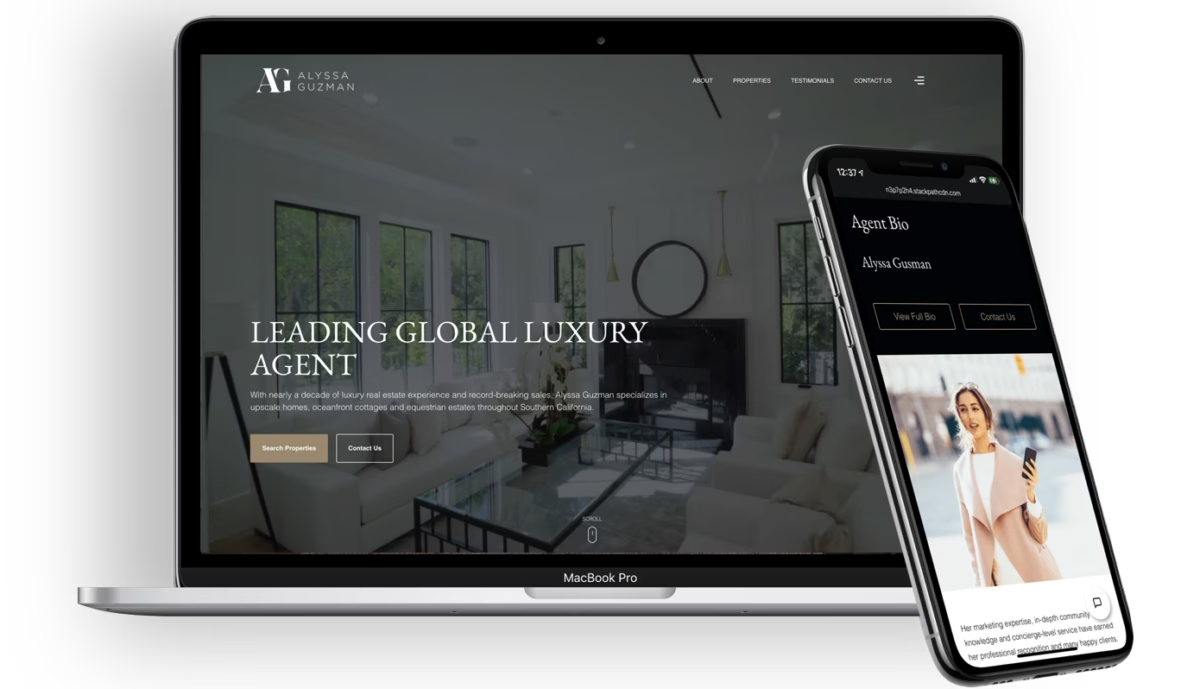
Every day, Luxury Presence creates and manages real estate websites for some of the biggest agents, teams, and brokerages in the country. Learn how we can transform your online presence.
About the author

Marketing Manager
Kate Evans is a content marketing strategist at Luxury Presence, the leading growth platform for high-performing real estate professionals. She develops data-driven editorial content and supports SEO strategy and brand voice frameworks that help agents attract qualified leads and establish market authority. Her published work covers topics including CRM strategy, social media marketing, and digital growth, supporting thousands of agents in scaling their businesses through modern marketing.