If you have ever felt overwhelmed by the sheer number of real estate marketing ideas available to you, you are not alone. In 2026, agents face more marketing channels, tools, and tactics than at any point in the industry’s history. The good news is that you do not need to do everything. You need to do the right things, and the right things depend on who you are as a marketer. This guide introduces five real estate marketing personalities, a framework built around the patterns we see in how agents at different career stages and with different natural strengths approach their marketing. Once you identify your type, you can stop spinning your wheels and start building a plan that actually fits.
The five-type framework draws on observed patterns across thousands of real estate professionals and aligns with persona-based marketing principles widely used in business strategy. Rather than prescribing a single path, it recognizes that your career stage, budget, comfort with content creation, and business model all shape which marketing channels will give you the strongest return. As Malte Kramer, CEO of Luxury Presence, has noted:
That insight is the foundation of this framework. Marketing is not a side task you bolt onto your real estate business. It is part of how you serve clients, win listings, and build a reputation. The question is not whether to market yourself, but how to do it in a way that plays to your strengths.
Find It Fast
Key takeaways
- There are five distinct real estate marketing personalities: the Newcomer, the Influencer, the Top Producer, the Powerhouse, and the Specialist. Most agents identify strongly with one or two.
- Every agent shares a set of foundation tools (website, IDX, lead capture, CRM, branding, and follow-up systems), but the channels and tactics that drive the best results differ by personality type.
- Choosing the marketing approach that matches your strengths, budget, and career stage matters more than trying to be everywhere at once.
- A well-designed website remains the centerpiece of every real estate marketing plan in 2026, regardless of your personality type.
- Identifying your type is the first step toward building a focused marketing plan. The comparison table and action steps later in this article will help you do exactly that.
Foundation tools every real estate marketer needs in 2026
Before we walk through the five personalities, let’s talk about the tools that every agent needs regardless of type. Think of these as your marketing baseline. No matter where you fall on the personality spectrum, these six elements form the infrastructure your marketing runs on.
- A professional website that is mobile-friendly, fast-loading, and designed to convert visitors into leads.
- IDX integration so buyers can search active listings directly on your site. IDX (Internet Data Exchange) pulls MLS listing data into your website, keeping visitors engaged and giving you a reason for them to return.
- Lead capture tools such as home valuation landing pages, registration gates on saved searches, and contact forms placed at natural decision points on your site.
- A CRM (customer relationship management) system built for real estate workflows. Luxury Presence’s CRM, for example, is designed to help agents nurture leads and maintain client relationships with automated yet agent-approved touchpoints that track the entire journey from first contact to closing.
- Branding assets including a consistent logo, color palette, typography, and brand voice that carry across every channel.
- A follow-up system so that no lead falls through the cracks. According to the National Association of Realtors, 82% of real estate sales are the result of agent contacts through previous clients, referrals, friends, family, and personal connections (NAR, 2025), which means consistent follow-up is not optional.
With these six elements in place, the question becomes: which additional channels and tactics should you focus on? That is where your marketing personality comes in.
1. The Newcomer: real estate marketing ideas for agents just getting started
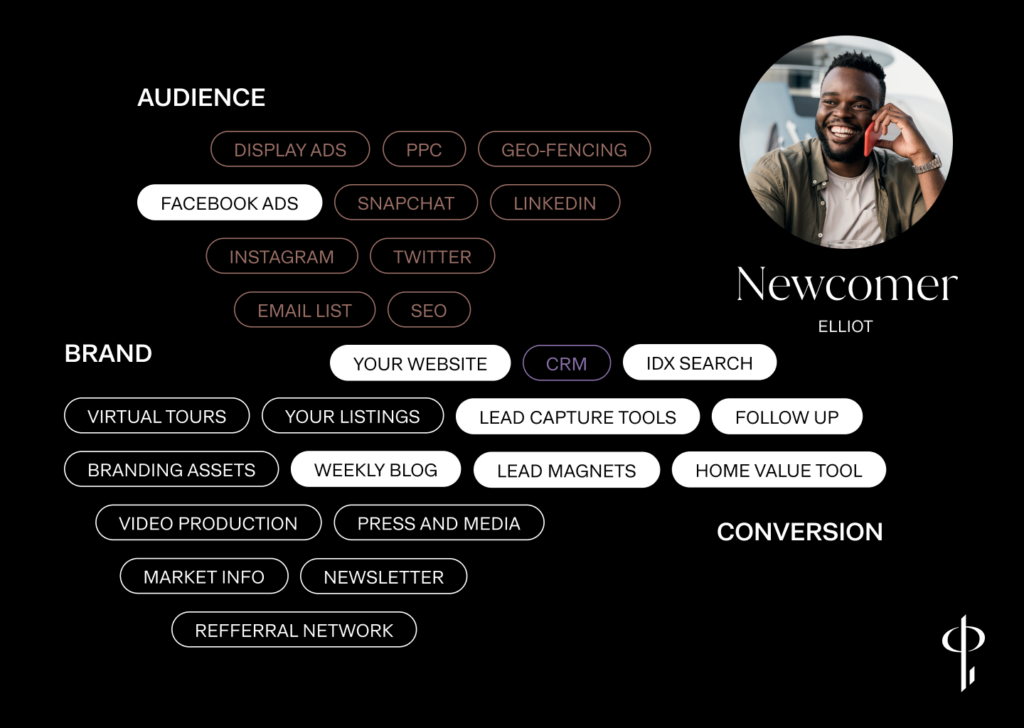
Newcomers are in the early years of their careers and are working to build credibility from scratch. If you have a handful of closed transactions, strong market knowledge (often gained as a buyer’s agent), and a willingness to put in the work on content, this is likely your type. Your marketing focus in 2026 should be on building a visible online presence and generating a steady flow of leads while keeping costs manageable.
What defines the Newcomer
- A willingness to create and share content to engage leads
- At least a few closed transactions under your belt
- Good market knowledge, often starting as a buyer’s agent
- A hunger to build your business from the ground up
The Newcomer’s goals
- Generate a consistent flow of leads online
- Stay within a manageable marketing budget (typically under $500 per month for paid channels)
- Build an online presence that earns trust with potential clients
Where the Newcomer should focus beyond the foundation
- Weekly blog posts targeting neighborhood-specific and buyer-focused long-tail keywords. Aim for at least one post per week to build SEO traction over your first 6 to 12 months.
- Lead magnets such as buyer guides, neighborhood comparison PDFs, or first-time homebuyer checklists that capture email addresses in exchange for high-value content.
- A social media content calendar with 3 to 5 posts per week across Instagram and one additional platform where your target audience is active.
- Facebook and Instagram ads with a modest budget ($10 to $20 per day) focused on home valuation landing pages or listing alerts to build your lead database.
As a Newcomer, your biggest advantage is energy and willingness to show up consistently. Pair that with SEO-focused blog content, a home valuation landing page, and a simple social media rhythm, and you will start building the kind of online footprint that earns trust before a prospect ever picks up the phone.
2. The Influencer: real estate marketing ideas built on social media
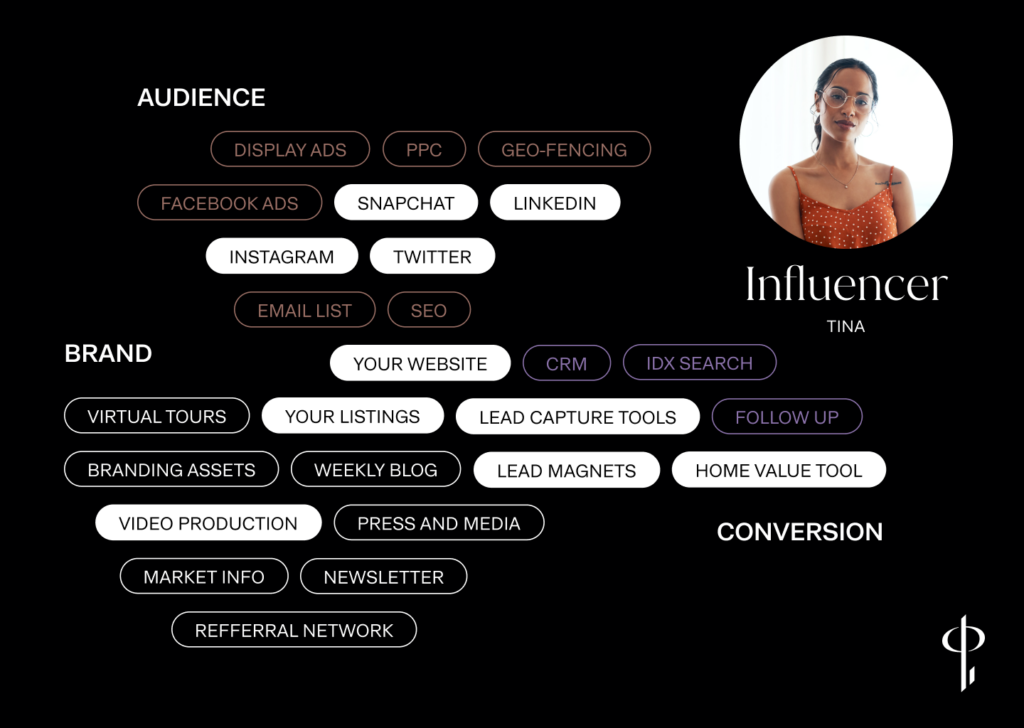
Influencers are social media-savvy agents who thrive on interaction with their followers. If you are comfortable sharing your personality, your day-to-day life, and your market insights on camera, and if you naturally draw engagement on platforms like Instagram or TikTok, you likely fall into this category. In 2026, short-form video remains the highest-reach content format for real estate agents on social platforms.
What defines the Influencer
- A strong presence on multiple social media platforms
- An engaging personality that resonates with followers
- Listings that are visually appealing for photos and videos
- Willingness to spend time creating content and building engagement
The Influencer’s goals
- Become a recognized voice in their market
- Differentiate by showcasing a strong, authentic online following
- Generate leads and drive website traffic through social media
- Reach new audiences by creating shareable, high-engagement content
Where the Influencer should focus beyond the foundation
- Video production including listing walkthroughs, market updates, and behind-the-scenes content. Aim for 3 to 5 Reels or TikToks per week.
- Social media platforms: Instagram, TikTok, YouTube Shorts, LinkedIn, and X (formerly Twitter). Choose the 2 to 3 platforms where your specific audience is most active rather than trying to be everywhere.
- Lead magnets promoted through social posts and stories to move followers from your social audience to your email list.
- Home valuation tool linked in your bio and promoted in call-to-action posts.
- Listing content that showcases properties in a way that feels native to each platform.
For the Influencer, social media is the backbone of your strategy. Use high-quality video content, interactive features like polls and Q&A stickers, and visually compelling images to keep followers engaged. Then use call-to-action posts and social proof (like client testimonials) to drive traffic back to your website, where your lead capture tools do the converting.
As Ben Belack, a top-producing agent in Los Angeles, has observed about the mindset shift that separates good social media marketing from great:
That audience-first mindset is what separates Influencers who build a following from Influencers who build a business. Every piece of content you create should answer a question your audience is already asking.
3. The Top Producer: marketing strategies for high-performing agents
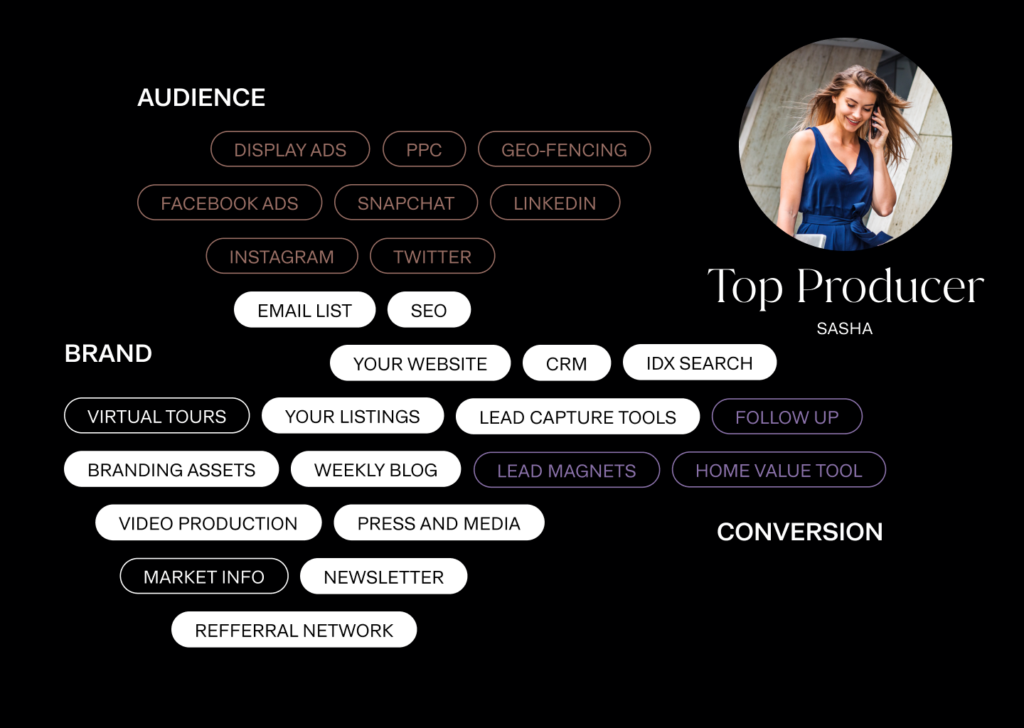
The Top Producer is a highly experienced agent with a strong track record, often in the upper price tiers of their market. If most of your business comes from repeat clients and referrals, you have a large contact database, and your name regularly appears in local press, this is your type. Your marketing challenge in 2026 is not getting started. It is making sure your online presence matches the caliber of your offline reputation.
What defines the Top Producer
- A proven sales history as one of the most productive agents in their market
- A large email list of qualified contacts (often 1,000 or more, a threshold commonly cited in real estate coaching as the point where email becomes a primary lead channel)
- High-end listings featuring high-quality photography
- Frequent media coverage or press features
The Top Producer’s goals
- Generate low-funnel buyer and seller leads (meaning prospects who are close to making a transaction decision)
- Reflect their brand and experience with a sophisticated online presence
- Activate their network to build a strong global referral network
Where the Top Producer should focus beyond the foundation
- SEO targeting high-intent keywords like “[city] homes for sale” and “[neighborhood] real estate agent” to capture buyers and sellers who are actively searching.
- Listing marketing with professional photography, video tours, and single-property landing pages.
- Weekly blog content focused on market analysis, neighborhood guides, and luxury lifestyle topics. Consider outsourcing content production to maintain a weekly cadence without pulling time from client work.
- Email marketing with a segmented list and a monthly newsletter that delivers market data, new listings, and community updates. According to HubSpot, segmented email campaigns can generate up to 760% more revenue than non-segmented sends (HubSpot, 2025).
- Video production including listing videos, market update videos, and client testimonial videos.
- Press and media outreach to maintain visibility in local and national publications.
Top Producers should think about their marketing as a system that runs in the background while they focus on serving clients. Luxury Presence’s SEO & GEO and Social Media Management, for example, can handle blog content, social media, and SEO at a pace and quality level that keeps your brand visible without pulling you away from the work that drives revenue. Nothing publishes without your approval, so your voice and standards stay intact.
That kind of alignment between your offline reputation and your online presence is exactly what Top Producers should aim for.
4. The Powerhouse: marketing strategies for high-volume agents and teams
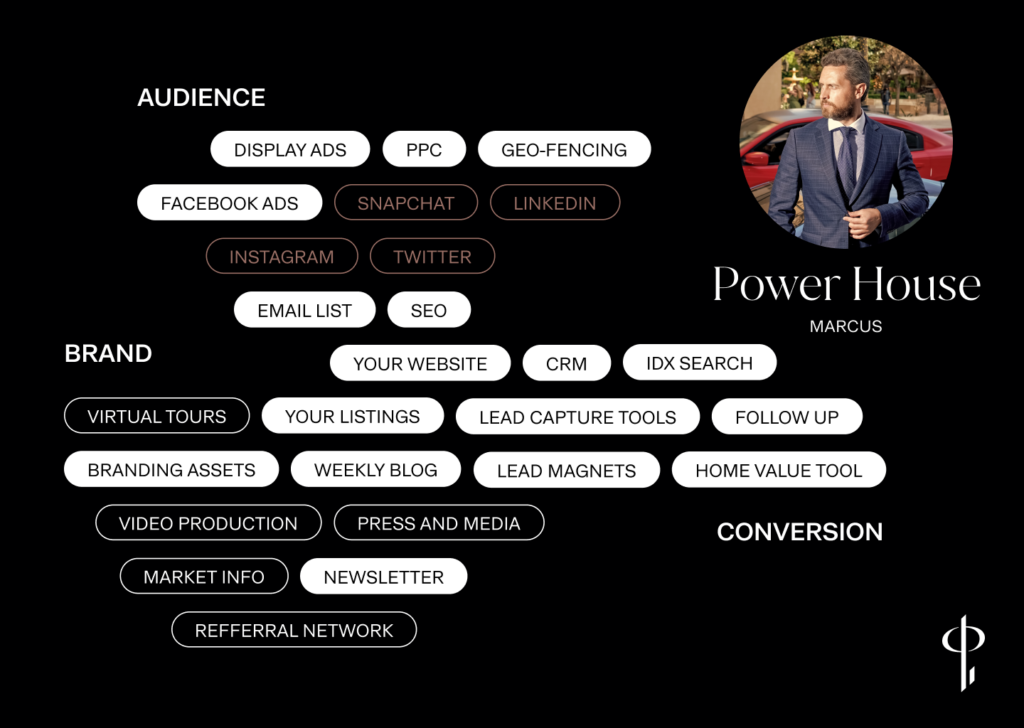
The Powerhouse is a high-volume agent or team leader who closes dozens of deals every year. If you have a team, a structured advertising budget, and a dedicated person handling lead follow-up, this is your type. Your marketing focus in 2026 is on driving a high volume of online leads through paid channels while continuously improving lead quality and conversion rates.
What defines the Powerhouse
- A staff, team, or brokerage
- The ability to handle lead follow-ups efficiently, often with a dedicated team member or an inside sales agent (ISA)
- A structured advertising budget (typically $2,000 or more per month for paid campaigns)
The Powerhouse’s goals
- Generate a large number of leads while improving lead quality over time
- Build a repeatable pipeline for lead generation that does not depend on any single channel
- Implement strong follow-up systems to convert leads at higher rates
- Use analytics to track return on investment (ROI) and reallocate budget toward the best-performing channels
Where the Powerhouse should focus beyond the foundation
- SEO targeting high-volume, high-intent keywords across multiple neighborhoods and property types.
- Paid advertising including Facebook Ads, Google PPC (pay-per-click), and display ads. In 2026, Facebook Ads and Google PPC continue to be the primary paid channels for high-volume real estate teams.
- Geo-fencing (location-based mobile advertising that targets users within a defined geographic area, such as around an open house or a competing brokerage) to reach hyper-local audiences.
- Email list nurturing with automated drip campaigns segmented by lead source, property interest, and timeline.
- Weekly blog and newsletter to maintain organic visibility and keep your database engaged between transactions.
- Lead magnets and home valuation tools as conversion points for both paid and organic traffic.
Powerhouses should focus on building a marketing system where paid channels feed leads into a CRM, automated nurture sequences keep those leads warm, and analytics tell you exactly which channels are producing the best ROI. Our CRM is designed for exactly this kind of workflow, tracking the entire client journey from first contact to closing with automated yet agent-approved touchpoints that maintain a personal feel at scale.
The key difference between a Powerhouse and every other type is volume. You are not looking for a handful of leads per month. You are building a machine, and every component needs to work together.
5. The Specialist: niche real estate marketing ideas that build authority
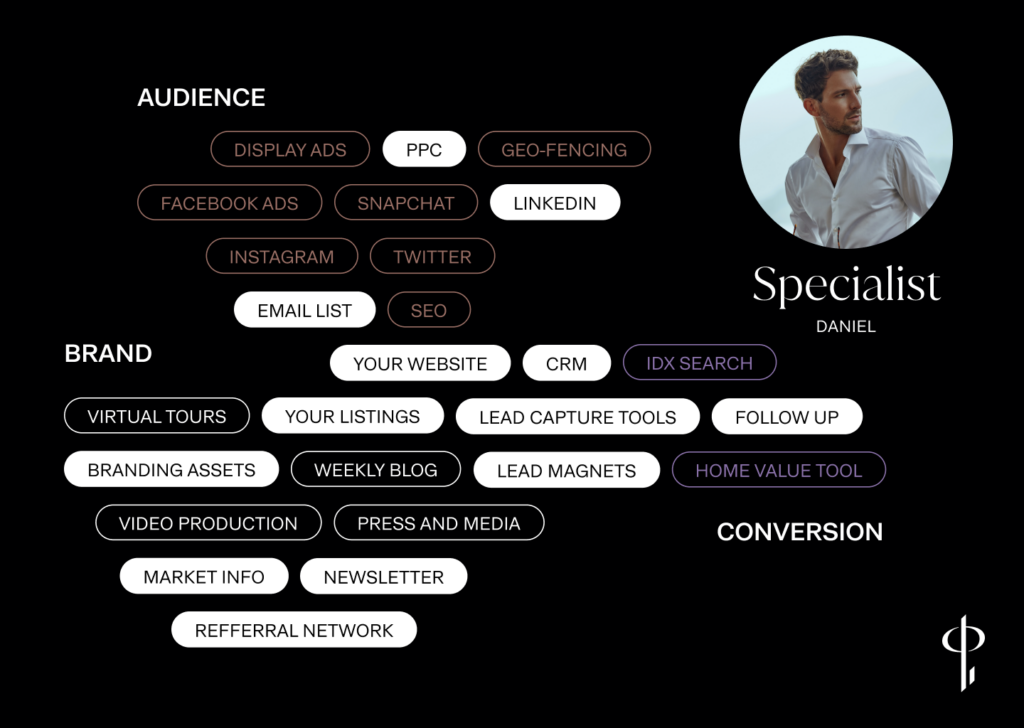
Specialists often come from other professional fields such as construction, law, architecture, or finance and focus on niche sectors within real estate. If you work primarily in development projects, high-end spec homes, commercial conversions, or another defined niche, this is your type. Your marketing centers on your deep expertise and established professional network.
What defines the Specialist
- A strong, trusted personal brand built over years of experience in a specific sector
- A large email list, often with 1,000 or more contacts cultivated through professional relationships
- Deep knowledge and established relationships in a specific niche
The Specialist’s goals
- Grow their business within their niche
- Get more value from their existing network through referrals and repeat business
- Build an online presence that clearly communicates their area of expertise
Where the Specialist should focus beyond the foundation
- A website that showcases niche projects with dedicated portfolio pages, case studies, and detailed project descriptions.
- LinkedIn as a primary social platform for B2B networking and thought-leadership content. Aim for 2 to 3 posts per week sharing market analysis, project updates, or industry commentary.
- Referral network development through both online and offline channels, including industry events, professional associations, and strategic partnerships.
- Newsletter with niche-specific market data, project spotlights, and industry news sent at least twice per month.
- PPC campaigns targeting niche-specific keywords with lower competition and higher intent (e.g., “[city] new construction homes” or “[city] spec home builder”).
- Lead magnets such as market reports, investment guides, or development feasibility checklists that speak directly to your niche audience.
As Mark O’Brien, a real estate marketing strategist, has put it:
That is the Specialist’s greatest advantage. Your niche expertise gives you a built-in differentiator. Your marketing should make that expertise impossible to miss, from the content on your website to the way you show up on LinkedIn to the market reports you send to your email list.
Side-by-side comparison of all five marketing personalities
Use this table to quickly identify which type fits you best and see the key differences at a glance.
| Marketing personality | Strengths | Primary goals | Best channels | Budget/time profile | Recommended first action |
| The Newcomer | Energy, willingness to create content, market knowledge | Build credibility, generate early leads | Blog/SEO, social media, Facebook Ads | Low budget, high time investment | Publish one SEO-focused blog post per week and activate a home valuation landing page |
| The Influencer | On-camera presence, audience engagement, visual storytelling | Grow following, drive website traffic from social | Instagram, TikTok, YouTube Shorts, video | Moderate budget, high content creation time | Post 3 to 5 short-form videos per week with a clear call to action in each |
| The Top Producer | Track record, referral network, media presence | Attract high-intent leads, strengthen online brand | SEO, email, press/media, video, referral network | Higher budget, lower personal time (outsource content) | Audit your website to confirm it reflects your offline reputation, then launch a monthly newsletter |
| The Powerhouse | Team infrastructure, ad budget, follow-up systems | High-volume lead gen, improve lead quality and ROI | PPC, Facebook Ads, geo-fencing, display ads, SEO | High budget, team-distributed time | Set up CRM-integrated lead nurture sequences for every paid channel |
| The Specialist | Niche expertise, professional network, deep sector knowledge | Grow within niche, activate existing network | LinkedIn, newsletter, referral network, niche PPC | Moderate budget, focused time on network and content | Create a niche-specific lead magnet and promote it through LinkedIn and email |
Crafting your own marketing plan in 2026
Now that you have a clear picture of the five marketing personalities, here is how to turn that self-awareness into a plan that works.
Steps to create a real estate marketing plan
- Identify your type. Review the five personalities above and determine which one (or two) you align with most. Consider your unique value proposition, your career stage, and where you naturally spend your marketing energy. Are you an Influencer who thrives on social media, or a Top Producer whose strength is a deep referral network?
- Choose the right tools. Based on your type, invest in the tools that match your goals. A Powerhouse needs a CRM and paid advertising infrastructure. A Newcomer might get the most value from SEO and a consistent social media presence. Do not try to adopt every tool at once.
- Build a strong digital presence. No matter your type, your website is the hub of your marketing. Make sure your site is mobile-friendly, loads quickly, includes clear calls to action (CTAs), and gives visitors a reason to share their contact information.
- Create content consistently. Regularly update your blog, send out newsletters, and engage on social media to stay top of mind with your audience. The cadence matters more than perfection. One blog post per week and one newsletter per month is a strong starting point for most agents.
- Track and adjust. Use analytics tools to monitor traffic, lead conversion rates, and cost per lead. Review your numbers monthly and reallocate time and budget toward the channels that are producing the best results.
Your website: the foundation of every real estate marketing plan
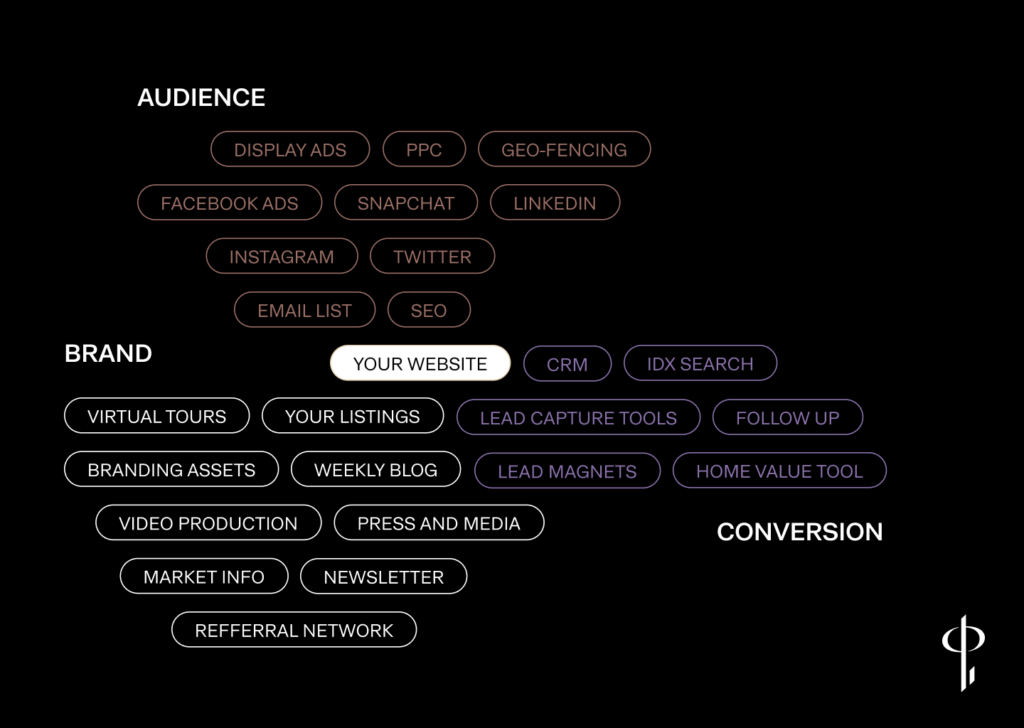
Every marketing plan for real estate agents starts with a website that converts visitors into leads. Your website is where all of your other marketing channels point. Social media posts, email campaigns, paid ads, and blog content all drive traffic back to your site. If your site does not convert that traffic, every other investment underperforms.
Website must-haves for real estate agents
- Responsive design: Your site must work well on phones, tablets, and desktops. According to Statista, mobile devices account for over 60% of global web traffic in 2026 (Statista, 2026), and real estate search behavior skews even more heavily mobile.
- SEO-friendly structure: Fast load times, clean URLs, descriptive page titles, and content organized around the keywords your target audience is searching for.
- Clear CTAs: Every page should guide visitors toward a next step, whether that is scheduling a consultation, requesting a home valuation, or signing up for listing alerts.
- IDX integration: Keep your listings current and searchable so buyers have a reason to return to your site.
- Easy navigation: Visitors should be able to find listings, neighborhood information, and your contact details within two clicks.
- Lead capture forms: Place forms at natural decision points, not just on a single “Contact” page.
- High-quality visuals: Professional photography and virtual tours make a measurable difference in engagement and time on site.
- A content-rich blog: Regular blog posts build SEO authority and give you material to share across email and social channels.
- Social proof: Display client testimonials and reviews to build trust with first-time visitors.
- Analytics integration: Track user behavior so you can see which pages convert, where visitors drop off, and which traffic sources produce the best leads.
As one Bay Area agent described the impact of getting these elements right:
That combination of design, IDX, and conversion-focused lead forms is what separates a website that looks good from a website that grows your business.
Your guide to the perfect homepage
Leverage our data and expertise to craft an online presence that delivers high-quality leads and best-in-class brand recognition.
Choosing the Right Real Estate Marketing Mix
The best real estate marketing plan is not the one with the most channels; it is the one that matches your strengths, budget, and stage of business. Once you identify whether you are a Newcomer, Influencer, Top Producer, Powerhouse, or Specialist, you can focus on the tactics that will actually move your business forward. Start with the foundation, stay consistent, and let your marketing reflect the way you work best.
FAQs
Your brand starts here
Use this companion to Josh Flagg’s masterclass to elevate your marketing and sharpen your online presence.

About the author

Marketing Manager
Kate Evans is a content marketing strategist at Luxury Presence, the leading growth platform for high-performing real estate professionals. She develops data-driven editorial content and supports SEO strategy and brand voice frameworks that help agents attract qualified leads and establish market authority. Her published work covers topics including CRM strategy, social media marketing, and digital growth, supporting thousands of agents in scaling their businesses through modern marketing.