
For real estate agents choosing between a self-hosted website and a SaaS platform for their website in 2026, the decision comes down to three variables: your budget, your technical capacity, and how much ongoing maintenance you want to own. A self-hosted site gives you full ownership of your code and data but requires a developer to build, maintain, and update it. A SaaS (Software as a Service) platform, especially one built for real estate, handles hosting, security, and updates for you in exchange for a monthly subscription. This guide breaks down the real differences between self-hosted websites and SaaS so you can make the right platform decision for your real estate business.
Find It Fast
Key takeaways
- Choose a real estate SaaS platform if you want IDX (Internet Data Exchange) and MLS (Multiple Listing Service) data built in, prefer a managed support model, and need a site live in weeks rather than months.
- Hidden costs are the biggest risk with self-hosted websites for agents. Custom builds can run into tens of thousands of dollars, and hourly fees for post-launch updates add up quickly.
- SaaS platforms carry a trade-off: you gain speed, support, and built-in real estate tools, but your data lives on the provider’s servers. Always confirm asset portability before signing any contract.
- In 2026, the platform question is no longer just “self-hosted website or SaaS” but whether your website platform includes native real estate marketing tools like IDX search, lead capture, and content marketing.
Editorial note: Luxury Presence publishes this content and also offers the SaaS real estate website platform discussed in this comparison. Our editorial team has aimed to present an objective analysis of both options.
What is SaaS?
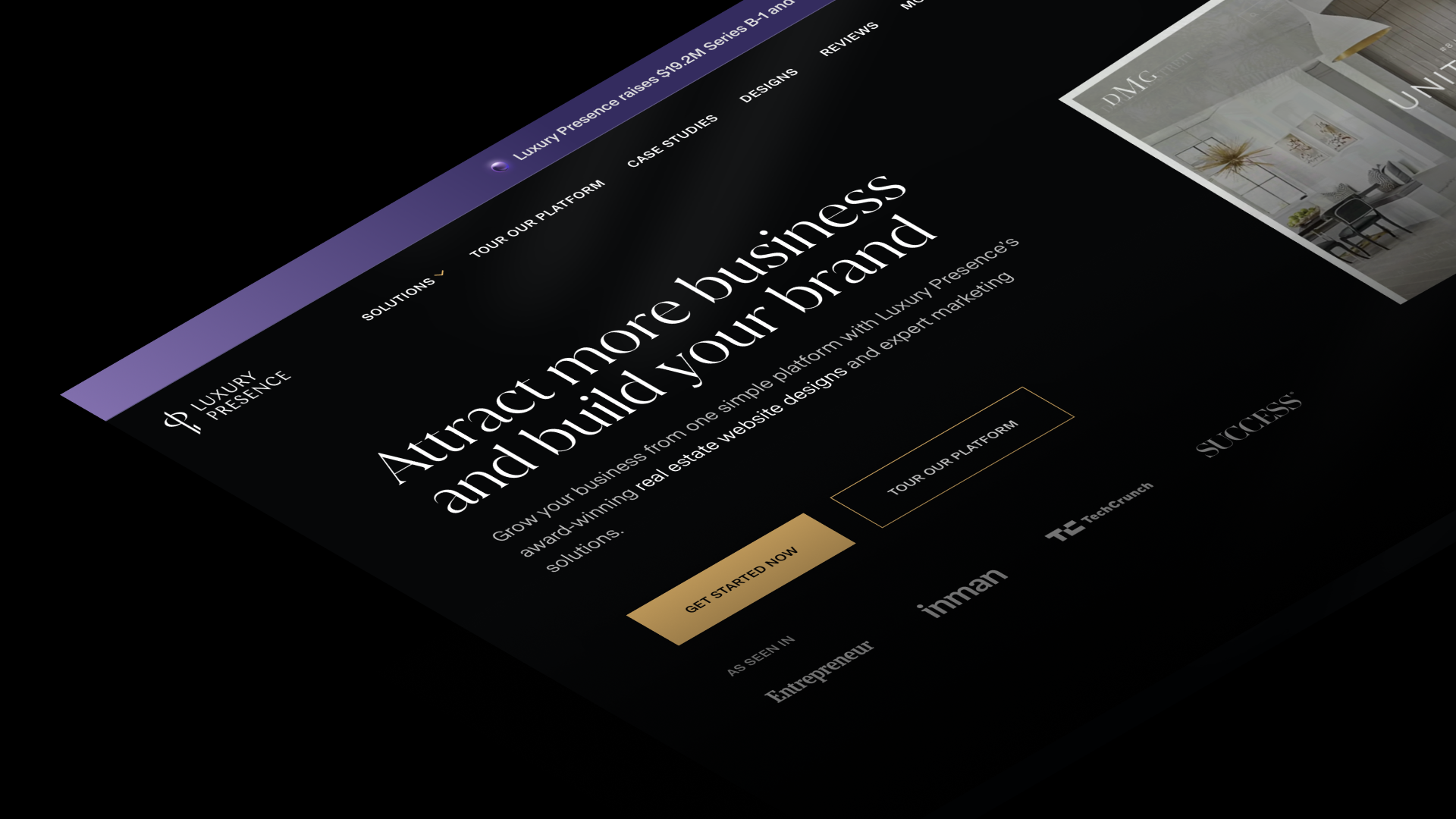 SaaS (Software as a Service) is a delivery model where a third-party company hosts a web-based application and offers it to customers on a subscription basis. As of 2026, SaaS is the dominant delivery model for business software, with adoption rates across industries continuing to climb year over year (Statista SaaS Market Overview, 2026). You likely interact with SaaS products every day: Google Workspace, Microsoft 365, Zoom, and Netflix all follow this model. For real estate websites specifically, SaaS platforms give agents a managed approach to building and running a site. The provider handles hosting, security patches, and software updates. You pay a recurring fee instead of a large upfront development cost. SaaS website platforms fall into two categories:
- General-purpose builders like general website builders, which serve any industry but lack real estate-specific tools like IDX or lead routing.
- Real estate-specific platforms like Luxury Presence, which include IDX search, lead capture, CMA (Comparative Market Analysis) tools, and MLS data feeds as native features.
With a SaaS platform, you also get a support team. That means help with technical issues, design adjustments, and website questions without hiring a separate contractor.
How Luxury Presence stacks up against other SaaS platforms
Not every SaaS provider is built for real estate. Luxury Presence is designed specifically for agents, teams, and brokerages. Unlike general-purpose builders, real estate marketing tools are native to the platform, not bolted on through third-party plugins. Here is what that looks like in practice:
IDX home search
The custom-branded IDX tool pulls accurate data directly from the MLS so buyers can search for homes on your site. General-purpose SaaS platforms either do not support IDX integration or require third-party plugins with limited functionality.
Digital presentations tool
The digital presentations tool lets you create listing presentations and CMAs with videos, interactive maps, side-by-side listings, and market analysis reports.
Instant home valuation tool
Visitors to your site receive an automated home estimate after submitting their contact information. Other platforms require a separate plugin for this feature, and those plugins often lack the design consistency of a native tool.
Custom lead routing
Inquiries from prospective clients are directed to the most suitable agent on your team for faster outreach and better response times.
Lead intelligence
The lead intelligence feature gives you access to additional third-party data about your leads, helping you understand their search behavior and readiness before your first conversation. With general website builders, you are responsible for all design updates and plugin management unless you pay someone separately. Luxury Presence combines well-designed websites with the flexibility to make updates on your own or with the support of a dedicated customer success team.
“The website’s back end is very simple and easy for me to use. It allows me to easily distribute leads. It allows me to easily update the website with information for our agents, but our agents also can use it as an incredible marketing tool.”
— Maria Coukoulis, Broker
What is a self-hosted website platform?
 A self-hosted CMS is a widely used content management system (CMS) model on the internet. As of 2026, self-hosted CMS platforms power a substantial share of websites globally. Note: this comparison refers to a self-hosted open-source CMS, not a hosted service. The distinction matters because a self-hosted platform gives you full control over your site files, server environment, and plugin choices, but it also means you bear full responsibility for hosting, security, and maintenance. Since a self-hosted open-source platform is free, it can be a strong option for technically skilled individuals who want to control every aspect of their site. Agents who use a self-hosted platform own their site files and database outright. Ownership, however, comes with obligations. Most agents who choose a self-hosted platform hire a professional developer to build the site and then take over maintenance once the build is complete. Once the developer’s contract ends, you are responsible for keeping the site running: updating plugins, renewing hosting, patching security vulnerabilities, and swapping out listings or links. If you need a rebrand or a major redesign, you will likely need to hire a developer again.
Breaking down the differences between self-hosted websites and SaaS in 2026
 Here is a direct comparison of both platforms across the factors that matter most to real estate agents.
| Factor | Self-hosted website | Real estate SaaS (e.g., Luxury Presence) |
| Cost model | High upfront build cost plus ongoing developer fees for updates | Monthly subscription with no separate management fees on ad spend |
| IDX integration | Requires third-party plugin with limited functionality | Native, built-in IDX with MLS data feed |
| Time to launch | Weeks to months depending on developer availability | Weeks from onboarding to live site |
| Maintenance | Owner-managed: hosting, security, updates, and plugins | Managed by platform: updates, security, and support included |
| Ownership | Full ownership of site files and data | Data hosted on provider servers. Confirm asset portability before signing. |
| Security | Requires manual plugin installation for SSL, backups, and threat protection | Built-in security audits, encryption, and compliance |
| Customization | Unlimited with a developer on retainer. Limited without one. | High within platform parameters. Backend customization available. |
| Support | Dependent on contractor availability and hourly rates | Dedicated customer success team included in subscription |
| Plugin ecosystem | Thousands of plugins available, but quality and compatibility vary | Real estate tools built in natively. Fewer third-party plugins needed. |
| SEO control | Full control over technical SEO with dedicated SEO plugins | SEO tools built in. Some platforms also offer Content Marketing and SEO Marketing services. |
Advantages of SaaS for real estate agents
Continuous updates without developer dependency
SaaS platforms push updates to all users automatically. New features, security patches, and design improvements arrive without you hiring a developer or manually installing anything. With a self-hosted platform, keeping up with updates often means manually updating the core software, theme, and each individual plugin, or paying someone to do it for you.
Managed maintenance and support
With a SaaS platform, the provider handles hosting, uptime monitoring, and technical troubleshooting. You do not need to worry about whether your site is responsive across devices or whether your SSL certificate has expired. If something breaks, you contact a support team rather than scrambling to find a freelance developer.
Faster setup and lower learning curve
SaaS platforms provide dashboards, page builders, and a single control center that require no coding knowledge. The dashboard is device-agnostic and accessible from any browser. Most agents can have a site live within weeks of signing up.
Consistent quality across updates
Open-source platforms like WordPress rely on a large community of independent developers to maintain plugins and themes. That community is a strength, but it does not guarantee consistent quality or timely updates for every plugin. SaaS platforms test their own updates before rolling them out, which reduces the risk of a plugin conflict breaking your site.
Built-in privacy and security
SaaS platforms typically include data encryption, regular security audits, and automated compliance with privacy laws as part of the subscription. A self-hosted platform requires you to install separate plugins for SSL encryption, data backups, and protection against cyber threats. According to annual security research, self-hosted CMS platforms account for many infected sites tracked, largely due to outdated plugins and themes (Website Threat Research Report, 2025).
Disadvantages of SaaS
Limited ownership and data portability
Your website data lives on the provider’s servers. If you cancel your subscription, you will need to migrate your content and assets to another platform. Before signing with any SaaS provider, confirm in writing that you retain ownership of your digital assets and can export them if you leave.
Platform dependency for advanced customization
SaaS platforms set the boundaries of what you can customize. If you need a feature the platform does not support, you are dependent on the provider’s development roadmap. With a self-hosted platform, a developer can build almost anything.
Long-term subscription cost
Monthly subscription fees accumulate over time. Over a five-year period, the total cost of a SaaS subscription can approach or exceed the cost of a custom self-hosted site build, depending on the plan and provider. The trade-off is that SaaS fees include maintenance, hosting, and support that self-hosted site owners pay for separately.
Advantages of self-hosted websites
Full ownership and portability
You own your site files, database, and content outright. If you want to switch hosting providers or hire a new developer, you can take everything with you. This level of control is the single biggest advantage a self-hosted platform holds over SaaS.
Extensive plugin ecosystem
Self-hosted platforms offer thousands of plugins for nearly any function: SEO, analytics, forms, e-commerce, and more. If a tool exists for the web, there is likely a plugin for it. The trade-off is that you (or your developer) must keep those plugins updated and compatible with each other.
Full technical SEO control
A self-hosted platform gives you direct access to your site’s code, server configuration, and technical SEO settings. For agents or teams with a dedicated developer, this means you can fine-tune every aspect of your site’s search performance without waiting on a platform provider.
Disadvantages of self-hosted websites
Ongoing maintenance and cost burden
Owning a self-hosted site means paying for domain registration, hosting, security monitoring, plugin licenses, and developer time for every update or new feature. Unless you can handle all of this yourself, you will pay a contractor or agency to manage it. Those costs are often invisible at the start but compound quickly.
Hidden and escalating fees
A custom self-hosted site build from a professional designer can cost thousands to tens of thousands of dollars. Many developers also charge hourly for every post-launch update, from swapping a listing photo to fixing a broken plugin. Even the DIY route becomes expensive once you factor in paid themes, premium plugins, and hosting upgrades.
Quality depends entirely on your contractor
The final product is only as good as the developer you hire. A high price tag does not guarantee a well-built site. Poor code, slow load times, and design inconsistencies are common outcomes when agents hire generalist developers who lack real estate-specific experience.
“One of the best decisions we ever made was to work with Luxury Presence instead of spending hundreds of thousands of wasted dollars on a custom back-end solution that I have instead invested into other things that actually keep people growing and happy.”
— Ryan Coyne, Real Estate Team Leader
What about AI-powered website builders?
In 2026, AI-powered website builders can generate layouts from a few prompts. These tools are impressive for general-purpose sites, but they do not include IDX data feeds, MLS integration, or real estate-specific lead capture natively. They are general-purpose tools applied to a specialized industry. Real estate-specific SaaS platforms like Luxury Presence take a different approach. Rather than using AI to generate a generic layout, the platform incorporates AI capabilities into real estate workflows: Content Marketing for SEO-focused blog posts, Social Media Marketing for consistent brand presence, and Lead Nurture Marketing for automated follow-up. Nothing publishes without agent approval, and the output is designed for real estate audiences from the start. For agents evaluating options in 2026, the relevant question is not “does this platform use AI?” but “does the AI capability serve real estate workflows specifically?”
Real-world case study: From developer-built site to SaaS
The contrast between self-hosted websites and SaaS is clearest in real-world outcomes. Better Homes and Gardens Real Estate Lifestyles Realty spent 13 years on a developer-built website that generated zero organic leads. When the brokerage decided to rebuild, they hired two independent developers and spent six months in development before the project stalled. After switching to Luxury Presence’s SaaS platform, the brokerage received 10 organic leads in its first week and reached 57% site engagement within four months (Source: Luxury Presence Case Study: Better Homes and Gardens Real Estate Lifestyles Realty, 2025). This case illustrates the two risks that self-hosted websites pose for most agents: the time cost of working with independent developers and the opportunity cost of running a site that does not generate business. A SaaS platform does not guarantee leads, but a real estate-specific platform with native IDX, lead capture, and managed SEO gives you a structural advantage over a static site that depends on a contractor to stay current.
SaaS vs. self-hosted websites: What’s best for you in 2026?
The right platform depends on your specific situation. Here is a decision framework: Choose a self-hosted website if:
- You have a dedicated, in-house developer (or a reliable agency on retainer) who can handle ongoing maintenance, security, and plugin updates.
- You require fully custom integrations that are not available through any SaaS provider.
- You have the budget for both the upfront build and the ongoing development costs that follow.
- You want full technical SEO control and are willing to manage it yourself or pay for it.
Choose a real estate-specific SaaS platform if:
- You need IDX, MLS data, and lead capture built into your site from day one.
- You want a site live in weeks, not months.
- You prefer a managed support model with a dedicated team over a contractor relationship.
- You want your website, marketing tools, and lead management in a single platform rather than stitched together from separate vendors.
For most agents and teams in 2026, a real estate-specific SaaS platform is the faster, lower-risk path to a site that generates business. A self-hosted website remains a strong choice for agents with developer resources and a need for deep customization, but the maintenance burden is real and ongoing. If you are ready to see what a real estate-specific SaaS platform looks like in practice, explore how Luxury Presence can help you build and market your real estate website.
FAQs
Expert website design services
Every day, Luxury Presence creates and manages real estate websites for some of the biggest agents, teams, and brokerages in the country. Learn how we can transform your online presence.

About the author

Marketing Manager
Kate Evans is a content marketing strategist at Luxury Presence, the leading growth platform for high-performing real estate professionals. She develops data-driven editorial content and supports SEO strategy and brand voice frameworks that help agents attract qualified leads and establish market authority. Her published work covers topics including CRM strategy, social media marketing, and digital growth, supporting thousands of agents in scaling their businesses through modern marketing.