
Luxury clients rarely choose an agent based on one post, one conversation, or one referral. They decide based on whether the full experience feels consistent, from how you show up in person to what shows up on Google to what they see when they click through your website.
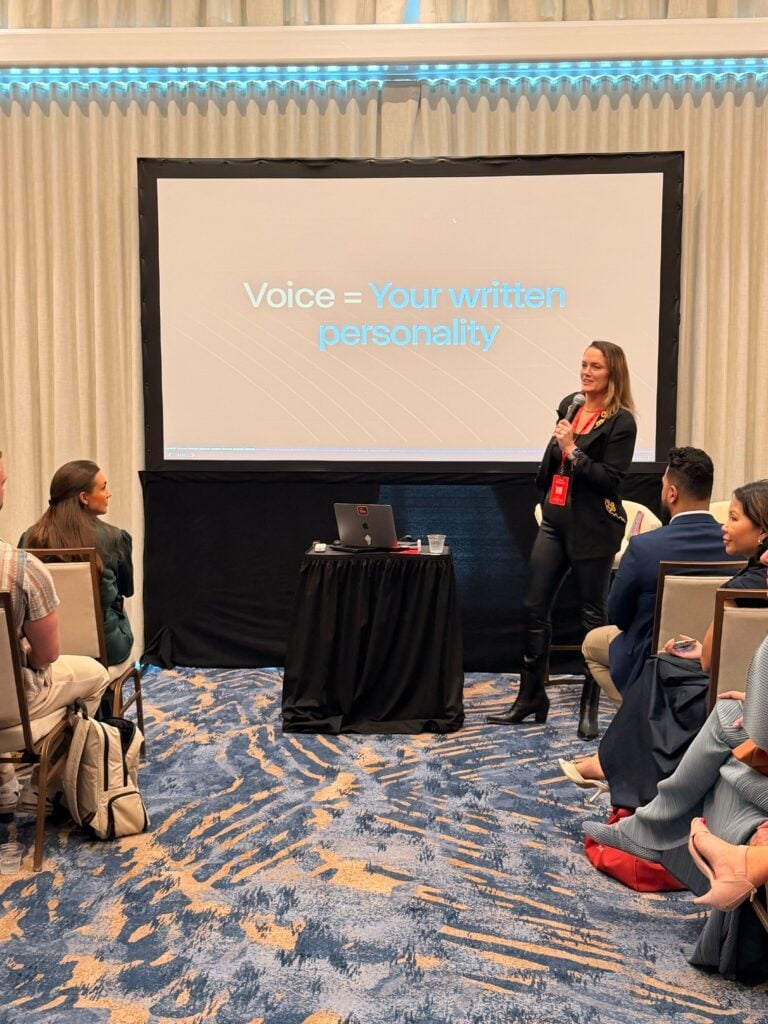
In her breakout session at the Agency’s Global Forum in Ft. Lauderdale, Laura McDonald shared a simple framework for building a brand people notice, remember, and ultimately choose.
Brand voice is how you translate yourself into writing
McDonald defined brand voice as “your written personality.” You use your brand voice in your social media captions, your website copy, your listing descriptions, your buyer follow-up messaging, and the way you explain your process.
It’s what clients absorb when they’re forming impressions quickly.
One of the most useful exercises she shared was about identifying what people pick up on immediately versus what they learn after spending real time with you. She encouraged agents to build their voice from both sides: what’s obvious on day one, and what becomes clear once trust is built.
Apply it: Write two short lists. First impressions (what strangers assume). Earned impressions (what clients say after closing). Your brand voice should connect those two lists, so prospects aren’t guessing.
For example, maybe strangers read you as polished, calm, and direct, while past clients describe you as strategic, relentless, and highly protective. Use that overlap to shape your copy, your captions, your listing language, and the way you describe your process.
Consistency is what makes clients comfortable moving forward
McDonald tied consistency to trust. When your website, social presence, and Google footprint tell the same story, clients feel more confident taking the next step.
She gave a familiar example: an agent has a beautiful, high-end website, but then you click their Instagram, and it’s “cartoon dogs outside of a home” with captions like “buy a house with me.”
It breaks trust fast, and the same thing happens in reverse when an agent has a strong reputation but almost no online presence to back it up.
Apply it: Review three places prospects check first: Instagram profile, website homepage, Google results. If they don’t feel like the same business, your next move is alignment, not volume.
For high-end leads, “being found” is only part of the job
McDonald called out a shift in how luxury leads behave online: they’re often vetting, not searching. A referral starts the conversation, but Google often decides whether the conversation continues.
Her question was direct: “Do [you] have control over the narrative of what people are seeing online?”
If the first click is Zillow, Realtor.com, or a directory page, the story quickly becomes someone else’s. If the first click is your website, you hold the narrative, the tone, and the next step.
Apply it: Google yourself like a seller would. If your website isn’t the clearest, most credible result when someone Googles you, then everything else has to work harder to earn trust.
Your website should do more than showcase listings
McDonald emphasized the website as the “flagship store.” Not just because it looks good, but because it creates a controlled environment where your voice stays consistent, and prospects can take action.
She pointed to practical “sticky” elements that capture attention and convert it: off-market signups, home valuations, property pages, and listing alerts that come from your website rather than a generic MLS tool.
McDonald also tied this directly to what agents already do every week. If you’re meeting people at open houses and you have a website, she recommended putting those leads onto a listing alert that comes from your site.
Apply it: Pick one conversion path to improve this month. Start with a home valuation page or an off-market signup. Then route your open house follow-up and postcard traffic there.
SEO builds over time, but the inputs are clear
McDonald acknowledged what many agents feel, that “SEO is a huge hot topic,” but it’s hard to “know what goes into actually building it.”
Her recommendations focused on credibility signals that benefit both rankings and client confidence: Google reviews, press mentions, local coverage, awards, and unique content that makes you the authority in your market.
Apply it: Publish content that a seller would actually use to make a decision. Neighborhood expertise, market guidance, timing considerations, and “what to know before listing” topics tend to outperform general real estate advice because they answer higher-intent questions.
Closing thought
McDonald’s breakout made the case for treating brand voice as a business asset. Not something you “post,” but something you build, repeat, and protect across every channel where clients form trust.
Your website is the anchor, but it shouldn’t be doing the heavy lifting alone. Luxury Presence helps agents bring everything together, from lead capture and follow-up to smarter marketing and AI support that keeps you consistent even when you’re busy.
Get the platform that drives results.
Agents using Luxury Presence grew sales nearly 2x faster than their peers, increased sold listings by 6%, and closed over $300B in transactions. Ready to grow your business? Let us show you how.
About the author

Marketing Manager
Kate Evans is a content marketing strategist at Luxury Presence, the leading growth platform for high-performing real estate professionals. She develops data-driven editorial content and supports SEO strategy and brand voice frameworks that help agents attract qualified leads and establish market authority. Her published work covers topics including CRM strategy, social media marketing, and digital growth, supporting thousands of agents in scaling their businesses through modern marketing.