
Find It Fast
The best real estate CRM software in 2026 is the platform that fits your workflow, matches your budget, and actually gets used every day. A CRM built for real estate helps agents track leads, automate follow-up, manage transactions, and maintain client relationships at scale. With dozens of options on the market, choosing the right one can feel overwhelming. This guide breaks down 10 of the top real estate CRM platforms, including their strengths, tradeoffs, pricing, and the specific type of agent or team each one serves best. Whether you are a solo agent closing 20 deals a year or a brokerage managing hundreds of contacts, the right CRM will keep every opportunity from slipping through the cracks.
Key takeaways
- The best CRM is the one you will actually use. Prioritize a platform that matches your daily workflow, tech comfort level, and business size over one that simply has the longest feature list.
- Real estate-specific CRMs ship with industry workflows out of the box, while general-purpose platforms like Pipedrive, ClickUp, and HubSpot offer more flexibility and customization for agents willing to configure them.
- Pricing ranges from free to $500+ per month. Solo agents can find strong options under $50 per month, while teams and brokerages should budget for enterprise-tier plans that include lead routing and manager dashboards.
- Integrations, mobile access, and marketing automation are baseline requirements. Any CRM you consider should connect to your existing tools, work on your phone, and handle at least basic drip email sequences.
- Always test before you commit. Most platforms offer 14- to 30-day free trials. Use that window to evaluate whether the system fits your actual day-to-day, not just a demo scenario.
Why do agents need a real estate CRM in 2026?
A CRM is the operating system behind every high-performing real estate business. Without one, agents rely on memory, spreadsheets, and scattered notes to manage a pipeline that can include hundreds of contacts at different stages. That approach breaks down fast. Here is what a purpose-built CRM actually does for your business:
- Lead management: Active agents handle dozens of new leads every week. A CRM organizes, scores, and prioritizes those leads so no opportunity gets lost in the shuffle.
- Relationship nurturing: Real estate is a repeat-and-referral business. A CRM tracks every interaction, reminds you when to follow up, and helps you deliver the kind of personal attention that keeps past clients coming back.
- Task and deadline tracking: Between inspections, appraisals, and closing dates, a single transaction can involve 30+ tasks. A CRM keeps every deadline visible and on schedule.
- Marketing automation: CRMs can automate outreach like email campaigns, follow-ups, and drip sequences. This saves hours each week and keeps communication consistent across your entire database.
- Data and reporting: A CRM gives you a clear picture of where your deals stand, which lead sources convert, and where your time is best spent. That visibility drives smarter decisions.
- Efficiency: By centralizing contacts, communication, and tasks in one place, a CRM removes the friction that slows agents down and lets you focus on closing deals and serving clients.
That 40% difference in gross commission income is not a small margin. It reflects the compounding effect of consistent follow-up, organized pipelines, and the kind of systematic outreach that a CRM makes possible. The question is not whether you need a CRM. The question is which one fits your business.
How much do real estate CRMs cost?
Prices for real estate CRM software vary based on the number of users (often called “seats”) and the features included. A solo agent may find that a plan under $50 per month covers their core needs, while brokerages running enterprise-level systems can spend several thousand dollars per month. Some platforms offer free tiers with limited functionality, and most offer trial periods of 14 to 30 days.
Pricing details listed for each platform below were verified as of June 2026 and are subject to change. Visit each provider’s website for current plan information.
How we evaluated these real estate CRM platforms
Every CRM in this guide was evaluated across six criteria that matter most to real estate professionals choosing a platform in 2026:
- Real estate specificity: Does the platform ship with workflows, templates, and features designed for agents and brokerages, or does it require significant customization?
- Pricing and value: What does the platform cost relative to the features it includes? Are there hidden fees for texting, dialer access, or add-ons?
- Automation capabilities: Can the CRM handle drip campaigns, follow-up sequences, lead routing, and task reminders without manual intervention?
- Integration ecosystem: How well does the platform connect to the tools agents already use, including websites, lead sources, email providers, and marketing platforms?
- Ease of use and onboarding: How quickly can a new user get up and running? Is training required, and is support available when issues arise?
- Mobile functionality: Can agents manage their pipeline, respond to leads, and update records from their phone?
Each CRM section below includes a “Best for” label, a pros and cons breakdown, and a bottom-line verdict to help you compare options quickly.
Disclosure: Luxury Presence, the publisher of this article and a real estate marketing technology company, integrates with several CRM platforms listed below. Integration status did not influence inclusion or evaluation. All assessments are based on published features, pricing, and independent user reviews.
The 10 best real estate CRM software platforms in 2026
Before diving into individual reviews, here is a side-by-side comparison of all 10 platforms. Use this table to narrow your shortlist, then read the detailed breakdowns below.
| CRM | Starting price | Free trial | Real estate specific | Best for | Notable feature |
| Follow Up Boss | $58/month per user | 14 days | Yes | Teams needing lead routing | 250+ integrations |
| ClickUp | Free (paid from $7/month) | Free tier | No | Tech-savvy agents on a budget | 1M contacts on free plan |
| Lone Wolf | Contact for pricing | Contact provider | Yes | Agents wanting multi-channel outreach | AI-powered lead assistant |
| Wise Agent | $49/month | 14 days | Yes | Solo agents wanting strong value | 24/7 U.S.-based support |
| Pipedrive | $19/month per user | 14 days | No | Sales-focused agents | AI-powered sales reports |
| MoxiEngage | Contact for pricing | No | Yes | Brokerages needing coaching tools | Manager dashboard |
| BoldTrail | $500/month (1-2 users) | No | Yes | Teams wanting an all-in-one system | IDX websites + lead capture |
| Realvolve | $94/month | 14 days | Yes | Agents who want workflow automation | Prebuilt workflow library |
| Salesforce | $25/month per user | 30 days | No | Large brokerages with admin support | Advanced analytics |
| HubSpot | Free (paid from $20/month) | Free tier | No | Small teams starting out | Free plan with marketing tools |
Follow Up Boss
Best for: Teams and brokerages that need strong lead routing and a wide integration ecosystem.
Follow Up Boss is a cult favorite among agents. While some have qualms about the inherent implications of this merger, Follow Up Boss is still considered one of the best CRMs for real estate and offers seamless functionality and a solid range of integrations. Email, calls, and texting all come baked into the software, making it an excellent all-in-one communications platform. Follow Up Boss allows agents to store unlimited contacts and comes equipped with marketing automation features, such as drip and batch emailing.
Pros
- More than 250 integrations, including Luxury Presence
- Flexible lead routing rules for teams of any size
- Individual and group texting built into workflows with automation triggers
- Automated follow-up campaigns and drip sequences
- Clean, easy-to-navigate dashboard
- Mobile app for iOS and Android
- 14-day free trial
Cons
- Support is not available around the clock
- No native ad campaign creation or Facebook Ads integration
- No free plan
- Owned by Zillow Group, which may concern some agents
ClickUp
Best for: Tech-savvy solo agents or small teams who want a free, highly customizable workspace.
ClickUp is a project management platform with a free CRM option. It is not a traditional sales CRM, and it is not built specifically for real estate. However, its organizational tools, real-time collaboration features, and ready-to-use real estate template make it a strong option for agents who are comfortable configuring their own systems. The free plan includes one million contacts and unlimited users, which is hard to beat on value alone.
Pros
- Free version includes one million contacts and unlimited users
- Dozens of native integrations, with additional connections via Zapier (an automation platform that connects different software tools)
- AI assistant chatbot for task management
- Real-time collaboration with assigned comments and live chat
- Time tracking and workload management
- Highly customizable dashboards and views
- Mobile app for iOS and Android
Cons
- Steep learning curve for new users
- Interface can feel cluttered with too many options visible at once
- Phone support and onboarding assistance are only available on the Enterprise plan
- Mobile app is less capable than the desktop version
- Requires manual configuration to fit real estate workflows
Bottom line: ClickUp delivers strong value for agents who want a free CRM and are willing to invest time in setup. If you prefer a system that works for real estate out of the box, look elsewhere on this list.
Lone Wolf
Best for: Agents who want a real estate-specific CRM with multi-channel outreach tools at a reasonable price.
Lone Wolf (formerly LionDesk) combines contact management and lead nurturing with standout features like video email, video texting, and an AI-powered lead assistant. The platform supports drip campaigns with text and phone integration, giving agents multiple ways to stay in front of prospects. Lone Wolf does not include extras like website builders, but its outreach automation is strong for the price.
Pros
- Real estate-specific CRM with industry workflows
- AI-powered lead assistant for automated follow-up
- Video email and video texting capabilities
- Affordable pricing tiers relative to feature set
- Instant lead alerts and mobile app functionality
Cons
- Limited customer support options
- Lacks some features offered by higher-priced competitors (e.g., IDX websites, landing page builders)
- Mobile app lacks advanced features available on desktop
- Add-ons like the Power Dialer can increase costs significantly
Bottom line: Lone Wolf is a solid mid-range CRM for agents who want real estate-specific tools and multi-channel outreach without paying enterprise prices.
Wise Agent
Best for: Solo agents who want a real estate-specific CRM with strong support and a low monthly cost.
Wise Agent is one of the longest-running real estate CRMs on the market. For $49 per month, agents get transaction management, drip marketing, landing pages, and a contact database with a minimal learning curve. The platform’s 24/7 U.S.-based customer service is a standout, especially for agents who are adopting a CRM for the first time and want hands-on help during onboarding.
Pros
- Real estate-specific CRM with transaction management built in
- More than 100 native integrations, plus Zapier connections to tools like Luxury Presence
- 24/7 U.S.-based customer service
- Complimentary one-on-one onboarding session
- 14-day free trial
- Built-in landing pages and drip marketing tools
- Low learning curve for first-time CRM users
Cons
- No mobile app (browser-based access only)
- Texting costs extra beyond the base plan
- No live chat support
- No auto dialer
Bottom line: Wise Agent delivers strong value for solo agents who want real estate-specific features, reliable support, and a price under $50 per month. The lack of a mobile app is the biggest tradeoff.
Pipedrive
Best for: Sales-focused agents who want a visual pipeline and strong reporting at a low entry price.
Pipedrive is a general-purpose sales CRM that works well for real estate agents who think in terms of deal stages and pipeline velocity. The base plan starts at $19 per month per user, though most agents will need the Professional tier at around $64 per month for features like lead routing, AI-powered reports, and personalized onboarding. Pipedrive’s visual deal pipeline is one of the clearest in the CRM category.
Pros
- Dozens of native integrations, plus Zapier connections to platforms like Luxury Presence, Mailchimp, and Slack
- Strong value at the base tier, with a free trial available
- Sales forecasting and reporting tools
- High levels of customization for deal stages and fields
- Clean, visual pipeline interface
Cons
- Not built for real estate, so industry-specific workflows require manual setup
- Mobile app has limited functionality compared to desktop
- Some integrations require third-party connectors
- Limited built-in marketing tools on lower-tier plans
Bottom line: Pipedrive is a strong pick for agents who want a clean pipeline view and solid reporting without paying for features they will not use. It requires some configuration to fit real estate workflows.
MoxiEngage
Best for: Brokerages and team leaders who need coaching dashboards and daily activity tracking for their agents.
MoxiEngage is a real estate-specific CRM from MoxiWorks that focuses on giving agents a clear daily view of their tasks, contacts, and goals. The platform includes a built-in dialer, messenger, and manager dashboard that makes it easy for team leaders to track agent activity and coach performance. Agents can set personal sales volume goals, manage listings, and track closings from a single interface.
Pros
- Real estate-specific CRM with daily activity tracking
- Integrates with Luxury Presence, Zillow, and major MLS systems
- Built-in dialer and messenger
- Manager dashboard for coaching and performance tracking
- Marketing automation features including prospect updates
- Listing management and closing tracking
Cons
- No free trial or free pricing tier
- Pricing requires direct contact with MoxiWorks (not published online)
- Less customizable than some competitors for non-standard workflows
Bottom line: MoxiEngage is built for brokerages that want visibility into agent activity and a coaching-friendly interface. Solo agents may find the platform more structured than they need.
BoldTrail (formerly kvCORE)
Best for: Teams that want an all-in-one platform with Internet Data Exchange (IDX) websites, lead generation, and CRM in a single package.
BoldTrail (previously known as kvCORE) provides IDX, marketing, lead generation, and more in a single package. The platform also includes advanced functions like automated campaigns and lead-capture landing pages. However, BoldTrail comes in at a higher-than-average price point. You’ll spend $500 per month for one to two users and pay a $1,000 one-time setup fee. While cheaper real estate CRM software programs may charge less upfront, you may have to pay extra for additional features that come standard with BoldTrail.
Pros
- Real estate-specific CRM with AI-driven automation
- Dozens of native integrations, plus connections to Luxury Presence and other tools
- Customizable IDX websites included
- Reporting and analytics dashboards
- Team management tools for brokerages of all sizes
- Lead capture landing pages and lead generation features
Cons
- No free trial or free version
- Steep learning curve due to the breadth of features
- Starts at $500 per month, which prices out many solo agents
- $1,000 one-time setup fee
Realvolve
Best for: Agents who want deep workflow automation and are willing to invest time in building custom processes.
Realvolve is a real estate CRM that specializes in automating workflows and managing transactions. The platform offers a large library of prebuilt, templated workflows that agents can deploy immediately or customize to match their process. Realvolve also includes a built-in calendar, lead nurturing sequences, and email and social media templates. Plans start at $94 per month for a single agent.
Pros
- Real estate-specific CRM with deep workflow automation
- Large library of prebuilt workflows and templates
- Customizable automated marketing sequences
- Affordable for single agents, with options that grow for teams and brokerages
- Integrates with Luxury Presence and other tools via Zapier
Cons
- Lacks some features found in broader platforms, such as landing page creation and market report generation
- Steep learning curve when building custom workflows from scratch
Bottom line: Realvolve is a strong choice for process-driven agents who want to automate their transaction workflows in detail. If you prefer a system that works with minimal setup, this is not the right fit.
Salesforce
Best for: Large brokerages with dedicated admin support that need a highly customizable, enterprise-grade CRM.
Salesforce is a cloud-based CRM known for its flexibility and depth of customization. It offers advanced analytics, customizable workflows, and a massive ecosystem of third-party app integrations. Real estate teams can tailor the platform to nearly any business process, but doing so often requires a Salesforce specialist or admin. The platform offers a 30-day free trial on its Enterprise and Unlimited plans, with base pricing starting at $25 per month per user.
Pros
- Highly customizable for any business process or reporting need
- Advanced analytics and reporting tools
- Works for teams of any size, from small brokerages to large enterprises
- Connects to thousands of third-party applications through its AppExchange marketplace
- 30-day free trial on Enterprise and Unlimited plans
Cons
- Steep learning curve due to the platform’s depth
- Higher pricing tiers can be costly for smaller teams
- Effective customization often requires a Salesforce specialist or consultant
- Not built for real estate, so industry workflows must be configured manually
Bottom line: Salesforce is the most powerful CRM on this list in terms of raw capability, but it demands admin resources and budget that most solo agents and small teams do not have.
HubSpot
Best for: Small teams that want a free starting point with room to grow into paid marketing and sales tools.
HubSpot CRM combines AI-powered tools with sales and marketing features on a single platform. Its free plan includes contact management, email tracking, deal pipelines, and access to marketing and content tools, making it one of the strongest no-cost options available. The catch is the pricing jump: moving from the Starter plan ($20 per month) to the Professional plan ($890 per month) is a significant leap that can price out growing teams.
Pros
- Free plan with access to marketing, content, and e-commerce tools
- Shared dashboards for collaboration between sales and marketing
- AI-powered tools like Breeze Copilot for task assistance
- Large integration marketplace with hundreds of connectors
- Strong reporting and analytics on paid plans
Cons
- Many advanced features are locked behind higher-priced plans
- Significant price gap between Starter ($20/month) and Professional ($890/month) tiers
- Additional charges for API calls, WhatsApp conversations, and other add-ons
- Not built for real estate, so industry-specific workflows require configuration
Bottom line: HubSpot’s free plan is hard to beat for agents and small teams just getting started with a CRM. Be prepared for a steep price increase if you outgrow the free tier and need advanced automation.
Choosing the Right Real Estate CRM for Your Business
The best real estate CRM is the one that fits your workflow, budget, and level of technical comfort. Solo agents may value simplicity and affordability, while teams and brokerages often need deeper automation, routing, and reporting. Take advantage of free trials where available, compare the features that matter most to your business, and choose the platform you will actually use every day.
FAQs
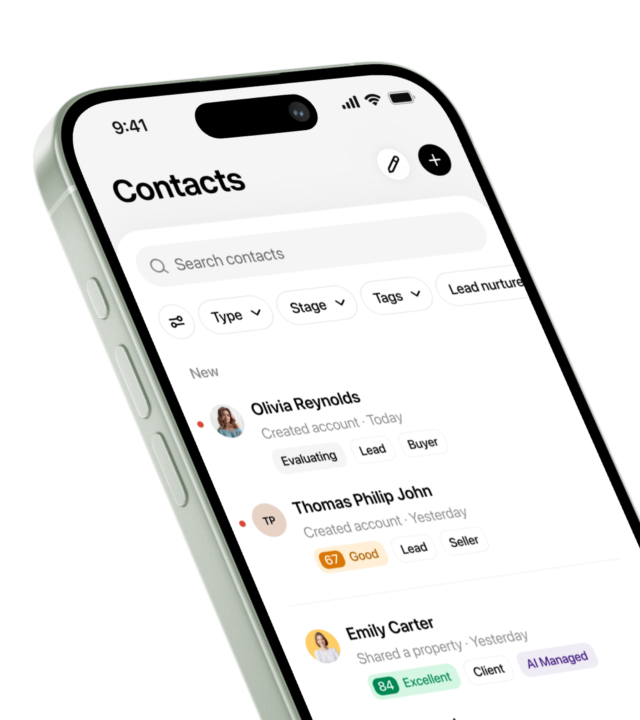
Introducing Presence® CRM
Activate your network’s full potential.
About the author

Marketing Manager
Kate Evans is a content marketing strategist at Luxury Presence, the leading growth platform for high-performing real estate professionals. She develops data-driven editorial content and supports SEO strategy and brand voice frameworks that help agents attract qualified leads and establish market authority. Her published work covers topics including CRM strategy, social media marketing, and digital growth, supporting thousands of agents in scaling their businesses through modern marketing.