
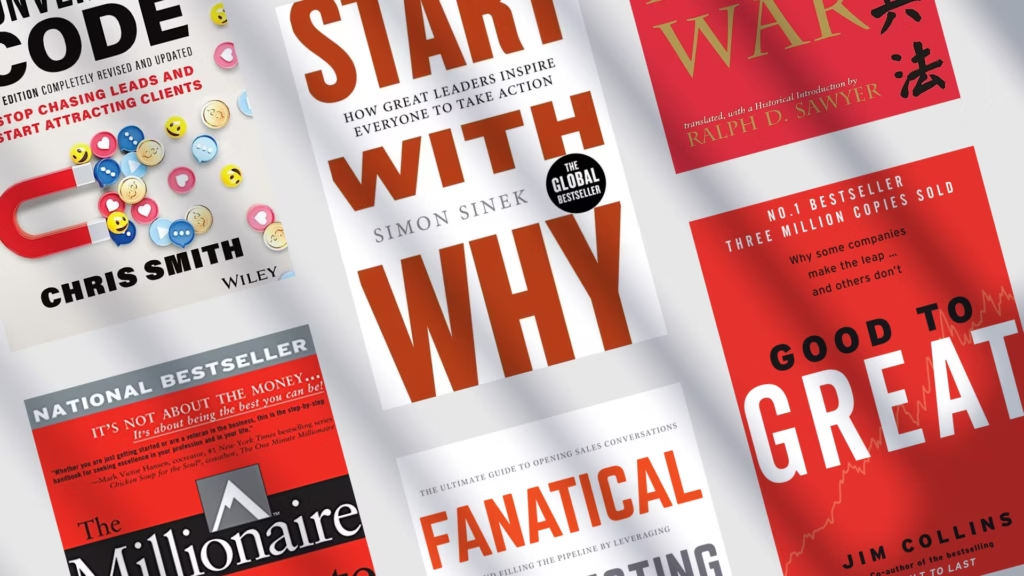
The best real estate books for agents in 2026 cover five areas that separate top producers from everyone else: negotiation, leadership, lead generation, sales, and mindset. In a market shaped by shifting commission structures and new buyer-agent agreement requirements following NAR policy changes, the agents who read with intention and apply what they learn will pull ahead of those who rely on instinct alone. Research from Deloitte's 2026 enterprise report confirms that consistent investment in learning tools drives measurable productivity gains across professional fields, including real estate (Deloitte, 2026). This list of 27 real estate books was built for ambitious agents who want a concrete edge, not just inspiration. Each title below includes a specific takeaway you can apply to your next listing presentation, buyer consultation, or team meeting.
Key takeaways
- The 27 books on this list span five skill categories that matter most for agents working in the luxury space: negotiation, leadership, lead generation, sales strategy, and professional mindset.
- Every entry includes a "Key takeaway for agents" and a "Best for" label so you can choose the right book for the exact gap in your business right now.
- Negotiation books like Never Split the Difference and Getting to Yes give you named frameworks (tactical empathy, principled negotiation) you can use in your next deal.
- Lead generation titles such as The Millionaire Real Estate Agent and Fanatical Prospecting provide repeatable systems rather than motivational platitudes.
- Mindset books including Atomic Habits and Mindset address the daily habits and mental models that compound into career-defining results over time.
- Pick two or three titles from different categories this quarter and commit to applying one concept from each before you pick up the next book.
How we selected these books
This list was curated by the Luxury Presence editorial team, which publishes resources read by agents representing 30% of the WSJ RealTrends Top 100. We evaluated each title against four criteria: direct relevance to the skill areas luxury agents request most (negotiation, leadership, lead generation, sales, mindset), a Goodreads rating of 3.9 or higher, endorsement by recognized industry figures or bestseller designation, and practical applicability to real estate scenarios rather than abstract theory. This list was reviewed and updated in 2026 to reflect current market conditions and newly available editions.
Summary comparison of all 27 real estate books
| # | Title | Author | Category | Published | Best for |
| 1 | Ask for More | Alexandra Carter | Negotiation | 2020 | Agents who freeze when they don't know what to ask |
| 2 | The Art of Persuasion | Bob Burg | Negotiation | 2011 | Agents who want to persuade without pressure |
| 3 | The Book on Negotiating Real Estate | J. Scott, Mark Ferguson, Carol Scott | Negotiation | 2019 | Agents handling investment-property deals |
| 4 | Getting to Yes | Roger Fisher, William Ury | Negotiation | 2011 (3rd ed.) | Agents who need a universal negotiation framework |
| 5 | Never Split the Difference | Chris Voss | Negotiation | 2016 | Agents who want field-ready tactics from high-stakes situations |
| 6 | Influence | Robert Cialdini | Negotiation | 2021 (expanded ed.) | Agents who want to understand why clients say yes |
| 7 | Bargaining for Advantage | Richard Shell | Negotiation | 2006 (revised ed.) | Agents who prefer a research-backed, academic approach |
| 8 | The Ideal Team Player | Patrick Lencioni | Leadership | 2016 | Team leaders hiring or coaching agents |
| 9 | The Art of War | Sun Tzu | Leadership | c. 500 BC | Agents who think in terms of market positioning and competition |
| 10 | Start With Why | Simon Sinek | Leadership | 2009 | Agents building a personal brand from scratch |
| 11 | Good to Great | Jim Collins | Leadership | 2001 | Brokers scaling from a small team to a large operation |
| 12 | Leaders Eat Last | Simon Sinek | Leadership | 2014 | Team leaders focused on retention and culture |
| 13 | The Millionaire Real Estate Agent | Gary Keller | Lead Generation | 2004 | Agents who want a full business-building blueprint |
| 14 | The Conversion Code | Chris Smith | Lead Generation | 2022 (2nd ed.) | Agents focused on digital lead capture and follow-up |
| 15 | Fanatical Prospecting | Jeb Blount | Lead Generation | 2015 | Agents who need a structured daily prospecting system |
| 16 | The Sell | Fredrik Eklund | Sales | 2015 | Agents who want to sell through authenticity and energy |
| 17 | Sell It Like Serhant | Ryan Serhant | Sales | 2018 | Agents who learn best from real-deal stories |
| 18 | The Book of YES | Kevin Ward | Sales | 2016 | Agents who need word-for-word scripts and dialogues |
| 19 | Shift | Gary Keller, Dave Jenks, Jay Papasan | Sales | 2008 | Agents navigating a down market or economic uncertainty |
| 20 | Sellebrity | Kofi Nartey | Mindset | 2017 | Agents working with high-profile or entertainment clients |
| 21 | Mindset | Carol Dweck | Mindset | 2016 (updated ed.) | Agents stuck in a performance plateau |
| 22 | The Go-Giver | Bob Burg, John David Mann | Mindset | 2015 (expanded ed.) | Agents who want a service-first philosophy |
| 23 | The Compound Effect | Darren Hardy | Mindset | 2010 | Agents who need proof that small daily actions add up |
| 24 | How to Develop a Six-Figure Income in Real Estate | Mike Ferry | Mindset | 1993 | New agents building their first income plan |
| 25 | Think and Grow Rich | Napoleon Hill (updated by Arthur R. Pell) | Mindset | 2005 (updated ed.) | Agents who respond to classic success philosophy |
| 26 | Atomic Habits | James Clear | Mindset | 2018 | Agents who want a science-based system for behavior change |
| 27 | Activate Your Passion, Create Your Career | Madison Hildebrand | Mindset | 2014 | Agents rethinking their career direction |
Best real estate books for agents who want to win negotiations
Negotiation is where deals are made or lost. In the luxury space, a single percentage point on a $10 million listing can mean a six-figure difference for your client. The agents who study negotiation as a discipline, not just a personality trait, consistently close stronger deals and earn deeper client trust.
"You got to know how to structure deals. You got to know how to manage risk and you got to know how to measure value beyond price per square foot."
— Roh Habibi, Luxury Real Estate Agent
That mindset is exactly what the following seven real estate negotiation books will sharpen. Each one approaches the skill from a different angle, so choose the title that matches the gap you feel most in your own deal-making.
1. Ask for More
Author: Alexandra Carter, Columbia Law School negotiation professor
Published: 2020
Ask for More: 10 Questions to Negotiate Anything is built around a single idea: the right question is more powerful than the right argument. Carter organizes her framework into two halves. The first five questions are directed inward (the "Mirror"), helping you clarify what you actually want before you sit down at the table. The second five are directed outward (the "Window"), designed to uncover the other party's real interests. For agents, this structure is a direct antidote to walking into a negotiation unprepared or reactive.
Key takeaway for agents: Use Carter's "Window" questions in your next buyer consultation to surface a client's true priorities before you ever discuss price.
Best for: Agents who freeze when they don't know what to ask.
2. The Art of Persuasion
Author: Bob Burg, bestselling author and speaker on influence and referral-based business
Published: 2011
The Art of Persuasion: Winning Without Intimidation focuses on ethical influence. Burg's core argument is that persuasion works only when you genuinely understand the other person's needs and frame your proposal as a solution to their problem, not yours. The book walks through specific language patterns and reframing techniques that move conversations forward without pressure. In a luxury context where relationships outlast any single transaction, Burg's approach to persuasion without aggression is especially relevant.
Key takeaway for agents: Apply Burg's "feel, felt, found" reframing technique the next time a seller resists your pricing recommendation.
Best for: Agents who want to persuade without pressure.
3. The Book on Negotiating Real Estate
Author: J. Scott, Mark Ferguson, and Carol Scott
Published: 2019
The Book on Negotiating Real Estate: Expert Strategies for Getting the Best Deals When Buying and Selling Investment Property is the most industry-specific negotiation book on this list. It covers market-dynamics analysis, property-value assessment, and identifying where you hold the strongest position in a deal. While the book is written for investors, agents who represent investment-property buyers or sellers will find its deal-structuring frameworks directly applicable. The chapters on managing emotions during multi-offer situations are particularly useful for agents handling competitive luxury listings.
Key takeaway for agents: Use the book's "information advantage" framework to identify your strongest negotiation position before presenting or countering any offer.
Best for: Agents handling investment-property deals or clients who think in terms of ROI.
4. Getting to Yes
Author: Roger Fisher and William Ury, Harvard Negotiation Project co-founders
Published: 2011 (3rd edition, originally 1981) | Over 15 million copies sold globally
Getting to Yes: Negotiating Agreement Without Giving In introduced the concept of "principled negotiation," a method that separates people from the problem, focuses on interests rather than positions, generates options for mutual gain, and insists on objective criteria. This framework has been taught in business schools and law schools for over four decades. For agents, the book's emphasis on objective criteria is directly applicable: when you anchor a pricing discussion in comparable sales data and market trends rather than opinion, you move the conversation from confrontation to collaboration.
Key takeaway for agents: In your next listing presentation, use the "objective criteria" principle by leading with CMA data before discussing your recommended list price.
Best for: Agents who need a universal negotiation framework they can apply to any deal.
5. Never Split the Difference
Author: Chris Voss, former FBI lead international kidnapping negotiator
Published: 2016 | Over 5 million copies sold globally
Never Split the Difference: Negotiating As If Your Life Depended On It draws on Voss's career negotiating hostage situations to teach techniques that work in business and daily life. The book's most applicable concepts for agents are tactical empathy (demonstrating that you understand the other side's perspective), mirroring (repeating the last few words someone said to encourage them to elaborate), labeling (naming the other party's emotion to defuse it), and calibrated questions (open-ended "how" and "what" questions that guide the other side toward your desired outcome without telling them what to do). These are not abstract theories. They are specific verbal tools you can deploy in your next negotiation call.
Key takeaway for agents: Practice "labeling" in your next price-reduction conversation: "It sounds like you're concerned the market isn't reflecting the value of your home." This one sentence can defuse resistance faster than any data slide.
Best for: Agents who want field-ready verbal tactics from high-stakes situations.
6. Influence
Author: Robert Cialdini, Arizona State University Regents' Professor Emeritus of Psychology and Marketing
Published: 2021 (new and expanded edition, originally 1984) | Over 7 million copies sold globally | [Updated edition]
Influence: The Psychology of Persuasion identifies seven principles that explain why people say yes: reciprocity, scarcity, authority, consistency, liking, social proof, and unity (the seventh principle was added in the 2021 expanded edition). Cialdini backs each principle with decades of peer-reviewed research. For luxury agents, the scarcity and social proof principles are immediately applicable. When you communicate that a property has received multiple inquiries (social proof) or that a showing window is limited (scarcity), you are applying Cialdini's research in real time.
Key takeaway for agents: Use the "social proof" principle in your marketing by highlighting the number of showings, saved searches, or inquiries a listing has received.
Best for: Agents who want to understand the psychology behind why clients say yes.
7. Bargaining for Advantage
Author: Richard Shell, Wharton School professor of legal studies, business ethics, and management
Published: 2006 (revised edition, originally 1999)
Bargaining for Advantage: Negotiation Strategies for Reasonable People blends academic research with real-world case studies to build a six-step negotiation framework: know your style, set goals, use authoritative standards, develop relationships, identify the other side's interests, and gain commitment. Shell's emphasis on understanding your own negotiation style before entering a conversation makes this book a strong complement to the more tactical titles above. Where Voss gives you specific phrases, Shell gives you the strategic architecture underneath them.
Key takeaway for agents: Take Shell's negotiation-style self-assessment before your next high-value listing appointment to identify whether you tend to accommodate, compete, or collaborate, and adjust your approach accordingly.
Best for: Agents who prefer a research-backed, academic approach to negotiation.
Best books for real estate agents who want to lead

Strong leadership is what separates an agent who closes deals from an agent who builds a lasting business. Whether you are guiding a client through a complex transaction, managing a growing team, or positioning yourself as a market authority, the ability to lead with clarity and conviction determines how far your career goes. These five books address leadership from different angles: team culture, purpose, competitive strategy, and organizational growth.
8. The Ideal Team Player
Author: Patrick Lencioni, founder of The Table Group and bestselling author of The Five Dysfunctions of a Team
Published: 2016
The Ideal Team Player: How to Recognize and Cultivate the Three Essential Virtues identifies three traits that define a strong team member: humility, hunger, and people smarts (Lencioni's term for emotional intelligence). Through a business fable, Lencioni shows how to screen for these traits during hiring, coach them in existing team members, and build a culture where all three are expected. For agents building or joining a team, this book provides a clear hiring and self-assessment filter.
Key takeaway for agents: Use Lencioni's three-virtue model as a screening framework in your next agent-recruiting interview to identify candidates who will strengthen your team culture rather than drain it.
Best for: Team leaders hiring or coaching agents.
9. The Art of War
Author: Sun Tzu, ancient Chinese military strategist
Published: c. 500 BC, still assigned in business school curricula worldwide
The Art of War has been applied to business strategy for decades because its principles map directly to competitive environments. The core lessons for real estate agents include knowing your market and your competition before making a move, concentrating your resources where you hold the strongest position, and adapting your strategy as conditions shift. In a luxury market where a handful of agents compete for the same high-value listings, Sun Tzu's emphasis on preparation and positioning is not metaphorical. It is operational.
Key takeaway for agents: Apply the "know your enemy" principle by researching the listing history, marketing approach, and client reviews of every competing agent in your target market before your next listing pitch.
Best for: Agents who think in terms of market positioning and competition.
10. Start With Why
Author: Simon Sinek, author and leadership speaker
Published: 2009
Start With Why: How Great Leaders Inspire Everyone to Take Action argues that the most influential leaders and organizations communicate from the inside out: they start with why they do what they do, then explain how and what. For real estate agents, this means articulating a purpose beyond closing transactions. At Luxury Presence, we have seen firsthand the difference that understanding your "why" can make. Agents who communicate their purpose attract clients who share their values and become long-term advocates rather than one-time transactions.
Key takeaway for agents: Write a one-sentence "why" statement for your business and place it on your website's about page to differentiate yourself from every other agent listing credentials and sales volume.
Best for: Agents building a personal brand from scratch.
11. Good to Great
Author: Jim Collins, business researcher and former Stanford Graduate School of Business faculty
Published: 2001 | Over 4 million copies sold | #1 Wall Street Journal bestseller
Good to Great: Why Some Companies Make the Leap and Others Don't examines what separates companies that achieve sustained greatness from those that remain merely good. Collins identifies several concepts that apply directly to real estate: the "Hedgehog Concept" (focus on the one thing you can be the best at), "Level 5 Leadership" (combining personal humility with fierce professional will), and the "Flywheel Effect" (small, consistent pushes that build momentum over time). For brokers scaling a team or agents building a brand, these frameworks provide a roadmap for compounding growth.
Key takeaway for agents: Apply the "Hedgehog Concept" by identifying the intersection of what you are deeply passionate about, what you can be the best at in your market, and what drives your economic engine, then build your entire brand around that intersection.
Best for: Brokers scaling from a small team to a large operation.
12. Leaders Eat Last
Author: Simon Sinek
Published: 2014
Leaders Eat Last: Why Some Teams Pull Together and Others Don't examines the biological and sociological factors behind trust and loyalty in organizations. Sinek's central argument is that great leaders create a "Circle of Safety" where team members feel valued and secure enough to take risks and collaborate openly. Drawing on examples from the military and business, the book explains how cortisol (the stress hormone) and oxytocin (the trust hormone) shape team dynamics. For team leaders in real estate, this book reframes retention as a leadership problem, not a compensation problem.
Key takeaway for agents: Audit your team's "Circle of Safety" by asking whether your agents feel safe enough to share a lost deal or a mistake without fear of blame. If the answer is no, start there before investing in any new recruiting.
Best for: Team leaders focused on retention and culture.
Best real estate books on lead generation in 2026

Your pipeline is your business. No matter how strong your negotiation skills or how polished your brand, without a consistent flow of qualified leads, none of it matters. These three books on real estate lead generation give you repeatable systems for filling your pipeline, not just tips for staying busy.
"Real estate is and will remain a high-contact sport."
— Ben Belack, Luxury Real Estate Agent
That reality means the agents who build disciplined, daily prospecting habits will always outperform those who wait for leads to come to them. The following titles show you how to build those habits and the systems behind them.
13. The Millionaire Real Estate Agent
Author: Gary Keller, co-founder of Keller Williams Realty, with Jay Papasan and Dave Jenks
Published: 2004 | Over 1 million copies sold
The Millionaire Real Estate Agent remains one of the most widely read books for real estate agents for a reason: it provides a full business-building blueprint, not just a collection of motivational stories. Keller breaks the agent's path into three models: the Economic Model (how much you need to earn and what it takes to get there), the Lead Generation Model (how many contacts, listings, and closings you need), and the Budget Model (how to allocate resources). The book's lead generation framework is especially strong because it quantifies the exact number of contacts required to hit specific income targets.
Key takeaway for agents: Use Keller's Lead Generation Model to calculate the exact number of weekly contacts you need to hit your annual income goal, then build your daily schedule around that number.
Best for: Agents who want a full business-building blueprint with specific numbers.
14. The Conversion Code
Author: Chris Smith, co-founder of a digital marketing company and digital marketing strategist
Published: 2022 (2nd edition) | [Updated edition]
The Conversion Code: Stop Chasing Leads and Start Attracting Clients is the most digitally focused book on this list. Smith covers how to build high-converting websites, capture leads through social media and paid advertising, and follow up with sequences that move prospects from inquiry to appointment. The 2022 second edition updates the original with current platform strategies and consumer behavior data. For agents who generate most of their leads online, this book fills the gap between getting a lead and actually converting it.
Key takeaway for agents: Implement Smith's "speed to lead" principle: respond to every online inquiry within five minutes to dramatically increase your conversion rate.
Best for: Agents focused on digital lead capture and follow-up systems.
15. Fanatical Prospecting
Author: Jeb Blount, CEO of Sales Gravy and sales acceleration specialist
Published: 2015
Fanatical Prospecting is built on one premise: the number one reason salespeople fail is an empty pipeline, and the number one reason pipelines are empty is insufficient prospecting activity. Blount provides a multi-channel prospecting framework that covers phone calls, email, text, social media, and in-person outreach. The book also addresses the emotional side of prospecting, including how to manage rejection and maintain motivation over long stretches. For agents who know they should be prospecting more but struggle with consistency, this is the book that removes the guesswork.
Key takeaway for agents: Block 90 minutes of uninterrupted prospecting time on your calendar every morning before anything else. Blount calls this the "Golden Hours" principle, and it is the single highest-ROI habit in the book.
Best for: Agents who need a structured daily prospecting system, not just motivation.
Best books for real estate agents who want to improve their sales strategies

Every agent is in sales, whether you frame it that way or not. The difference between agents who close consistently and those who chase deals is usually not talent. It is method. These four books give you specific sales frameworks, scripts, and strategies you can apply to your next conversation.
16. The Sell
Author: Fredrik Eklund, star of Bravo's "Million Dollar Listing New York" and co-founder of SERHANT.
Published: 2015
The Sell: The Secrets of Selling Anything to Anyone is part memoir, part sales manual. Eklund's central argument is that selling starts with focusing entirely on the client's needs rather than your own agenda. The book covers how to read a room, how to be honest and assertive without being aggressive, and how to handle difficult questions during negotiations. For luxury agents, Eklund's emphasis on energy, authenticity, and client obsession translates directly to the high-touch service that affluent buyers and sellers expect.
Key takeaway for agents: Before your next listing appointment, prepare three questions focused entirely on the seller's goals and concerns. Lead with those questions before presenting any marketing plan.
Best for: Agents who want to sell through authenticity and energy.
17. Sell It Like Serhant
Author: Ryan Serhant, founder and CEO of SERHANT., star of "Million Dollar Listing New York"
Published: 2018
Sell It Like Serhant: How to Sell More, Earn More, and Become the Ultimate Sales Machine is built around Serhant's personal story of going from zero deals to becoming one of the top-producing agents in New York City. The book introduces the "Serhant Sales Flywheel," a framework for maintaining momentum through follow-up, personal branding, and relentless work ethic. What makes this book different from other sales titles is its story-driven format. Serhant uses specific deal stories to illustrate each principle, making the lessons concrete and memorable. The chapters on handling objections and managing multiple deals simultaneously are especially relevant for agents juggling a full pipeline.
Key takeaway for agents: Apply the "FKD" (follow up, keep in touch, don't forget) system from the book to every lead in your database. Consistent follow-up is the single biggest differentiator between agents who close and agents who lose.
Best for: Agents who learn best from real-deal stories and want a repeatable follow-up system.
18. The Book of YES
Author: Kevin Ward, real estate coach and founder of YesMasters
Published: 2016
The Book of YES: The Ultimate Real Estate Agent Conversation Guide is the most script-heavy book on this list. Ward provides word-for-word dialogues for the most common real estate conversations: listing presentations, buyer consultations, objection handling, FSBO calls, expired-listing calls, and referral requests. The book also covers how to use positive language, ask questions that move conversations forward, and build rapport quickly. For agents who want to know exactly what to say in a given situation, this is the reference guide to keep on your desk.
Key takeaway for agents: Memorize Ward's expired-listing script and practice it until it sounds natural. Expired listings are one of the highest-conversion lead sources in any market, and having a polished script removes the hesitation that stops most agents from making the call.
Best for: Agents who need word-for-word scripts and dialogues for common scenarios.
19. Shift
Author: Gary Keller, Dave Jenks, and Jay Papasan
Published: 2008
Shift: How Top Real Estate Agents Tackle Tough Times was written during the 2008 financial crisis, and its lessons remain directly applicable in any period of market uncertainty. The book provides 12 specific strategies for adapting when transaction volume drops, including how to tighten your lead generation focus, how to adjust your marketing spend, and how to maintain client confidence during volatile conditions. Through case studies and interviews with agents who thrived during downturns, Shift reframes challenging markets as opportunities for agents who are willing to adjust their approach.
Key takeaway for agents: Review the book's "Get Real, Get Right, Get to Work" framework at the start of any quarter where your market shows signs of slowing. It provides a three-step reset for your mindset, your numbers, and your daily activity.
Best for: Agents navigating a down market or economic uncertainty.
Best real estate agent books for developing a winning mindset in 2026

Skills get you into the room. Mindset determines whether you stay there. The agents who produce at the highest levels year after year share a common trait: they treat their mental framework as seriously as they treat their CRM. These eight books address the habits, beliefs, and daily disciplines that compound into long-term career growth.
20. Sellebrity
Author: Kofi Nartey, former NFL player turned top-producing luxury agent and founder of GLOBL RED
Published: 2017
Sellebrity: How to Build a Successful Sports and Entertainment Based Business is the most niche-specific mindset book on this list. Nartey shares his framework for building a client database of high-profile individuals, gaining trust and access in entertainment and sports circles, exceeding expectations, and becoming a go-to resource rather than just another agent. While the book focuses on the sports and entertainment niche, its principles of specialization, trust-building, and exceeding client expectations apply to any agent working with affluent or high-profile clients.
Key takeaway for agents: Apply Nartey's "become the resource" principle by positioning yourself as the market-knowledge authority in your niche. Share data, insights, and connections that go beyond the transaction so clients see you as indispensable.
Best for: Agents working with high-profile or entertainment clients.
21. Mindset
Author: Carol Dweck, Stanford University professor of psychology
Published: 2016 (updated edition, originally 2006)
Mindset: The New Psychology of Success introduces the distinction between a "fixed mindset" (believing your abilities are static) and a "growth mindset" (believing your abilities can be developed through effort and learning). Dweck's research shows that people with a growth mindset consistently outperform those with a fixed mindset because they treat setbacks as learning opportunities rather than evidence of failure. For agents, this reframe is directly applicable: the agent who loses a listing and asks "What can I learn from this?" will outperform the agent who loses a listing and concludes "I'm not good enough for this market."
Key takeaway for agents: After every lost deal or missed listing, write down one specific lesson you learned and one thing you will do differently next time. This simple habit builds a growth mindset into your daily practice.
Best for: Agents stuck in a performance plateau who need a mental reset.
22. The Go-Giver
Author: Bob Burg and John David Mann
Published: 2015 (expanded edition, originally 2007) | Praised by top producers like Glennda Baker
The Go-Giver: A Little Story About a Powerful Business Idea tells the story of a young professional named Joe who learns the "Five Laws of Stratospheric Success" from a mentor named Pindar. The five laws are: the Law of Value (give more in value than you take in payment), the Law of Compensation (your income is determined by how many people you serve), the Law of Influence (your influence is determined by how abundantly you place others' interests first), the Law of Authenticity (the most valuable gift you can offer is yourself), and the Law of Receptivity (the key to giving is to stay open to receiving). For agents, this book reframes the entire sales process as a service process.
Key takeaway for agents: Apply the Law of Value by identifying one way to give your clients more value than they expect at every stage of the transaction, from the first meeting to the closing gift.
Best for: Agents who want a service-first philosophy backed by a clear framework.
23. The Compound Effect
Author: Darren Hardy, former publisher of SUCCESS magazine
Published: 2010
The Compound Effect: Jumpstart Your Income, Your Life, Your Success is built on one principle: small, consistent actions taken over time produce disproportionately large results. Hardy walks through how this principle applies to health, finances, relationships, and career growth. The book emphasizes tracking your daily habits, setting specific goals, and holding yourself accountable. For agents, the compound effect is visible in every part of the business: the agent who makes five extra prospecting calls per day, five days per week, will have made over 1,300 additional contacts by the end of the year.
Key takeaway for agents: Track one key daily metric (calls made, appointments set, or follow-ups completed) for 30 consecutive days. The act of tracking alone will increase your output, and the compounding results will become visible within a quarter.
Best for: Agents who need proof that small daily actions add up.
24. How to Develop a Six-Figure Income in Real Estate
Author: Mike Ferry, founder of The Mike Ferry Organization and one of the most recognized real estate coaches in the industry
Published: 1993
How to Develop a Six-Figure Income in Real Estate covers the foundational systems of a real estate business: prospecting, lead generation, negotiation, client management, and marketing. While the title references six figures, the systems Ferry describes scale well beyond that threshold. The book's strength is its directness. Ferry does not spend time on theory. He tells you what to do, how often to do it, and what results to expect. For newer agents or agents resetting their business, this book provides a no-nonsense income-building plan.
Key takeaway for agents: Use Ferry's daily prospecting schedule as a template for your first 90 days in a new market or after any period of inconsistent activity.
Best for: New agents building their first income plan or experienced agents resetting after a slow period.
25. Think and Grow Rich
Author: Napoleon Hill (updated by Arthur R. Pell for the 21st century)
Published: 2005 (updated edition, originally 1937) | Over 100 million copies sold globally
Think and Grow Rich distills lessons from interviews with the most successful people of Hill's era into 13 principles, including the "Definiteness of Purpose" (knowing exactly what you want), the "Mastermind Principle" (surrounding yourself with people who sharpen your thinking), and "Auto-Suggestion" (programming your subconscious through repeated affirmation of your goals). The updated edition by Arthur R. Pell adds modern context while preserving Hill's original framework. For agents, the "Definiteness of Purpose" principle is the most immediately applicable: agents who can articulate their specific income goal, their target market, and their daily action plan outperform those who operate on vague ambition.
Key takeaway for agents: Write your specific annual income goal, the number of transactions required to reach it, and the daily actions that will produce those transactions. Review this document every morning before you start work.
Best for: Agents who respond to classic success philosophy and want a structured goal-setting framework.
26. Atomic Habits
Author: James Clear, author and habit-formation researcher
Published: 2018 | Over 20 million copies sold globally (Forbes, 2023)
Atomic Habits: An Easy and Proven Way to Build Good Habits and Break Bad Ones provides a four-step framework for habit formation: make it obvious, make it attractive, make it easy, and make it satisfying. Clear backs each step with behavioral science research and practical examples. For real estate agents, the book's concept of "habit stacking" (attaching a new habit to an existing one) is immediately useful. For example: "After I pour my morning coffee, I will review my CRM and identify five people to follow up with." That single habit stack, repeated daily, can produce hundreds of additional touchpoints per year.
Key takeaway for agents: Create one habit stack that links your morning routine to your most important prospecting activity. Use Clear's four-step framework to make the habit obvious (set a reminder), attractive (pair it with something you enjoy), easy (start with just five contacts), and satisfying (track your streak).
Best for: Agents who want a science-based system for building better daily routines.
27. Activate Your Passion, Create Your Career
Author: Madison Hildebrand, star of Bravo's "Million Dollar Listing Los Angeles"
Published: 2014
Activate Your Passion, Create Your Career is part career guide, part personal development book. Hildebrand shares stories from his own career to illustrate principles of goal setting, networking, and building a business around what makes you different rather than what makes you similar to everyone else. The book encourages agents to break away from formulaic career paths and instead design a business that reflects their strengths and interests. For agents feeling burned out or uncertain about their direction, this book provides a reset.
Key takeaway for agents: Identify the one thing about your background, personality, or market knowledge that no other agent in your area can replicate. Build your brand messaging around that differentiator.
Best for: Agents rethinking their career direction or looking for a fresh perspective on their brand.
FAQs
Elevate your presence
If you’re ready to join Matt Breitenbach and the thousands of other top-producing agents who work with Luxury Presence, schedule a strategy session with our expert team today.

Ready to grow?
Turn your content into your best lead source
See how Luxury Presence helps agents turn website visits into closed deals