Three things happened at once. Interest rates didn’t fall the way everyone expected, instability overseas rattled the markets, and the job economy put people on edge. Each one alone would have changed the conversation. Together, they’ve created a fundamental shift in how people make decisions about who they trust, who they listen to, and who they let into their inner circle.
It is the trust economy. And it changes everything about how agents and corporate leaders need to operate.
When people are on edge, they tighten their circles. They stop tolerating surface-level relationships. They stop giving their time to anyone who shows up wanting something. Your clients, especially high-net-worth clients, want to be surrounded by people who make them sharper and who already know what’s going on in their world. Tolerance for inauthenticity right now is zero.
The agents who thrive in this market will be the ones who understand that shift and respond to it. The ones who still think marketing means sending another drip campaign are going to wonder why nothing is working.
Find It Fast
The advisor gap is wider than you think
Everyone in this industry calls themselves an advisor. But when I actually count the agents who are operating at a true advisory level right now, the ones doing what I’m about to describe, I land at about five.
Five.
That’s the gap. And it’s a massive opportunity for anyone willing to close it.
Here’s what advisory-level work looks like in practice. Your high-end buyers and sellers are often executives. They run companies. They sit on boards. They make acquisitions. And all of that information is available to you if you know where to look.
Set Google Alerts on their name, weekly rather than daily (daily will overwhelm you). If their company is publicly traded, go to the investor relations page and sign up for news alerts. Every earnings release, every acquisition, every 8-K (a material change in company structure that has to be disclosed to the SEC), or 10-K lands in your inbox.
Now, when you reach out, the conversation changes completely. You’re not asking how the kids’ soccer game went. You’re saying, “I saw your company just opened a second headquarters in Nashville. If you’re splitting time between two cities, I’m happy to make recommendations on how to best handle your new cross-country commute. That is the difference between a salesperson and an advisor.
Your clients are already smarter than your marketing
Here’s something that should make every agent uncomfortable: your clients are already getting market updates from CNBC, Bloomberg, Forbes, and the Wall Street Journal. They know what interest rates are doing.
They don’t need another CMA or another drip email with the same data points they’ve already seen three times this week.
What they need is someone two steps ahead of them. Someone who’s done the research, who understands what a specific acquisition means for their family’s living situation, who knows enough about their business to bring solutions before they even realize they have a problem.
Stop asking what’s on your to-do list
There’s a mindset trap that keeps most agents stuck in commodity territory. Every morning, they ask themselves: what’s on my to-do list today? What emails do I need to send? What tasks do I need to check off?
Flip the question. Ask yourself: how am I adding value today?
Is it worth sending a hundred emails with the same market report your clients may or may not open, one they’re probably getting from five other agents? Or is it worth spending that same time going deep on 10 people in your sphere who actually matter?
Take those 10 people. Set up the alerts. Put their names into ChatGPT to learn what causes they care about, what their companies are doing, what their recent wins have been. Then reach out with something specific. Something that proves you’ve been paying attention.
One approach is volume with zero depth. The other is precision with full context. Only one builds a referral business that compounds over time.
The content game has changed too
If you’re still planning year-long marketing campaigns, you’re operating in a world that doesn’t exist anymore. The market shifts too fast. Consumer attention spans are down to about eight seconds.
Take London. When the British pound weakens, prime central London can become more attractive to international buyers, particularly dollar- and oil-linked capital, who may view areas like Mayfair, Knightsbridge, and Belgravia as relatively discounted in their home currencies. While currency moves alone don’t drive the market, they can contribute to episodic increases in demand at the ultra-prime level, especially in landmark developments and trophy assets where global wealth competes for scarcity.
An agent who was paying close attention to those signals earlier would likely be having more globally oriented conversations with sellers than one who was not, but the idea of a clear, perfectly timed inflection point is often overstated.
That’s the kind of intelligence your clients can’t get from a generic drip email. And it’s the kind that earns you a seat at the table.
What’s working right now is getting in front of people in rooms where they’re actively looking for guidance. Podcasts. Press. Speaking at events where your audience already showed up to learn something. We get a significant portion of our leads from those channels. Someone hears you speak for 20 minutes and they already know whether you think the way they do. That’s where trust forms.
Go against the grain
Let’s be honest. Real estate agents, as a profession, rank alongside used car salespeople in consumer trust. That’s the reality. And every agent who sends another generic market report or posts another “just listed” graphic without context is reinforcing that perception.
The agents who break out of that bracket treat their client relationships like an investment portfolio. They research before they buy in. They monitor their positions. They know when material changes happen. And they make deposits in the relationship long before they ever need to make a withdrawal.
Brokerages have a role to play here too. We spend so much energy on production that we sometimes miss the higher-level play. What if we focused on both production and advisory skill development? Higher-level deals, closed in less time, because the agent walked in already knowing what the client needed.
Be the most valuable person in the room
Thought leadership means having a point of view that changes how someone else operates. It’s being the person in the room who knows something nobody else does, because you did the work to learn it.
Every agent reading this can be that person. Subscribe to investor relations, press alerts, corporate newsletters, etc. Read the business press. Know your clients’ companies as well as you know the neighborhood comps. Treat relationships like investments, not transactions.
The trust economy rewards depth over volume, advisors over salespeople, and authenticity over polish. The agents and brokerages that understand this will own the next cycle. The ones that don’t will keep wondering why their marketing isn’t working.
About the author

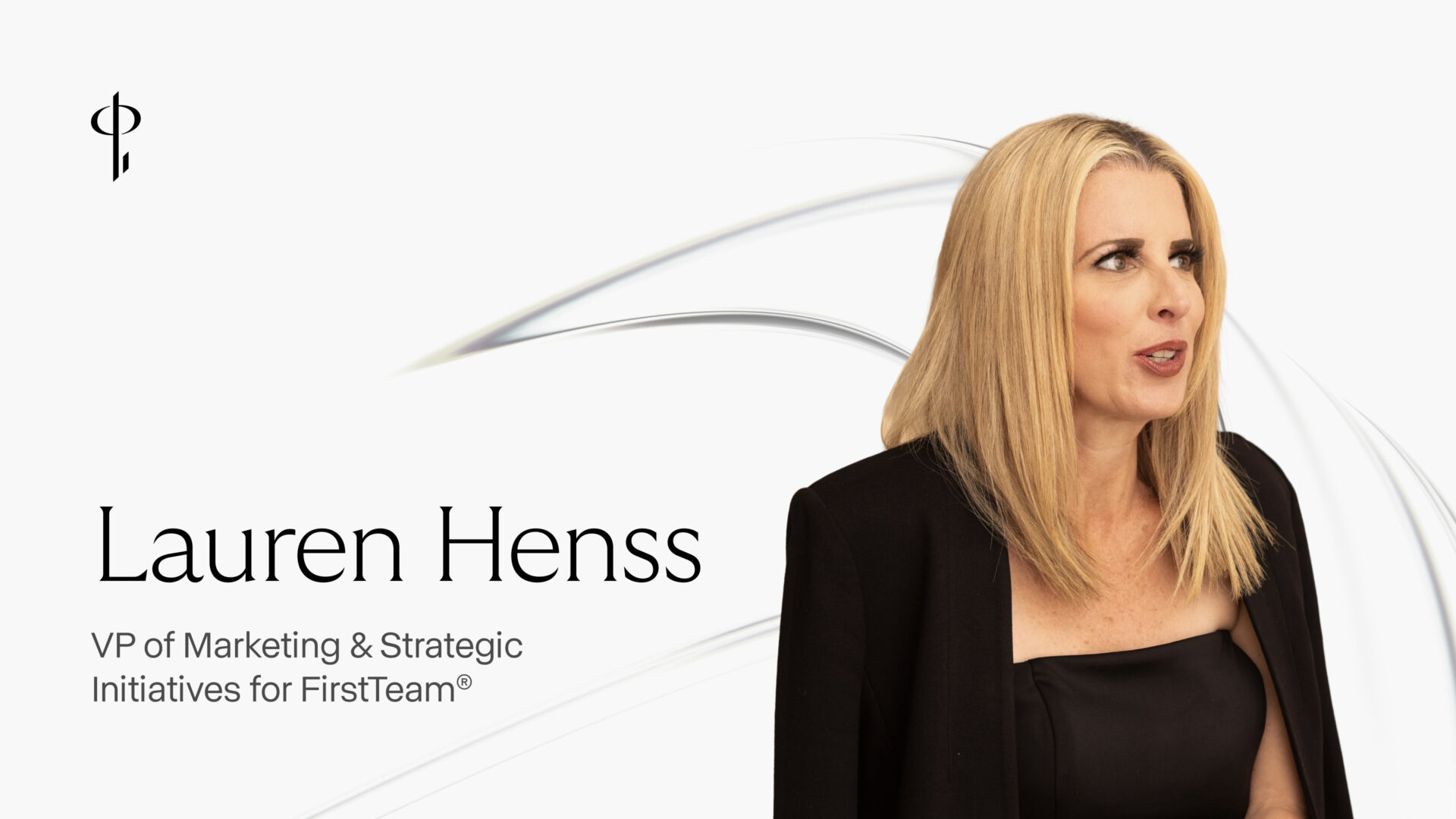
VP, Marketing & Strategic Initiatives at First Team Real Estate
Lauren Henss is a leading Strategy and Marketing Executive who has led brand, marketing, and growth strategy for real estate, PropTech, SaaS, and large consumer brands for more than 20 years. Her career has centered on the intersection of brand technology and human behavior, helping companies translate long-term vision into strategy, measurable growth, and impact. She currently serves as the VP of Marketing and Strategic Initiatives for FirstTeam®.
Through operational excellence, strategic alignment, M&A integration, digital transformation (AI), and strategic partnerships, Henss enables organizations to scale sustainably and future-proof growth. These initiatives drive global expansion, go-to-market success, and long-term enterprise value.
Henss has led high-performing teams for global brands and high-growth companies, blending Fortune 150 discipline with startup agility. Her work consistently translates strategy into measurable outcomes, including 3X revenue growth, global market expansion, and sustained competitive advantage. In her current role, she leads marketing and communications,
digital transformation, GTM, partnerships, and strategic growth initiatives, aligning brand, recruitment, revenue operations, and partnerships into a single growth engine that drives agent acquisition, retention, and market expansion. At COMPASS and Toll Brothers, she played a key role in accelerating sales volume ($6 billion+) and expanding regional market share (28% increase).
Her experience spans both B2B and B2C, partnering with Fortune 500 companies and global brands including Amazon, Salesforce, Nike, CHANEL, Hyatt, DreamWorks, WPP (VML), CBRE, Zoho, Zillow, and LPL Financial.
Henss was named a 2025 HousingWire Marketer of the Year for driving marketing innovation, digital transformation, and measurable GTM impact.