An IDX website is a real estate website that connects directly to MLS (Multiple Listing Service) data, allowing visitors to search live property listings in real time. If you are an agent or broker preparing to build or rebuild your online presence in 2026, understanding what an IDX website is and how to set one up correctly is the difference between a site that generates leads and one that simply exists. According to Luxury Presence internal data, websites with an IDX tool receive roughly four times as much traffic as websites without one. That stat alone should tell you how much is at stake when you get this decision right.
This guide walks you through 24 factors to evaluate before choosing or building a new IDX website. Each one is designed to help you avoid common mistakes, ask better questions of potential providers, and set your site up to convert visitors into real business.
Key takeaways
- IDX (Internet Data Exchange) is the system that pulls live MLS listings onto your own website, giving you control over the visitor experience and the leads it produces.
- In 2026, the RESO Web API has largely replaced the older RETS standard for IDX data feeds. Make sure your provider uses the current standard.
- Site speed, mobile responsiveness, and SSL certification are non-negotiable technical requirements that affect both search rankings and visitor trust.
- A strong IDX website pairs listing search with a clear lead-capture strategy, including calls to action, registration prompts, and content that builds credibility.
- Agents who invest in community pages, blog content, and video alongside their IDX integration see stronger organic traffic and higher conversion rates over time.
What is an IDX website?
According to NAR’s most recent Profile of Home Buyers and Sellers, the vast majority of buyers begin their search online. That makes a well-built IDX website one of the highest-return tools in an agent’s business. But when you consider how many agents in your market already have IDX sites, the question shifts from “Should I have one?” to “How do I make mine better than everyone else’s?”
The answer is in the details. From the data feed standard your provider uses to the way your listing pages load on a phone, every choice you make during setup affects whether your site generates leads or just takes up space on the internet. The 24 factors below cover the full picture.
Technical setup for your IDX website in 2026
1. Choose the right IDX data feed standard
Not all IDX integrations are built the same. The underlying data feed standard determines how listings appear on your site, how much you can customize them, and whether search engines can index them.
As of 2026, the RESO Web API has largely replaced the older RETS (Real Estate Transaction Standard) as the modern standard for IDX data feeds. RESO Web API delivers faster, more reliable listing data and is the standard most MLSs now support. When evaluating providers, confirm that they connect through RESO Web API rather than legacy methods.
Budget options using Iframe or FTP (File Transfer Protocol) rely on “framing,” which means the listings that appear on your site are not actually hosted on your domain. They just look like they are. This creates two problems. First, you cannot customize how listings look, which weakens your brand. Second, search engines cannot index those listings because they belong to someone else’s server. You may save money upfront, but you will spend more on paid ads over time because your listing pages will never rank organically.
2. Get a hosting package that can handle IDX data loads
Your website and your hosting provider are separate entities. IDX technology pulls large volumes of listing data, images, and map tiles. A shared hosting plan that works fine for a five-page brochure site will buckle under the weight of an active IDX feed.
When choosing a host, look for plans that offer dedicated or cloud-based resources, SSD storage, and a content delivery network (CDN). Ask your IDX provider what hosting specs they recommend and match accordingly.
3. Prioritize site speed and limit unnecessary plugins
One of the fastest ways to slow down a site is to install too many plugins. Some will be incompatible with your theme or with each other. All of them require regular updates. Be selective. Only install plugins that directly improve the visitor’s experience, and test your site speed after each addition.
4. Confirm theme compatibility with your IDX provider
You will want a theme that looks polished and aligns with your brand. But not every theme works with every IDX integration. Before purchasing a theme, check with your IDX provider to confirm compatibility. A theme that breaks your listing search or slows your load time is not worth the design.
5. Secure an SSL certificate
An SSL (Secure Sockets Layer) certificate encrypts data between your website and its visitors. This protects anyone entering personal information on your site, such as their name, email, or phone number during a lead registration.
Beyond security, SSL is a ranking signal. Google has confirmed that HTTPS sites receive a ranking preference over HTTP sites. Not having an SSL certificate will hurt your ability to get your pages indexed and will display a “Not Secure” warning in the browser bar, which destroys trust instantly.
6. Make sure your site is fully responsive
More than half of all web traffic in 2026 comes from mobile devices (Strategic Agent, 2026). If your listings, images, or text get cut off on a phone screen, you will lose visitors before they ever see a property.
When setting up your site, toggle between desktop, tablet, and mobile views for every page. Pay special attention to your IDX search interface, listing detail pages, and contact forms. These are the pages where mobile breakdowns cost you the most.
7. Choose a simple, memorable domain name
Your domain name is what people type into a browser when they see your name on a business card, a yard sign, or a direct mail piece. Keep it short. Avoid hyphens. Avoid strings of numbers. If someone cannot remember it after hearing it once, it is too complicated.
8. Set up analytics from day one
Google Analytics (GA4 as of 2026) shows you how long visitors stay on each page, which listings get the most views, which blog posts drive the most traffic, and where your visitors come from. Without this data, every marketing decision you make is a guess.
Set up analytics before your site goes live, not after. You want baseline data from the very first visitor.
“Excellent customer service, IDX Integration, and you have so much control over changes and updates to your website on the back end.”
— Karen Hackett, Cowanesque Lake Realty
SEO and marketing for IDX websites
9. Do keyword research before you build
Broad keywords like “Miami real estate” are saturated. You are unlikely to rank for them in 2026 without a massive domain authority advantage. Instead, focus on long-tail keywords that match how buyers actually search: “3-bedroom homes in Coral Gables under $800K” or “waterfront condos in Fort Lauderdale with boat dock.”
Long-tail keywords have lower search volume but higher intent. A visitor searching for a specific property type in a specific neighborhood is much closer to a transaction than someone typing a city name into Google. Build your IDX search pages and blog content around these phrases.
10. Budget for paid traffic with Google Ads
Organic rankings for IDX listing pages typically take 3 to 6 months to gain meaningful traction. In the meantime, Google Ads gives you a way to appear at the top of search results by paying for each click. This is especially useful during the first few months after launching a new site, when your domain has little to no organic authority.
Set a monthly budget, target your farm area with location-specific keywords, and send that traffic to your IDX listing pages rather than a generic homepage.
11. Connect your IDX to Meta for retargeting ads
Relying only on SEO to bring visitors back is a slow play. Meta Advantage+ catalog ads (formerly known as Facebook Dynamic Ads) allow you to retarget website visitors with the specific listings they viewed on your site. When a buyer sees that same property in their Instagram or Facebook feed the next day, it keeps you top of mind and brings them back to your domain.
To set this up, install the Meta Pixel on your site and connect your IDX listing feed to your paid advertising account. Your IDX provider should be able to walk you through the integration.
12. Include your IDX website link in your email signature
This takes less than a minute to set up and drives passive traffic to your listings every time you send an email. Add your website URL to your email signature with a short call to action like “Search homes in [your area].”
13. Integrate social media sharing on listing pages
When you add social media sharing buttons to your IDX listing pages, you allow visitors to share properties with friends and family on their own platforms. Every share puts your brand and your website URL in front of a new audience at no additional cost to you.
14. Update your site regularly
A website that sits untouched for months signals to both visitors and search engines that it may not be current or trustworthy. Search engines favor sites that show regular activity, whether that is new blog content, updated listings, or backend maintenance like theme and plugin updates.
Set aside at least one day per week to publish a new blog post, refresh your featured listings, or complete any backend maintenance your site needs.
UX and design for IDX real estate websites
15. Build a clean interface that signals credibility
Your website is most visitors’ first impression of you. Using too many colors or fonts is a common mistake that makes a site look unpolished. Pick a maximum of three colors and two fonts (one for headings, one for body text). Consistency builds trust.
16. Keep your search filters simple at first
Offering a wall of filter options before a visitor sees a single listing creates friction. Many buyers prefer to see a broad view of available properties first and then narrow down from there.
As a starting point, limit your default search view to 3 to 5 filters: price range, bedrooms, bathrooms, property type, and location. Let buyers add more filters after they see initial results. This reduces the barrier between landing on your site and engaging with your listings.
“The process of moving my website over from another provider has been so smooth. They have provided me the ability to have 2 MLSs available to my clients. The problem with my last provider was that I could have the 2 MLSs but I couldn’t have a drop down where the client could pick which state they were searching in.”
— Katherine Jennings, Real Estate Agent
17. Make navigation clear and shallow
Set your most important pages as top-level navigation items so visitors can see them immediately. Burying your listing search or contact page inside a submenu is a fast way to lose attention. The pages you most want people to visit should never be more than one click from the homepage.
18. Include clear calls to action
Every listing page should tell the visitor exactly what to do next: schedule a showing, request more information, or save the property. The key is to use one call to action per page or section. When you ask visitors to do too many things at once, they tend to do nothing.
19. Build a lead capture strategy
Letting visitors browse your listings without any mechanism to capture their information means you are generating traffic but not leads. Create an incentive for visitors to share their email address. A free home valuation tool, an area-specific buyer’s guide, or a “save this search” feature that requires registration are all effective approaches.
The goal is to turn anonymous visitors into contacts you can follow up with. Once a lead registers, CRM can help you nurture that relationship with automated, agent-approved touchpoints that keep you connected from first contact through closing.
Content strategy and credibility for your IDX website
20. Write a results-focused bio
Your bio should focus on what you can do for a client, not just how long you have been in the business. Years of experience and community involvement matter, but they should be supported by concrete outcomes: neighborhoods you specialize in, transaction volume, or specific ways you make the buying or selling process smoother.
21. Publish authoritative blog content
A blog gives you a place to answer the questions your clients ask every day: “What is the market doing in [neighborhood]?” “How much do I need for a down payment?” “What should I know before buying a condo?” Each post creates a new indexed page that can rank for a long-tail keyword and bring organic traffic to your site.
Search engines favor websites with a deep library of relevant content. A site with 50 well-written blog posts covering local market topics will outperform a five-page brochure site over time. If writing is not your strength, SEO & AI Search from Luxury Presence can produce agent-approved blog posts on a consistent schedule, saving you hours each week while keeping your site active.
22. Create community pages
Too many agents build IDX websites that are only about listings. Showing potential buyers that you are a genuine authority on the neighborhoods you serve is what separates you from the portals. Create dedicated pages for each community in your farm area. Include information about schools, restaurants, parks, commute times, and local events.
These pages also serve as strong SEO assets. A page titled “Living in [Neighborhood Name]: A Complete Guide” can rank for dozens of long-tail searches that bring high-intent visitors to your site.
23. Add video to your site
Video helps visitors feel connected to you before they ever pick up the phone. An introductory agent video of 60 to 90 seconds placed prominently on your homepage builds familiarity and trust. Listing walkthrough videos of 2 to 3 minutes give buyers a reason to spend more time on your site and share your content with others.
24. Provide interesting, shareable content beyond listings
Market updates, local event roundups, home improvement tips, and buyer/seller guides all give visitors a reason to return to your site even when they are not actively searching for a property. This kind of content also performs well on social media, driving new visitors back to your domain.
Consistency matters more than volume. One well-researched post per week will outperform a burst of five posts followed by months of silence.
IDX website checklist: all 24 tips at a glance
| Tip | Action | Benchmark |
| 1. Data feed standard | Confirm provider uses RESO Web API | RESO Web API (not legacy RETS or Iframe) |
| 2. Hosting package | Choose hosting that supports IDX data loads | Dedicated or cloud hosting with CDN |
| 3. Site speed and plugins | Test LCP and remove unnecessary plugins | LCP under 2.5 seconds |
| 4. Theme compatibility | Verify theme works with your IDX provider | Confirmed before purchase |
| 5. SSL certificate | Install SSL for HTTPS | Active SSL on all pages |
| 6. Mobile responsiveness | Test all pages on mobile, tablet, and desktop | No layout breaks on any device |
| 7. Domain name | Choose a short, memorable domain | No hyphens, under 15 characters if possible |
| 8. Analytics | Set up GA4 before launch | Tracking live from day one |
| 9. Keyword research | Target long-tail, location-specific keywords | 5 to 10 seed keywords per farm area |
| 10. Google Ads | Run paid campaigns during first 3 to 6 months | Monthly budget set, location-targeted |
| 11. Meta retargeting | Install Meta Pixel and connect listing feed | Retargeting active within first month |
| 12. Email signature | Add website URL with CTA to email signature | Live on all outgoing emails |
| 13. Social sharing | Add share buttons to listing pages | Buttons visible on every listing |
| 14. Regular updates | Publish new content or update listings weekly | At least one update per week |
| 15. Clean interface | Limit to 3 colors and 2 fonts | Consistent across all pages |
| 16. Search filters | Start with 3 to 5 default filters | Price, beds, baths, type, location |
| 17. Navigation | Keep top pages in primary nav | No more than one click to listings or contact |
| 18. Calls to action | One clear CTA per page or section | Visible without scrolling on listing pages |
| 19. Lead capture | Add registration incentive (valuation, guide, saved search) | Capture form on every high-traffic page |
| 20. Agent bio | Write a results-focused bio | Specific outcomes and specialties listed |
| 21. Blog content | Publish at least one post per week | Target one long-tail keyword per post |
| 22. Community pages | Create a page for each farm area neighborhood | Schools, dining, parks, commute info included |
| 23. Video | Add intro video and listing walkthroughs | Intro: 60 to 90 seconds. Walkthroughs: 2 to 3 minutes |
| 24. Shareable content | Publish market updates, guides, and local content | At least one non-listing post per week |
Frequently asked questions about IDX websites
Expert website design services
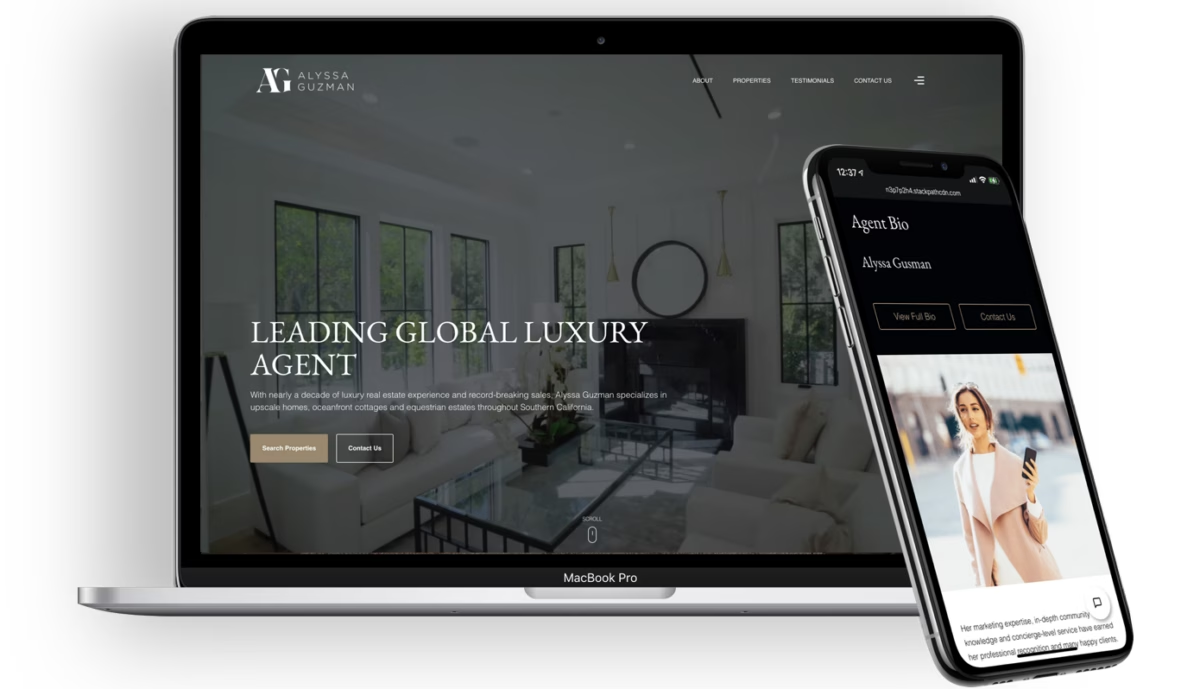
Every day, Luxury Presence creates and manages real estate websites for some of the biggest agents, teams, and brokerages in the country. Learn how we can transform your online presence.
About the author

Marketing Manager
Kate Evans is a content marketing strategist at Luxury Presence, the leading growth platform for high-performing real estate professionals. She develops data-driven editorial content and supports SEO strategy and brand voice frameworks that help agents attract qualified leads and establish market authority. Her published work covers topics including CRM strategy, social media marketing, and digital growth, supporting thousands of agents in scaling their businesses through modern marketing.