I’ve spent years running paid ad campaigns across Google and Meta, first on the agency side, then in-house at Calendly, and now at Luxury Presence. The one thing that stays consistent across every account I’ve managed: the agents who win with PPC are the ones who understand the full system, from the first keyword to the last follow-up email.
Most guides on this topic tell you to pick some keywords, write an ad, and watch the leads roll in. That skips over the parts that actually determine whether you’ll see a return on your ad spend. The real work happens in the details that connect each step to the next, and in the patience to let the system learn.
Here’s what I’ve found matters most after years of running these campaigns.
TLDR
- The landing page you send traffic to matters more than the ad copy you write. Fix your post-click experience before you spend a dollar scaling.
- Google and Meta serve completely different purposes. Google captures intent from people actively searching. Meta builds awareness and fills your pipeline over time.
- Start with tight targeting and expand from there. The default platform recommendations will spend your budget fast on low-quality traffic.
- Feed quality conversion data back to the ad platforms. The better the signal you give Google and Meta, the better results they’ll deliver.
- Your first closed deal from ads can pay for an entire year of ad spend. Think in terms of long-term ROI, not cost per lead in month one.
- AI tools are powerful partners for strategy and creative iteration, but letting platforms run on full autopilot sacrifices the control that drives real results.
Find It Fast
What PPC actually means in real estate (and how it differs from Zillow leads)
Pay-per-click advertising is exactly what it sounds like: you pay each time someone clicks on your ad. But the way it works for real estate agents is fundamentally different from buying leads on Zillow or Realtor.com. With PPC, you own the relationship from the start. You control the messaging, the landing page experience, and the follow-up. You’re building your own audience rather than renting someone else’s.
The two primary PPC channels for real estate are Google (paid search) and Meta (Facebook and Instagram ads). Each one works differently, and understanding that difference is the foundation of a good strategy.
On Google, people are actively searching for something. They have intent. If someone types “real estate agent in Atlanta,” they’re looking for help right now. Your job is to show up for that search with an ad that matches what they’re looking for and carry that message through to a landing page that converts.
On Meta, people are scrolling through their feed. They’re not searching for an agent. They’re watching videos of their friends’ kids and looking at vacation photos. Your ad is an interruption, which means the creative, the image or video and the hook in the first few seconds, has to earn their attention. The more your ad feels like organic content and less like a sales pitch, the more likely someone is to stop scrolling.
Start tight with targeting, then expand
One of the most common mistakes I see is agents following every default recommendation the ad platforms give them. Google will push you toward broad match keywords. Meta will encourage you to let its algorithm decide everything. And if you just accept every suggestion to get your account score to 100, you’ll end up with a campaign that spends a lot of money on people who will never become clients.
On Google, I always recommend starting with exact match keywords. That means you’re telling Google: only show my ad when someone searches this literal phrase. From there, you can layer in phrase match, which allows some flexibility while keeping the core intent intact.
And just as important as what you’re targeting is what you’re excluding. Negative keywords are your filter for junk traffic. If you don’t do rentals or commercial real estate, exclude those terms on day one. Then monitor your actual search terms report weekly and keep adding negatives.
On Meta, location targeting is your biggest lever. Set a radius around the cities and markets you serve. From there, you can layer interest targeting related to life events like buying or selling a home. Meta’s algorithm is genuinely good at finding the right people once you give it the right guardrails.
This week: If you’re running Google Ads, pull your search terms report and add at least 10 negative keywords. On Meta, tighten your location targeting to only the specific markets you serve.
Your landing page matters more than your ads
Here’s where most agents get it backwards. They spend hours tweaking ad copy and barely think about what happens after someone clicks. I think of it bottom-up: start with the page you’re sending people to and work your way back to the ad.
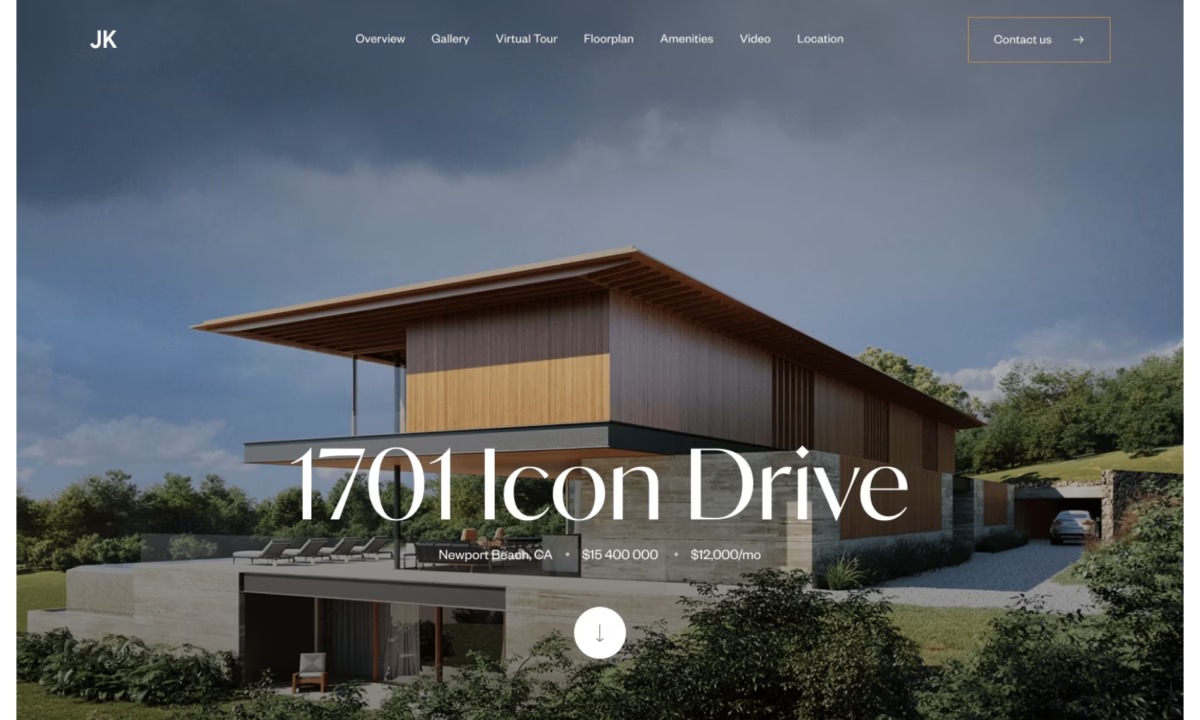
If you’re driving traffic to your homepage, you’re paying to send people to a leaky bucket. Homepages have multiple calls to action, navigation menus, bios, listings, blog links. Every one of those is a potential exit point. A dedicated landing page built for conversion has one job: get the visitor to fill out a form.
The most important principle here is message alignment. Whatever keyword you’re targeting, the ad headline should echo it. And when someone clicks through, the landing page headline should echo the ad.
If someone searches “real estate agent in Austin” and your ad says “Top Austin Real Estate Agent,” your landing page better say something nearly identical at the top. That alignment builds subconscious trust. When it’s missing, people feel a disconnect and bounce.
Keep forms short. Name and email. Maybe phone number. A 7-field form is intimidating, and every field you add reduces your conversion rate. Pair that short form with a clear, specific button: “Get My Free Home Valuation” beats “Submit” every time.
This week: Build one dedicated landing page for your highest-priority campaign. Match the headline to your ad copy. Use a two-field form and a single, clear call to action.
Feed the algorithm quality data
I like to think of running ads as training an algorithm. The data you feed Google and Meta is what teaches them who to show your ads to next. This is the same principle behind AI tools like ChatGPT or Claude: quality in, quality out.
If you’re only telling the platform about clicks, it will find you lots of clicks, but many of those people will never convert. If you optimize for leads, that’s better, and it’s where I recommend starting. You get a fast feedback loop because someone might see your ad, click through, and fill out a form within five minutes. That quick turnaround gives the algorithm plenty of data to learn from.
But here’s where it gets interesting. We’ve seen cases where one audience delivers great cost-per-lead numbers, but when you look further down the funnel, the cost per actual meeting is double that of a smaller, more qualified audience. The leads looked good on paper. They just weren’t the right people.
As you scale and accumulate more conversion data (meetings booked, deals closed), start feeding those events back into the platforms. This is called offline conversion tracking, and it’s one of the most underappreciated levers in paid advertising. It trains the algorithm to find people who look like your actual customers, not just people who like to fill out forms.
This week: If you’re running ads and tracking leads, set up a system to feed meeting and closed-deal data back to your ad platform. Even a simple monthly upload of offline conversions makes a meaningful difference.
The long game: budget, patience, and lead nurture
One of the biggest misconceptions about PPC is that you should expect to see ROI in the first month. Real estate has long deal cycles. Someone might find you through an ad today and not be ready to buy or sell for 12 to 24 months.
The agents who actually close deals from ads are the ones who treat lead capture as the beginning of a relationship, not the end of a transaction. You’re building a bucket of contacts. Your job after capturing a lead is to stay top of mind through email sequences, retargeting ads, and genuinely valuable content. Offer something useful (a local market guide, a free home valuation) rather than immediately pushing for a meeting.
On budget, I’d consider the first one to two months a learning phase. The platforms need time to build conversion data, and you need time to see what’s working. Give a campaign at least three months before you judge its performance. Cost per lead in real estate can range from $40 to $80 depending on your market and the type of lead, but the math still works. If your average commission is $10,000 to $15,000 and you’re spending $1,000 a month on ads, one additional closed deal pays for an entire year of advertising.
AI tools can accelerate this whole process. I use them to analyze ad performance data, iterate on creative concepts, and refine strategy. Upload your campaign reports into a tool like Claude, give it context about your account structure and goals, and use it as a thought partner to brainstorm new hooks and headlines.
The first output is usually decent but needs refinement. The real value comes from iterating back and forth, explaining what you like and what should change. That feedback loop produces much stronger creative than starting from scratch every time.
This week: Set a 90-day evaluation window for any new campaign. Block time each week to review your search terms, test new creative, and follow up with leads who haven’t booked a meeting yet.
The best strategies are built bottom-up
If there’s one thing I’d leave you with, it’s this: build from the bottom of the funnel up. Tighten your landing page before you scale your ads. Nail your follow-up process before you pour more leads into the top. Feed quality data back to the platforms before you expand your budget. Every dollar you spend on ads performs better when the system beneath it is built to convert.
The agents who treat PPC as a long-term growth engine, and invest the time to learn what works through testing, iteration, and patience, are the ones who build something that compounds over time.
FAQs
About the author

Sr. Paid Media Manager (Brand Marketing)
Brad Beyea is a growth and performance marketing leader specializing in paid media, demand generation, and product-led growth. As Senior Paid Media Manager at Luxury Presence, he drives scalable customer acquisition and revenue growth for real estate businesses.