Most agents know their next deal is probably coming from the sphere they already have. The data backs it up. Repeat and referral business drives the majority of transactions for agents who’ve been in the business more than a few years.
But your sphere is not a short list of people you talk to regularly. It’s hundreds of contacts accumulated over years. Past clients, open house visitors, old colleagues, neighbors, family friends, someone you met at a conference in 2019. You open your database. There are hundreds of people in it.
Who do you call today?
Without a specific signal, that decision is paralyzing. So most agents don’t make it. They act on whoever surfaces naturally. A text that came in yesterday. A name that crossed their mind in the car. The rest of the database sits there, full of people quietly moving through life events that make them likely to buy or sell. Nobody is watching.
The CRM category has had thirty years to solve this. It hasn’t. And the reason is structural.
Speed to lead works. Everything else is stuck.
Response time genuinely affects conversion on new inquiries and CRMs generally have strong tools for that part of the job. It’s simple-speed-to-lead: you know a person is in the market, you know where they came from, and you build a workflow around them.
But agents are largely missing everything beyond active leads. They’re told to stay top of mind with their sphere, but the tools they have can only do one thing: execute rules.
And so CRMs have offered better segmentation, smarter sequences, more integrations, and a cleaner interface on top of the same foundation.
But here’s why that’s not good enough anymore.
Rules-based automation has a hard ceiling, and it’s conceptual. The system can only act on signals you’ve already anticipated. If someone fills out a form, send an email. If they open three emails, tag them hot. If 90 days pass, trigger a check-in.
You can’t build a rule for an opportunity you didn’t know to look for.
The deals that disappear without a trace
Let’s say a contact in your sphere just got promoted. They might be thinking about a bigger home?
Maybe another contact’s children just reached college age. Perhaps a great time to show them options for smaller condos?
Someone who went quiet for 18 months just started searching listings in a zip code they’ve never looked at before. Great time to reach out!
In a traditional CRM, a rule won’t catch any of that. No sequence fires when someone is promoted.
The opportunities within your database are real, but the current systems are blind to them.
And the cost is invisible. A contact transacts with another agent, you find out months later, if you find out at all.
During our beta tests, users connect their email history and start to see all the activity they missed because their CRM didn’t have access to outside signals. Contacts who went dark over a year ago but continued having important life events… and already closed with someone else. The data was always there, but nobody built a system to access and surface it.
AI answers the three questions agents actually have
Every agent has the same three questions: who do I reach out to, when is the right moment, and what should I say?
Rules-based CRMs gave agents tools to build their own answers. Build a segment, configure a sequence, and maintain the automations. Most agents configured the basics and stopped, because extracting full value from a rules engine is itself a job.
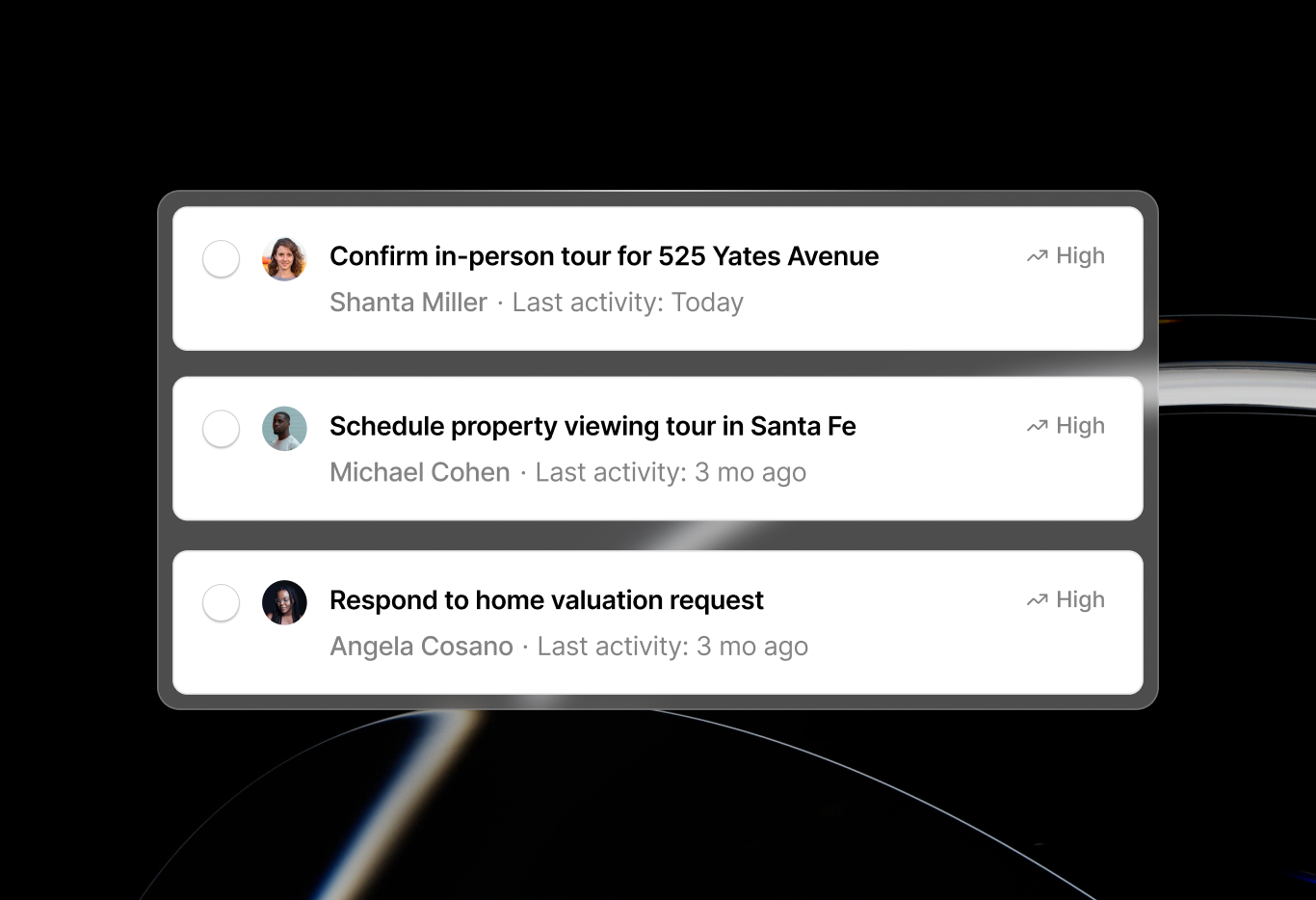
AI doesn’t need rules. It continuously researches your contact network, detects signals that someone is about to move across life events, browsing behavior, communication gaps, and property ownership shifts, and delivers a specific recommended action.
Who to call. Why today matters. What to say. Including opportunities you never would have thought to watch for.
That requires making the website, email integration, enrichment pipeline, and the AI layer simultaneously work together. And we’re uniquely positioned to offer that.
When the signals surface
One of our beta users got a suggestion to reach out to a past client who had recently changed jobs. She called to say congratulations. Turns out, that contact was planning to sell and that nudge became a listing in a matter of days!
She had no reason to make that call on her own. No automation would have caught it. The signal was invisible until the system found it.
Agents acting on these suggestions are making better decisions about who needs their attention, because they have real signals telling them who is actually close to a transaction. The calls have a reason behind them.
The outreach is specific to that person at that moment. Follow-up stops feeling like maintenance and starts feeling like the relationship work agents got into this business to do.
The rest of the category will catch up eventually
The rules engine had its time in the sun for thirty years. It’s time for something different.
The agents who move first will have a real advantage over the ones still configuring sequences. The rest of the category will get there. The question is what your business looks like by the time they do.
About the author

Chief Product Officer, Luxury Presence
Zac Hays is the Chief Product Officer at Luxury Presence, where he leads product and design and focuses on how AI can transform the way teams prototype, collaborate, and deliver value. Over the past 20 years, he has built and scaled product organizations across startups and large companies, including Microsoft, TiVo, Autodesk, and BuildingConnected, where he joined as the first executive hire and helped grow the business to a $285M acquisition by Autodesk. At Autodesk, he led a global product development organization of 100+ product managers, designers, researchers, and engineers. He is an active voice in the product community, sharing lessons on how AI is reshaping product management, and outside of work, spends time with his two young daughters in San Francisco and at Oracle Park cheering on the Giants.