
Real estate has long relied on referrals, open houses, and cold calls to generate business. In 2026, many agents still resist digital marketing for three specific reasons: unfamiliarity with the platforms, doubts about return on investment (ROI), and the belief that online leads do not convert. All three concerns are understandable, and all three are wrong.
This article addresses four of the most common myths about real estate lead generation through digital marketing. Each myth is rebutted with evidence from agents who have built measurable businesses using the exact strategies skeptics dismiss.
Find It Fast
Key takeaways
- In 2026, nearly all homebuyers begin their search online, making digital channels the primary source of real estate leads for agents who show up consistently.
- Online leads are not inherently low quality. Agents who pair strong SEO with proper follow-up systems report daily inbound calls from motivated buyers and sellers.
- Social media marketing generates real, trackable revenue. One agent documented more than $1.6 million in closed deals directly from short-form video content.
- High-net-worth buyers research properties online just like every other demographic. A strong digital presence is now a requirement for winning luxury listing appointments.
- Digital marketing does lead to conversions when agents treat their website as a lead generation system rather than a static brochure.
How does digital marketing generate real estate leads in 2026?
Digital marketing for real estate agents works by placing your brand in front of buyers and sellers at the exact moment they are searching for help. Instead of waiting for a referral or hoping someone walks into an open house, you meet prospects where they already spend their time: on Google, on social media, and in their email inbox.
The core channels of real estate digital marketing include:
- Targeted advertising on social media platforms like Facebook, Instagram, and YouTube
- Search engine optimization (SEO) for real estate websites so your listings and market pages rank when buyers search
- Content marketing through property listings, neighborhood guides, and blog posts that answer the questions buyers and sellers type into Google
- Email marketing campaigns that nurture leads over weeks and months until they are ready to act
- Visual marketing tools like virtual tours and drone footage that showcase properties and keep visitors on your site longer
The goal is straightforward: attract the right audience, earn their attention with useful content, and give them a clear path to contact you. Each channel feeds the others. SEO brings traffic to your site. Your site captures contact information. Email and retargeting ads keep you top of mind. And when the prospect is ready to buy or sell, you are the agent they call.
Real estate digital marketing strategies are not about quick tricks. They are about building a system that generates leads consistently, month after month, without requiring you to start from scratch every quarter.
Common digital marketing myths agents still believe in 2026
Despite the data, myths about digital marketing persist in real estate. Below are four of the most common, along with the evidence that disproves each one.
1. “Online leads are low quality”
This is the myth agents cite most often. The logic goes like this: if 97% of homebuyers start their search online (NAR Profile of Home Buyers and Sellers, 2024), then the sheer volume of digital leads must include a large number of unqualified prospects. That part is true. But dismissing the entire channel because of volume misses the point.
Within that volume, there are highly motivated buyers and sellers actively searching for an agent. The difference between agents who complain about lead quality and agents who close from digital leads almost always comes down to two things: how well their website is built to attract the right visitors, and how quickly they follow up.
Holly Meyer Lucas, principal founding agent of the Meyer Lucas Team, is ranked number one in Palm Beach County. Her team generates $100 million in annual sales, and she attributes roughly half of that revenue directly to Google. In a conversation with Luxury Presence CEO Malte Kramer, Holly shared that she receives at least one call per day from a motivated lead ready to do business, all from her digital marketing presence.
That is not a fluke. When your website ranks for the search terms buyers and sellers actually type, the leads that come through are already self-qualified. They searched for something specific, found your site, and chose to contact you. That is a fundamentally different lead than a purchased list of names.
One Luxury Presence brokerage client, Better Homes and Gardens Real Estate Lifestyles Realty, went 13 years without generating a single organic lead from their website. After rebuilding their site with SEO-focused architecture, they generated 10 organic leads in the first week and saw 57% site engagement within four months (Source: Luxury Presence Case Study: Better Homes and Gardens Real Estate Lifestyles Realty, 2025).
The fix: Stop judging digital leads by the worst ones. Build a site that ranks for high-intent search terms in your market, and pair it with a follow-up system that contacts new leads within five minutes. The quality of your leads is a direct reflection of the quality of your digital presence.
2. “Social media marketing doesn’t generate actual leads”
Some agents treat social media as a vanity project: nice for brand awareness, but not a real source of closed deals. The data tells a different story. According to a 2024 survey, 46% of realtors reported that social media was their top technology tool for generating high-quality leads, ahead of MLS sites and CRM tools (NAR Real Estate in a Digital Age, 2024).
Glennda Baker is one of the clearest examples of social media lead generation for real estate agents done right. In an episode of The Presence Podcast, she walked through how she has closed more than $1.6 million in deals directly from her social media videos. She broke down her process, her budget, and how she built an audience on TikTok that translates into signed contracts.
Real estate marketing expert Jose Prats reinforces this point: “We have case studies where we’ve sold property through Instagram, where we had offers in hand before on MLS from social media. It’s so powerful.” That is not brand awareness. That is revenue.
The fix: Treat social media as a lead generation channel, not a hobby. Post content that answers real questions from buyers and sellers in your market. Track which posts generate direct messages and inquiries. And if creating content consistently feels impossible given your schedule, consider a done-for-you social media marketing system that maintains your brand presence without requiring hours of your time each week.
3. “Affluent clients don’t care about digital marketing”
This myth assumes that high-net-worth individuals rely exclusively on personal networks and private referrals to find properties. In reality, wealthy buyers are among the most active online researchers. A 2024 wealth and lifestyle study found that 98% of high-net-worth individuals use the internet daily, and a significant share use social media to research major purchases including real estate (Statista Luxury Goods Report, 2024).
Record-breaking luxury agent and Luxury Presence client Jade Mills sees this firsthand. In her conversation with Malte Kramer, she explained why luxury real estate digital marketing depends on a strong online presence: “When you go on a listing appointment, and you have your iPad there, and you’re showing people what you do and how you advertise, you have to have the most beautiful website.” When asked what her digital presence does for her business, she answered in two words: “It’s my lifeline.”
The numbers back her up. Thirty percent of the WSJ RealTrends Top 100 agents use Luxury Presence for their digital marketing, which signals that the agents closing the highest-value deals in the country treat their online presence as a business requirement, not an afterthought.
The fix: If you serve a high-net-worth market, your website and digital brand are your first impression. Affluent buyers will research you online before they ever agree to a meeting. Make sure what they find reflects the level of service you provide in person.
4. “Digital marketing doesn’t lead to conversions”
This is the myth that ties the other three together. Even agents who accept that online leads exist and that social media has reach sometimes argue that digital marketing does not actually close deals. The belief is that digital channels are good for awareness but not for the final conversion.
Top Florida real estate agent Anna Sherrill, affiliated with ONE Sotheby’s International Realty and consistently ranked among South Florida’s top producers, disagrees. Her assessment is direct: “My website is my best marketing campaign.” For Anna, the website is not a digital brochure. It is the center of a system that attracts, nurtures, and converts leads into closed transactions.
Real estate marketing analyst Chris Linsell adds broader context: “Paid ads have been a proven model for success in real estate since the paid ad model on the internet came to be.” The channel is not new and unproven. It has more than two decades of performance data behind it.
The Luxury Presence platform itself reflects this at scale. Across its client base, the platform drives more than 60 million annual website visitors and has published over 74,000 blog posts with a 97.9% content acceptance rate. Those are not vanity metrics. They represent a system designed to turn digital visibility into real business.
The fix: If your digital marketing is not converting, the problem is almost certainly the system, not the channel. A website that loads slowly, lacks clear calls to action, or ranks for the wrong keywords will underperform regardless of how much traffic it receives. Audit your site for speed, search ranking, and lead capture before concluding that digital marketing does not work.
Four myths at a glance
| Myth | Reality | Supporting data | Expert example |
| “Online leads are low quality” | Lead quality depends on your site’s SEO targeting and your follow-up speed, not the channel itself. | One brokerage generated 10 organic leads in its first week after rebuilding with SEO-focused architecture. | Holly Meyer Lucas attributes roughly half of her team’s $100M annual sales to Google. |
| “Social media doesn’t generate actual leads” | Social media produces trackable, closeable revenue when agents post consistently and engage with inquiries. | 46% of realtors named social media their top tool for high-quality leads (NAR, 2024). | Glennda Baker closed more than $1.6M in deals directly from social media videos. |
| “Affluent clients don’t care about digital marketing” | High-net-worth buyers research agents and properties online before agreeing to a meeting. | 98% of high-net-worth individuals use the internet daily (Statista, 2024). | Jade Mills calls her digital presence “my lifeline” for winning luxury listings. |
| “Digital marketing doesn’t lead to conversions” | Conversions depend on site speed, keyword targeting, and lead capture design, not the channel. | Luxury Presence clients collectively receive 60M+ annual website visitors. | Anna Sherrill: “My website is my best marketing campaign.” |
FAQs
Trust our team with your ads
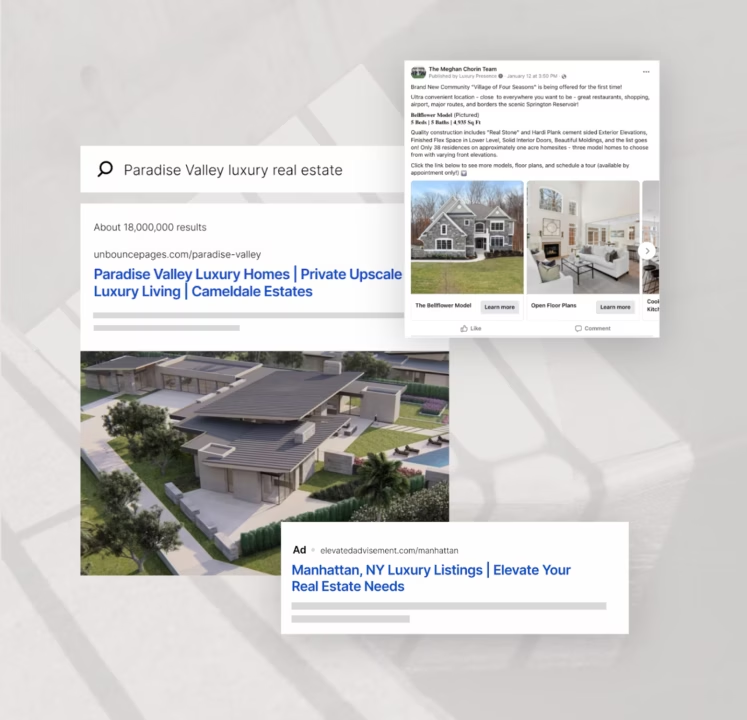
Our advertising experts routinely run hyper-targeted campaigns that are proven to convert in search and social, sending high-quality leads directly to the databases of top producers all over the country.
About the author

Marketing Manager
Kate Evans is a content marketing strategist at Luxury Presence, the leading growth platform for high-performing real estate professionals. She develops data-driven editorial content and supports SEO strategy and brand voice frameworks that help agents attract qualified leads and establish market authority. Her published work covers topics including CRM strategy, social media marketing, and digital growth, supporting thousands of agents in scaling their businesses through modern marketing.