Your sphere of influence (SOI) is the single most valuable asset in your real estate business. It is not a contact list. It is not a database. It is the living, breathing network of people who already know you, trust you, and are willing to refer you when someone they care about needs real estate help. In 2026, with housing inventory still tight in many markets and buyer-agent relationships under more scrutiny than ever, the agents who win are the ones who treat their SOI like the revenue engine it is. This article will show you exactly what a real estate SOI includes, why it matters more than any paid lead source, and how to build a system that keeps you visible, valuable, and referable to every person in your network.
Find It Fast
Key takeaways
- Your SOI is your most cost-effective source of referrals and repeat business, outperforming cold lead channels in both conversion rate and cost per transaction.
- Every agent already has an SOI. The difference between agents who get consistent referrals and those who do not comes down to follow-up cadence and CRM discipline.
- Segmenting your contacts in a CRM built for real estate workflows, like Luxury Presence’s CRM, allows you to send the right message to the right person at the right time, without losing the personal touch.
- A 30-60-90 day action plan gives you a concrete framework for organizing, activating, and measuring your SOI outreach starting this week.
- Expanding your SOI is not about collecting more names. It is about turning every new relationship into a long-term referral source through consistent visibility and genuine value.
What is your real estate SOI?
A real estate agent’s sphere of influence refers to the network of people the agent knows personally and professionally who can refer business or become clients themselves. This is not a vague marketing concept. It is a specific, identifiable group of people who already have a relationship with you. Your SOI includes:
- Family and friends
- Neighbors and community members
- Past clients who have bought or sold with you
- Other real estate professionals you collaborate with
- Business associates and colleagues from previous careers
- Service providers such as lenders, inspectors, contractors, and title professionals
- Members of local clubs, organizations, religious groups, and associations
- Community leaders and local business owners
- School and alumni connections
- Social media followers who engage with your content
- Email list subscribers
- Contacts through professional networking sites such as LinkedIn
The common thread across every name on that list is proximity. These are people who already know you exist. The work is not in making them aware of you. The work is in staying visible, staying valuable, and staying top of mind so that when a real estate need arises, your name is the first one they think of. That is what separates a contact list from a sphere of influence.
Your SOI is also a direct reflection of your marketing strategy. Agents who invest in their SOI consistently report that referral-based transactions close faster, cost less to acquire, and produce higher client satisfaction than transactions sourced from cold outreach or paid advertising.
Why your real estate SOI is important in 2026
In 2026, with buyer and seller activity driven increasingly by trust and personal recommendation rather than cold outreach, your sphere of influence is the most cost-effective pipeline you have. According to the National Association of Realtors (NAR), approximately 40% of buyers found their agent through a referral from a friend, neighbor, or relative, and another significant share used an agent they had worked with before (NAR Profile of Home Buyers and Sellers, 2024). That means nearly half of all real estate transactions start inside someone’s SOI.
No two agents share the same sphere. Your SOI is yours alone, shaped by the relationships you have built over years of personal and professional life. That makes it a competitive advantage no one can replicate or outbid.
That kind of referral dominance does not happen by accident. It is the result of years of consistent follow-up, genuine relationship investment, and a system that keeps every contact in the SOI from falling through the cracks. Referrals are the most direct benefit of a strong SOI. Satisfied contacts recommend you to friends, family, and colleagues who need real estate help. Past clients within your SOI often become repeat clients. That repeat business builds long-term loyalty and strengthens your credibility in the market.
Your SOI also serves as a support network. It gives you access to off-market listing opportunities, partnership referrals from other professionals, and honest feedback about how your brand is perceived in the community. Agents who treat their SOI as a relationship asset rather than a marketing list consistently outperform those who chase cold leads.

Identify your SOI
Start with your customer relationship management (CRM) software and audit every contact you have. A CRM built for real estate workflows, like our CRM, lets you segment your SOI into categories that match how you actually do business: past clients, active prospects, referral sources, and professional contacts. Use tags or labels to identify characteristics such as first-time homebuyers, investors, or those interested in a specific neighborhood.
Segmentation is what turns a static contact list into a working pipeline. When your contacts are organized by category, you can send the right message to the right segment. First-time buyers get financing tips. Investors get market trend updates. Past clients get home anniversary notes. Each message feels personal because it is relevant, even when your CRM is helping you send it at scale.
Newer agents typically have a smaller SOI than those who have been practicing for several years. But size matters less than the quality of each relationship and the consistency of your follow-up cadence. An agent with 150 well-nurtured contacts will generate more referrals than an agent with 1,000 names sitting untouched in a spreadsheet.
Not every contact qualifies as part of a useful SOI. Focus on people who know you well enough to recommend you by name. If someone would not recognize your voice on the phone, they are not yet in your sphere. They are a lead. The goal is to move leads into your SOI over time through consistent, value-driven communication.
Invest in your SOI
Growing your SOI matters, but investing in the contacts you already have matters more. The agents who generate the most repeat and referral business are the ones who show up consistently for the people already in their network. Here is how to do that in 2026.
Provide value between transactions
Share content that your SOI actually wants to receive: local market reports, home maintenance checklists, neighborhood guides, and investment insights. Post this content through your blog, email newsletters, and social media platforms. The goal is to position yourself as the person your contacts think of when a real estate question comes up, not just when a transaction is imminent.
Maintain a consistent communication cadence
Send a monthly or quarterly newsletter with market updates, buying or selling tips, and local real estate news. Actively post on social media to engage with your network and share listings, client success stories, testimonials, and market commentary. Send handwritten notes for birthdays, home purchase anniversaries, and holidays. That personal touch creates a memory that a digital ad never will.
Automate your touchpoints without losing the personal feel
A CRM designed for real estate, like our CRM, allows you to set up communication sequences for different segments. Past clients can receive home anniversary emails on the date of their purchase. Potential sellers can get quarterly market condition updates for their neighborhood. You review and approve every message before it goes out, so nothing sends without your sign-off.
If your current CRM does not support automated sequences, you can still set calendar reminders for regular follow-ups. The point is to build a system that prevents any contact from going six months without hearing from you. According to HubSpot, segmented email campaigns produce a 14.31% higher open rate than non-segmented campaigns (HubSpot Marketing Statistics, 2024). That difference compounds over hundreds of contacts and dozens of months.
Many CRMs can also send post-transaction surveys to gather feedback. Encourage satisfied clients to leave reviews on your website and social media profiles. Track these requests and follow up as needed.
Track your progress
Keep a record of all interactions with your contacts in your CRM: calls, emails, meetings, and event attendance. Monitor engagement metrics like email open rates, click-through rates, and response rates to understand which messages resonate and which fall flat. This data tells you who in your SOI is most engaged and most likely to refer, so you can invest more time in those relationships.
| SOI engagement metric | What it tells you | Action to take |
| Email open rate | Whether your subject lines and send timing are working | Test new subject lines for segments with open rates below 25% |
| Click-through rate | Whether your content is relevant to the recipient | Adjust content topics for segments with click rates below 3% |
| Response rate (replies) | How engaged and trusting your contacts are | Move high-responders to a higher-touch follow-up cadence |
| Referral count per quarter | Whether your SOI is actively sending you business | Thank referrers personally and add them to a VIP segment |
| Event attendance rate | How connected your SOI feels to you in person | Increase event frequency if attendance exceeds 20% of invites |
Put on events
Host events such as holiday parties, summer barbecues, or client appreciation nights. These gatherings demonstrate your investment in past clients and keep you visible for future real estate needs. Conduct seminars on homebuying, selling, or investing in real estate and invite your SOI to attend. Attend local events, join clubs, and participate in community activities to stay connected and meet new contacts who can enter your sphere over time.
Socialize with your SOI online
Engage with your SOI’s social media posts by liking, commenting, and sharing. This keeps you visible and shows that you care about their lives outside of real estate. In 2026, short-form video formats and live audio rooms on platforms like Instagram and LinkedIn are increasingly effective ways to stay in front of your sphere without requiring a large time commitment.
Identify and segment your SOI on social media
- Cross-reference your CRM contact list with the platforms you are active on. Make sure you are connected with your SOI on each shared network.
- Use Meta’s audience segmentation tools or LinkedIn’s contact tagging features to organize your SOI into categories such as past clients, active prospects, and referral sources. This allows for targeted communication on each platform.
Engage with your SOI directly
- Regularly interact with your SOI’s posts by liking, commenting, and sharing. This increases your visibility and keeps you top of mind.
- Use private messages to check in, congratulate contacts on personal milestones, and offer advice when appropriate.
- Encourage satisfied clients to share their experiences on social media and tag your business. When they do, repost their content to your profile.
Host virtual events
- Conduct live Q&A sessions on topics like homebuying, selling tips, and market trends. Promote these events to your SOI and invite them to participate.
- Host virtual tours and open houses on Instagram Live or LinkedIn Live. Engage with viewers and answer their questions in real time.
Pop-bys and gifting
Order branded items like calendars, magnets, or notepads that include your contact information. These small items keep your name visible in the daily lives of your SOI. Pop by to deliver these, or drop off a small gift like brownies or a bottle of wine. The cost is minimal. The impression is lasting.
How to expand your sphere of influence
Expanding your SOI as a real estate agent means actively meeting new people, building trust, and positioning yourself as the go-to resource in your market. Here are the most effective ways to grow your network in 2026.
Networking and community involvement remain the foundation. Attending local events, joining clubs and organizations, and volunteering put you in front of new people in a context where trust forms naturally. The more conversations you have and the more email addresses you collect with permission, the wider your sphere reaches.
Educational seminars and workshops give you a platform to share market knowledge and demonstrate your expertise. Hosting open houses creates face-to-face opportunities with potential buyers and neighbors who may not yet be in your SOI. Every sign-in sheet is a chance to add a new contact to your CRM and begin the nurture process.
Client referrals and testimonials play a direct role in expanding your network. Satisfied clients who leave a review or recommend you to a colleague are doing your marketing for you. Partnering with local businesses and engaging in cross-promotional activities can also put your name in front of audiences you would not reach on your own.
As Bonneau Ansley of Ansley Real Estate has said, “I made people that I came in contact with multipliers for me.” That is the compounding effect of SOI investment. Every contact who refers one new client effectively doubles the value of that original relationship. Over years, those multipliers build a pipeline that no advertising budget can match.
A 30-60-90 day SOI action plan
If you have been meaning to get serious about your SOI but have not built a system yet, this 90-day plan gives you a concrete framework. Start this week.
Days 1-30: Organize
- Audit every contact in your phone, email, and social media accounts.
- Import all contacts into your CRM software. If you do not have a CRM built for real estate, consider our CRM as your starting point.
- Segment contacts into at least four categories: past clients, active prospects, referral sources, and professional contacts.
- Set a baseline follow-up reminder for every contact. No one should go more than 90 days without hearing from you.
- Delete or archive contacts who do not recognize your name. They are not in your SOI yet.
Days 31-60: Activate
- Send your first segmented email newsletter with content relevant to each group.
- Engage with SOI contacts on social media at least three times per week: like, comment, and share their posts.
- Send five handwritten notes to past clients thanking them for their business or congratulating them on a home anniversary.
- Schedule one in-person or virtual event for the following month, such as a market update webinar or a client appreciation happy hour.
Days 61-90: Measure
- Review email open rates and click-through rates in your CRM.
- Identify the top 10 contacts who engaged most with your outreach.
- Move those 10 contacts to a higher-touch follow-up cadence: monthly calls, personal check-ins, or coffee meetings.
- Document at least one referral conversation. If you have not had one yet, reach out to your five most engaged contacts and ask directly: “Who do you know who is thinking about buying or selling?”
- Set your 90-day plan for the next quarter based on what you learned.
Sources
- NAR Profile of Home Buyers and Sellers, 2024
- HubSpot Marketing Statistics, 2024
- NAR: A Powerful Sphere Can Boost Your Business
FAQs
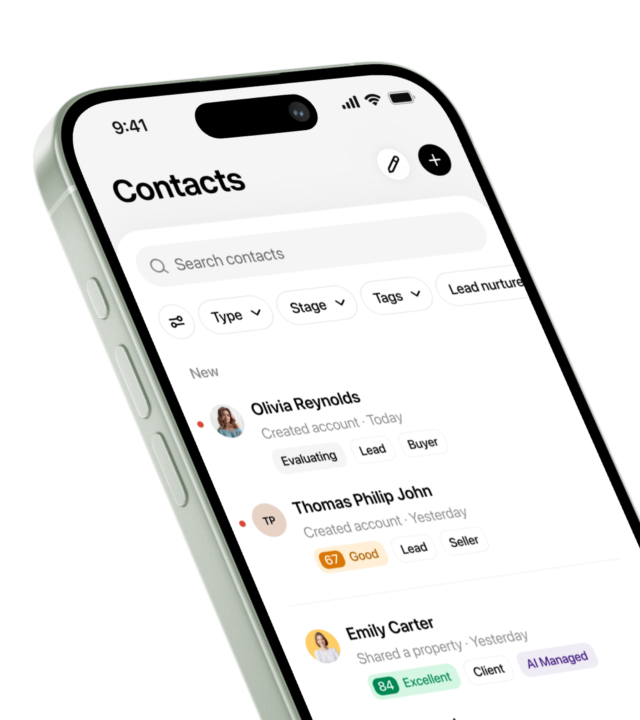
Introducing Presence® CRM
Activate your network’s full potential.
About the author

Marketing Manager
Kate Evans is a content marketing strategist at Luxury Presence, the leading growth platform for high-performing real estate professionals. She develops data-driven editorial content and supports SEO strategy and brand voice frameworks that help agents attract qualified leads and establish market authority. Her published work covers topics including CRM strategy, social media marketing, and digital growth, supporting thousands of agents in scaling their businesses through modern marketing.