by Aaron Grushow
The real estate industry entered 2026 with two forces reshaping how agents compete: artificial intelligence and the aftermath of the NAR (National Association of Realtors) settlement. Inman Connect Las Vegas 2024 put both of those forces on stage, and the conversations that followed have only grown louder. Two years later, the three signals that emerged from that event remain the clearest roadmap for agents, brokers, and teams navigating what comes next. Here are the hot takes from Inman Connect that still define the industry’s direction in 2026.
Key takeaways
- AI has moved from experiment to expectation. In 2026, 90% of real estate companies are testing or deploying AI, up from just 5% three years ago. Agents who treat AI as a productivity layer across marketing, lead follow-up, and content creation are pulling ahead. Start by auditing three manual tasks you can hand off to an AI-assisted workflow this week.
- Relationships are the moat technology cannot cross. Glennda Baker’s “stalker” philosophy, building deep, personal knowledge of clients through consistent touchpoints, is the human counterweight to algorithm-driven disruption. Map out a repeatable touchpoint plan for your top 25 contacts and commit to it.
- A documented brand is now a sales requirement, not a marketing luxury. Since the NAR settlement took effect on August 17, 2024, buyer’s agents must convince clients to sign binding representation agreements before touring homes. A clear brand and value proposition are the tools that close that conversation. Review your current materials and ask whether they differentiate you from every other agent in your market.
- The cost of inaction is rising faster than the cost of change. Across all three themes, the speakers at Inman Connect delivered the same underlying message: the agents who invest now in AI fluency, relationship systems, and brand clarity will define the next era of the industry.
1. Embrace AI or fall behind in 2026
The adoption curve has already steepened
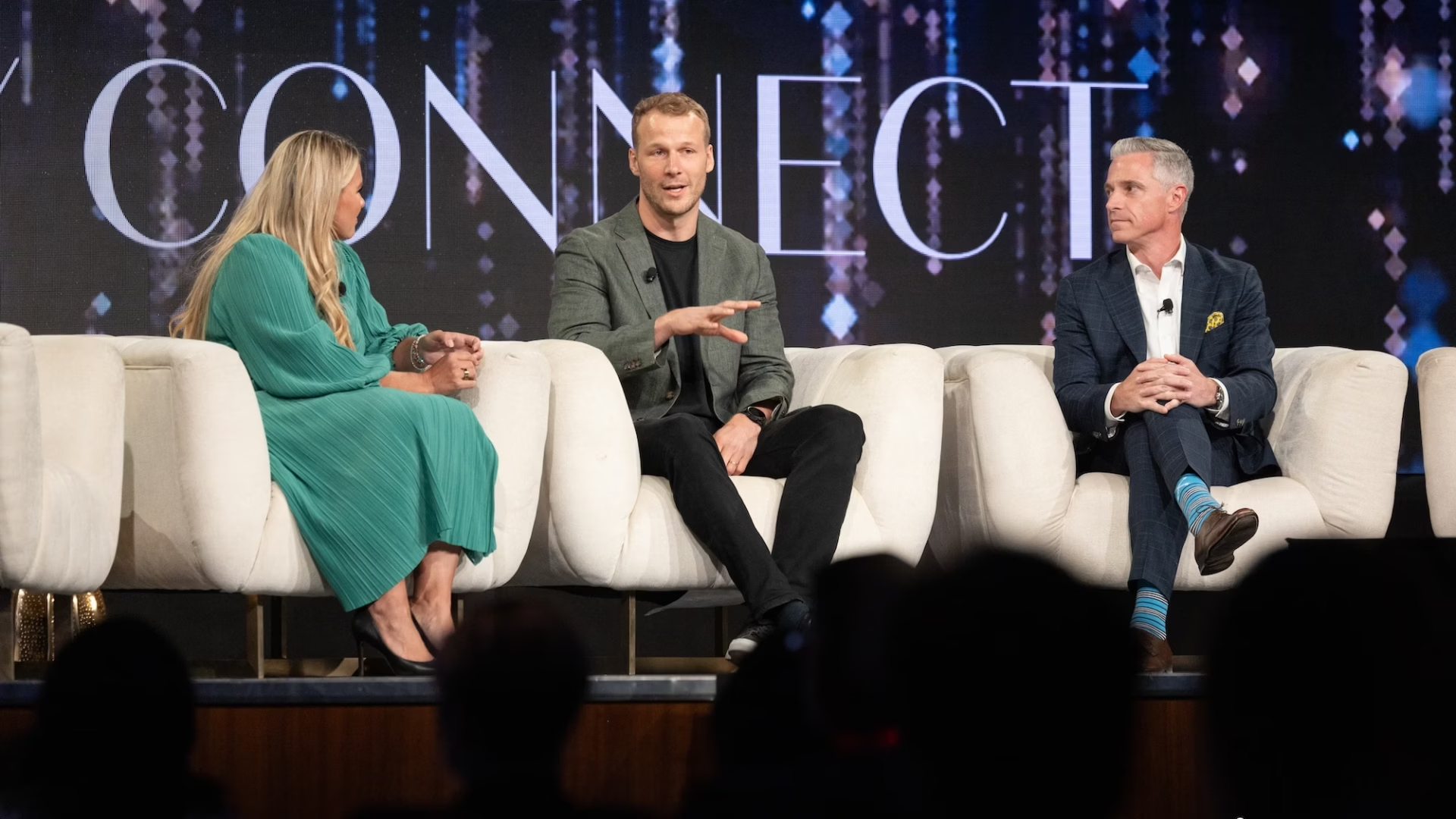
The message at Inman Connect Las Vegas was blunt: AI is no longer a novelty for early movers. It is the baseline. During the panel “Demystifying AI In Luxury Deals,” Kevin Van Eck, President of Affiliate Strategy at Christie’s International Real Estate, framed the stakes in a single sentence: “You’re not going to be replaced by AI, but you’re going to be replaced by others in this room who know how to use it.”
The data backs him up. Just three years ago, only 5% of real estate companies were testing AI. In 2026, that figure has reached 90% (World Economic Forum, 2026). This is not a slow adoption curve. It is a market-wide shift that has already sorted agents into two groups: those building AI into their daily operations and those watching their competitors do it.

Why this cycle is different from every previous one
Malte Kramer, CEO of Luxury Presence (the publisher of this article) and a co-panelist with Van Eck, drew a sharp distinction between AI and earlier waves of real estate technology. Previous tools like e-signatures and search portals changed specific layers of the transaction. AI changes all of them.
“This innovation cycle is fundamentally different from previous innovation cycles,” Kramer said. “AI affects every part of the value chain, from how homes are designed and built to how they are marketed and sold, and even how the software used to sell them is developed. Everything is becoming more efficient.”
At the agent level, that efficiency is already measurable. An RPR survey found that 82% of real estate agents now use AI, primarily for writing and marketing tasks, with time savings as the most cited benefit (HousingWire, 2026). The shift is moving from pilot projects to full-scale integration across brokerages of every size (The Voice of SF, 2026).
What agents should do now
While earlier discussions highlighted anxiety around AI, Inman attendees in 2024 seemed to grasp the opportunity. Kramer reflected this in an interview after his panel: “It feels like for the first time, real estate is an industry of early adopters.”
In 2026, the use of artificial intelligence in real estate is shifting from efficiency to growth (tech.realtor, 2026). Agents who treat AI as a marketing and operations layer, not just a writing shortcut, are the ones pulling ahead.
| AI adoption level | Typical agent behavior | Competitive position in 2026 |
| Not using AI | Manual content creation, inconsistent follow-up, no marketing system | Losing market share to peers who produce more content and respond faster |
| Using AI for writing only | Drafting listing descriptions and social captions with AI tools | Keeping pace but missing gains in lead nurture, SEO, and paid advertising |
| AI across the marketing stack | Content, social media, SEO, paid ads, and lead follow-up all running through an AI-assisted system | Generating leads and maintaining brand presence while saving 10+ hours per week |
Action step: Audit three workflow tasks you handle manually this week and identify which can be handled through AI-assisted marketing. Start with content creation and lead follow-up, the two areas where agents report the largest time savings.
2. Why relationships still outperform algorithms
The case for being a “stalker”
Adopting new technology is one clear way to stay competitive. Leaning into your humanity is the other. No one made that case more memorably than Glennda Baker, a Georgia-based broker with more than 500,000 followers on Instagram.
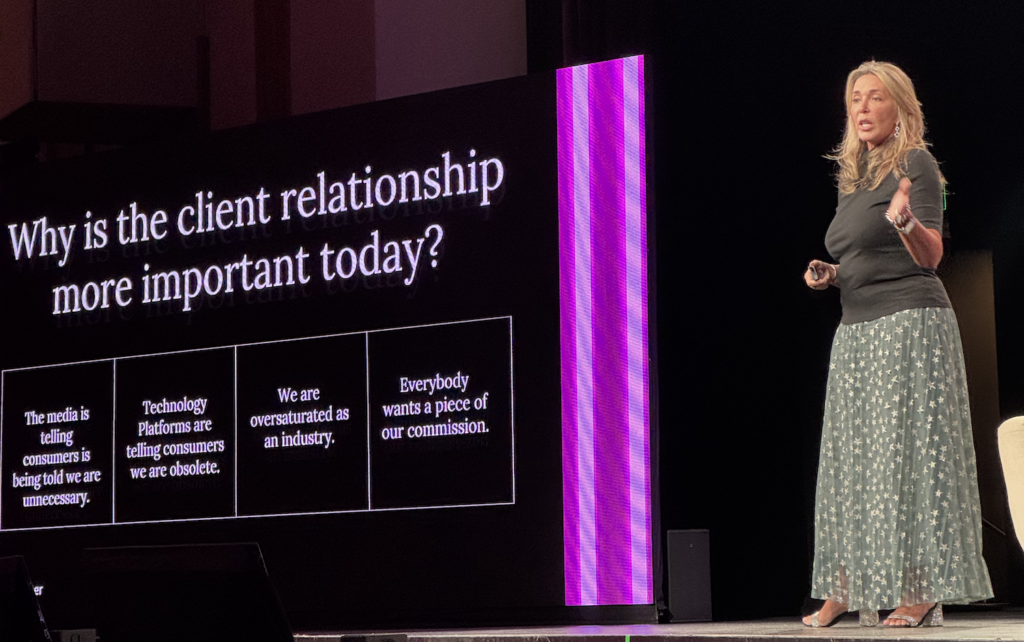
In her session, “Building a One-of-a-Kind Brand Experience,” Baker noted that the industry is oversaturated. Many tech companies are eager to slice commissions or cut agents out entirely. “That’s why it’s crucial to build strong relationships with your clients, so you’re not easily replaceable and they don’t forget about you,” she said.
Her advice for the best way to do that? “It’s okay to be a stalker.” Baker researches clients’ significant life events online, uses Facebook’s birthday feature, and proactively seeks out ways to connect before clients ever think to call another agent.
Offline touchpoints that build referral loyalty
Baker takes the same approach in person. She hosts “coffee and comps” every week, inviting neighbors to view her new listings and receive on-site home valuations. She also runs “eight at eight,” a dinner event where she hires a private chef to cook in her home. She invites three couples she believes would connect well, turning a meal into a relationship-building engine.
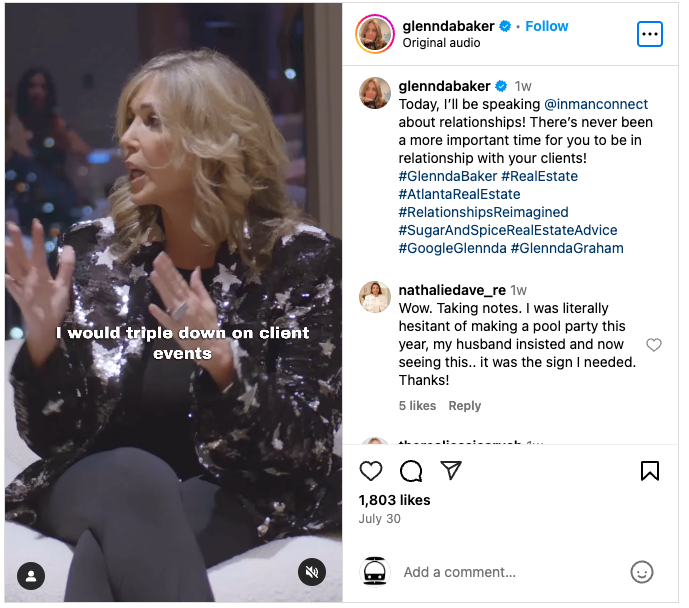
Baker also highlighted the value of thoughtful, personalized closing gifts. She shared an example of a client who so cherished the custom cake she had made that they refused to let anyone eat it. That kind of emotional imprint is what keeps a client from ever Googling “real estate agent near me” again.
“The most successful agents utilizing saved search and property alerts are using it to kickstart conversations.”
— Ben Belack, Real Estate Agent
Baker’s philosophy maps directly onto the data: in an industry where referrals and repeat business still drive the majority of transactions, the agents who invest in knowing their clients deeply are the ones who earn those calls. Consistent, genuine engagement is not a soft skill. It is a retention strategy.
Action step: Map out one repeatable touchpoint plan for your top 25 contacts: a birthday acknowledgment, a quarterly check-in, and one event invitation per year. Then connect that plan to a relationship management system that tracks every interaction so nothing falls through the cracks.
3. Branding is no longer optional after the NAR settlement
The settlement changed the rules for buyer’s agents
The days of stumbling into success without a clear brand and marketing strategy are over. The NAR settlement, which took effect on August 17, 2024, requires buyer’s agents to secure signed representation agreements before showing homes (National Association of Realtors, 2024). That means every buyer’s agent now needs to demonstrate their value before the first showing, not after.

During the session “How to Future-Proof Your Brand,” Kevin Knight, cofounder of real estate marketing agency Upgrade, put the question directly to the audience: “The modern consumer wants a different package. Are we willing to change our ways and invest in the future, or are we going to keep milking the way we’ve been doing things forever until it runs out?”
Why brand inertia is more expensive than brand investment
Many agents know they should invest in a brand book, but they resist the time, energy, and cost. Knight illustrated the danger of that resistance with a story from his work with Procter & Gamble on the Dawn dishwashing liquid brand. The company knew its packaging needed a redesign to stop losing market share. But leadership told Knight: “We know it’s the packaging, but do you know how much it costs to retrofit the factories? It’s too expensive to change.”
The lesson is direct. The cost of changing your brand is real. The cost of not changing it is higher. In a post-settlement market, the agents who show up with a documented value proposition, a polished digital presence, and a consistent visual identity are the ones who win the signed agreement. Everyone else is competing on price alone.
What a differentiated brand looks like in 2026
A differentiated real estate brand in 2026 is not a logo and a tagline. It is a system: a website that communicates your market expertise within seconds, listing presentations that reflect your positioning, social content that reinforces your authority, and a clear answer to the question every buyer now asks: “Why should I sign with you?”
Action step: Pull your current bio, headshot, and listing presentation. Ask yourself: do these materials communicate a clear, differentiated value proposition to a buyer who has never met me? If the answer is no, start with a brand book and work outward from there.
Speakers mentioned
- Kevin Van Eck, President of Affiliate Strategy, Christie’s International Real Estate
- Malte Kramer, CEO, Luxury Presence (publisher of this article)
- Glennda Baker, Broker, Glennda Baker and Associates (Georgia)
- Kevin Knight, Cofounder, Upgrade (real estate marketing agency)

The signals from Inman Connect Las Vegas have only sharpened since 2024. AI fluency, relationship depth, and brand clarity are the three pillars separating agents who are growing from agents who are stalling. If you want to turn these insights into a plan built around your market and your goals, book a free strategy call with the Luxury Presence team.