
IDX real estate websites allow agents and brokers to display live MLS listings directly on their own site, turning a static online presence into an active property search destination. In 2026, IDX integration is the standard method for pulling listing data from your local Multiple Listing Service (MLS) and presenting it to buyers on your domain, rather than sending them to a third-party portal. If you are evaluating how to add IDX to a real estate website, or wondering whether the investment is worth it, this guide covers what IDX is, how it works, when it makes sense, and how to get it set up the right way.
Key takeaways
- IDX (Internet Data Exchange) is the policy framework and technology that lets agents display MLS listings on their own websites, with data that updates automatically as properties are listed or sold.
- Websites with IDX tools receive roughly four times as much traffic as websites without one, according to Luxury Presence internal data.
- IDX is a lead capture tool first and an SEO tool second. It works best when paired with strong original content, SEO best practices, and a clear marketing strategy.
- The technical standard powering most MLS data feeds in 2026 is the RESO Web API, which has largely replaced the older RETS feed.
- Better Homes and Gardens Real Estate Lifestyles Realty generated approximately 10 organic leads in its first week after launching a site with proper IDX integration, ending a 13-year stretch without a single website lead. (Source: Luxury Presence Case Study: Better Homes and Gardens Real Estate Lifestyles Realty, 2024)
What is IDX and how does it work in 2026?
IDX stands for Internet Data Exchange. It is the set of policies, standards, and technology that governs how MLS listing data can be displayed on individual agent and broker websites. When you hear someone refer to an “IDX website” or “IDX integration,” they are describing the data connection between a real estate website and one or more MLS databases.
Here is how the process works at a high level: your website connects to the MLS through a data feed (in 2026, most MLS organizations use the RESO Web API standard). That feed pulls listing information, including photos, pricing, property details, and status, directly into your site. Listings appear and disappear automatically as they are added to or removed from the MLS, so your visitors always see current inventory.
The business case is straightforward. Roughly 97% of homebuyers use the internet during their home search (NAR, 2024). An IDX website for real estate lets you capture that search activity on your own domain, rather than ceding it to portals like Zillow, Realtor.com, or Trulia.
One distinction worth understanding: IDX only works on individual agent or brokerage websites. The major portals do not use IDX. Instead, they receive listing data through brokerage syndication agreements, which is why you sometimes see outdated or inaccurate information on those sites. When a buyer searches on your IDX-powered site, the data comes straight from the MLS and refreshes on a set schedule, often multiple times per day.
Is IDX the right move for your website?
If you have ambitions to grow your visibility in your market and generate leads online, an IDX tool is going to be a key part of your website strategy. The data backs this up: Luxury Presence internal tracking shows that websites with an IDX tool receive about four times as much traffic as websites without one. That traffic gap alone makes IDX worth serious consideration for any agent or broker who wants their site to be more than a digital business card.
That said, IDX is a lead capture mechanism, not a magic traffic source. Installing IDX on a site with no content, no marketing, and no visitors will not suddenly fill your pipeline. IDX works best when it sits on top of a site that already has (or is building toward) strong original content, a clear SEO strategy, and consistent marketing activity driving visitors to the domain.
Think of it this way: IDX gives visitors a reason to stay on your site and register. Your content and marketing give them a reason to arrive in the first place. The combination is what produces leads.
When IDX makes the most sense
- You are actively marketing your website through paid ads, social media, email, or content marketing, and you want to convert that traffic into registered leads.
- You serve a geographic area with enough inventory that a property search tool adds real value for buyers visiting your site.
- You want to keep buyers on your site instead of losing them to portals. As Tracy Tutor put it: “Because you’re sending people to your site, not somewhere like Zillow, you create the opportunity to turn any traffic into leads.”
- You plan to use saved searches and property alerts to nurture leads over time. Ben Belack has noted that the most successful agents using saved search and property alerts are using them to kickstart conversations with prospects.
When you might wait
If you are still in the earliest stages of building your business and your website does not yet have meaningful traffic, you can prioritize content and marketing first and add IDX integration once your site has a foundation of visitors to convert. IDX adds the most value when there is already an audience engaging with your site.
IDX integration is not just about displaying listings. It is about pairing those listings with the right site structure, neighborhood content, and lead generation tools so that visitors take action.
How to integrate IDX into a real estate website
If you have already built out your website design, content, and marketing foundation, you are ready to add IDX. The integration process varies depending on whether you are working with a vendor or doing it yourself, but the core steps follow the same sequence.
- Contact your local MLS to learn their IDX policies. The National Association of Realtors sets national IDX guidelines, but each MLS has its own specific rules around data display, attribution requirements, and refresh intervals. Confirm what is required before you start.
- Confirm which data standard your MLS supports. Most MLS organizations in 2026 use the RESO Web API rather than the older RETS feed. Some still support both. Ask your MLS which standard is active and request the appropriate login credentials.
- Choose your integration method. You have two main options:
Vendor-managed IDX: A website platform like Luxury Presence handles the MLS connection, data mapping, and display for you. This is the fastest path and the one most agents choose.
Custom build: You or your developer connect directly to the RESO Web API (or RETS feed), map every data field manually, and build the search interface from scratch. This offers the most control but demands significant development resources. - Map the MLS data fields to your website. Each listing in the MLS contains dozens of fields: price, address, bedrooms, bathrooms, square footage, photos, status, and more. These fields need to be mapped to the corresponding display fields on your site. With a vendor, this is handled for you. With a custom build, you will need to check each import field on the data server and connect it to the matching field on your website.
- Add lead capture forms and calls to action. This is where IDX becomes a lead management tool. Require registration for saved searches, set up property alert sign-ups, and make sure your contact forms are visible on every listing page. Prospects should be able to reach you without hunting for a button.
- Run your first listing import. The initial data pull can take anywhere from a few minutes (with a modern API) to several hours (with an older RETS feed), depending on the size of the MLS and the number of active listings in your area.
- Verify the data. Once the import is complete, review the listings on your site. Check that photos display correctly, prices are accurate, addresses are formatted properly, and status labels (active, pending, sold) match the MLS. Have a second person review as well.
- Set up automatic sync. Configure your system to pull updated data from the MLS on a regular schedule, typically every 15 minutes to every few hours. This ensures new listings appear quickly and sold properties are removed.
- Configure your property search display. Decide where and how the search tool appears on your site: a dedicated search page, a homepage search bar, filtered neighborhood pages, or all of the above. The search experience should be fast, intuitive for buyers, and consistent with your site’s design.
This process is more technical than it may sound on paper. Even experienced agents rarely handle it alone. That is why the majority of agents and brokerages work with a website platform that manages IDX integration as part of the site build, removing the need to deal with API credentials, field mapping, and cron jobs directly.
Avoid the iFrame shortcut
Some agents try to reduce setup costs by using an iFrame (also called the “framing method”) to embed another site’s IDX search on their own domain. This is a short-term fix that creates long-term problems. Search engines treat iFrame content as belonging to the source domain, not yours, which means the listings do not contribute to your site’s search visibility. If you are investing in IDX, do it properly with a direct data feed.
What to look for in an IDX solution in 2026
Not all IDX integrations are created equal. The quality of the search experience, the speed of data updates, and the lead capture tools built around the listings vary widely between providers. Here is a comparison of the factors that matter most when evaluating an IDX solution for your real estate website.
| Feature | Why it matters | What to ask your provider |
| Data refresh frequency | Stale listings frustrate buyers and damage credibility. Faster refresh means more accurate data on your site. | How often does the feed sync with the MLS? Is it every 15 minutes, hourly, or daily? |
| Multi-MLS support | If you serve areas covered by more than one MLS, your IDX tool needs to pull from all of them and display results in a single search. | How many MLS feeds can the platform support? Is there an additional cost per MLS? |
| Map-based search | Buyers search by location. A map-based interface lets them draw boundaries, zoom into neighborhoods, and browse visually. | Does the search include an interactive map? Can buyers draw custom search areas? |
| Saved searches and alerts | Property alerts keep leads engaged over weeks or months and give you a reason to follow up. | Can visitors save searches and receive automatic email alerts for new matches? |
| Lead registration controls | You need to balance user experience with lead capture. Forced registration too early drives visitors away; too late means you never capture their information. | Can I control when and how registration prompts appear? Can I A/B test different triggers? |
| Mobile performance | The majority of property searches in 2026 happen on mobile devices. A slow or clunky mobile search experience costs you leads. | Is the search interface built for mobile-first browsing? What are the page load times on mobile? |
| SEO-friendly listing pages | If listing pages are rendered in a way that search engines can crawl and index, they can contribute to your site’s organic visibility. | Are individual listing pages server-rendered with unique URLs? Can I add custom content to listing or neighborhood pages? |
Case study: From zero leads to 10 in one week
Better Homes and Gardens Real Estate Lifestyles Realty spent 13 years with a website that never generated a single lead. The brokerage’s marketing director, Holly Burt, described the problem directly: “We ran into a whole slew of problems, legalities, the plugins not being able to filter, so we basically had no proper property search function. We would have been stuck with that if we hadn’t found out about Luxury Presence.”
The brokerage launched a new site on the Luxury Presence platform with full multi-MLS search capability. The results were immediate:
- 10 organic leads in the first week after launch, from a site that had produced zero leads in over a decade.
- 57% site engagement rate within the first four months.
- 187 impressions for “houses for sale near me” searches in the first month of the new site going live.
The difference was not just having IDX on the site. It was having IDX that actually worked: fast search, accurate filtering, and a design that made visitors want to register and explore. That combination of a well-built property search, strong content, and a site designed for conversion is what separates an IDX website that generates leads from one that simply displays listings. (Source: Luxury Presence Case Study: Better Homes and Gardens Real Estate Lifestyles Realty, 2024)
That level of control matters. When your IDX integration is managed well, you can adjust how listings display, update lead capture settings, and make changes to your site without waiting on a developer or submitting a support ticket every time something needs to shift.
IDX real estate website example
Jade Mills Estates is a strong example of IDX done well. The site opens with a curated display of active listings in a magazine-style layout, immediately showing visitors that this is a site with live, searchable inventory. A prominent search bar lets buyers filter by location, property type, and price range. Below the search, visitors can browse carefully organized categories spanning luxury homes and specific communities.
What makes this site effective is not just the presence of IDX, but how the listings are woven into the overall site experience. The property search feels like a natural part of the site rather than a bolted-on widget. Neighborhood pages, agent branding, and listing detail pages all work together to keep visitors engaged and moving toward a contact form or saved search registration.
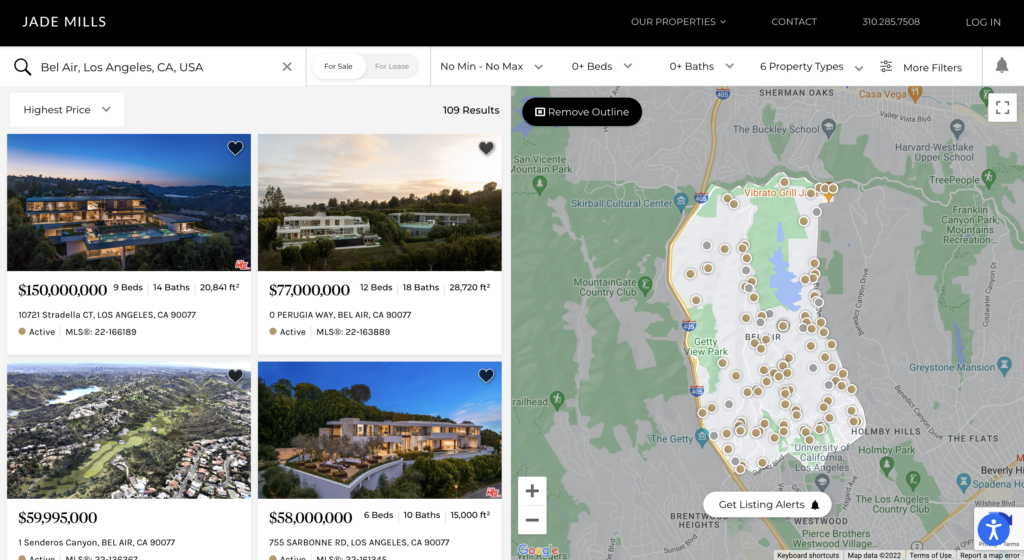
Source: jademillsestates.com
Making IDX Work for Your Real Estate Website
IDX can turn a real estate website from a simple online brochure into a high-performing property search destination, but only when it is paired with the right content, search experience, and lead capture strategy. The most effective setups keep listings accurate, make it easy for buyers to browse and register, and support the site with enough traffic to convert. When those pieces come together, IDX becomes a practical tool for both visibility and lead generation.
FAQs
Expert website design services
Every day, Luxury Presence creates and manages real estate websites for some of the biggest agents, teams, and brokerages in the country. Learn how we can transform your online presence.

About the author

Marketing Manager
Kate Evans is a content marketing strategist at Luxury Presence, the leading growth platform for high-performing real estate professionals. She develops data-driven editorial content and supports SEO strategy and brand voice frameworks that help agents attract qualified leads and establish market authority. Her published work covers topics including CRM strategy, social media marketing, and digital growth, supporting thousands of agents in scaling their businesses through modern marketing.