

A general-purpose content management system (CMS) can be a strong option for many use cases, but it is not the best CMS for a real estate website in 2026 if your goal is to generate leads, rank in local search, and maintain a site that reflects the credibility buyers and sellers expect. For agents who want a simple blog or branding page, a general website platform can work. For agents who need Internet Data Exchange (IDX) integration, search engine optimization (SEO), and a site that converts visitors into clients, a purpose-built real estate platform will outperform a DIY website build in almost every measurable category. This guide walks through the real tradeoffs so you can make the right call for your business.
Key takeaways
- A widely used CMS powers a large share of the internet, but its open-source flexibility creates maintenance, security, and plugin-compatibility burdens that most agents do not have time to manage.
- IDX integration is the breaking point. Third-party IDX plugins on a general website platform frequently conflict with themes and other plugins, leaving agents without a functioning property search, which is the single most-used feature on any real estate website.
- DIY savings disappear fast. The upfront cost of a DIY site is low, but ongoing plugin fees, security monitoring, and time spent troubleshooting can exceed the cost of a professionally developed site within the first year.
- A purpose-built real estate CMS removes the guesswork. Platforms designed specifically for agents handle IDX, lead capture, and SEO natively, without requiring you to research, install, and maintain dozens of separate plugins.
- Your website is your highest-converting marketing asset. Choosing the right platform is not a technical decision. It is a business decision that directly affects your pipeline
DIYing your real estate website: smart move or a costly mistake?
Building your own real estate website is appealing because the barrier to entry looks low. Register a domain, pick a theme, upload a headshot, and publish a few neighborhood pages. The problem is that the gap between “a website that exists” and “a website that generates business” is enormous. Before you decide whether a general CMS or another platform is the right choice for your real estate website, you need an honest look at the tradeoffs of doing it yourself.
Advantages of building your own site
- Lower upfront cost. A self-hosted website typically runs between $300 and $1,000 per year in hosting, theme, and basic plugin fees. That is a fraction of what a professionally developed real estate website costs at launch.
- Full creative control. You choose the color palette, the homepage layout, and the copy. No waiting on a designer to interpret your vision.
- Flexible scheduling. You work at your own pace. Need to swap out a hero image at 11 p.m.? You can do it without submitting a support ticket.
- Brand intimacy. Nobody knows your market positioning better than you do. When you build the site yourself, every page reflects your voice from the start.
Disadvantages of building your own site
- Time cost is real. Most agents spend 40 to 80 hours getting a DIY site to a launchable state, and that does not include ongoing content creation, plugin updates, or troubleshooting. Those are hours you are not spending on appointments, negotiations, or referral partnerships.
- The learning curve is steep. IDX integration, SEO configuration, lead capture forms, and Google Analytics 4 (GA4) tracking all require technical knowledge that goes well beyond choosing a theme. Researching and following tutorials for each of these tasks adds weeks to your timeline.
- Maintenance never stops. Security patches, plugin updates, changes to GA4 reporting standards, and new SEO requirements from Google all demand regular attention. Fall behind, and your site becomes a liability instead of an asset.
- Technical support is limited. Most hosting providers and theme developers offer basic support, but they will not debug a conflict between your IDX plugin and your contact form plugin. That is on you.
The decision comes down to whether your time is better spent building and maintaining a website or doing the work that directly produces revenue. If you decide to build it yourself, the next question is which CMS to use.
The truth about real estate websites in 2026
As of early 2026, one of the most widely used CMS options powers a large share of websites on the internet. For real estate agents evaluating the best website platform for their business, a general-purpose CMS may deserve serious consideration, but its strengths and weaknesses look very different when you apply them to the specific demands of a real estate site.
Advantages of a general CMS for real estate websites
- Familiar editing interface. Some general CMS platforms started as blogging tools, and their content editors remain among the most approachable in the market. Agents with no coding experience can publish blog posts, update pages, and manage media without touching a line of code.
- Large plugin ecosystem. A major CMS plugin repository lists more than 59,000 plugins as of 2026, including plugins for IDX property search, mortgage calculators, and amortization tools. That breadth gives you options, though it also creates complexity (more on that below).
- Built-in SEO foundations. A flexible CMS can generate clean permalink structures, support meta tags natively, and integrate with popular SEO plugins. For agents who want to rank for local search terms, this is a meaningful starting point.
- Full site ownership. With a self-hosted website installation, you own your domain, your content, and your data. If you ever switch providers, your content comes with you.
Limitations of a general CMS for real estate websites
The advantages above are real, but they come with caveats that matter more for real estate sites than for most other industries.
- IDX plugin compatibility is fragile. Property search is the single most important feature on a real estate website, and on many general website platforms, it depends entirely on third-party IDX plugins. These plugins frequently conflict with themes, page builders, and other plugins, which can break your search functionality without warning.
Holly Burt, broker-owner of Better Homes and Gardens Real Estate Lifestyles Realty, experienced this firsthand after running a DIY website for more than a decade.
“We ran into a whole slew of problems, legalities, the plugins not being able to filter, so we basically had no proper property search function. We had the website for 13 years and never got a single lead from it.”
— Holly Burt, Broker-Owner, Better Homes and Gardens Real Estate Lifestyles Realty
After switching to a purpose-built real estate platform, Burt’s brokerage generated 10 leads in its first week and saw 57% engagement within four months (Source: Luxury Presence Case Study: BHGRE Lifestyles Realty, 2024). That gap between 13 years of zero leads and 10 leads in one week illustrates the cost of relying on plugins for a function that should be built into the platform itself.
- Security requires constant vigilance. Because some open-source CMS platforms are frequent targets for malware and brute-force attacks, keeping your site secure means staying on top of core updates, plugin patches, and hosting-level protections, tasks that most agents do not have time to manage consistently.
- Customization demands technical depth. A flexible CMS can offer enormous design flexibility, but accessing it requires working knowledge of PHP, CSS, child themes, and plugin architecture. Without that knowledge, you are limited to what your theme allows out of the box.
Comparing common website builders for real estate
Agents sometimes compare different website builders and CMS options. Here is how common approaches stack up on the criteria that matter most for a real estate agent website builder.
| Criteria | General CMS | Website Builder A | Website Builder B |
| IDX/MLS integration | Available via third-party plugins, but compatibility issues are common | No native IDX support, requires iFrame workarounds that hurt SEO | Limited IDX options, mostly through third-party apps with restricted functionality |
| SEO control | Strong, with full access to meta tags, schema markup, and URL structure | Moderate, with limited control over URL slugs and no access to server-level settings | Moderate, improved in recent years but still behind more customizable platforms for technical SEO |
| Design flexibility | Very high, but requires technical skill to access | High within templates, but rigid outside them | High with drag-and-drop editor, but can produce inconsistent code |
| Plugin/app ecosystem | 59,000+ plugins | Limited extensions marketplace | Growing app market, but fewer real estate-specific options |
| Ongoing maintenance | High, agent is responsible for updates, security, and backups | Low, platform handles hosting and security | Low, platform handles hosting and security |
| Best suited for | Agents with technical skills or a dedicated webmaster | Agents who want a simple branding site with no IDX | Agents who want a basic site with minimal maintenance |
The table makes the tradeoff clear. A flexible CMS gives you the most control, but it also gives you the most responsibility. Simpler website builders reduce the maintenance burden, but they lack the IDX and SEO capabilities that a real estate website needs to generate leads. None of these platforms were built specifically for real estate, and that gap shows up in the features that matter most.
How to evaluate the best CMS for a real estate website
Rather than asking “Is WordPress good enough?” the better question is: “What does my website need to do, and which platform does that natively?” Here is a three-point evaluation framework you can apply to any CMS or website platform before you commit.
1. Does it handle IDX/MLS integration natively?
If property search depends on a third-party plugin, you are one update away from a broken site. A platform built for real estate should include IDX search as a core feature, not an add-on. Native IDX means the search is designed to work with the site’s templates, lead capture, and SEO structure from the ground up.
2. Does the provider handle security and technical maintenance?
Every hour you spend patching plugins or monitoring for malware is an hour you are not spending with clients. The right platform should handle hosting, security updates, and performance monitoring on your behalf, so your site stays fast and protected without requiring your attention.
3. Does the platform produce measurable lead generation results?
A beautiful website that does not capture and route leads is a digital brochure. Look for built-in lead capture forms, customer relationship management (CRM) integrations that store and track leads and client interactions, and analytics that show you exactly where your leads are coming from and how they move through your site.
If a platform checks all three boxes natively, it will outperform a DIY site that depends on plugins for each of those functions. If it does not, you will spend your time assembling and maintaining a patchwork of tools instead of closing deals.
The benefits of a professionally developed real estate website in 2026
Working with a company that specializes in real estate website design means you get a site built around the way agents actually work. Instead of researching which IDX plugin is compatible with which theme, you get a platform where property search, lead capture, SEO, and analytics are already wired together.
Here is what to look for in a professional real estate website provider:
- Real estate-specific design. Templates and layouts built for property showcases, agent bios, neighborhood pages, and listing presentations, not generic business themes you have to retrofit.
- Native IDX and MLS connectivity. Property search that works with the site’s design and lead capture without requiring a separate plugin or iFrame embed.
- Ongoing technical support. A team that handles hosting, security, updates, and performance so you can focus on clients.
- Built-in analytics and CRM integration. Reporting that shows you which pages generate leads, which listings get the most views, and how visitors interact with your site, connected to your CRM so nothing falls through the cracks.
- Mobile-ready editing. The ability to update your site from your phone between showings, without needing to log into a desktop dashboard.
Work Tiefenbach, a veteran agent, summed up the difference after switching from a series of DIY and semi-custom sites to a professionally built platform.
“23 years in the Real Estate business and have spent thousands on agent websites. Luxury Presence is by far the easiest web designer to work with.”
— Work Tiefenbach, Real Estate Agent
That quote reflects a pattern: agents who have tried multiple approaches tend to land on a purpose-built platform because the total cost of ownership, measured in dollars and hours, is lower than maintaining a DIY site over time.
What Luxury Presence offers
Luxury Presence serves 30% of the WSJ RealTrends Top 100 agents and has powered more than 60 million annual website visitors across its client base. The company’s CMS, Presence, is built specifically for real estate and includes:
- Visual website editor with design controls. Adjust layouts, branding, and color schemes without writing code. The editor includes access to a library of high-quality images and media.
- Mobile editing. Make changes from your phone so you do not have to wait until you are at your desk to update a listing or publish a blog post.
- Smart analytics. See which pages drive traffic, where your leads come from, and how visitors interact with your site. Analytics integrate with Luxury Presence’s CRM, a relationship management system designed specifically for real estate agents to nurture leads and maintain client relationships with automated, agent-approved touchpoints.
- Luxury Presence’s SEO & GEO. Advances SEO and content creation that supports search and AI discovery at a pace and consistency that would take an agent more than 10 hours per week to replicate manually. Nothing publishes without your review and approval.
- Luxury Presence’s Social Media Management. Covers social media and listing creatives on the same disciplined cadence. Nothing publishes without your review and approval.
- Luxury Presence’s Paid Ad Management. Runs buyer and listing ad programs—including retargeting and seller-ready reporting—with pass-through transparency on spend. Paid work goes live only after your review and approval.
- Luxury Presence’s AI Lead Nurture. Adds conversational lead nurture so follow-up stays as consistent as the channels above while you focus on appointments. Responses stay agent-approved.
The difference between a DIY real estate website and a platform like Luxury Presence is not just design quality. It is the distance between assembling your own tools and using a system where everything already works together.
FAQs
Expert website design services
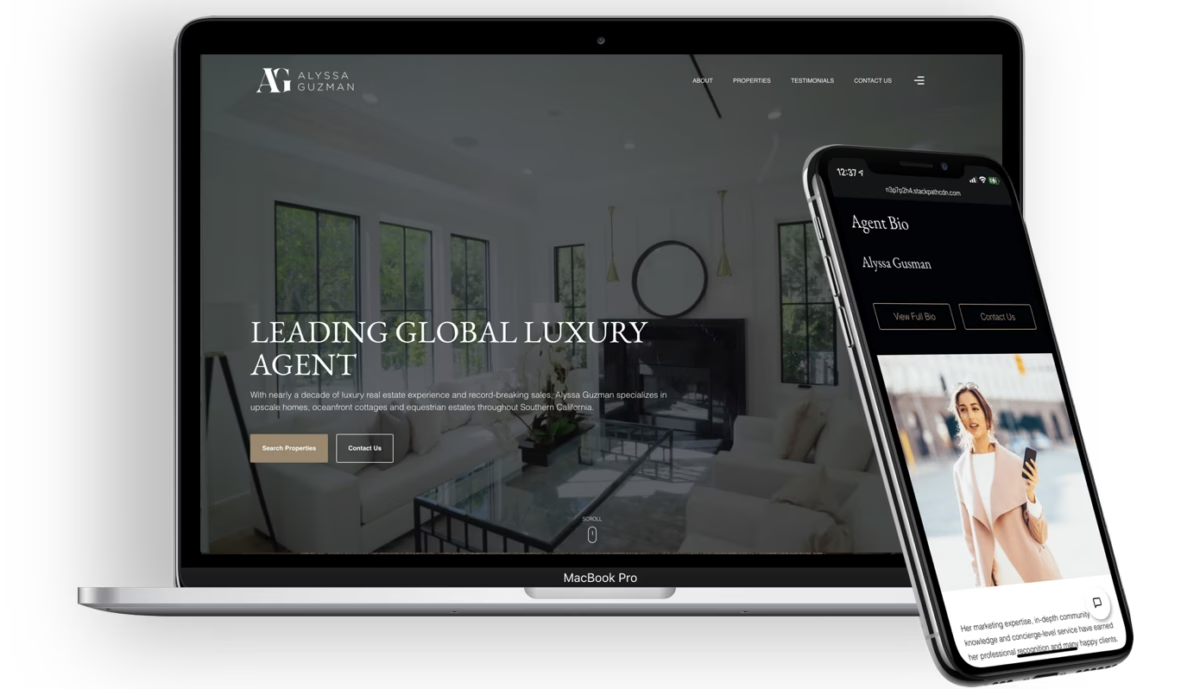
Every day, Luxury Presence creates and manages real estate websites for some of the biggest agents, teams, and brokerages in the country. Learn how we can transform your online presence.
Ready to grow?
Turn your content into your best lead source
See how Luxury Presence helps agents turn website visits into closed deals