

Real estate postcards that feature local market data do something most direct mail cannot: they give homeowners a reason to read, keep, and respond. In 2026, when digital inboxes are overflowing and social feeds move at light speed, a physical postcard with hard numbers about a neighbor’s sale price or the average days on market in a specific ZIP code cuts through the noise. This guide breaks down what real estate market reports are, why they belong on your postcards, and exactly how to turn raw data into a farming tool that builds trust and generates listing appointments.
Key takeaways
- A real estate market report postcard pairs local housing data (median price, days on market, inventory, list-to-sale ratio) with your personal brand to position you as the go-to agent in your farm area.
- Market data postcards outperform generic “just listed” or “just sold” mailers because they deliver something homeowners actually want: an answer to “What is my home worth right now?”
- In 2026, agents should refresh postcard data monthly using sources like their local multiple listing service (MLS) or other reputable housing data providers to keep figures accurate and credible.
- Every postcard needs a clear call to action, whether that is a QR code to a home valuation page, a phone number for a free consultation, or a link to a full digital market report on your website.
- Consistent mailing to a defined farm area over six to twelve months is what turns a postcard campaign from a one-off expense into a predictable source of leads.
What are real estate market reports in 2026?
A real estate market report is a periodic summary of local housing data, including median home prices, inventory levels, days on market, and sales volume, used by agents and consumers to assess current buying and selling conditions. These reports pull from your local MLS, county records, and national aggregators to give a snapshot of what is happening in a specific neighborhood, city, or ZIP code right now.
In 2026, a market report postcard for a competitive farm area might feature data on:
- Median home prices over the past three months
- Number of new listings versus sold homes
- Average days on the market
- Price per square foot
- List-to-sale-price ratio
For instance, as of early 2026, Redfin’s Data Center shows median sale prices, days on market, and active inventory figures updated monthly for hundreds of U.S. metro areas, giving agents a ready-made data source for their next postcard campaign (Redfin Data Center, 2026). When you put those numbers on a postcard and drop it in a homeowner’s mailbox, you are not just sending mail. You are proving you know their market better than anyone else.
Why market report postcards work for real estate agents
Including market data in your real estate marketing postcards serves two purposes: building credibility and capturing interest. Here is why that matters.
They establish you as the local authority
When you share current market data, you show homeowners that you track the numbers they care about. The National Association of Realtors (NAR) publishes local market reports precisely because buyers and sellers rely on data to evaluate agents and make decisions (NAR Local Market Reports, 2026). Putting that same caliber of data on your postcard signals that you operate at a high level.
They deliver content homeowners actually want
Generic postcards that announce “just listed” or “just sold” tell the recipient about your business. A market report postcard tells them about their home’s value. That shift in focus, from you to them, is what makes the piece worth reading. Homeowners keep postcards that answer the question “What is happening in my neighborhood?” and discard the ones that do not.
They create conversations, not just impressions
A postcard with a local median price or a year-over-year appreciation figure gives homeowners something specific to react to. When they see that homes in their ZIP code are selling 12% above last year’s median, they start wondering what their home could sell for. That curiosity leads to a phone call, a text, or a scan of the QR code on your card. Market data turns a passive mailer into an active conversation starter.
| Postcard type | Primary message | Typical homeowner response |
| Just listed / just sold | "Look what I did" | Glance and discard |
| Market report | "Here is what your home could be worth" | Read, keep, and consider calling |
| Holiday or seasonal | "Happy holidays from your agent" | Brief goodwill, low action |
| Home valuation offer | "Find out your home's value" | Moderate interest if no data is shown |
How to create real estate postcards with market data
Now that you understand why data-driven postcards outperform generic mailers, here is the step-by-step process for building one that gets results.
Step 1: Select relevant data for your farm area
Choose metrics that matter to the homeowners you are mailing. If you specialize in a luxury market, include the percentage of all-cash sales and price-per-square-foot trends. If your farm is a first-time buyer neighborhood, focus on median price and days on market.
These sources offer local market data you can pull directly into your postcards:
- Your local MLS — the most granular, neighborhood-level data available to licensed agents
- Keeping Current Matters — a real estate content platform that publishes monthly market commentary and ready-to-share graphics (keepingcurrentmatters.com)
- realtor.com Research — tracks listing trends, median prices, and days on market by metro area (realtor.com Research, 2026)
- U.S. Department of Housing and Urban Development (HUD) — publishes quarterly housing market commentary with regional economic context (HUD Quarterly Commentary, 2026)
Your local MLS and other housing data sources update their figures monthly. NAR and HUD publish quarterly reports. Match your postcard mailing cadence to the update frequency of your chosen source so recipients always receive current figures.
Step 2: Simplify the information
A postcard is roughly 4×6 or 6×9 inches. You do not have room for a full report. Pick three to five data points and present them with large, bold numbers, short labels, and a simple chart or icon set. Bullet points work. Paragraphs do not.
Before you print, ask someone outside the real estate industry to look at your postcard. If they can understand every number and what it means in under ten seconds, you have the right level of simplicity.
Chris’s point is worth remembering every time you design a postcard. The goal is not to dump data on a homeowner. The goal is to spark a reaction that leads to a conversation.
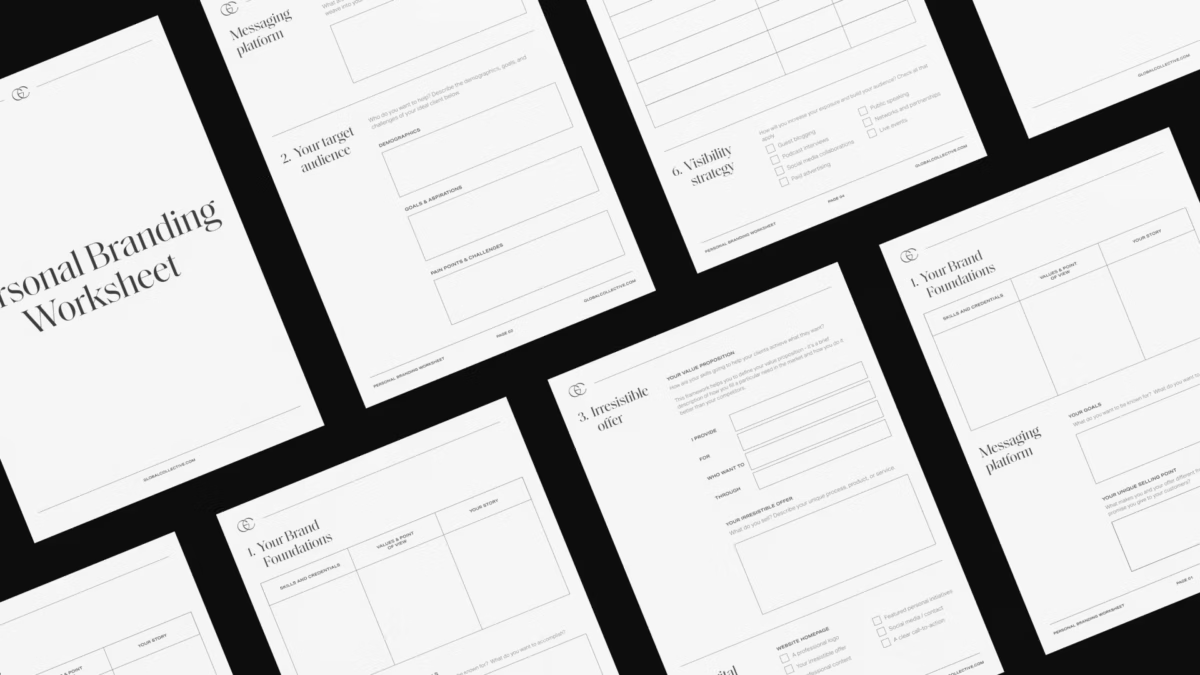
Step 3: Add your personal brand
Your postcard should clearly reflect your personal brand. Include your logo, your tagline, and a professional headshot. Add a one-line personal message that ties to the data, such as: “Your neighborhood appreciated 8% this year. Let’s talk about what that means for you.”
Keep your color palette, fonts, and layout consistent with your brand book. When a homeowner receives your postcard and then visits your real estate website, the visual connection should be immediate. That consistency builds recognition over time.
Rewrite your brand strategy
Our free resources can help you define your personal brand, level up your marketing plan, and reach your target audience.
Step 4: Include a clear call to action
Every postcard needs a strong call to action. Tell the recipient exactly what to do next. Here are three CTA examples that work well on market report postcards:
- “Curious about your home’s current value? Contact me for a detailed market analysis.”
- “See how 2026 market trends affect your home. Call today for a free consultation.”
- “Ready to invest in real estate? Scan this QR code to download my free homebuyer checklist.”
A QR code that links to a landing page on your website is one of the most trackable CTAs you can use. It lets you measure exactly how many recipients took action, which makes it easy to calculate your cost per lead.
Step 5: Use a professional print and mail service
To get your postcards professionally printed and mailed to your farm area, consider these services:
- Corefact — offers real estate postcard templates with built-in market data fields
- PostcardMania — provides design, printing, and mailing with campaign tracking
- ProspectsPLUS! — specializes in geo-farming postcards for real estate agents
If the templates from these providers do not match your brand, design your own in a program like Canva and upload the finished file to any of these mailing platforms. You can also find customizable postcard designs on Etsy from independent designers.
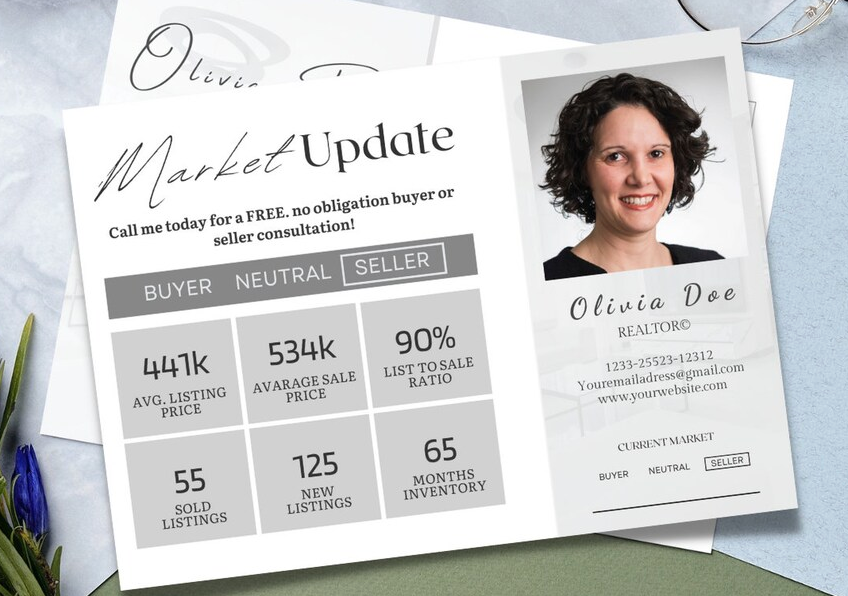
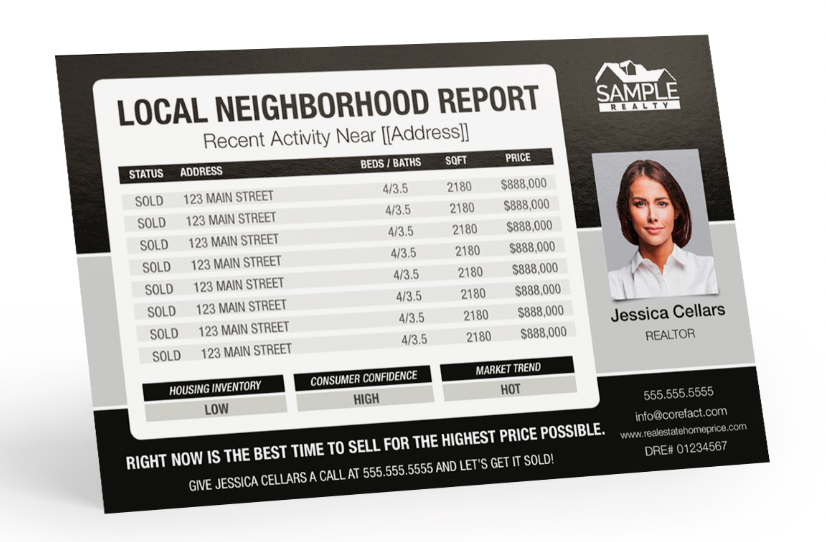
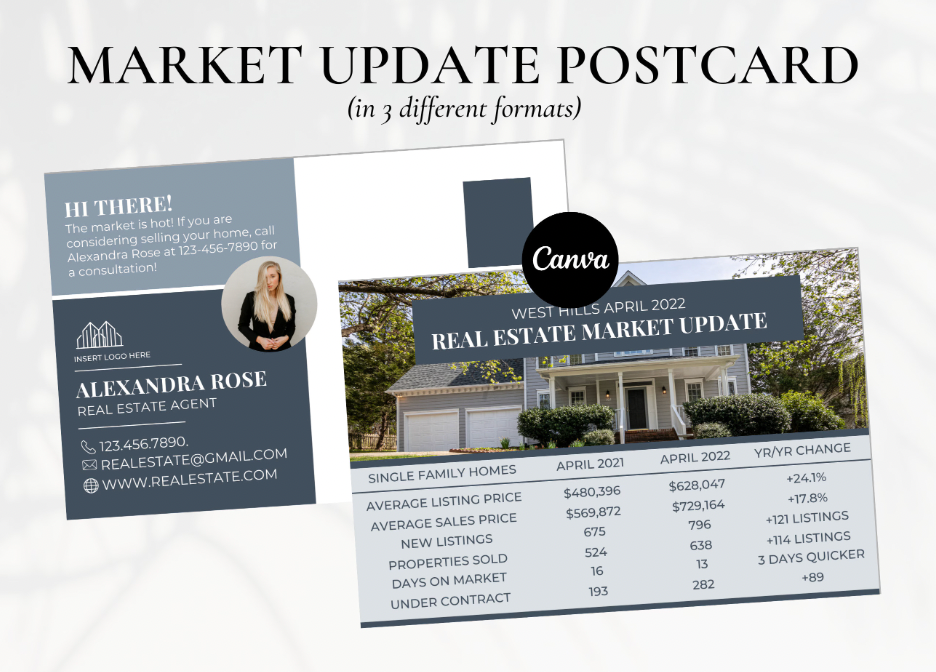
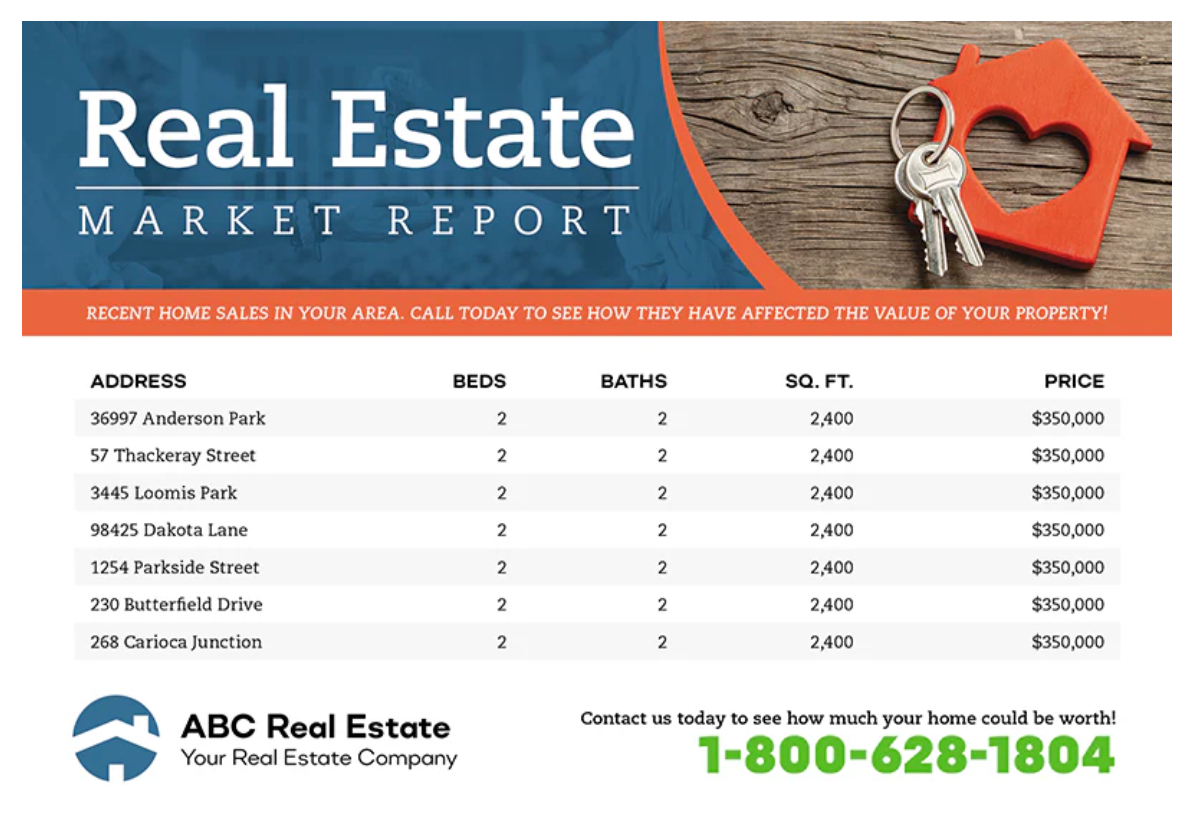
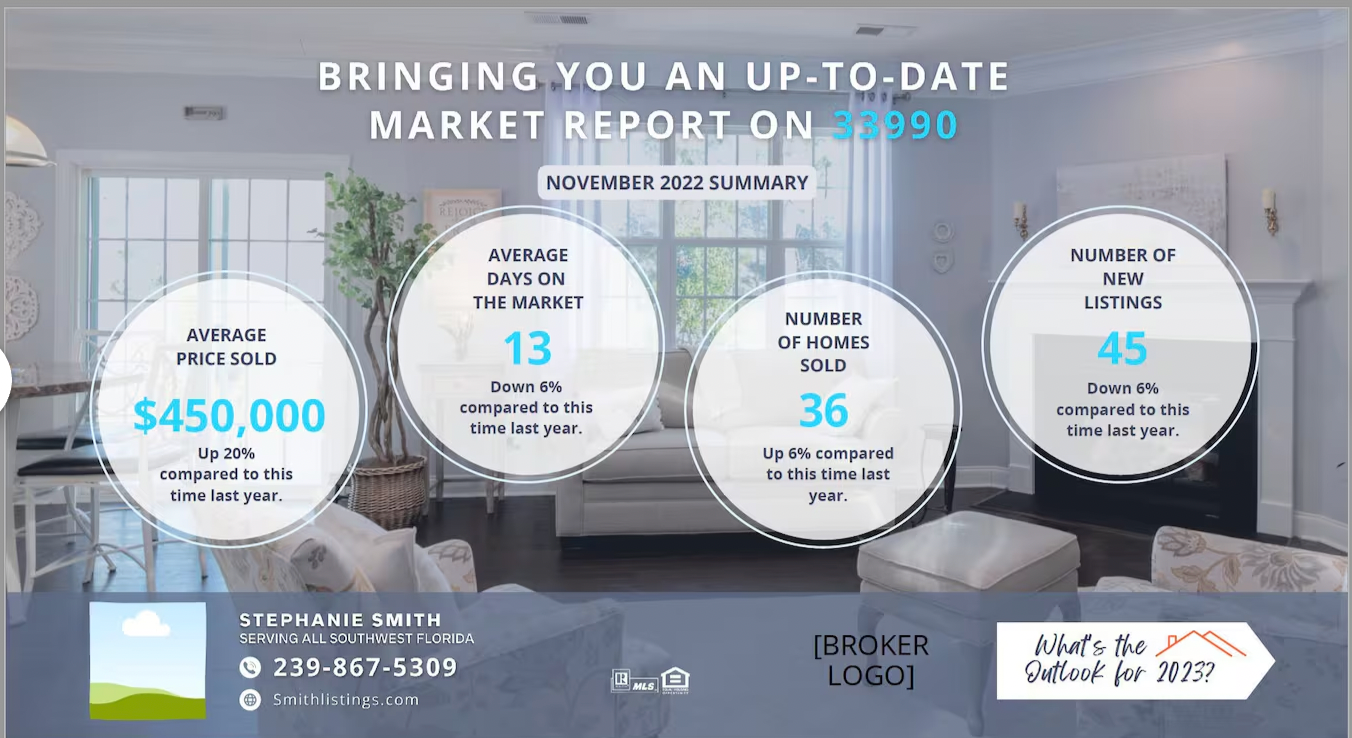
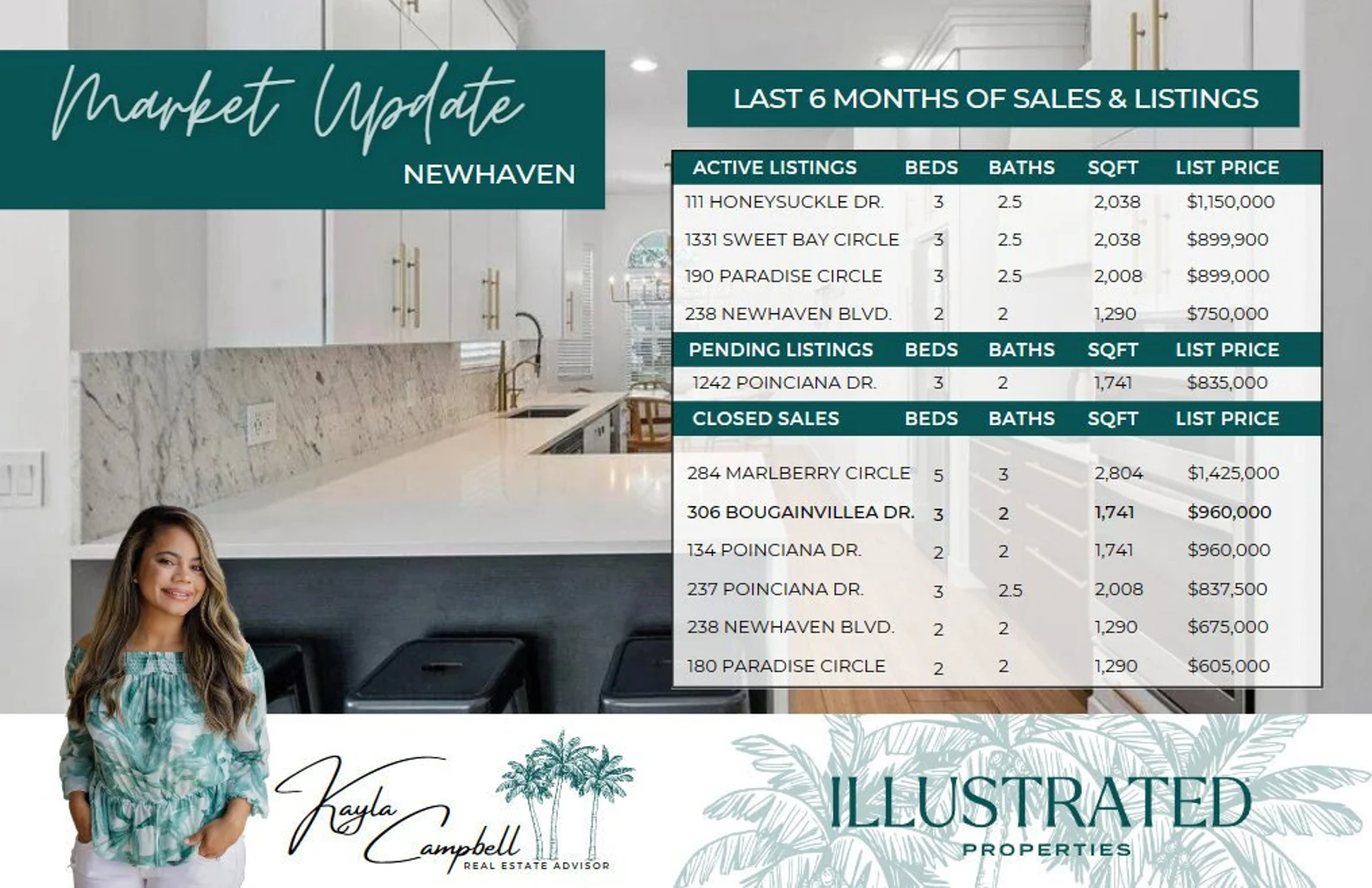
Example market report postcards
Below are six real-world postcard templates that show different ways to present market data. Notice how each one leads with numbers, keeps the layout clean, and includes a clear brand identity and CTA.
How geo-farming with real estate postcards builds long-term leads in 2026
A single postcard mailing is a marketing expense. A consistent monthly or quarterly mailing to the same farm area is a lead generation system. This approach is called geo-farming, and it is one of the most reliable ways to become the dominant agent in a neighborhood.
Here is how it works: you select a geographic farm of 200 to 500 homes, commit to mailing market report postcards on a regular schedule, and track your results over six to twelve months. The first few mailings build name recognition. By the fourth or fifth touch, homeowners start to associate your name with local market knowledge. By month eight or nine, you start getting calls.
The math is straightforward. If you mail 400 postcards per month at $0.75 each (printing plus postage), your monthly cost is $300. One listing appointment from that farm, even if it takes six months to arrive, more than covers the investment. The key is consistency. Agents who mail once or twice and stop never see the return. Agents who commit to twelve months almost always do.
In 2026, pairing your physical postcard campaign with a digital follow-up system makes the approach even stronger. When a homeowner scans your QR code or visits your website, you can capture their contact information and add them to your email marketing workflow. That way, your postcards drive offline awareness and your digital presence nurtures the lead until they are ready to act.
Turning Market Data into Listing Leads
Real estate market report postcards work because they give homeowners useful, local information they can trust and a clear reason to reach out. When you keep the data current, keep the design simple, and mail consistently to the same farm area, your postcards can build recognition, credibility, and real conversations over time. Add a strong call to action and a way to track responses, and your mailers become a repeatable source of listing opportunities.
Sources
- Redfin Data Center, 2026
- National Association of Realtors, Local Market Reports, 2026
- realtor.com Research, 2026
- U.S. Department of Housing and Urban Development, Quarterly Commentary, 2026
- Keeping Current Matters, 2026
FAQs
Ready to grow?
Turn your content into your best lead source
See how Luxury Presence helps agents turn website visits into closed deals