
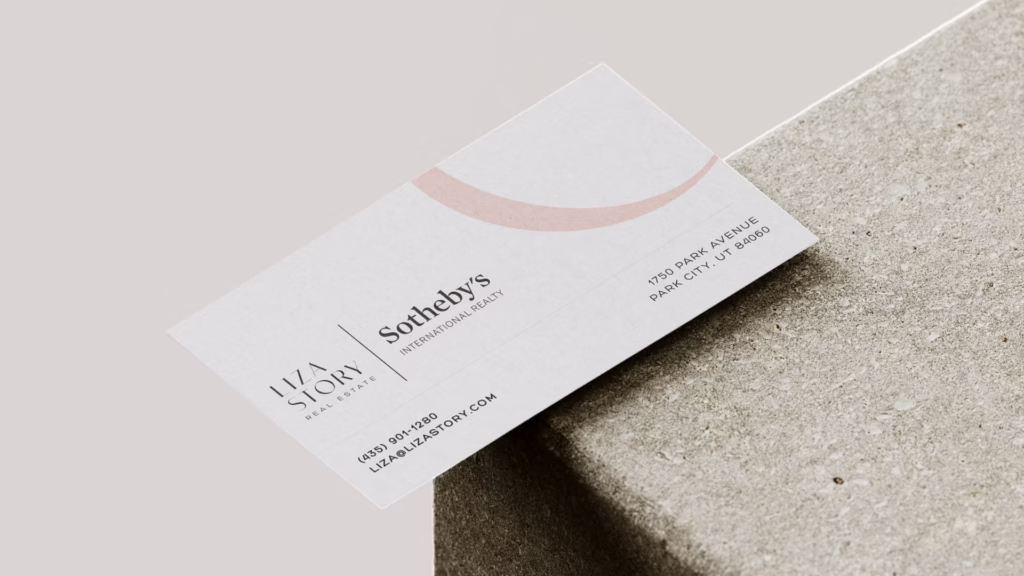
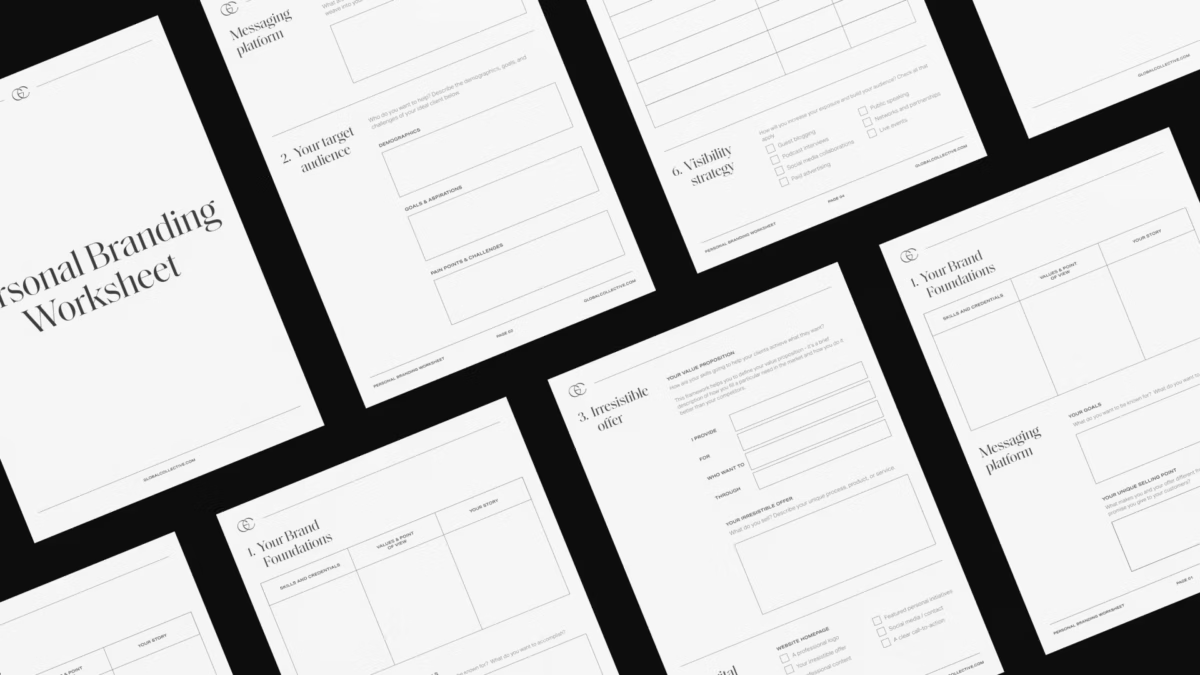
Real estate agent branding is the difference between being one of hundreds of agents in your market and being the one people remember, trust, and call first. In 2026, where every prospect Googles your name before picking up the phone, a strong personal brand is not a nice-to-have. It is the foundation of a business that attracts clients instead of chasing them. This guide walks you through what personal branding actually means for real estate professionals, why it matters more now than ever, and the exact steps to build a brand that reflects who you are and draws the right people to your door. Plus, you can download our free real estate branding worksheet to put every step into action.
Rewrite your brand strategy
Our free resources can help you define your personal brand, level up your marketing plan, and reach your target audience.
Key takeaways
- Your personal brand is not your logo or your brokerage name. It is the reputation and perception that clients, colleagues, and prospects carry about you before you ever speak.
- A clear brand attracts your ideal clients, builds trust faster, and generates more referral business over time.
- Building a brand follows a repeatable process: define your value proposition, know your audience, stay visually and verbally consistent, show up on social media, network in person, and refine as you grow.
- A simple personal brand statement template can give you a working brand message in minutes, not months.
- Consistency across your website, social profiles, and offline materials is what turns a brand idea into a brand experience.
What is personal branding in real estate?
Personal branding in real estate is the process of shaping how clients, prospects, and industry peers perceive you as a professional. It includes your values, your communication style, your visual identity, and the way you show up both online and offline. Think of it as the story people tell about you when you are not in the room.
A realtor brand identity goes deeper than colors and fonts. It answers three questions at once: Who do you serve? What do you stand for? And why should someone choose you over the dozens of other agents in the same zip code? When those answers are clear and consistent, your brand does the heavy lifting of building trust before you ever shake a hand or hop on a call.
In an industry built on relationships, personal branding for realtors is not vanity. It is a business system. A well-defined brand shortens the trust gap between “I found you online” and “I want to work with you.”
Why personal branding matters for realtors in 2026
The benefits of real estate branding go far beyond looking polished. A strong brand changes the way clients find you, evaluate you, and refer you. Here is how each benefit plays out in practice.
It builds trust before the first conversation
Trust is the single biggest factor in whether a prospect picks up the phone. In 2026, buyers and sellers research agents online long before making contact. When they find a consistent brand with clear messaging, a professional website, and visible social proof, they arrive at the first meeting already leaning in your direction. According to the 2025 Edelman Trust Barometer, 64% of consumers across industries say they will choose, recommend, or pay more for brands they trust (Edelman, 2025). That principle applies directly to how prospects evaluate individual agents.
It separates you from every other agent in your market
Most agents describe themselves the same way: hardworking, dedicated, knowledgeable. A brand strategy forces you to get specific. Maybe you specialize in relocating tech professionals. Maybe you are the agent who produces cinematic listing videos for every property. Maybe your deep roots in a particular neighborhood give you insight no newcomer can match. Real estate branding ideas like these turn a generic pitch into a memorable position.
It attracts the right clients to you
When your brand clearly communicates who you serve and how you work, the people who resonate with that message self-select. You spend less time qualifying leads and more time working with clients who are a genuine fit. Shannon Gillette, a Luxury Presence client, saw her team generate nearly 2,000 leads in nine months after launching a branded website that reflected her market expertise and visual identity (Source: Luxury Presence Case Study: Shannon Gillette, 2025). That volume of inbound interest did not come from cold calling. It came from a brand that attracted the right audience.
It drives referral business
Referrals remain one of the most reliable sources of new business in real estate. According to the National Association of Realtors’ 2024 Profile of Home Buyers and Sellers, 40% of sellers who used a real estate agent found that agent through a referral from a friend, neighbor, or relative (NAR, 2024). A strong brand makes you easier to refer. When a past client can say, “You need to call [your name], she’s the downtown condo specialist,” that specificity carries more weight than “I know a good agent.”
It opens doors for professional growth
Branding for real estate is not only about closing transactions. Agents with a visible, well-defined brand get invited to speak at events, contribute to media coverage, and form referral partnerships with agents in other markets. Your brand becomes a magnet for opportunity, not just for clients.
| Brand benefit | What it looks like without a brand | What it looks like with a strong brand |
| Trust | Prospects ask lots of qualifying questions on the first call | Prospects arrive pre-sold after reviewing your website and social profiles |
| Differentiation | You compete on commission rate or speed of response | You compete on expertise, niche, and reputation |
| Client fit | You take any lead that comes in | Inbound leads already match your ideal client profile |
| Referrals | Past clients say "I know an agent" | Past clients say "You need THE agent for [your niche]" |
| Growth | You hustle for every opportunity | Opportunities come to you through visibility and reputation |
What a strong brand looks like in action

It is one thing to talk about branding in theory. It is another to see the numbers. Shannon Gillette’s team had been doing strong work in their market, but their online presence did not reflect it. After partnering with Luxury Presence to build a branded website and run a coordinated digital marketing strategy, the results told a clear story: 2.6x more website traffic, a 91% lead reply rate, and a $4.3 million closed transaction that originated from their new site.
Shannon’s experience illustrates a pattern that holds true across markets in 2026: when your digital presence matches the quality of your service, prospects trust you faster and convert at higher rates. Your brand is not just what you say about yourself. It is what people experience when they encounter you online.
How to build a personal brand in real estate in 2026
Building a real estate personal brand is not about hiring a designer and picking colors (though that helps). It is about making a series of clear decisions about who you are, who you serve, and how you show up. Follow these six steps to create a brand that works for your business.
Step 1: Define your unique value proposition
Your brand starts with a single question: What do you do for your clients that they cannot easily get from someone else? The answer might be a deep specialization, a specific market niche, a distinctive service model, or a combination of all three. Identifying what makes you unique is the foundation of every branding decision that follows. Write it down in one or two sentences. If you cannot explain it simply, keep refining until you can.
Step 2: Understand your target audience
A brand that tries to speak to everyone ends up resonating with no one. Get specific about who your ideal clients are. Are they first-time buyers in a particular price range? Relocating executives? Downsizing empty nesters? Investors looking for multi-family properties? Once you know who you serve, you can shape your messaging tone, visual identity, and content strategy to speak directly to their needs and concerns.
Step 3: Create consistent branding across all platforms
Your brand should look and sound the same everywhere a prospect encounters you. That means your website, social media profiles, business cards, email signature, and marketing materials all share the same color palette, typography, headshot style, and voice.
Consider building a brand book that documents these choices in one place. A brand book acts as your single source of truth when you work with photographers, designers, or marketing partners. It keeps everyone aligned so your brand stays cohesive no matter who is creating content on your behalf.
Step 4: Build your social media presence
In 2026, social media algorithms on platforms like Instagram and LinkedIn increasingly favor consistent, niche-specific content. Agents who post regularly within a defined brand voice earn greater organic reach than those who post sporadically or off-topic. According to the Pew Research Center, roughly 70% of U.S. adults use at least one social media platform, and a growing share use those platforms to research professionals and businesses before making decisions (Pew Research Center, 2024).
Social media marketing for real estate works best when each platform serves a specific branding purpose:
- Instagram: Visual storytelling through listing photos, neighborhood highlights, behind-the-scenes reels, and client celebration posts.
- LinkedIn: Thought leadership, market commentary, and professional credibility for agents working with executives, investors, or commercial clients.
- Facebook: Community engagement, local event promotion, and longer-form posts that build rapport with a broad local audience.
- X (formerly Twitter): Quick market updates, industry commentary, and real-time engagement with other professionals.
Use hashtags and keywords that match your niche and market to increase discoverability. The goal is not to be everywhere. It is to be unmistakably you wherever you show up.
Step 5: Network and build relationships offline
Your brand does not live only on screens. In-person networking reinforces everything your digital presence communicates. Attend industry events, join local real estate associations, and participate in community activities where your target audience spends time. Every handshake, conversation, and follow-up note is a chance to make your brand tangible. The agents who build the strongest brands are the ones whose online and offline personas match perfectly.
Step 6: Revisit and refine your brand
Your brand is a living system, not a one-time project. Markets shift. Your expertise deepens. Your ideal client profile may change as your career grows. Set a recurring reminder, quarterly works well, to review your brand messaging, visual assets, and online profiles. Ask yourself: Does this still reflect who I am and who I serve? If the answer is no, update it. The best real estate brand strategy is one that evolves with you.
Personal brand statement template and consistency checklist
Before you download the full worksheet, here is a quick framework you can use right now to draft a working brand statement and audit your consistency.
Your personal brand statement (fill in the blanks)
“I help [target client type] in [market or geography] [achieve a specific outcome] through [your unique approach or differentiator].”
Example: “I help relocating tech professionals in Austin find their ideal neighborhood and close on a home within 30 days through hyper-local market data and a concierge-level moving plan.”
This is not a tagline for your business card. It is an internal compass that guides every piece of content you create, every conversation you have, and every decision about where to spend your marketing time.
Brand consistency checklist
Use this quick audit to see where your brand is aligned and where it needs work:
- Professional headshot is the same across your website, social profiles, and Google Business Profile.
- Brand colors and fonts are applied consistently on your website, email templates, and printed materials.
- Your messaging tone is defined in a brand book or style guide and followed by anyone creating content for you.
- Your Google Business Profile is claimed, complete, and updated with current photos and contact information.
- Your social media bios match the language and positioning on your website’s About page.
If you checked fewer than four of those boxes, the full branding worksheet will help you close the gaps. Download it using the link at the top of this article.
Building a Real Estate Brand That Lasts
A strong personal brand helps you stand out, build trust faster, and attract the kinds of clients who are the right fit for your business. When you define your value proposition, stay consistent across every platform, and keep refining your message over time, your brand becomes one of your most valuable business assets. The goal is not to be everywhere at once, but to be clear, recognizable, and memorable wherever prospects find you.
FAQs
Rewrite your brand strategy
Our free resources can help you define your personal brand, level up your marketing plan, and reach your target audience.
Ready to grow?
Turn your content into your best lead source
See how Luxury Presence helps agents turn website visits into closed deals