
Most real estate agents know they should follow up with leads. Far fewer have a system that actually does it. A drip campaign is a series of pre-written, automated emails sent on a set schedule to nurture leads over time, and in 2026, it remains one of the most reliable ways to stay in front of buyers and sellers without spending hours each week writing individual messages. The right email drip campaign templates give you a repeatable framework you can load into your CRM, personalize for each segment of your database, and let run in the background while you focus on appointments, showings, and closings. This guide gives you 16 copy-ready real estate drip campaign templates for buyers and sellers, a comparison framework for structuring each sequence, and a step-by-step playbook for making every send count.
Find It Fast
Key takeaways
- A drip campaign is a sequence of automated, pre-scheduled emails designed to nurture real estate leads from first contact through conversion.
- Segment your database into at least two tracks (buyers and sellers) so every message speaks directly to the recipient’s situation.
- A well-built three-email nurture sequence can produce a 43% buyer engagement boost and zero unsubscribes when the content is relevant and well-timed.
- Personalize beyond the first name: reference the lead’s preferred neighborhood, price range, or timeline in every email.
- Track open rates and click-through rates after every send, then adjust subject lines, send times, and content based on what the data tells you.
- Use seasonal check-ins and market updates to re-engage leads who have gone quiet without resorting to generic “just checking in” messages.
Why use real estate drip campaign templates in 2026
Email marketing drip campaigns let you communicate consistently without overwhelming your leads. Instead of relying on memory or sticky notes, you build a sequence once, load it into your CRM, and let it run. Every lead gets the right message at the right time, whether they signed up yesterday or six months ago.
Here is what a well-structured drip campaign does for your business:
- Consistency: Leads hear from you at regular, planned intervals instead of only when you remember to follow up.
- Efficiency: You write the sequence once and automate delivery, freeing hours each week for dollar-productive activities.
- Lead nurturing: Messages match the lead’s stage of readiness, so a first-time browser gets different content than someone who just attended an open house.
- Database growth: As your database grows, automation keeps communication manageable without adding headcount.
The numbers back this up. One automated three-email nurture sequence built for a top Chicago real estate professional produced a 43% buyer engagement boost, a 31% open rate on the first email, a 43% click-through rate on the second email, and zero unsubscribes across the entire campaign (Source: Luxury Presence Case Study: Automated Lead Nurture Email Strategy, 2025). Those are not hypothetical projections. That is what happens when you send the right message, to the right person, at the right time.
Bali’s point is the one most agents miss. A single welcome email is not a drip campaign. The power of a drip sequence comes from sustained, value-driven contact that keeps you in the lead’s consideration set over weeks and months. The templates below give you that sustained structure, ready to personalize and deploy.
Buyer vs. seller drip campaigns: a side-by-side comparison
Before you start copying and pasting, understand that buyer leads and seller leads have different motivations, timelines, and objections. Your drip email templates need to reflect those differences from the first send. The table below breaks down how each campaign type should be structured.
| Campaign element | Buyer drip campaign | Seller drip campaign |
| Audience | Active home searchers, pre-approved buyers, open house attendees | Homeowners considering selling, FSBO leads, expired listing contacts |
| Primary goal | Convert to a represented buyer with a signed agreement | Win the listing appointment and secure a signed listing agreement |
| Recommended cadence | 8 emails over 3 to 6 months | 8 emails over 3 to 6 months |
| Key content themes | Homebuying process, new listings, pre-approval, financing, neighborhood guides, market updates | Home valuation, preparation tips, pricing strategy, agent value proposition, staging ROI, market updates |
| Primary objection to address | “I’m not ready yet” or “I’m just browsing” | “I can sell it myself” or “I want to wait for a better market” |
| Call to action focus | Schedule a buyer consultation or request a showing | Request a free home valuation or schedule a listing presentation |
Use this framework to guide your personalization decisions. A buyer in month one of their search needs education and encouragement. A seller sitting on the fence needs market data and proof that working with an agent nets a higher sale price. The templates that follow are organized by audience so you can build both tracks in a single afternoon.
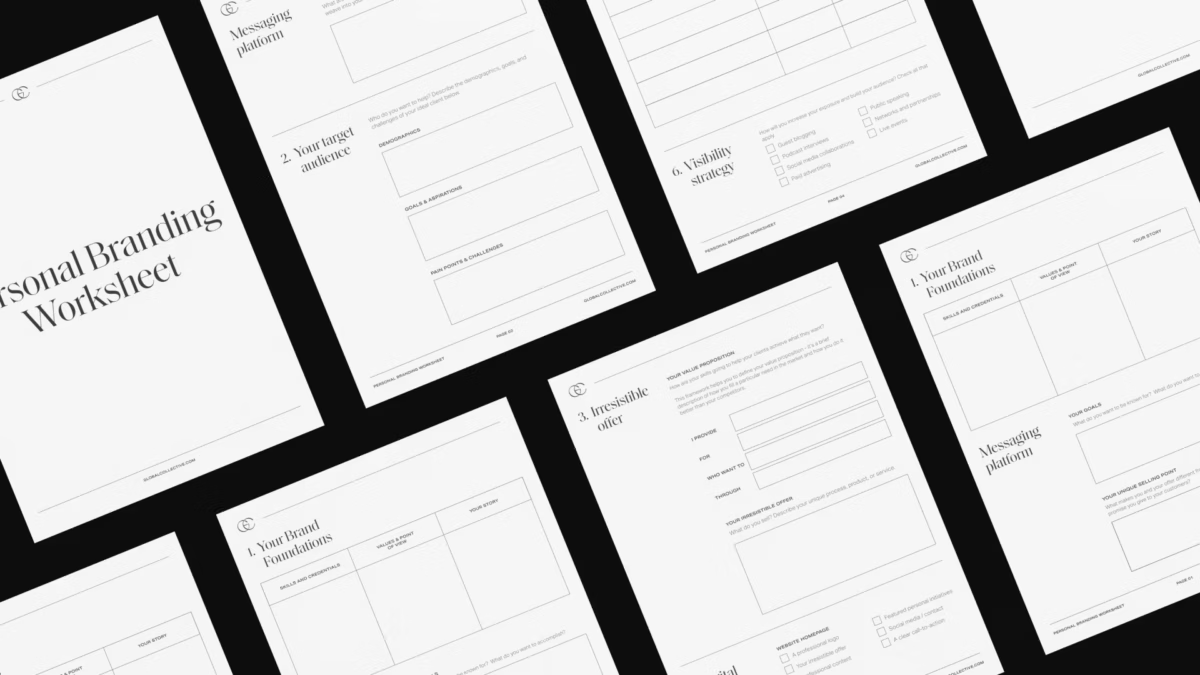
Need help defining the voice you use across these emails? Download the Luxury Presence personal brand worksheet to lock in your tone, messaging pillars, and visual identity before you write a single subject line.
Rewrite your brand strategy
Our free resources can help you define your personal brand, level up your marketing plan, and reach your target audience.
Real estate drip campaign templates for buyers
These buyer-focused real estate email templates help you nurture leads over time by delivering information that matches where they are in the home search. To get the most from each send, personalize every email with the prospect’s name, their preferred neighborhoods, their price range, and any details they shared during your first conversation.
Schedule these emails over three to six months to keep engagement high without flooding inboxes. Monitor open rates and replies after each send, and follow up by phone or text within 24 hours when someone responds. These campaigns are built to start conversations, not replace them.
Email 1: Introduction
Subject: Let’s find the right home for you
Hi {first name},
I’m {your name}, a local real estate agent who works with buyers in {area}. Whether you are just starting to browse or you are ready to schedule showings this weekend, I am here to walk you through every step.
I would love to hear what matters most to you in a home. Reply to this email or click here to book a quick call: {scheduling link}.
Looking forward to connecting,
{your name}
Email 2: The homebuying process, simplified
Subject: What to expect when buying a home
Hi {first name},
Buying a home is a big move, and it helps to know what is coming before you get started. Here is a quick overview of the four main stages:
1. Getting pre-approved for a mortgage so you know your budget
2. Finding the right home based on your needs and neighborhood preferences
3. Making an offer and negotiating terms
4. Closing the deal and moving inI walk my clients through each of these steps so nothing catches them off guard. Want to go through them together? Just reply with a time that works for you.
Best,
{your name}
Email 3: New listings in the area
Subject: New homes on the market in {area}
Hi {first name},
I just came across some new listings that line up with what you told me you are looking for:
1. {brief description and link to listing}
2. {brief description and link to listing}
3. {brief description and link to listing}Let me know if any of these catch your eye, or if you want to adjust your search criteria. I will keep sending you matches as they hit the market.
Talk soon,
{your name}
Email 4: The importance of getting pre-approved
Subject: Why pre-approval puts you ahead of other buyers
Hi {first name},
One of the smartest moves you can make right now is getting pre-approved for a mortgage. Pre-approval tells you exactly what you can afford, and it signals to sellers that you are a serious, qualified buyer. In a competitive market, that distinction can be the difference between winning and losing an offer.
If you need a lender recommendation, I work with several who specialize in helping first-time and move-up buyers. Let me know if you would like an introduction.
Best,
{your name}
Email 5: Market update and opportunities
Subject: What the 2026 market means for your home search
Hi {first name},
The real estate market shifts month to month, and I want to make sure you have the latest picture. Here is a quick snapshot of what is happening in {area} right now:
- {Interest rates update}
- {Inventory levels and what they mean for buyers}
- {Planned developments or zoning changes that could affect home values}
If you have questions about timing or want to talk through your options, I am happy to set up a call. Just reply with a time that works.
Best,
{your name}
Email 6: Seasonal greeting and check-in
Subject: {Seasonal greeting} from {your name}
Hi {first name},
Hope you are enjoying the {current season or holiday}. I wanted to check in and see how your home search is going. Are you still actively looking? Have your priorities shifted since we last spoke?
If you would like, I can send over updated listings or a neighborhood guide based on what is available right now. Just let me know.
Wishing you a great {season},
{your name}
Email 7: Common homebuying mistakes to avoid
Subject: Three homebuying mistakes that cost buyers money
Hi {first name},
Buying a home is exciting, but there are a few mistakes I see regularly that end up costing buyers real money and time. Here are three to watch for:
1. Skipping pre-approval: This slows you down when you find the right home and weakens your offer against competing buyers.
2. Ignoring additional costs: Property taxes, homeowners association (HOA) fees, insurance, and maintenance add up fast. Budget for them before you commit.
3. Waiting too long to make an offer: In a competitive market, hesitation means someone else writes the contract first.I help my clients avoid all three of these. If you have questions about any of them, reply to this email and I will walk you through it.
Best,
{your name}
Email 8: Special offer or incentive
Subject: A thank-you offer for buyers this {month}
Hi {first name},
I appreciate you staying in touch during your home search, and I wanted to share something with you. For buyers who close on a home with me in {month}, I am offering a {home warranty, closing cost credit, or discount on moving services}.
If you are ready to take the next step, let’s connect. Reply to this email with a good time to chat, or call me directly at {###-###-####}.
Looking forward to hearing from you,
{your name}
Nurture leads effortlessly with email templates
Our free e-book offers customizable resources and tips to keep your database engaged, move leads through the funnel, and close deals effectively.
Real estate drip campaign templates for sellers
Seller leads often take longer to convert than buyers because they are weighing more variables: timing, pricing, renovation costs, and whether they even need an agent. These drip campaign templates are designed to address each of those concerns over time, building your credibility with every send.
Personalize each email with local market data, your specific service offerings, and the prospect’s name. Schedule the sequence over three to six months, and respond within 24 hours whenever a prospect replies. The goal is to earn the listing appointment, and that starts with proving your value before you ever walk through their front door.
Email 1: Introduction
Subject: Thinking about selling? Let’s talk
Hi {first name},
I’m {your name}, a local real estate agent who helps homeowners in {area} sell for the strongest possible price. Whether you are actively planning to list or just curious about your options, I would love to be a resource for you.
Let’s talk about your goals and your timeline. Reply to this email or click here to schedule a quick call: {link}.
Looking forward to connecting,
{your name}
Email 2: Understanding your home’s value
Subject: How much is your home worth in the 2026 market?
Hi {first name},
One of the first steps in selling your home is understanding its current market value. Several factors affect what your home could sell for, including recent comparable sales, local buyer demand, and any improvements you have made since you purchased.
I would be happy to provide you with a free, no-obligation home valuation so you can see exactly where you stand. Interested? Just reply with your property address and I will get started.
Best,
{your name}
Email 3: Preparing your home for sale
Subject: Simple upgrades that can increase your sale price
Hi {first name},
Small, targeted upgrades can make a measurable difference in what buyers are willing to pay. According to Remodeling Magazine’s 2025 Cost vs. Value report, a minor kitchen remodel recoups roughly 96% of its cost at resale (Remodeling Magazine, 2025). Here are three of the highest-impact improvements I recommend to my sellers:
1. Declutter and depersonalize: Make every room feel spacious and easy for buyers to picture themselves in.
2. Improve curb appeal: A fresh coat of exterior paint, trimmed landscaping, and a clean front entry create a strong first impression.
3. Handle minor repairs: Fix leaky faucets, touch up scuffed paint, and replace outdated hardware.I would love to walk through your home and give you specific suggestions based on what buyers in {area} are looking for right now. Reply to this email if you would like to schedule a quick consultation.
Best,
{your name}
Email 4: Market update for sellers
Subject: Is now the right time to sell? Here is what the data says
Hi {first name},
The market in {area} is shifting, and I want to make sure you have the latest numbers. Here are three data points that matter for sellers right now:
1. Average home prices: {up/down} {#}% compared to last {month/year}
2. Average days on market: {#}
3. Buyer demand: Sales activity is strongest in {neighborhood}If you are thinking about listing, I can help you evaluate your timing and pricing options. Reply with the best time for a quick call.
Best,
{your name}
Email 5: The value of working with an agent
Subject: Selling solo vs. working with an agent
Hi {first name},
If you are thinking about selling, you may be weighing whether to work with an agent or go it alone. Here is what the data shows: according to the National Association of Realtors’ 2024 Profile of Home Buyers and Sellers, the median sale price for homes sold with agent representation was significantly higher than for-sale-by-owner transactions (NAR, 2024).
Here is how an experienced agent makes a difference:
1. Pricing strategy: Avoid overpricing (which drives buyers away) and underpricing (which leaves money behind).
2. Marketing exposure: Professional photography, listing syndication, and targeted advertising put your home in front of more qualified buyers.
3. Negotiation: An agent who negotiates daily will almost always secure a stronger deal than a homeowner negotiating once every few years.I would love to show you what my marketing plan looks like for homes in {area}. Reply and let’s set up a time.
Best,
{your name}
Email 6: Seasonal greeting and check-in
Subject: {Seasonal greeting} from {your name}
Hi {first name},
Hope you are enjoying the {current season or holiday}. I wanted to check in and see where you are with your selling timeline. Are you still considering putting your home on the market, or have your plans changed?
If you would like an updated market analysis for your property, I am happy to put one together. Just reply or call me at {###-###-####}.
Wishing you a great {season},
{your name}
Email 7: What to expect during the selling process
Subject: The home selling process in four steps
Hi {first name},
Selling your home does not have to be stressful. Here is a quick look at what to expect when you list with me:
1. Pricing and preparation: We determine the right list price and get your home show-ready.
2. Marketing and showings: Professional photography, online listings, and open houses bring qualified buyers through the door.
3. Offer negotiation: I help you evaluate every offer and negotiate the strongest terms.
4. Closing and transition: Once the sale is finalized, I guide you through the paperwork and moving logistics.If you want to walk through any of these steps in more detail, I am here. Call me anytime at {###-###-####}.
Best,
{your name}
Email 8: Special offer or incentive
Subject: A special offer for sellers this {month}
Hi {first name},
I appreciate you staying in touch about your property, and I wanted to share something with you. If you list your home with me this month, I will provide {professional staging, a discounted commission, or a home warranty} at no additional cost.
If you are ready to take the next step, let’s connect. Click here {link} to set up a meeting on my calendar.
Looking forward to hearing from you,
{your name}
How to improve your real estate drip campaign in 2026
Loading templates into your CRM is step one. Making those templates perform is where the real work begins. The agents who get the best results from automated drip campaigns treat them as living systems: they test, measure, adjust, and test again. Here is a six-part playbook for getting more opens, more clicks, and more conversations from every sequence you run.
Segment your audience before you send anything
Audience segmentation is the single biggest factor in whether your drip campaign feels relevant or gets deleted. At a minimum, separate your database into buyers, sellers, past clients, and sphere of influence. Within those groups, segment further by timeline (active vs. long-term), price range, and geographic preference. The more specific your segments, the more specific your messaging can be, and specific messaging converts.
Personalize beyond the first name
Personalization means more than a merge tag. Reference the lead’s preferred neighborhood, the open house they attended, or the price range they mentioned on your intake call. When a lead reads an email that reflects details from a real conversation, they are far more likely to reply. If your CRM supports custom fields, use them to store these details and pull them into your templates automatically.
Set a send cadence and stick to it
For most real estate drip campaigns, one email every two to three weeks strikes the right balance between staying visible and avoiding inbox fatigue. Sending more frequently than once a week risks unsubscribes. Sending less frequently than once a month risks being forgotten. Map out your eight-email sequence on a calendar before you load it into your CRM so you can see exactly when each message will land.
A/B test your subject lines
Your subject line determines whether the email gets opened at all. Test two versions of each subject line against a small segment of your list before sending the winner to the full group. Variables worth testing include: question vs. statement, lead’s name in the subject vs. not, and specific neighborhood name vs. general area. Track which version gets a higher open rate and apply what you learn to future sends.
Integrate your drip campaigns with your CRM
Your drip campaign should live inside a CRM that tracks every touchpoint from first contact to closing. Luxury Presence’s CRM, for example, is built specifically for real estate workflows and lets you automate relationship nurturing with personalized, agent-approved touchpoints while tracking the entire client journey. When a lead replies to Email 3, your CRM should log that interaction, update the lead’s status, and prompt you to follow up by phone. If your drip campaign and your CRM are not connected, you are flying blind.
Track open rates, click-through rates, and replies
Monitoring engagement after every send tells you what is working and what needs to change. Here are the three metrics to watch:
- Open rate: Measures subject line effectiveness. If your open rate drops below 20%, rewrite your subject lines.
- Click-through rate: Measures whether the email content is compelling enough to drive action. If clicks are low, revisit your calls to action and the value you are offering in the body.
- Reply rate: The most important metric for real estate agents. A reply means a conversation, and conversations lead to appointments.
Review these numbers monthly. Drop or rewrite any email in the sequence that consistently underperforms, and double down on the formats and topics that generate the most replies.
Building a Drip Campaign That Keeps Leads Engaged
The strongest real estate drip campaigns do more than send automated emails on a schedule. They segment buyers and sellers, personalize every message, and stay focused on the lead’s stage in the process so each send feels useful instead of generic. With the right templates, cadence, and CRM setup, you can nurture more consistently, start more conversations, and stay top of mind until your leads are ready to move.
FAQs
Nurture leads effortlessly with email templates
Our free e-book offers customizable resources and tips to keep your database engaged, move leads through the funnel, and close deals effectively.
About the author

Marketing Manager
Kate Evans is a content marketing strategist at Luxury Presence, the leading growth platform for high-performing real estate professionals. She develops data-driven editorial content and supports SEO strategy and brand voice frameworks that help agents attract qualified leads and establish market authority. Her published work covers topics including CRM strategy, social media marketing, and digital growth, supporting thousands of agents in scaling their businesses through modern marketing.