By Elizabeth “Ellie” McGillan, Managing Broker of The Haven Group
When you’re managing a real estate team, you can’t rely on everyone remembering every follow-up. Agents have clients to call, appointments to schedule, transactions to manage, and new leads coming in. Even a good agent can miss something when the day gets busy.
That’s why I’ve put a lot of thought into building systems that help our agents stay on top of their leads. The goal is to give them clear reminders, make sure records stay current, and keep opportunities moving to the right person.
We use Follow Up Boss to manage leads, and we’ve added an automation system called Interface to help with follow-up and accountability. It has made a real difference in how we manage our rental leads.
Give every lead a clear next step
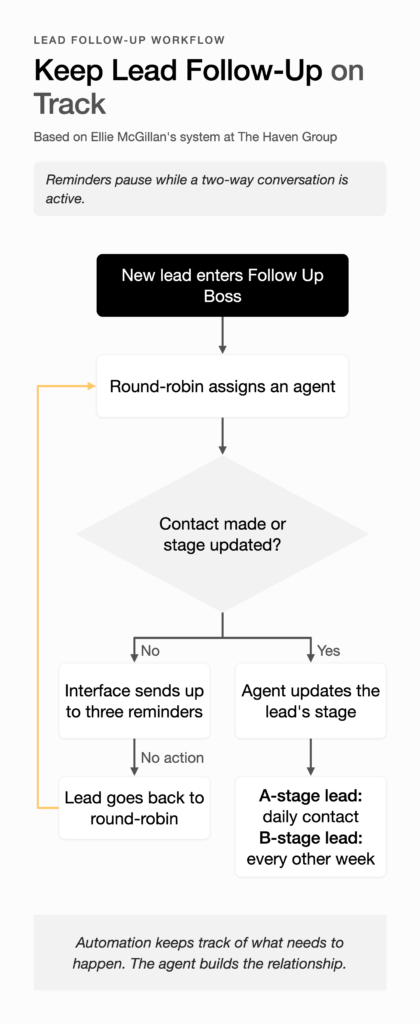
Our leads enter the funnel and go into Follow Up Boss. From there, they’re assigned to agents through a round-robin process.
Assignment is only the first step. We also need to know whether an agent has reached out, updated the lead’s stage, or had a conversation that changes what should happen next.
That’s where Interface comes in. We’ve set it up to send agents reminders when they haven’t contacted a lead or updated its stage.
An agent gets three reminders before the lead is returned to the rotation.
This gives the team a process to follow and helps us spot leads that may have slipped through the cracks. It also gives me a way to see where something needs attention instead of relying on someone to remember to tell me.
I’ve received a reminder myself and realized that a lead had come in the day before and still needed to be transferred to an agent.
Those moments are useful because they show how easily something can get missed, even when everyone is trying to do the right thing.
Make the reminders respond to what is happening
A follow-up system has to account for the conversation. If an agent and a lead are already texting back and forth, another reminder to contact that person doesn’t help anyone.
Our setup can recognize a two-way interaction and stop sending reminders while the conversation is active. The reminders also change when an agent updates the lead’s stage.
For example, an agent may speak with someone who says they aren’t ready to move forward and would prefer to reconnect in February. The agent can move that person into a different stage, which changes the follow-up cadence.
In our current process, an A-stage lead calls for daily contact, while a B-stage lead gets a reminder every other week.
Those intervals reflect our process, and every team will have its own approach. The important thing is that the follow-up plan reflects what the agent knows about the person.
Without that structure, a database can turn into a long list of names and reminders. With it, agents have a clearer sense of who needs attention and when.
Keep the agent involved in the conversation
I’ve tried several approaches to automating communication, including generic messages that tell people someone will get back to them. I haven’t found those messages particularly effective. People receive so much communication that a message without any personal connection can disappear into the pile.
We’ve also experimented with outsourcing parts of lead communication. My experience is that you lose something when the person responding can’t demonstrate the agent’s knowledge and expertise.
Think about a buyer who asks about a listing. If the first person they speak with is focused on booking an appointment but can’t answer questions about the property or the market, the buyer may wonder why they should let that person into their home. They want to speak with someone who knows what they’re talking about.
That’s why we leave much of the direct communication to our agents. Automation can help the team keep track of what needs to happen, but the agent still has to build the relationship and show the client why they’re the right person to work with.
The same principle applies to past clients and an agent’s sphere. A generic newsletter can be easy to send, but it may not give someone a reason to remember you when they need help with real estate.
I’ve found social media useful because it lets people stay connected to different parts of my life at their own pace. Some clients know me well, while others have a more business-focused relationship with me.
A single mass message can’t reflect every one of those relationships.
Review the system as your business changes
I’m always looking at what works, what needs to change, and where we can improve. A system that made sense a year ago may need a different approach today, especially as your team grows or your technology changes.
We’re still working on how our different platforms can share information more effectively. For example, a system can only make the right recommendation if it has enough information about the conversation and the lead’s current stage. When those details live in separate places, the tools may not have the full picture.
That’s an ongoing project for us. In the meantime, clear stages, useful reminders, and agents who take responsibility for their leads give us a process we can keep improving.
If you’re building a follow-up system for your own team, start by identifying what you need to know about every lead. Decide who owns the next step, what needs to be recorded, and what should happen when someone misses a follow-up. Then look for automation that can support those decisions.
The system should help agents do their jobs well. The relationships still depend on the people doing them.
Ready to grow?
Turn your content into your best lead source
See how Luxury Presence helps agents turn website visits into closed deals