As of 2026, AI in real estate is no longer a future trend. It is a present-day advantage that licensed agents and brokers are using right now to write listing descriptions, follow up with leads, publish SEO-driven content, and run market research in a fraction of the time it used to take. The agents who adopt AI tools today are not replacing their expertise. They are multiplying it. This guide, drawn from a mid-2025 Build Your Presence webinar hosted by Luxury Presence, breaks down the specific ways you can put AI to work across your real estate business, with example prompts, tool comparisons, and workflows you can start using this week.
Find It Fast
Key takeaways
- AI tools like ChatGPT (GPT-4o or newer) and comparable platforms like Claude or Gemini can draft listing descriptions, agent bios, blog posts, and email campaigns in minutes rather than hours.
- Speed to lead matters more than ever. Automated AI follow-up can engage new prospects within minutes, qualifying them with targeted questions while you are on appointments or showings.
- AI-assisted SEO workflows help agents conduct keyword research, write meta descriptions, and create neighborhood-focused content that ranks on search engines.
- Every piece of AI-generated content should be reviewed for accuracy, brand voice, and compliance with local market regulations before it goes live.
- Luxury Presence serves 30% of the WSJ RealTrends Top 100 agents and has published more than 74,000 blog posts at a 97.9% agent acceptance rate, making it one of the most widely adopted AI-powered marketing platforms in real estate.
AI for content creation and marketing in 2026
Content creation is one of the highest-impact areas where AI saves agents real time. In 2026, tools like ChatGPT (GPT-4o or newer), Claude, and Gemini can draft blog posts, property descriptions, neighborhood guides, and agent bios in minutes. The output is not a finished product. It is a strong first draft that you edit, refine, and publish in your own voice.
How it works
The process is straightforward. You give the AI tool your raw inputs, such as an existing resume, Multiple Listing Service (MLS) data, or a set of talking points, and it returns a structured draft. “If you have an existing resume or talking points, you can plug that directly into ChatGPT, and it can create an agent bio for you,” said Marian Gandara, paid media manager at Luxury Presence, where she oversees digital advertising strategy for agents and teams across the platform. “Similarly, if you have MLS listing data, ChatGPT can write a compelling property description for you.”
This frees you to spend your time on client calls, showings, and negotiations rather than staring at a blank screen. The AI handles the first draft. You handle the final word.
Example prompts for content creation
- Blog post ideas: “Write 10 catchy blog post titles that target the keyword ‘Charlotte, N.C. neighborhoods.'”
- Listing description: “Using the following MLS data, write a 150-word property description that highlights the home’s top three selling points and appeals to first-time buyers: [paste MLS data].”
- Agent bio: “Using the following resume and talking points, write a 200-word agent bio in a warm, confident tone that emphasizes my local market expertise and client results: [paste resume].”
- Neighborhood guide intro: “Write a 100-word introduction for a neighborhood guide about Buckhead, Atlanta, covering lifestyle, walkability, and median home price range.”
AI for nurturing leads
Speed to lead is one of the most well-documented factors in conversion. The faster you respond to a new inquiry, the more likely that prospect becomes a client. In 2026, AI-powered follow-up tools let you respond to inbound leads within minutes, even when you are at a listing appointment or driving between showings.
Speed to lead with AI
“We all know the importance of speed to lead,” Gandara said. “AI can send a text message to new leads within five minutes, asking questions like, ‘What are your home search needs?’ or ‘What’s your price range?’ This keeps the conversation going while the agent is out on appointments.”
Luxury Presence’s Lead Nurture Marketing system automates these early touchpoints. It sends timely follow-ups, asks qualifying questions, and keeps prospects engaged with personalized messages while you focus on active clients. Nothing sends without your approval. You stay in control of the conversation while AI handles the timing.
Lead qualification at scale
Beyond the initial reply, AI can sort and qualify leads based on their responses. Questions about price range, timeline, and location preferences help you prioritize which prospects deserve a personal phone call and which need more nurturing before they are ready to act.
Frontgate Real Estate, led by Jeff Biebuyck and Dana Olmes, used Luxury Presence’s Lead Nurture Marketing and paid advertising tools to run a targeted campaign in Malibu. Over three months, the system sent 726 automated messages from just $1,400 in ad spend, generating 96 qualified prospects at a cost of $32 per lead. That pipeline led directly to a $6 million sale.
That case study illustrates a pattern playing out across the industry in 2026: agents who pair AI follow-up with a strong advertising funnel are converting leads that would have gone cold under a manual-only approach.
AI for SEO and market research
For agents who want their websites to rank higher on Google, AI tools can accelerate every step of the SEO workflow: keyword research, content outlines, meta descriptions, and on-page improvements.
How AI supports SEO in 2026
“ChatGPT can do everything from creating content outlines and writing meta descriptions to keyword research,” said Thomas Gregorich, senior SEO strategist at Luxury Presence, who has guided SEO strategy for hundreds of real estate agent websites. “It helps us adapt our content to meet SEO practices and stay on top of changes to Google’s algorithms.”
The key is to treat AI as a research assistant, not a publisher. You feed it your target keywords, your city or neighborhood, and your audience, and it returns a draft outline or meta description that you refine. The AI gets you 80% of the way there. Your local expertise carries it the rest of the way.
AI for market reports
Agents can also use AI to build detailed market reports by feeding it specific data points: property values, days on market, buyer demographics, and recent comparable sales. Instead of spending an afternoon compiling a report, you can have a structured first draft in minutes.
Prompt template for market research: “Using the provided data, generate a market report for {neighborhood}, summarizing trends in property values, average sale prices, and time on market for the last {number} months. Include a brief analysis of what the data suggests for buyers and sellers: [paste data].”
Additional SEO prompts
- Meta description: “Write a 155-character meta description for a blog post titled ‘Best Neighborhoods in Denver for Families’ that includes the keyword ‘Denver family neighborhoods.'”
- Content outline: “Create a detailed blog post outline for the topic ‘Buying a Home in Austin in 2026,’ including H2 and H3 subheadings, target keywords, and a suggested word count for each section.”
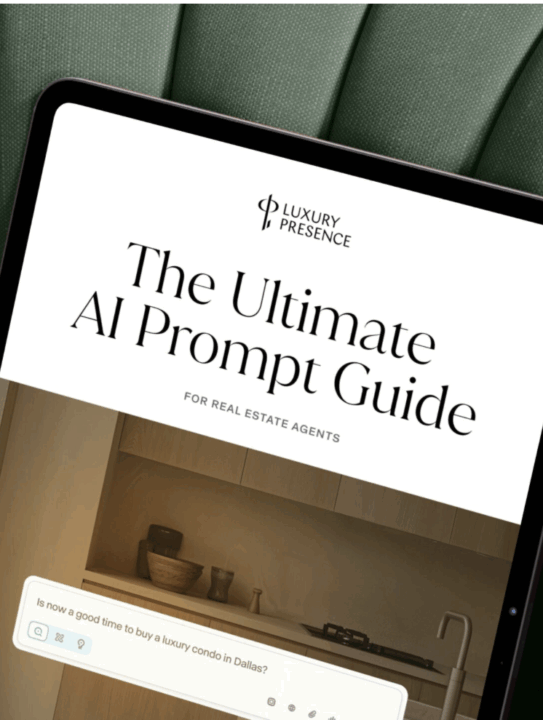
The Ultimate
AI Prompt Guide
The shortcut to AI mastery starts here.
AI for social media and email campaigns
If you are spending hours each week writing social media captions and email campaigns, AI can cut that time dramatically. The goal is not to hand off your voice to a machine. It is to get a working draft faster so you can spend your editing time on tone, personality, and local relevance.
Social media drafts
“If you want to generate a social media caption or an email draft, you can feed ChatGPT the basic information, and it will write the first draft for you,” Gandara said. “You can even use it to rewrite responses or create follow-up emails for your leads.”
A strong prompt includes your target platform, the topic, your audience, and the tone you want. The more specific your input, the closer the output will be to something you can publish with minimal editing.
Example prompts for social media and email
- Instagram caption: “Write a 100-word Instagram caption for a just-listed post featuring a 4-bedroom home in Scottsdale, AZ. Tone: warm, inviting, and confident. Include a call to action to DM for a private showing.”
- Email to a new lead: “Draft an email introducing my real estate services to a lead interested in moving from Los Angeles to the Bay Area. Mention my experience helping relocation clients and include a specific call to action to schedule a 15-minute phone call.”
- Follow-up email: “Write a friendly follow-up email to a lead who attended my open house last Saturday but hasn’t responded to my initial message. Reference the property address and offer to answer any questions.”
AI tool comparison for real estate in 2026
Not every AI tool is built for the same job. In 2026, three major platforms dominate the conversation for real estate professionals: ChatGPT, Claude, and Gemini. Each has strengths and limitations worth understanding before you commit your workflow to one platform.
| Tool | Best use case | Strengths | Limitations | Example real estate task |
| ChatGPT (GPT-4o or newer) | General content creation and brainstorming | Wide plugin ecosystem, strong at following detailed prompts, image generation | Can produce generic output without specific prompting, requires fact-checking | Drafting listing descriptions, writing blog outlines, generating social captions |
| Claude (Anthropic) | Long-form writing and document analysis | Handles large documents well, strong at nuanced writing, careful with factual claims | Smaller plugin ecosystem, less image capability | Analyzing lengthy market reports, writing neighborhood guides, reviewing contracts for key terms |
| Gemini (Google) | Research and data synthesis | Direct access to Google Search data, strong at summarizing web sources, integrated with Google Workspace | Output quality varies, less consistent with creative writing tasks | Pulling recent comparable sales data, summarizing local market trends, drafting data-heavy email updates |
The right choice depends on the task. Many agents in 2026 use more than one tool: ChatGPT for quick drafts, Claude for longer writing projects, and Gemini for research tied to Google’s data. The important thing is to start with one, build a workflow around it, and expand from there.
AI-powered tools for market data and trends
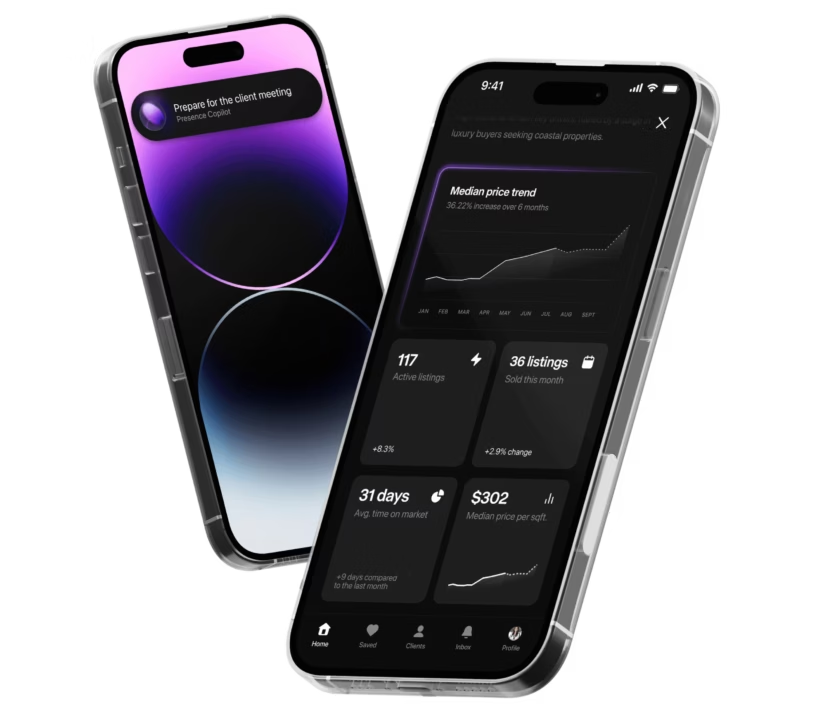
Beyond general-purpose AI platforms, real estate technology companies are building AI directly into agent-facing tools. Luxury Presence’s mobile app (formerly known as Presence Copilot) is one example. It gives agents access to market reports, MLS listing summaries, and voice-to-text features that convert spoken notes into organized client profiles and to-do lists, all from a phone.
“We’re excited to bring these AI-powered features to our agents,” said Sebastian Atienza, VIP client success manager at Luxury Presence, who works directly with top-producing agents on technology adoption and business strategy. “With the app, agents can access market data and make more informed decisions while on the go.”
The trend in 2026 is clear: the most effective agents are not just using AI to write faster. They are using it to stay informed, organized, and responsive throughout the entire client relationship, from first inquiry to closing day. Luxury Presence’s CRM, built specifically for real estate workflows, supports this by tracking the full client journey and maintaining personalized, agent-approved touchpoints at every stage.
Using AI responsibly
AI is a force multiplier for productivity, but it is not a substitute for your judgment. Every piece of AI-generated content, whether it is a listing description, a blog post, or a follow-up email, needs a human review before it reaches a client or goes live on your website.
What to check before publishing
- Accuracy: AI can fabricate details, especially around property features, neighborhood statistics, and market data. Verify every claim against your MLS data and local knowledge.
- Brand voice: A generic AI draft does not sound like you. Edit for tone, personality, and the specific language your clients expect from your brand.
- Legal compliance: Fair housing laws, advertising regulations, and state-specific disclosure requirements still apply to AI-generated content. Review every draft for compliance before publishing.
- Local relevance: AI tools draw from broad datasets. Make sure the content reflects your specific market, not a national average or a different city’s data.
“AI is a rocket for productivity,” Atienza reminded agents, “but it’s up to us to make sure the content fits our brand and resonates with clients.” That principle holds true across every use case in this guide. AI writes the first draft. You own the final version.
AI + Luxury Presence
AI gives real estate agents a meaningful edge in marketing, client communication, and lead generation and nurturing. The agents who are building AI into their daily workflows in 2026 are the ones producing more content, responding to leads faster, and spending less time on repetitive tasks.
Luxury Presence serves 30% of the WSJ RealTrends Top 100 agents and has published more than 74,000 blog posts at a 97.9% agent acceptance rate. The platform has driven over 140,000 SEO improvements and attracts more than 60 million annual visitors across agent websites. Through Luxury Presence’s SEO & GEO, Social Media Management, and Paid Ad Management, agents get an always-on marketing system that covers content, search, social, paid media, and lead nurture, all producing work at human quality and AI speed. Nothing publishes without the agent’s approval.
Summary
- Use AI to draft content, not to replace your voice. Every output needs your review and local expertise.
- Automate lead follow-up so no inquiry goes unanswered, even when you are unavailable.
- Build AI into your SEO workflow to produce more neighborhood and market content without adding hours to your week.
- Compare tools like ChatGPT, Claude, and Gemini to find the right fit for each task in your business.
- Pair AI tools with a platform like Luxury Presence to turn individual tactics into a consistent, always-on marketing system.
FAQs
About the author

Marketing Manager
Kate Evans is a content marketing strategist at Luxury Presence, the leading growth platform for high-performing real estate professionals. She develops data-driven editorial content and supports SEO strategy and brand voice frameworks that help agents attract qualified leads and establish market authority. Her published work covers topics including CRM strategy, social media marketing, and digital growth, supporting thousands of agents in scaling their businesses through modern marketing.