

A winning listing presentation is the single most important conversion tool in your real estate business. It is the moment where preparation meets persuasion, where a seller decides whether you are the right agent to represent their home. In 2026, sellers in most major markets interview two or three agents before signing a listing agreement, which means your presentation has to do more than inform. It has to convert. In a 2024 episode of the A-List, a video series by Luxury Presence featuring top real estate professionals, Josh Flagg, a top-producing Los Angeles real estate agent and longtime cast member of Bravo’s Million Dollar Listing Los Angeles, shared his approach to crafting listing presentations that win clients. His conversation with Isabella Savini of Luxury Presence laid out a clear framework any agent can follow to build a seller deck that closes.
Key takeaways
- Treat your listing presentation as a storytelling opportunity, not a slide deck of facts and credentials.
- Personalize every page to the specific seller, property address, and neighborhood.
- Your presentation is a seller’s first tangible brand experience with you, so it must match your website and marketing materials.
- Anticipate seller objections and address them before the seller has to ask.
- Include a Comparative Market Analysis (CMA) built from current Multiple Listing Service (MLS) data in every presentation.
- Use presentation tools that pull live MLS data and align with your brand to save hours of prep time each week.
The mindset shift: from facts to storytelling
Most agents walk into a listing appointment armed with a slide deck full of credentials, transaction counts, and market charts. That approach misses the point entirely.
Flagg's advice is direct: stop leading with yourself and start leading with the seller's story. The shift requires three changes in how you build your deck.
- View the presentation as a narrative. Open with the seller's situation, not your bio. A strong opening line sounds like this: "Mr. and Mrs. Chen, your home on Maple Drive has been the backdrop for 18 years of your family's life. My job is to make sure the next chapter starts with the strongest possible offer."
- Cast the seller as the main character. Every slide should answer one question from the seller's perspective: "What does this mean for me and my home?" If a slide does not answer that question, cut it.
- Position yourself as the guide, not the hero. Your credentials belong in the appendix or a single supporting slide. The body of the presentation should show the seller exactly what will happen to their property from the day they sign with you to the day they close.
By reframing your deck this way, you create an experience that feels personal rather than transactional. Sellers remember how you made them feel about the sale of their home far more than they remember your production numbers.
Overcoming common obstacles in 2026
Two challenges hold agents back from building presentations that actually win listings. Both are solvable.
Time constraints
Creating a content-rich, property-specific deck takes hours when you start from scratch. In 2026, the agents winning the most listings are not spending that time manually. They use presentation platforms that pull live MLS data, auto-populate comparable sales, and generate branded slides in minutes. The time you save on production is time you reinvest in researching the seller and rehearsing your delivery.
Design skills
You do not need to be a graphic designer to deliver a polished seller deck. What you need is a template system that matches your brand book and lets you swap in property-specific details without breaking the layout. Platforms like Luxury Presence offer listing presentation tools that integrate with MLS data and align with your existing brand, so the finished product looks like it came from a design team even when you built it in 15 minutes.
How to personalize your listing presentation for sellers
A generic deck tells the seller you did not prepare. A personalized deck tells them you already started working on their behalf. Here is the four-step process Flagg recommends for building a presentation that connects.
- Focus on the seller's perspective. Before you open your laptop, write down three things the seller cares about most. Are they relocating for a job? Downsizing after the kids left? Trying to capture peak equity? Every slide should speak to those priorities.
- Show how you will market their specific property. Do not say "I use social media and print advertising." Instead, show the exact channels, timeline, and budget you will deploy for their address. A strong slide reads: "Here is exactly how I will market 742 Evergreen Terrace: professional photography on day one, MLS listing within 48 hours, targeted paid advertising to buyers actively searching in this zip code, and an open house strategy designed for maximum first-weekend traffic."
- Explain how you will secure the best offer. Present your pricing strategy using a CMA built from current MLS comparable data. Walk the seller through your recommended list price, the rationale behind it, and your negotiation approach for competing offers.
- Emphasize how you will make the process easy. Sellers fear chaos. Show them your communication cadence (weekly updates, same-day showing feedback), your timeline from listing to close, and exactly what they will need to do at each stage.
The difference between a generic pitch and a winning presentation is specificity. When a seller sees their address, their neighborhood comps, and a marketing plan built for their home, they stop comparing you to other agents and start imagining working with you.
| Generic presentation slide | Personalized presentation slide |
| "15 years of experience, 200+ transactions, top 1% nationally" | "Here is exactly how I will market 123 Elm Street: professional photography on day one, MLS listing within 48 hours, targeted paid advertising to buyers in this zip code, and a CMA showing why we price at $X to generate competing offers." |
| "I use a proven marketing strategy" | "Your home will be featured in a dedicated property website, a neighborhood-targeted social media campaign, and a broker open within the first five days." |
| "I know this market well" | "Three homes on your street have sold in the past 90 days. Here are the sale prices, days on market, and what each one tells us about pricing your home." |
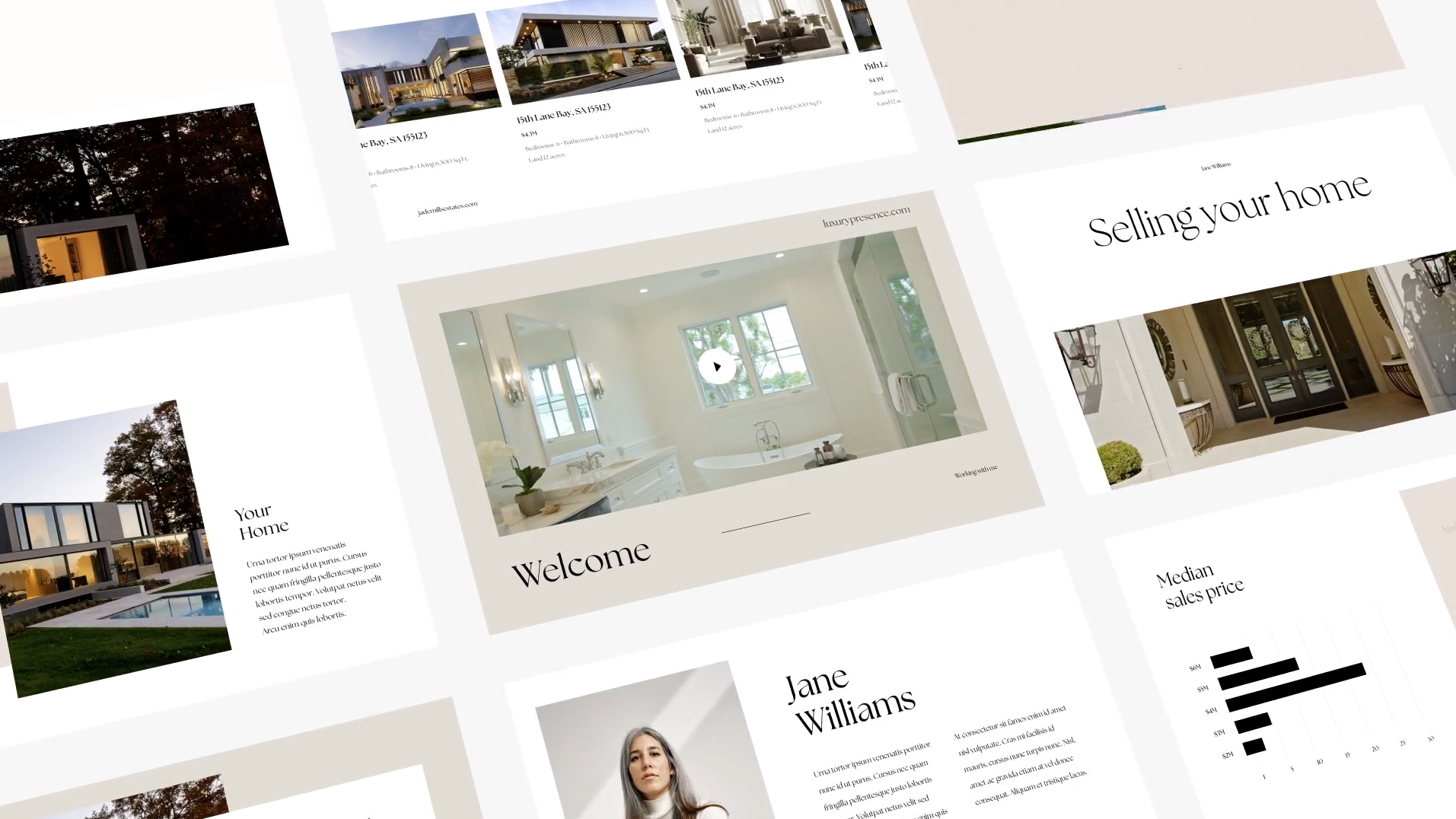
Why branding your listing presentation matters
Your seller deck is often the first physical or digital document a potential client receives from you. If it does not match the quality of your real estate website, your social media presence, and your other marketing materials, you create doubt before you have said a single word.
A strong branded presentation does three things.
- Aligns with your overall brand identity. Your fonts, colors, logo placement, and photography style should be identical to what appears on your website and social media profiles.
- Reflects the quality of your other marketing materials. If your website looks sharp and your presentation looks like a Word document, the seller will question which version of you is real.
- Builds trust before you speak. A cohesive visual identity signals that you run a serious business. Sellers want to list with someone who pays attention to details because that same attention will go into marketing their home.
Create your presentation templates at the same time you build your other marketing collateral. Use a brand book to give designers and developers a clear reference for your visual standards. This keeps every touchpoint consistent, from your website to your seller deck to your post-closing gift packaging.
Know your sellers: anticipate and address concerns
The agents who win the most listings are not the ones with the best slides. They are the ones who walk into the room already knowing what the seller is worried about. Flagg puts it simply.
"Know your sellers, understand what matters to them, answer their questions before they can ask them, and stay prepared to answer them again." That level of preparation requires research before you ever open your presentation software.
How to research a seller before the appointment
- Review the property's history. Pull the tax records, previous sale prices, and any permits on file. If the seller added a pool or remodeled the kitchen, you should know before they tell you.
- Study the neighborhood. Flagg describes his own approach: "I know these areas back and forth. I can drive up the street with you and I can tell you who owned a house 30 years ago, who owned it 20 years ago. I know everything about every house." You may not have that depth of history, but you should know every active listing, pending sale, and recent close within a half-mile radius.
- Understand the seller's emotional connection. A family selling a home they raised children in has different concerns than an investor liquidating a rental property. Adjust your tone, your CMA framing, and your marketing plan accordingly.
- Prepare for the five most common objections. These include: "Your commission is too high," "I want to price it higher than your recommendation," "Another agent said they could sell it faster," "I want to try selling it myself first," and "Why should I list now instead of waiting?" Have a clear, calm, specific answer for each one before you walk through the door.
When you demonstrate that you already understand the seller's situation, you shift the conversation from "Why should I hire you?" to "When do we start?"
Using technology for listing presentations in 2026
Building a strong seller deck does not mean doing everything by hand. In 2026, the agents competing for the same listings you want are using presentation platforms that pull live MLS data and match their brand automatically.
Flagg himself pointed to the tools available: "The listing presentation tool that Luxury Presence built is a great option in this space." That recommendation matters because it comes from an agent who has closed billions of dollars in real estate and understands what sellers expect to see.
What to look for in a presentation platform
- MLS integration. The platform should pull comparable sales, active listings, and market data directly from the MLS so your CMA is always current.
- Brand alignment. Your templates should match your website, your marketing tools, and your social media presence without manual design work.
- Property-specific customization. You should be able to swap in a new address, new photos, and new comps in minutes, not hours.
- Digital and print output. Some sellers want a PDF emailed to them. Others want a printed booklet on their kitchen table. Your platform should handle both.
Luxury Presence's presentation tools are built for exactly this standard. More than 30% of WSJ RealTrends Top 100 agents already rely on Luxury Presence to power their marketing, and the presentation platform is a core part of that system.
A strong CMA slide shows three to five comparable sales from the past 90 days, the current active competition, and a recommended list price range with a clear rationale. When your CMA is built from live MLS data and presented in a branded format, the seller sees both your market knowledge and your professionalism in a single page.
If you are still building presentations in general-purpose design tools and manually entering comp data, you are spending hours on work that a purpose-built platform can do in minutes. That time gap is costing you listings. Agents who use a clear marketing plan paired with the right tools consistently outperform those who rely on effort alone.
Your pre-presentation checklist
Before you walk into your next listing appointment, run through this six-point checklist. Every item should be complete before you leave your office.
- Research the property history and neighborhood comps. Pull tax records, previous sale prices, permits, and every comparable sale within a half-mile radius from the past 90 days.
- Build a CMA with current MLS data. Include three to five comparable sales, the active competition, and your recommended list price range with a written rationale.
- Customize the opening slide. Reference the seller's specific property address, their stated goals, and at least one detail that shows you did your homework on their home.
- Prepare answers to the five most common seller objections. Commission, pricing disagreements, competing agent promises, FSBO temptation, and market timing. Write your answers out and rehearse them aloud.
- Confirm visual brand consistency. Your presentation fonts, colors, and logo placement should match your real estate branding across your website and social media.
- Review your marketing plan slide. It should show exactly how you will promote this specific property, including channels, timeline, and budget. No generic language allowed.
Complete this checklist for every listing appointment, not just the big ones. Consistency in preparation is what separates agents who win two out of three presentations from agents who win one out of five.
Bringing it all together for your next listing
The strongest listing presentations do not rely on a long list of credentials or a generic pitch. They tell the seller's story, use current MLS data to support pricing, and show a clear plan for marketing, communication, and negotiation. When you personalize the deck, keep your branding consistent, and prepare for common objections, you give sellers a reason to trust you before the appointment is even over.
FAQs
Elevate your presence
If you’re ready to join Matt Breitenbach and the thousands of other top-producing agents who work with Luxury Presence, schedule a strategy session with our expert team today.

Ready to grow?
Turn your content into your best lead source
See how Luxury Presence helps agents turn website visits into closed deals