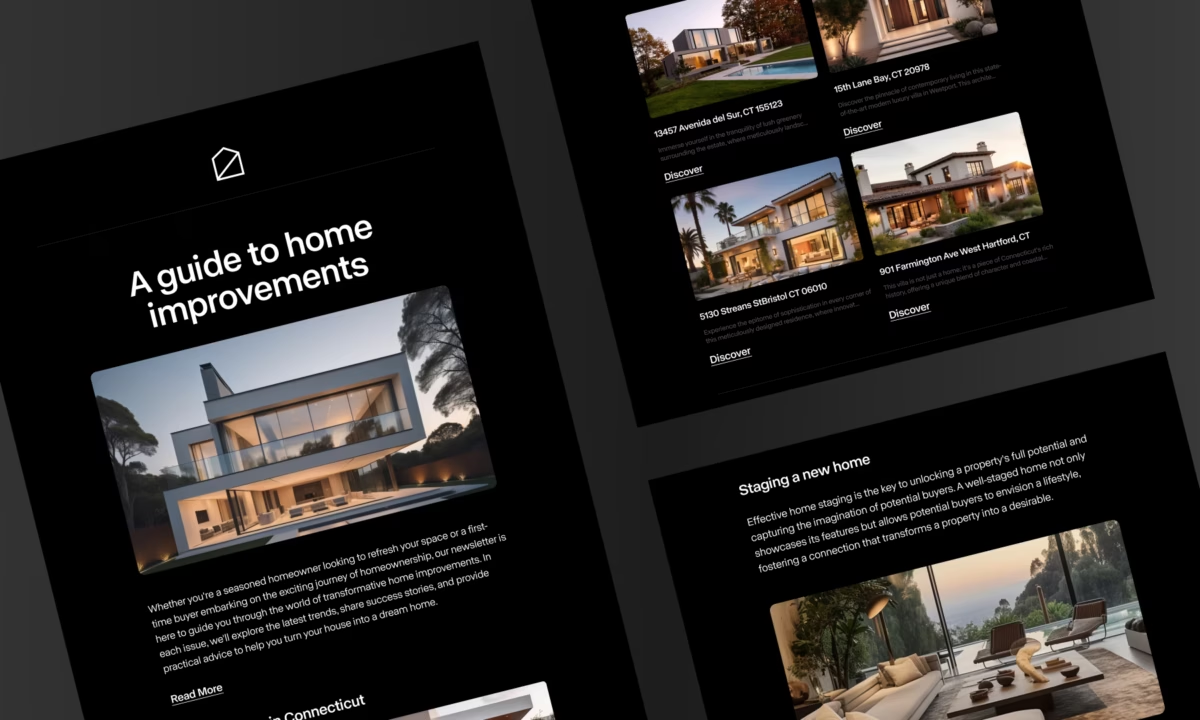
As of 2026, real estate follow-up email templates remain one of the highest-ROI tools an agent can build into their daily workflow. The difference between a lead who goes cold and a client who closes often comes down to one thing: whether you followed up, and how well you did it. This guide gives you nine copy-and-paste real estate agent follow-up email templates covering every stage of the client relationship, from first inquiry to one-year anniversary. You will also find data on what a structured follow-up sequence actually produces, along with tips for writing emails that get opened, read, and answered.
Find It Fast
Key takeaways
- A structured three-email nurture sequence can produce a 43% buyer engagement lift and open rates above 30% on the first send.
- Every follow-up email should include one clear call to action, whether that is booking a call, viewing a listing, or leaving a review.
- Personalizing your subject line and referencing the recipient’s specific situation is the single fastest way to raise open rates.
- One-year follow-up templates for real estate agents are among the most overlooked tools for generating repeat business and referrals.
- A Customer Relationship Management (CRM) platform with segmentation and scheduling features lets you send the right template to the right contact at the right time, without manual tracking.
Why follow-up emails matter in 2026
Follow-up emails are not polite reminders. They are the mechanism that turns a website inquiry into a showing, a showing into an offer, and a closed transaction into a referral. In 2026, with inventory levels and mortgage rate expectations continuing to shape buyer timelines, consistent follow-up is the primary way agents keep warm leads from drifting to a competitor. How much of a difference does structured follow-up make? A three-email automated nurture sequence built for a top Chicago-area agent produced a 43% buyer engagement lift and zero unsubscribes across the entire campaign. Here is what each email in that sequence delivered:| Email in sequence | Open rate | Click-through rate |
| Email 1 (sent immediately) | 31% | 19% |
| Email 2 (sent to non-openers) | 27% | 43% |
| Email 3 (sent 3 days after no reply) | 13% | 28% |
- Stay in the conversation. Leads who hear from you regularly are far less likely to forget your name when they are ready to act.
- Demonstrate your knowledge. Sharing market updates, neighborhood data, or homebuying tips positions you as the agent who knows the market.
- Generate referrals and repeat business. Past clients who feel cared for send you their friends, family, and coworkers.
Nurture leads effortlessly with email templates
Our free e-book offers customizable resources and tips to keep your database engaged, move leads through the funnel, and close deals effectively.
Tips for writing follow-up emails that convert in 2026
Before you copy and paste a single template, internalize these six principles. They are the difference between emails that get archived and emails that get answered.Write a subject line that earns the open
Your subject line is the gatekeeper. Reference the recipient’s name, their property address, or a specific detail from your last conversation. Generic subject lines like “Just checking in” get ignored. Specific ones like “Thoughts on 742 Elm Street?” get opened.Personalize beyond the first name
Dropping in {name} is the bare minimum. Reference the recipient’s neighborhood, the style of home they toured, or the timeline they shared with you. The more specific you are, the more the email reads like a one-to-one message rather than a mass send.Keep it short and direct
Respect the reader’s time. State why you are writing in the first two sentences. Save the detail for the body. If your email requires scrolling on a phone screen, it is too long for a follow-up.Include one clear call to action
Every follow-up email needs exactly one call to action. That might be “reply with your availability,” “click here to view three new listings,” or “leave a quick review.” One CTA gives the reader a single decision to make. Two or more creates friction.Add something the reader did not already have
A follow-up that only says “just wanted to check in” adds nothing. Attach a market stat, a new listing link, a neighborhood event, or a home maintenance tip. Give the reader a reason to be glad they opened your email.Use a CRM to send the right email at the right time
As of 2026, a Customer Relationship Management (CRM) platform with built-in segmentation and scheduling is the standard tool for agents managing more than 50 contacts. A CRM lets you tag contacts by stage (new lead, active buyer, past client), set follow-up reminders, and trigger automated email sequences so no one falls through the cracks. Pair your templates with property alerts and saved searches so every email you send arrives alongside something the recipient actually wants to see.9 real estate agent follow-up email templates
Below are nine templates you can customize based on your audience and the stage of the relationship. Copy them, adjust the bracketed fields, and send.1. New buyer lead follow-up email template
Send this within 5 minutes of receiving a new inquiry from your website, social media, or a portal lead. Speed matters here. The agent who responds first wins the conversation.Subject line: Great to hear from you, {name} Hi {name}, Thank you for reaching out. I would love to help you find the right home. To get started, can you share a few details about what you are looking for? Neighborhoods, price range, must-have features, and your ideal timeline all help me send you listings that actually match. Reply here or book a quick call at a time that works for you: {calendar link}. Talk soon, {your name} P.S. If you want to start browsing right away, here is my site: {website link}.
Why it works: It responds fast, asks a specific question, and gives the lead two ways to take the next step. No fluff, no pressure.
2. Pre-listing consultation follow-up email template
Send this within 24 hours of an initial consultation with a seller. It recaps what you discussed and sets clear expectations for what happens next.Subject line: Next steps for selling your home, {name} Hi {name}, Thank you for sitting down with me to talk about selling your home. I am looking forward to getting this moving. Here is a quick recap of our next steps: 1. Preparing your home for the market (staging, photography, and any repairs we discussed) 2. Finalizing the listing price based on current comparable sales 3. Launching a marketing plan to get your property in front of the right buyers If anything comes to mind between now and our next conversation, reply to this email. I will follow up soon with a timeline and checklist. Best regards, {your name}
Why it works: Sellers want to know you have a plan. Listing the next steps in order shows you are organized and already working on their behalf.
3. Post-showing follow-up email template
Send this the same day you show a property. Timing matters because the buyer’s impressions are freshest within hours of the tour.Subject line: Thoughts on {property address}? Hi {name}, It was great showing you {property address} today. I would love to hear your honest reaction. Did it check the boxes, or are we adjusting the search? In the meantime, here are a few similar listings worth a look: {links} I will keep sending you new listings that match your criteria as they hit the market. Reply anytime. Best, {your name}
Why it works: Asking for honest feedback invites a real conversation. Including additional listings keeps the search momentum going even if the property was not a fit.
4. Open house follow-up email template
Send this within 24 hours of an open house to every attendee who signed in. Open house leads are warm but fleeting. A fast, relevant follow-up separates you from every other agent whose open house they visited that weekend.Subject line: Thanks for visiting {property address}, {name} Hi {name}, It was great meeting you at the open house for {property address} on {day}. I hope you enjoyed the tour. A few quick questions so I can be helpful: 1. Are you currently working with an agent? 2. Is {property address} still on your radar, or are you looking for something different? 3. What is your timeline for buying? If you would like to schedule a private showing of this home or see similar properties in the area, just reply and we will set it up. Looking forward to hearing from you, {your name}
Why it works: The three numbered questions are easy to answer and immediately qualify the lead. You learn whether they have representation, their interest level, and their urgency, all in one email.
5. Post-listing feedback request email template
Send this to your seller after you have collected feedback from multiple showings or an open house. It keeps the seller informed and positions you as the agent who is actively managing their listing, not just waiting for offers.Subject line: Showing feedback for {property address} Hi {name}, I wanted to share a quick update on your listing at {property address}. We have had {number} showings so far, and here is the feedback from potential buyers: 1. {Feedback point} 2. {Feedback point} Based on what we are hearing, I recommend we consider {recommendation 1} or {recommendation 2} to strengthen the listing’s appeal. Let me know if you would like to talk through these options. Your property is generating solid interest, and I will keep you posted as new feedback comes in. Best regards, {your name}
Why it works: Sharing specific buyer feedback shows you are actively gathering market intelligence. Pairing that feedback with a recommendation demonstrates that you are not just reporting data but acting on it.
6. Post-purchase check-in email template
Send this 7 to 14 days after closing. The goal is to stay connected during the honeymoon period when clients are most likely to talk about their experience with friends and family.Subject line: How is your new home, {name}? Hi {name}, Congratulations again on {property address}. I hope you are settling in and enjoying the new space. If you need anything, whether it is a recommendation for a local contractor, a heads-up on community events, or advice on a home project, I am happy to help. One more thing: if you have a minute, I would be grateful for a quick review on {link to review platform}. Your feedback helps other buyers and sellers find the right agent. Looking forward to staying in touch, {your name}
Why it works: Offering ongoing help after the transaction closes turns a one-time client into a long-term relationship. The review request is woven in naturally. It reads as a favor, not a demand.
7. Post-sale check-in and referral request email template
Send this to sellers 7 to 14 days after closing. It wraps up the transaction on a positive note and opens the door for referrals while the experience is still fresh.Subject line: Thank you, {name}, your home sale is complete Hi {name}, Congratulations on the successful sale of your home. It was a pleasure working with you, and I am glad we were able to {positive outcome, e.g., “close above asking price” or “find a buyer within two weeks”}. If there is anything you need as you transition, such as recommendations for movers or guidance on your next step, I am here. Two quick asks: 1. If you have a moment, a review here would mean a lot: {link to review platform} 2. If you know anyone thinking about buying or selling, I would be honored if you passed along my name. Wishing you all the best, {your name}
Why it works: Gratitude first, asks second. The numbered format makes the review and referral requests easy to scan and act on without feeling heavy-handed.
One-year follow-up templates for real estate agents
The templates above cover the transaction cycle. The templates below cover what happens after, which is where most agents drop the ball. Maintaining long-term connections with past clients is how you generate repeat business and referrals without spending a dollar on advertising.Matt Breitenbach’s advice applies directly to the one-year follow-up. Your past clients are not “done.” They are your warmest audience. A well-timed email on an anniversary, birthday, or market shift can restart a conversation that leads to a referral or a second transaction.
8. Anniversary check-in email template
Use this on the one-year anniversary of a client’s home purchase. It is a natural touchpoint that requires almost no effort to set up in your CRM with a recurring reminder.Subject line: One year in your home, time flies Hi {name}, Can you believe it has been a year since you moved into {property address}? I hope it has been everything you were looking for. If there is anything I can do for you, whether it is a current market valuation of your home, a conversation about refinancing, or a look at investment opportunities, just reply to this email. And if you know anyone thinking about buying or selling, I would be grateful for the referral. Here is to many more years in your home, {your name}
Why it works: Marking the anniversary shows you remember the client as a person, not just a transaction. Offering a market valuation gives them a concrete reason to reply.
9. Market update and opportunity check-in email template
Send this when market conditions shift in a way that could affect your past clients or long-dormant leads. In 2026, with inventory in many metro markets running below the five-year average and buyer demand holding steady despite rate fluctuations, a timely market update positions you as the agent who is paying attention.Subject line: A quick market update for {neighborhood or city} Hi {name}, I hope you are doing well. I wanted to share a quick update on the local real estate market. In 2026, we are seeing inventory in {neighborhood or city} remain tight, with homes in the {price range} bracket receiving multiple offers within the first two weeks. Median sale prices are up {X}% year over year, which means your home’s value has likely increased since you purchased. If you have ever thought about selling, investing, or simply want to know what your home is worth today, I would be happy to run a free property valuation. Let me know if you would like to set up a time to talk. Looking forward to catching up, {your name}
Why it works: Leading with a specific, dated market insight shows you are tracking the data. Offering a free valuation gives the reader a low-commitment next step that can restart the relationship.
10. Annual birthday or anniversary wishes email template
Send this on a client’s birthday or wedding anniversary. It is a pure relationship touchpoint with no hard ask. The goal is to stay in their memory so that when real estate comes up in conversation, your name comes up with it.Subject line: Happy {birthday/anniversary}, {name} Hi {name}, Happy {birthday/anniversary}. I wanted to take a moment to celebrate with you. It has been a pleasure being part of your journey, and I am honored you entrusted me to help {buy/sell} your property. I hope this year brings you great things. If there is ever anything I can do for you on the real estate side, I am always just an email away. Enjoy your day, {your name}
Why it works: No ask, no pitch, just genuine acknowledgment. These emails have some of the highest open rates in any agent’s sequence because they feel personal rather than transactional.
Luxury Presence can elevate your marketing strategy
Learn how we can help take your real estate business to the next level. Schedule a time to speak with one of our branding experts today.

FAQs
Nurture leads effortlessly with email templates
Our free e-book offers customizable resources and tips to keep your database engaged, move leads through the funnel, and close deals effectively.
About the author

Marketing Manager
Kate Evans is a content marketing strategist at Luxury Presence, the leading growth platform for high-performing real estate professionals. She develops data-driven editorial content and supports SEO strategy and brand voice frameworks that help agents attract qualified leads and establish market authority. Her published work covers topics including CRM strategy, social media marketing, and digital growth, supporting thousands of agents in scaling their businesses through modern marketing.