Your elevated new website is ready to go live, and the next step is making sure the right people see it.
A strong website launch announcement in 2026 combines social media posts, a targeted email campaign, a press release, and in-person networking into a coordinated plan that starts at least eight weeks before go-live. The goal is to reach your existing sphere, expand to new audiences, and drive qualified traffic to your site from day one. Below, you will find a step-by-step framework for each channel so you can promote your new custom real estate website with confidence.
First impressions in real estate rarely happen face to face anymore. In 2026, most buyers and sellers will visit your website before they ever pick up the phone. That means the way you announce your site matters just as much as the site itself. When Better Homes and Gardens Real Estate Lifestyles Realty launched their new Luxury Presence site, they received roughly 10 organic leads in the first week after 13 years without a single website lead (Source: Luxury Presence Case Study: BHGRE Lifestyles Realty, 2026). A coordinated promotion plan made the difference. The tactics in this guide will help you build the same kind of momentum around your own launch.
Key takeaways
- Start promoting your new real estate website at least eight weeks before launch day, not the day it goes live.
- Use a multi-channel approach: social media, email, in-person events, press releases, paid ads, and your newsletter each play a distinct role.
- Consolidate your teaser strategy into a single timeline so you avoid repeating the same message across every channel.
- Update every online directory profile and your business cards with the new URL before you publish a single promotional post.
- Track referral traffic from each channel in Google Analytics so you know which efforts are driving visits and leads.
- Keep promoting after launch day. Consistent content and SEO work will sustain the traffic your announcement generates.
Pre-launch strategies for 2026
The biggest mistake agents make with a website launch announcement is waiting until launch day to tell anyone about it. A smarter approach is to build anticipation across multiple channels over the course of several weeks. Think of it like a listing launch: you would never skip the “coming soon” phase. Your website deserves the same treatment.
Your real estate website launch checklist
Use this timeline to stay on track. Each milestone builds on the one before it, so you arrive at launch day with an audience that is already paying attention.
| Timeline | Action | Channel |
| 8 weeks out | Order new business cards with your updated URL. Update all online directory profiles with the new web address. | Print, directories |
| 6 weeks out | Draft your launch-day email, social posts, and any press release copy. Begin collecting behind-the-scenes photos or screenshots for teaser content. | Email, social, PR |
| 4 weeks out | Start posting teaser content on social media. Send a preview email to your list hinting at what is coming. Finalize giveaway or event logistics if applicable. | Social, email, events |
| 2 weeks out | Schedule your launch-day email blast and social posts. Confirm any paid ad budgets and targeting. Send your press release to local outlets or a wire service. | Email, social, ads, PR |
| Launch day | Publish all scheduled posts. Send your launch email. Go live on Instagram or Facebook if you planned a live video. Share the link in every relevant group and community. | All channels |
| Week 1 post-launch | Monitor Google Analytics daily. Respond to every comment and DM. Send a follow-up email highlighting one specific feature of the new site. | Analytics, email, social |
Build anticipation before launch day
Your teaser strategy should follow one simple rule: give people a reason to care before you ask them to click. Instead of repeating “new website coming soon” on every platform, share a different angle each week.
- Week 1 teaser: Share a behind-the-scenes screenshot of a feature you are excited about, such as a neighborhood guide or IDX home search tool.
- Week 2 teaser: Post a short video explaining one problem your new site solves for buyers or sellers in your market.
- Week 3 teaser: Send a preview email to your list with a sneak peek of the design and a “mark your calendar” note for launch day.
- Week 4 teaser: Mention the upcoming launch in your regular newsletter and ask subscribers what features they would most like to see.
This approach keeps each channel feeling fresh rather than repetitive. It also gives you four distinct content pieces instead of one message copied across platforms.
That kind of reaction does not happen by accident. It starts with a site worth visiting and a promotion plan that puts it in front of the right people at the right time. The sections below walk through each channel in detail.
Use social media for your website launch announcement
Social media is where most of your sphere already spends time, which makes it the natural starting point for your website launch announcement. Post on every professional account you maintain, including LinkedIn, Facebook, Instagram, and X (formerly Twitter). The key is to make each post valuable on its own, not just a link drop.
How to execute your social media rollout
- Audit your platforms. Identify which channels your target buyers and sellers use most. If your market skews toward luxury buyers over age 40, LinkedIn and Facebook may outperform Instagram Reels.
- Set a posting cadence. Schedule a minimum of three posts per week for the two weeks leading up to launch. Alternate between teaser screenshots, short videos, and text posts that highlight a specific feature.
- Use a consistent hashtag. Create a branded hashtag tied to your market area, such as #NewSiteFromJaneDoeRealty or #AustinHomesOnline. This makes it easy for followers to find all your launch content in one place.
- Link every post to a destination. Before launch, link to a coming-soon landing page. After launch, link directly to your new site.
- Update your directory profiles. Update your directory listings with your new URL. Every inbound link from a directory profile contributes to your domain authority.
When creating posts, focus on what your site offers visitors regardless of where they are in the buying or selling process. A strong social media strategy ties each post back to a clear benefit: “Search every active listing in [your city] on my new site” is more compelling than “Check out my new website.”
Tease special features
Will your new site include a mortgage calculator, a neighborhood guide, or regular market updates? Each of these features gives you a standalone social post. Frame each one as a resource your followers can use right now, not just a feature you are proud of.
For example, if your site includes a home valuation tool, your post could read: “Curious what your home is worth in 2026? My new site has a free valuation tool that pulls the latest comps in your neighborhood. Launching [date].” That gives followers a reason to bookmark your launch date and come back.
Create a video series
Video grabs attention faster than static posts, and it lets your personality come through in a way that text alone cannot. You do not need a production crew. A well-lit, 60-second clip filmed on your phone is more than enough.
How to execute your video rollout
- Plan three to five short clips. Each one should cover a single topic: why you redesigned your site, a walkthrough of your favorite feature, a behind-the-scenes look at the design process, a quick market update that ties into a resource on your site, or a “launch day is here” announcement.
- Keep each video under 90 seconds. Shorter clips hold attention and are easier to repurpose across Instagram Reels, Facebook, LinkedIn, and X.
- Add captions to every video. A large share of viewers in 2026 watch social video with the sound off. Viewers who watch silently will miss your message entirely if captions are absent. Most editing apps can auto-generate captions in minutes.
- Go live on launch day. An Instagram Live or Facebook Live on the morning of your launch creates real-time comments and shares that extend your reach beyond your existing follower count. Walk viewers through the site in real time and answer questions as they come in.
If real estate video production feels overwhelming, start with just one video: a 60-second “here is what is coming and why I am excited” clip. You can always add more as you get comfortable.
Send an email campaign for your 2026 website launch
Email remains one of the most direct ways to reach your sphere. Unlike social media, where algorithms decide who sees your post, an email lands in every subscriber’s inbox. That makes it a high-impact channel for a website launch announcement.
How to execute your email rollout
- Segment your list. Divide contacts into past clients, active leads, and cold contacts. Each group should receive slightly different messaging. Past clients might appreciate a “thank you for your trust, here is what is new” angle. Active leads might respond to “search homes faster on my new site.”
- Send a teaser email two weeks before launch. Keep it short. Share one screenshot or feature preview and include a “mark your calendar” note with the launch date.
- Send a launch-day email. This is your main announcement. Include a direct link to your site, a brief description of two or three key features, and a clear call to action: “Visit the new site and let me know what you think.”
- Send a follow-up one week later. Highlight a specific feature, such as your blog or neighborhood guides, and link directly to that page. This gives contacts who missed the first email a second reason to visit.
- Track every link. Use UTM parameters so you can see exactly how many visits and leads came from each email in Google Analytics.
You can repurpose video content from your social rollout inside your emails. A short clip embedded in an email often drives higher click-through rates than a text-only message. If you are using a real estate marketing platform, you can schedule the entire sequence in advance and let it run on autopilot while you focus on clients.
Every message you send should reinforce your credibility and give the reader a clear reason to visit your site. Keep the copy concise, the design clean, and the call to action obvious.
Host an event or giveaway
Despite all the digital tools available in 2026, face-to-face connection still carries weight. A small event or a thoughtful giveaway gives you a reason to reconnect with your sphere and introduce your new site in person.
Low-cost giveaway ideas that pair well with a website launch
- A pie or baked goods before Thanksgiving
- A branded tote bag with your new URL printed on it
- A local coffee shop gift card tucked into a card that says “Grab a coffee and check out my new site”
- A seasonal item tied to your market, such as sunscreen packets in a beach community or hot cocoa kits in a mountain town
How to execute your event
- Choose a format. A casual happy hour, a coffee meetup, or an open house at a local venue all work well. Keep it relaxed and relationship-focused.
- Send invitations three weeks out. Use your email list and social channels. Frame the event as a celebration, not a sales pitch.
- Demo your site in person. Set up a tablet or laptop and walk guests through your favorite features. Seeing the site in real time makes it more memorable than a link in an email.
- Collect contact info. If new faces show up, add them to your CRM so you can follow up after the event. Luxury Presence’s CRM can help you track new contacts and set up follow-up reminders so no one falls through the cracks.
Use the conversations you have at the event as fuel for your next round of follow-ups. A quick “It was great catching up at the launch party” email the following week keeps you top of mind and gives you another reason to link back to your site.
Update your business card
Before you hand out a single card at your launch event or any networking opportunity, make sure the URL on it matches your new site. This sounds obvious, but it is one of the most commonly overlooked steps in a website launch.
How to execute your business card update
- Order new cards eight weeks before launch. This gives you time to proof the design and receive the printed cards well before you need them.
- Use a vanity URL if needed. A vanity URL is a short, branded web address that is easy to remember and type. If your full domain is long, a vanity URL like JaneDoeHomes.com is easier for someone to recall after a brief conversation.
- Carry cards everywhere. Networking events, open houses, coffee shops, school pickup lines. You never know when you will meet someone who just decided to buy or sell.
- Post your card in local businesses. Many coffee shops, gyms, and community centers have bulletin boards where you can leave a card. Each one is a low-cost touchpoint with a potential client.
The weeks leading up to your launch are a great time to attend more networking events and conferences than usual. Make sure your name is out there and aligned with the brand image your new real estate website design reinforces.
Issue a press release
A press release helps you reach people outside your direct network. It is especially useful if your new site comes with a rebrand or a shift in your market focus. Local journalists and real estate reporters are always looking for story angles, and a well-written release gives them one.
How to execute your press release
- Write a 400-word release. Include a headline, a dateline, a two-to-three paragraph body, one quote from yourself, and a boilerplate about your business at the bottom.
- Keep it concise. Unlike a blog post or long-form email, a press release should be quick and scannable. Busy journalists will skip anything that reads like marketing copy.
- Include one or two high-interest quotes. A quote that shares a specific insight about your market or your approach to serving clients will stand out more than a generic statement about being excited.
- Distribute strategically. If you have a relationship with a local publication, send the release directly to your contact there. Otherwise, use a wire service like Cision, which distributes your press release to hundreds of media outlets at once. Wire services typically require a budget, so plan accordingly.
- Track your results. Ask any online publication that picks up your release to include a tracked link to your site. This lets you measure exactly how many visitors came from that coverage.
If this is your first time pitching to media outlets, spend 30 minutes reading the submission guidelines for your target publications before you send anything. A release that follows the publication’s preferred format has a much better chance of getting picked up.
Pay to advertise your new real estate website
Organic promotion is powerful, but putting a few dollars behind your announcement can accelerate your results significantly. Paid advertising for real estate lets you reach people who are not yet in your sphere but match your ideal client profile.
How to execute your paid ad campaign
- Set a budget. Even a modest budget of $200 to $500 can generate meaningful traffic during launch week. You can always scale up if the results justify it.
- Choose your platform. Facebook and Instagram ads let you narrow your audience by age, location, interests, and homeownership status. Google Ads can capture people actively searching for agents in your area.
- Create a clear ad. Use a clean image of your new site, a one-line headline that states the benefit (“Search every home for sale in [city] on my new site”), and a direct link to your homepage or a specific landing page.
- Run ads for at least two weeks. A one-day ad burst rarely generates enough data to tell you what is working. Two weeks gives the platform time to find your best audience.
- Review performance weekly. Check your click-through rate, cost per click, and the number of leads or site visits each ad generates. Pause anything that is not performing and shift budget to what is.
Local newspapers and neighborhood newsletters are another option worth considering. Some community publications offer ad space for as little as $50 to $100 per issue, and they reach a hyper-local audience that aligns well with a real estate agent’s market.
Include it in your newsletter
If you already send a regular email or print newsletter, your subscribers are one of the warmest audiences you have. They already expect to hear from you, and they are likely to click through to something new.
How to execute your newsletter mention
- Dedicate a section, not the entire issue. Your newsletter should still deliver the value your subscribers signed up for. Add a “New Website” callout box or a dedicated section within your regular format.
- Highlight one or two features. Instead of listing everything your new site offers, pick the one or two features most relevant to your subscriber base. If most of your subscribers are homeowners, highlight your market update page or home valuation tool.
- Ask for input. Poll your subscribers on what they would like to see on your site. This creates engagement and gives you content ideas for post-launch updates.
- Include a direct link. Make it easy for readers to get to your site with a single click. Use a UTM-tagged link so you can track newsletter traffic separately in your analytics.
Your newsletter audience is also a great source of word-of-mouth referrals. If a subscriber forwards your newsletter to a friend who is thinking about buying or selling, that friend lands on a polished, professional site that makes a strong first impression. A well-designed social media and digital presence reinforces that impression across every touchpoint.
Post-launch strategies for 2026
Launch day is not the finish line. It is the starting line. The traffic you generate during your announcement will taper off within a few weeks unless you keep giving people reasons to visit your site.
Keep your site ranking with fresh content
Search engines reward sites that publish new, relevant content on a regular basis. A real estate blog is one of the most effective ways to keep your site visible in search results over time. Write about topics your target audience is actively searching for: local market updates, neighborhood guides, home maintenance tips, and answers to common buyer and seller questions.
Monitor your analytics
Set up Google Analytics on your new site before launch day. In the weeks after launch, check your dashboard daily to track the following:
- Referral sources: Which channels are sending the most traffic? Social, email, paid ads, or organic search?
- Top pages: Which pages are visitors spending the most time on? This tells you what content resonates.
- Bounce rate: Are visitors leaving after viewing one page? If so, your site may need clearer navigation or stronger calls to action.
- Lead conversions: How many visitors are filling out a contact form or signing up for property alerts?
Use this data to refine your ongoing promotion strategy. If email is driving the most leads, invest more in your email cadence. If paid ads are underperforming, adjust your targeting or creative before spending more.
Continue promoting across channels
Your website launch announcement was the opening act. The ongoing work is what builds lasting visibility. Keep linking to your site from social posts, email signatures, directory profiles, and any print materials. Ideally, when someone searches “real estate agent + [your area],” your site should appear near the top of the results. Consistent content, strong backlinks, and an active online presence are what make that happen over time.
Bringing Your Website Launch Together
A successful website launch announcement works best when every channel supports the same goal: building anticipation, driving traffic, and turning attention into real leads. Start early, keep your messaging consistent, and use social, email, events, press, and paid ads to reach people at different stages of awareness. After launch day, stay visible with fresh content and ongoing promotion so the momentum you built continues to pay off.
FAQs
Get the coverage you deserve
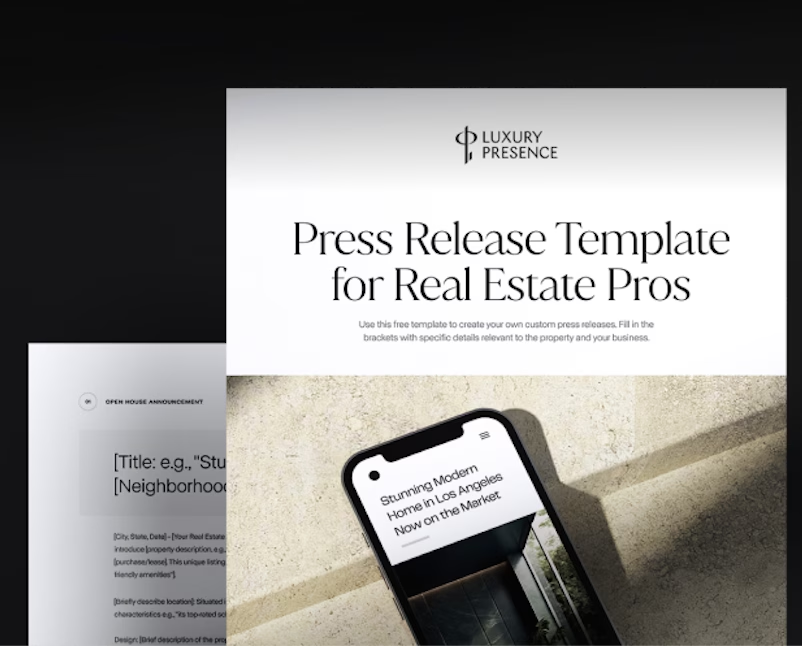
We partnered with industry experts to create easy-to-use, customizable press release templates announcing new listings, switching brokerages, sales awards, and more.
About the author

Marketing Manager
Kate Evans is a content marketing strategist at Luxury Presence, the leading growth platform for high-performing real estate professionals. She develops data-driven editorial content and supports SEO strategy and brand voice frameworks that help agents attract qualified leads and establish market authority. Her published work covers topics including CRM strategy, social media marketing, and digital growth, supporting thousands of agents in scaling their businesses through modern marketing.