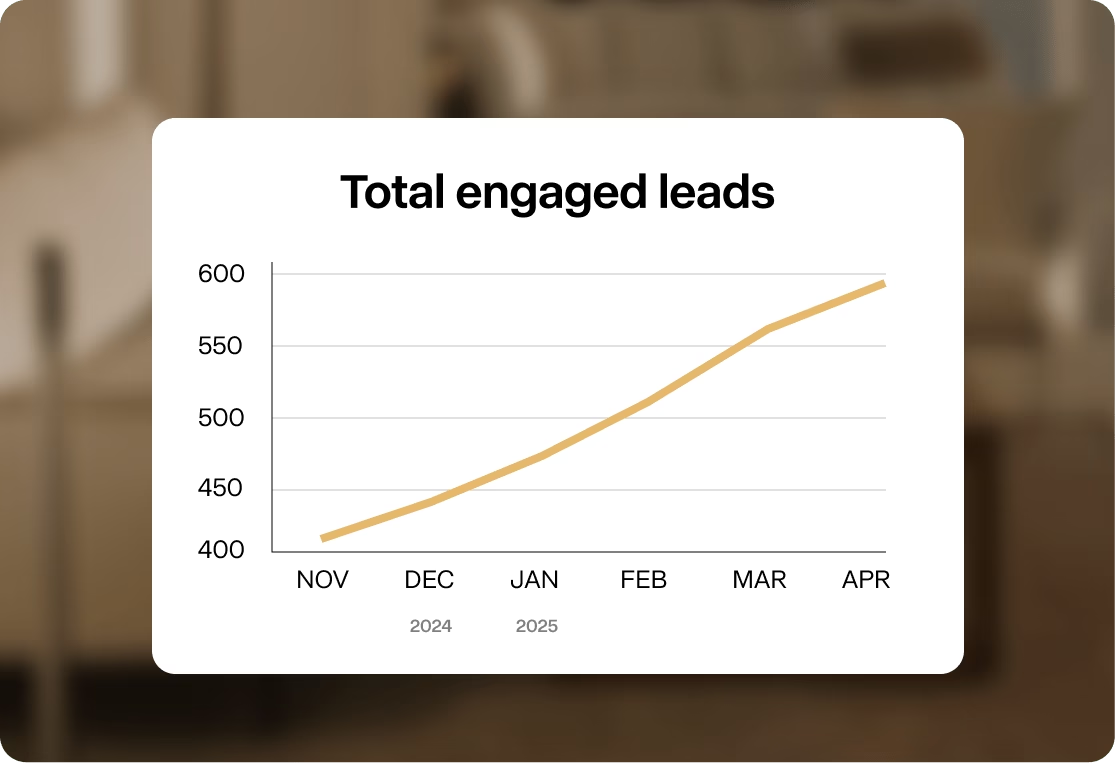
A real estate lead magnet is a high-value resource you offer to buyers or sellers in exchange for their contact information, and in 2026, it remains one of the most reliable ways to build a pipeline without cold calling. Whether you are working with first-time buyers navigating rate sensitivity or sellers trying to understand their home’s worth in a shifting market, the right lead magnet gives prospects a reason to raise their hand and tell you exactly what they need. This guide breaks down 12 real estate lead magnet ideas you can put to work right now, along with the strategy behind creating them, the landing pages that make them convert, and the follow-up systems that turn downloads into appointments.
Find It Fast
Key takeaways
- Lead magnets attract higher-intent prospects who are actively seeking guidance, not just browsing listings.
- Specific lead magnets outperform generic ones. A title like “Your 90-Day Plan to Sell for Max Value in a Cooling Market” will pull more targeted leads than “Real Estate Guide.”
- Home valuation tools are among the highest-converting seller lead magnets, with one Luxury Presence client generating 144 seller leads at $24.50 per lead in 98 days.
- Every lead magnet needs a dedicated landing page with a clear headline, a short form, and analytics tracking.
- A lead magnet without a follow-up sequence loses most of its value. Automated nurture is what turns a download into a conversation.
- In 2026, promoting your lead magnets across at least three channels (email, social media, and paid advertising) is the minimum for meaningful reach.
What is a real estate lead magnet?
A real estate lead magnet is a resource, tool, or piece of content you create for buyers or sellers that they can access only after submitting their contact information. Think of it as a trade: you give them something genuinely useful (a market report, a home valuation, a buyer’s guide) and they give you their name, email, and often their phone number. This inbound approach focuses on providing immediate value, building trust, and starting a relationship with someone who has already told you what they care about.
The format can vary. A lead magnet might be a downloadable portable document format (PDF), an interactive quiz, a video walkthrough, an email course, or a gated landing page with curated listings. What matters is that the resource solves a real problem or answers a real question for the person downloading it, and that the exchange feels fair.
How do lead magnets benefit real estate agents in 2026?
In 2026, with inventory constraints and rate sensitivity shaping buyer behavior across most metros, the agents capturing the most leads are those who give prospects a reason to self-identify early. Lead magnets do exactly that. They draw in people who are actively looking for guidance and willing to share their information in exchange for something that helps them make a decision. According to the National Association of Realtors, 97% of home buyers in recent years used the internet during their home search (NAR, 2024), which means your lead capture strategy needs to be working before you ever pick up the phone.
Lead magnets also give you a built-in segmentation signal. When someone downloads a first-time buyer guide, you know they are early in the process and need education. When someone requests a home valuation, you know they are at least considering a sale. That context makes your follow-up more relevant and your first conversation more productive.
That distinction matters. A prospect who voluntarily exchanges their information for a resource you created is signaling intent. They are not just clicking an ad. They are telling you what stage of the process they are in, and that makes every follow-up call, email, or text message more likely to land.
How to create a compelling real estate lead magnet
Not every lead magnet converts. The ones that work share a set of attributes that make the exchange feel worthwhile to the prospect. Here is what to build into yours.
Relevance
Address the specific needs and interests of your target audience. A first-time homebuyer guide and a luxury seller prep checklist serve very different people. The more precisely you match the resource to the audience, the higher your conversion rate will be.
Value
The resource needs to contain information the prospect cannot easily find with a quick search. Original data, local pricing context, or a clear framework for making a decision all qualify. If the content feels like it could have been pulled from a generic blog post, it will not earn a form submission.
Specificity
Clear, focused lead magnets tend to perform better than broad ones. Instead of a general real estate guide, a title like “Your 90-Day Plan to Sell for Max Value in a Cooling Market” attracts more targeted leads because it speaks to a specific situation and a specific outcome.
Clarity
The benefits of the lead magnet should be obvious before the prospect fills out the form. They should know exactly what they are getting, what format it is in, and how it will help them. Ambiguity kills conversions.
Ease of access
Whether it is a downloadable PDF, an email course, or a video tutorial, the format should be convenient. If someone has to jump through multiple steps to access the resource after submitting their information, you will lose them.
Design quality
A well-designed lead magnet signals that you take your business seriously. Clean formatting, readable typography, and a polished layout reflect well on your brand and increase the likelihood that the prospect will actually read what you sent them.
Action orientation
The best lead magnets include steps the reader can take immediately. A checklist they can start working through today, a calculator that gives them a number they can use in a conversation, or a timeline that helps them plan their next 90 days. When the resource leads to action, it also leads to a follow-up conversation with you.
Testing and iteration
Review your analytics regularly. Track which lead magnets get the most downloads, which landing pages have the highest conversion rates, and which follow-up sequences produce the most replies. Use that data to retire underperformers and double down on what works.
12 real estate lead magnet ideas for agents
Below are 12 lead magnet formats that work for real estate agents across different markets and audience segments. For each one, you will find the concept, who it serves, and how to make it convert.
1. Local market analysis reports
Provide in-depth local market trends, pricing data, and neighborhood-level insights. In 2026, with buyers and sellers navigating a market shaped by persistent rate sensitivity and limited inventory in many metros, a well-timed local market report gives you a reason to reach out and a reason for prospects to respond. When the data feels specific and timely, people are more willing to trade their contact information for the download.
To make this work, update your report monthly or quarterly and include data points that are not available on major portals: days on market by neighborhood, price-per-square-foot trends, and absorption rates. The more local and current the data, the more valuable the report.
2. Neighborhood guides
Compile detailed information on local areas, highlighting amenities, school districts, lifestyle features, and community characteristics. People often research neighborhoods long before they speak with an agent. A well-made guide positions you as the local authority they trust when they are ready to act.
Include details that only a local would know: the best coffee shop on the block, which streets flood during heavy rain, where the farmers market sets up on weekends. That level of specificity is what separates a useful guide from a generic one.
3. Real estate quizzes
Create quizzes that group people into categories like buyer profile, seller type, or preferred neighborhood style, using light, curiosity-driven questions that collect preferences without acting as formal assessments. Typeform, an online form and quiz builder, offers conditional logic and result screens as part of their 2026 subscription plans, making it straightforward to display a personalized buyer or seller summary at the end.
Quizzes work because they feel interactive rather than transactional. The prospect gets a result they are curious about, and you get their contact information plus a snapshot of their preferences.
4. Short surveys with personalized summaries
Offer brief surveys that generate a customized outcome such as a buyer-readiness rating, an estimated selling timeline, or a home-style match. Jotform, a form-building platform, includes an AI-assisted survey generator in its 2026 product suite, making it straightforward to build branching surveys without coding.
The key is to make the output feel personalized. A generic “you’re ready to buy” message will not impress anyone. A summary that says “based on your answers, you are likely 3 to 6 months from being mortgage-ready, and here are the two steps to close that gap” gives the prospect a reason to reply to your follow-up email.
5. Buyer’s guides by segment
Outline step-by-step resources for different types of home buyers: first-time buyers, investors, relocators, or luxury clients. As of 2026, first-time buyers face a steeper learning curve than in prior cycles, making a clear, jargon-free guide one of the most appreciated resources you can offer.
Segment your guides by audience rather than trying to create one guide that covers everyone. A first-time buyer guide should explain pre-approval, earnest money, and inspection contingencies. An investor guide should cover cap rates, 1031 exchanges, and rental yield calculations. The more specific the guide, the more qualified the lead.
6. Seller’s preparation checklists
Give homeowners a clear list of the most important tasks to complete before listing. In a 2026 market where presentation and pricing precision matter more than ever, sellers who prepare early have a measurable advantage.
Go beyond the basics of cleaning and decluttering. A strong checklist also includes:
- Gathering appliance warranties and manuals
- Checking permits for past improvements
- Updating lightbulbs for consistent brightness in listing photos
- Scheduling a pre-listing inspection to identify surprises early
- Improving curb appeal with small exterior touchups
- Requesting a preliminary title report
7. Buyer or seller decision worksheets
Offer short worksheets that help people think through decisions such as whether to rent or buy, whether it is a good time to sell, or what price range fits their budget. These work well with first-time buyers and sellers who are still in the research phase and looking for a structured way to evaluate their options.
Keep the worksheet to one or two pages. Include prompts, not just blank fields. For example, instead of “Monthly budget: ___,” try “What is the maximum monthly payment you could make without cutting into your emergency fund?” That level of guidance makes the worksheet feel like a consultation, not a form.
8. Home valuation tools
Home valuation tools offer property value estimates based on recent sales and current market data. They capture seller interest early because most homeowners want to understand what their home might be worth before speaking with an agent. Learn more by reading the guide to capturing seller leads with home valuations.
To see what this looks like in practice: a Luxury Presence client in the San Francisco Bay Area ran a Facebook campaign built around a home valuation offer, supported by A/B-tested ad creative and a lead capture form. In 98 days, the campaign generated 144 seller leads at an average cost of $24.50 per lead and produced 2 signed listings from a total ad spend of $3,536 (Luxury Presence Case Study: Seller Leads at $24.50 CPL in San Francisco, 2026).
9. Hyperlocal and niche property finder pages
Build landing pages focused on specific property categories such as no-homeowners association (HOA) listings, homes with accessory dwelling units (ADUs), waterfront properties, or homes within a specific price range. These serve as curated listing collections rather than neighborhood guides, and they attract prospects with a very specific search intent.
Luxury Presence websites, a real estate website and marketing platform, allow you to use a Forced Conversion Modal to capture lead information before visitors can access your landing page. That means every visitor who wants to see the listings has to give you their contact details first.
This approach works because the prospect is already telling you exactly what they want. Someone searching for “no-HOA homes under $600K in Scottsdale” is a highly qualified buyer, and a gated page built around that search gives you the lead and the context to have a relevant first conversation.
10. Financial calculators
Create tools such as a closing cost calculator or mortgage readiness estimator that give buyers or sellers quick financial clarity. Outgrow, an interactive content platform, lets you build custom calculators with no coding experience, and as of 2026 includes native lead capture and customer relationship management (CRM) integration.
Calculators convert well because they deliver an immediate, personalized result. A buyer who discovers their estimated closing costs are $18,000 is far more engaged than one who read a blog post saying “closing costs are typically 2% to 5%.” The specificity creates urgency and a natural opening for your follow-up.
11. Home search starter kits
Offer a short starter kit that teaches buyers how to get the most from your website’s home search tool, including saved searches, custom filters, and listing alerts. You will not only capture leads, but show them how to engage with your website’s search portal so they keep coming back.
This is a two-for-one lead magnet. The prospect gets a useful resource, and you get a lead who is now trained to use your website instead of a third-party portal. Every saved search they set up is another reason for them to return to your site and another touchpoint for you to follow up on.
12. Contests
Contests work best when participation is quick and the prize is clear. Offer something simple, like a neighborhood photo contest where people submit their favorite local snapshot for a chance to win a gift card to a local business. Require an email address to enter, and you have a lead magnet that also builds community engagement.
Keep the barrier to entry low. The more steps required, the fewer entries you will receive. A single form field (email) plus a photo upload is enough. Announce the winner on social media to drive additional visibility for the next round.
How to create landing pages for real estate lead magnets
Landing pages are where your lead magnets convert. Each lead magnet should have its own dedicated page where visitors can quickly understand what you are offering, see why it is worth their contact information, and fill out a form to receive it. A dedicated page lets you match the message to the audience, which directly improves your conversion rate.
A strong landing page includes:
- A clear headline that tells visitors exactly what they will get
- Simple, direct content that explains the benefit of the lead magnet
- A strong call to action (CTA) that tells visitors what to do next
- A short, easy-to-complete form (name, email, and phone number at most)
- A unique URL you can use in ads, emails, or social campaigns
- Analytics tracking so you can measure performance and improve over time
According to Unbounce’s conversion benchmark data, the median landing page conversion rate across industries is approximately 4.3%, with the top 25% of pages converting above 5.3% (Unbounce, 2024). In real estate, where the ask is often just a name and email, well-designed landing pages can exceed those benchmarks, especially when the lead magnet is specific and the headline clearly communicates the value.
The table below compares common landing page elements and their impact on conversion:
| Landing page element | Best practice | Common mistake |
| Headline | States the specific benefit the visitor will receive | Uses vague language like “Download our free guide” |
| Form length | 2 to 3 fields (name, email, phone) | Asking for mailing address, budget, and timeline upfront |
| CTA button text | Action-specific (“Get My Market Report”) | Generic (“Submit”) |
| Page layout | Single focus, no navigation menu distractions | Full website header and footer with multiple exit points |
| Social proof | One testimonial or “500+ homeowners downloaded this report” | No credibility signals anywhere on the page |
Landing pages give your lead magnets the clarity and focus they need to convert. When you pair them with a thoughtful follow-up sequence, you turn casual visitors into real clients.
How to implement your real estate lead magnet strategy
In 2026, multi-channel promotion is not optional. A lead magnet that lives only on your website will reach a fraction of its potential audience. Here is a step-by-step approach to putting your lead magnet strategy into motion.
- Assess your target audience. Identify the most pressing needs and questions of your ideal clients. Are you primarily serving first-time buyers, move-up sellers, investors, or a mix? The answer determines which lead magnets to build first.
- Develop two to three targeted lead magnets. Start with a small number of high-quality resources rather than trying to build ten at once. One buyer-focused magnet and one seller-focused magnet gives you coverage across both sides of the transaction.
- Build a dedicated landing page for each lead magnet. Follow the landing page framework outlined above. Each page should have its own URL, its own headline, and its own analytics tracking.
- Promote across multiple channels. Use a mix of email, social media, paid advertising, and content marketing to drive traffic to your landing pages. Details on each channel are in the promotion section below.
- Monitor and adjust. Review conversion rates weekly for the first month, then monthly. If a landing page is getting traffic but not conversions, test a new headline or shorten the form. If a lead magnet is converting but not producing appointments, revisit your follow-up sequence.
- Nurture captured leads. Develop a follow-up sequence to engage new leads and move them toward a conversation. Luxury Presence automates this for you with their Lead Nurture Marketing system, which sends the right message at the right time so no opportunity goes unanswered. Nothing sends without your approval.
The agents who get the most from their lead magnets are the ones who treat them as part of a system, not a one-time project. Build the magnet, build the landing page, build the follow-up sequence, and then promote consistently.
How to promote real estate lead magnets
Creating a lead magnet is half the work. The other half is getting it in front of the right people, consistently, across the channels where your prospects are already spending time.
Email marketing
Create email sequences specific to each lead magnet to nurture prospects as they enter your CRM. Develop a monthly email campaign highlighting different lead magnets to re-engage your database. A seller who did not respond to your market report in January may be ready for your home valuation tool in March.
Social media
Share lead magnet teasers across social media platforms. Fold lead magnet posts into your content calendar so they appear regularly, not just once. Short video clips explaining what the resource covers tend to outperform static image posts for driving clicks to your landing page.
Paid advertising
Content marketing integration
Incorporate lead magnet CTAs into your blog and article content strategy. Every blog post you publish should include a relevant lead magnet CTA that matches the topic. A blog post about preparing a home for sale should link to your seller’s preparation checklist. A post about understanding mortgage rates should link to your financial calculator.
Website placement
Place lead magnet offers throughout your website. Use exit-intent popups, sidebar banners, and in-content CTAs to catch visitors at different points in their browsing session. The goal is to make sure no one leaves your site without seeing at least one relevant offer.
Networking and event marketing
Promote lead magnets during in-person interactions. Create business cards with a quick response (QR) code linking directly to your landing page. When you meet someone at an open house, a community event, or a networking meeting, you can hand them a card that leads to a resource rather than just your contact information. That gives them a reason to engage with you digitally after the conversation ends.
Turning Lead Magnets Into Consistent Real Estate Leads
The best real estate lead magnets do more than collect emails. They give buyers and sellers something genuinely useful, make it easy to take the next step, and create a natural opening for follow-up. If you focus on specificity, strong landing pages, and consistent promotion, you can turn one helpful resource into a steady source of qualified conversations.
FAQs
Landing pages generate leads
Our e-book guides you through seven types of landing pages that are engineered to bring in high-quality prospects.

About the author

Marketing Manager
Kate Evans is a content marketing strategist at Luxury Presence, the leading growth platform for high-performing real estate professionals. She develops data-driven editorial content and supports SEO strategy and brand voice frameworks that help agents attract qualified leads and establish market authority. Her published work covers topics including CRM strategy, social media marketing, and digital growth, supporting thousands of agents in scaling their businesses through modern marketing.