

Your contact database is the biggest asset in your real estate business, and most agents manage it worse than they'd admit. A real estate CRM is built to fix that. It stores every contact, tracks every transaction milestone, and tells you who to follow up with before a competing agent gets there first.
The term real estate CRM covers wildly different products, from $19-a-month sales trackers to $500-a-month all-in-one platforms, and picking the wrong one means paying for features you'll never touch or missing the ones that actually save you time.
This guide breaks down what a real estate CRM does, which features are worth paying for, and how 15 leading platforms compare on price, fit, and honest limitations.
Whichever platform you land on, treat the database inside it as the valuable resource that it is.
Real estate coach and advisor, Chirag Shah, frames it this way: "It's the only tangible asset you have of value. It's the only thing that people will eventually buy from you if you ever want to sell your business."
Key takeaways
- A real estate CRM does two jobs a generic CRM doesn't: it tracks the specific milestones of a real estate transaction (offer, inspection, appraisal, closing), and it's built around long-cycle, referral-driven relationships instead of one-time sales.
- The best CRM is the one you'll actually use. Prioritize a platform that matches your daily workflow and tech comfort over one with the longest feature list.
- Pricing ranges from free to $500+ per month. Solo agents can find strong options under $60/month. Teams and brokerages should budget for enterprise tiers with lead routing and manager dashboards.
- Real estate-specific CRMs ship with industry workflows out of the box. General-purpose platforms like Pipedrive, HubSpot, and ClickUp offer more flexibility, but you'll configure real estate workflows yourself.
- Disclosure: Luxury Presence, which publishes this article, sells an AI CRM included with its website plans. We've included it below with the same pros-and-cons format as every other platform, and it didn't get preferential treatment in scoring. Skip to Luxury Presence AI CRM if you want to judge for yourself first.
What is a real estate CRM?
A real estate CRM (customer relationship management platform) is software built to manage the contacts, communications, and transaction milestones specific to buying, selling, and leasing property. It does what any CRM does: store contact records, log interactions, and organize a pipeline.
What makes it a real estate CRM is the layer on top: MLS and IDX integration, transaction checklists tied to real estate-specific stages (under contract, inspection, appraisal, closing), commission tracking, and marketing templates written for buyers and sellers instead of generic sales prospects.
That distinction matters because real estate sales cycles look nothing like a typical B2B or retail sales cycle. A lead might take 18 months to become a client. A past client might not transact again for seven years, but when they do, they're a warm referral source in the meantime.
A generic sales CRM optimizes for closing a deal and moving on. A real estate CRM optimizes for staying visibly, usefully present in someone's life for years, so you're the person they call when they're ready to move.
What features actually matter in a real estate CRM
Not every feature on a pricing page moves the needle. These are the ones that separate platforms agents keep using from the ones they abandon after a few months:
- Lead capture and routing. The CRM should pull leads automatically from your website, IDX pages, and ad campaigns, then route them to the right agent without manual entry.
- Automated follow-up. Drip email and text sequences that run on their own, triggered by lead behavior like a saved search or a viewed listing, rather than a static calendar.
- Transaction and task tracking. A single deal can involve 30+ tasks between contract and closing. The CRM should keep every deadline visible.
- Segmentation and smart lists. Separating active buyers, active sellers, past clients, and vendors without manually tagging every contact.
- Mobile access. Agents are rarely at a desk. A CRM that only works well in a browser will get used less.
- Reporting on lead source ROI. Knowing which sources actually convert is what lets you stop paying for the ones that don't.
Matt Breitenbach adds, "It amazes me that brokers are not using CRMs. There's so much power in automation. For example, we've set up an email campaign for leads that invites them to our private market database."
How much do real estate CRMs cost?
Pricing depends mainly on seat count and how much automation is included. A solo agent can typically find a strong platform for $50 to $100 per month. Teams and brokerages that need lead routing, manager dashboards, and higher contact limits should budget several hundred dollars per month.
A few platforms run into four figures monthly once you add users, AI texting, or a power dialer. Platforms that require you to "contact sales" instead of publishing a price are usually signaling that cost scales with team size.
Most reputable platforms offer a 14- to 30-day free trial, so use it before you commit.
Pricing below was verified in August 2026 and is subject to change. Confirm current pricing directly with each vendor before purchasing.
How we evaluated these platforms
Every CRM in this guide was assessed on six criteria:
- Real estate specificity: Does it ship with real estate workflows and templates, or does it require you to build them?
- Pricing and value: What do you get for the price, and are there hidden costs for texting, dialing, or add-ons?
- Automation capabilities: Can it run drip campaigns, lead routing, and follow-up sequences without manual work?
- Integration ecosystem: How well does it connect to the tools agents already use, including websites, lead sources, email, and marketing platforms?
- Ease of use and onboarding: How fast can a new user get productive, and is support available when something breaks?
- Mobile functionality: Can agents manage their pipeline entirely from a phone?
Each entry below includes a "best for" label, pros and cons, a bottom-line verdict, and independent ratings from G2 and Capterra where enough reviews exist to be meaningful.
Methodology: This comparison is built from each platform's published pricing and product documentation, plus independent user reviews on G2 and Capterra, not hands-on testing. Commercial integrations or partnerships with Luxury Presence had no bearing on inclusion or ranking. Where a platform doesn't publish a price, or where G2 and Capterra don't have enough reviews to be reliable, we say so instead of estimating. Spotted something outdated? Tell us and we'll correct it.
Real estate CRM comparison at a glance
| CRM | Starting price | Free trial | Best for |
|---|---|---|---|
| Luxury Presence AI CRM | Custom quote across 4 plans | No (demo available) | Agents who want signal-based outreach instead of a static database |
| Follow Up Boss | $58/user/mo (annual) | 14 days | Teams needing lead routing |
| Wise Agent | $49/mo, or $42/mo annual | 14 days | Solo agents wanting strong value |
| Lone Wolf Relationships | Contact for pricing | 14 days | Former LionDesk users needing the simplest migration |
| Pipedrive | $19/user/mo | 14 days | Sales-focused agents who like a visual pipeline |
| MoxiEngage | Contact for pricing | No | Brokerages needing coaching dashboards |
| BoldTrail (kvCORE) | Quote-based, not published | No | Teams wanting IDX sites + CRM in one system |
| Lofty (formerly Chime) | Quote-based, not published | No | Agents wanting website, CRM, marketing, and AI in one system |
| Realvolve | $59/mo (Essential), $99/mo (Professional) | 14 days | Agents who want deep workflow automation |
| Salesforce Starter Suite | $25/user/mo | 30 days | Large brokerages with dedicated admin support |
| HubSpot Smart CRM | Free, paid from $45/seat/mo (annual) | Free tier | Small teams that want to start free |
| Sierra Interactive | $299.95/mo (1 user, annual) | No | Teams wanting CRM + IDX site + paid lead gen in one bundle |
| Real Geeks | $399/mo (12-mo term) + $500 setup | No | Agents who want CRM, IDX site, and built-in AI text engagement |
| Top Producer | ~$129/user/mo (Pro plan) | Contact provider | Agents who rely heavily on MLS-driven farming |
| ClickUp | Free (paid from $7/mo) | Free tier | Tech-savvy agents on a budget |
Disclosure: Luxury Presence, the publisher of this article and a real estate marketing technology company, integrates with several platforms listed above, including Follow Up Boss, Wise Agent, Realvolve, MoxiEngage, BoldTrail, and Pipedrive (via Zapier). Integration status did not influence inclusion or scoring. All assessments are based on published features, pricing, and independent user reviews.
The 15 best real estate CRM platforms in 2026
Luxury Presence AI CRM

Best for: Agents and teams who want a CRM that tells them who to contact and why, instead of a database they have to work.
Luxury Presence's AI CRM is included with every Luxury Presence website plan rather than sold as a standalone product. That's the tradeoff worth knowing upfront. It pulls contacts from your email, third-party CRMs, and lead sources, then organizes them into smart lists automatically.
Its core function is signal detection: it monitors website visits, saved listings, ad engagement, email opens, and public life events, like a new job or a marriage, across your network, then surfaces the contacts most likely to transact.
Every day, "Smart Actions" recommends specific people to reach out to and drafts a message in your brand voice, which you approve or edit before anything sends.
As of publication, Luxury Presence reports over 3.5 million contacts managed and 920,000+ contacts scored for buying and selling signals across the platform.
Pros
- Signal-based prioritization (life events, behavior, market activity) instead of static contact storage
- Drafts follow-up messages in your voice, and nothing sends without approval
- Automatic contact organization and de-duplication, with no manual sorting
- Included with every plan (Launch, Brand, Scale, All In), not an upsell
Cons
- Not available as a standalone CRM. It requires a Luxury Presence website plan (Launch, Brand, Scale, or All In)
- Priced by custom quote rather than a published monthly rate, so you won't find a self-serve number on the pricing page. A one-time setup fee starts at $2,500
- Nurtured contact limits scale by plan, so high-volume teams need a higher tier
Bottom line: If you're already choosing a real estate website platform and want a CRM that actively tells you who to call instead of just holding contacts, this is worth evaluating alongside the standalone options below. If you specifically need a CRM you can buy independent of a website, it's not the right fit.
Rating: 4.4/5 on G2 (28 reviews), as of August 2026.
Follow Up Boss
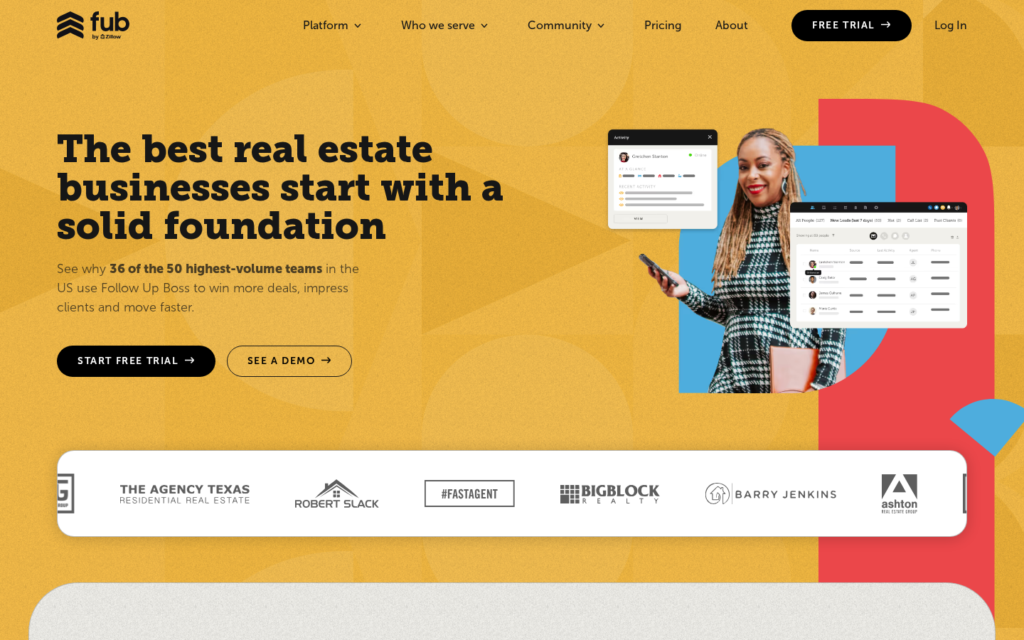
Best for: Teams and brokerages that need strong lead routing and a wide integration ecosystem.
Follow Up Boss is one of the most widely used CRMs in real estate, with email, calling, and texting built into one dashboard. It allows unlimited contacts and includes drip and batch email automation out of the box. Our Follow Up Boss pricing guide breaks down what teams actually pay once add-ons are factored in.
Pros
- 250+ integrations, including Luxury Presence
- Flexible lead routing for teams of any size
- Built-in texting with automation triggers
- Mobile app for iOS and Android
Cons
- No 24/7 support
- No native Facebook Ads integration
- Owned by Zillow Group, which some agents weigh as a conflict given Zillow's own lead business
Bottom line: A reliable default for teams that need lead routing without stitching together separate tools.
Rating: 4.6/5 on G2 (117 reviews), 4.5/5 on Capterra (58 reviews), as of August 2026.
Wise Agent
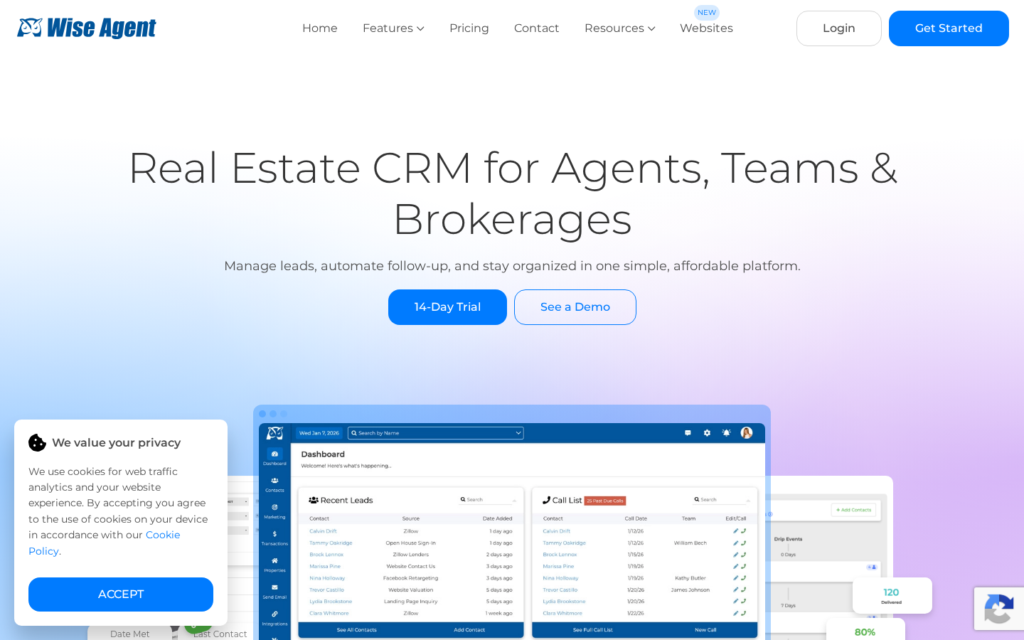
Best for: Solo agents who want a real estate-specific CRM with strong support at a low monthly cost.
Wise Agent has been around longer than most CRMs on this list, and it shows in how complete the core feature set is for $49/month, or $42/month billed annually ($499/year): transaction management, drip marketing, landing pages, and a contact database with a minimal learning curve. Our full Wise Agent review covers how it holds up day to day.
Pros
- 100+ native integrations plus Zapier connections
- 24/7 U.S.-based customer service
- Free 1:1 onboarding session
Cons
- No mobile app, browser access only
- Texting costs extra
- No auto dialer
Bottom line: Hard to beat under $50/month for a solo agent who wants hands-on support during setup.
Rating: 3.6/5 on G2 (15 reviews), 4.4/5 on Capterra (531 reviews), as of August 2026.
Lone Wolf Relationships (formerly LionDesk)

Best for: Former LionDesk users who want the simplest possible migration, or anyone who wants straightforward CRM functionality without rethinking their whole stack.
LionDesk was discontinued as a standalone CRM in 2025. Lone Wolf wound the product down through September 2025 and pointed former users to Lone Wolf Relationships, which launched that year as the official replacement. It carries over a familiar workflow with a simplified interface and AI-enhanced email tools.
If you're still evaluating options after the shutdown, our LionDesk alternatives guide walks through six platforms agents commonly consider, including this one.
Pros
- AI-powered email optimization features
- Simplified interface built to reduce day-to-day friction
- Automated workflows, including reminders, follow-ups, and unified communications
- A straightforward migration path for former LionDesk accounts
Cons
- Released in 2025, so it has a short track record and limited independent reviews
- Pricing isn't published, so you'll need to contact Lone Wolf directly
- Built around CRM and communications, not brand-building or lead generation, so agents who relied on LionDesk for those will need a separate tool
Bottom line: The easiest option if you were on LionDesk and just want a CRM that works the same way. Not built for agents who also need website, SEO, or lead-gen tools bundled in.
Rating: Too new to have a meaningful independent review base as of August 2026.
Pipedrive
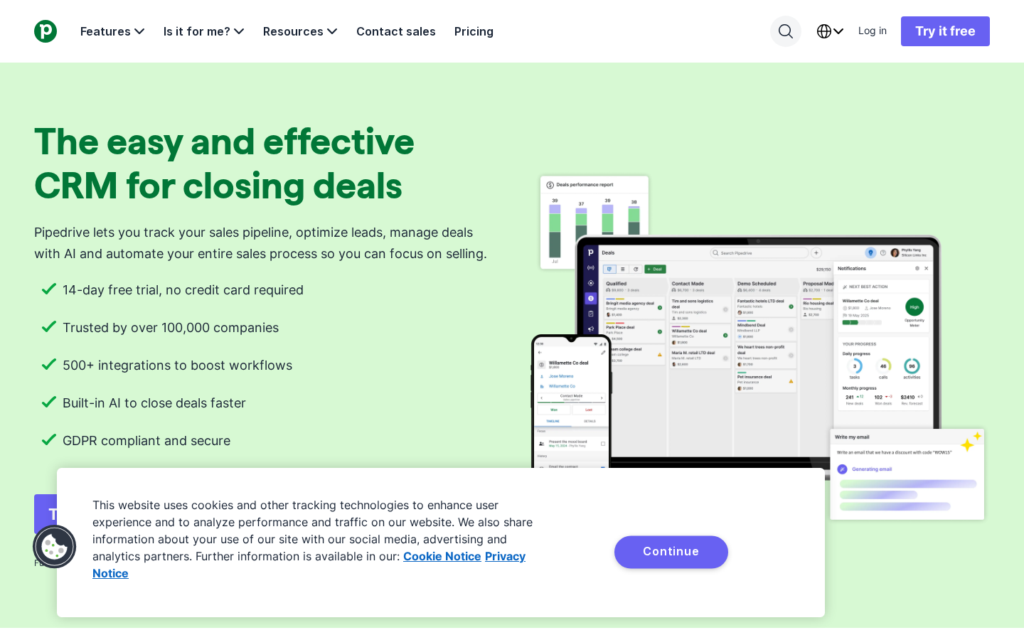
Best for: Sales-focused agents who want a clean visual pipeline and strong reporting at a low entry price.
Pipedrive is a general-purpose sales CRM, not built for real estate, but its deal-stage pipeline view is one of the clearest in the category. The base plan is $19/user/month. Most agents will want the Professional tier, around $64/user/month, for lead routing and AI-powered reporting.
Pros
- Clean, highly visual pipeline
- Strong forecasting and reporting
- Zapier connections to Luxury Presence, Mailchimp, and others
Cons
- No real estate workflows out of the box, so you build them yourself
- Limited mobile functionality relative to desktop
- Thin marketing tools on lower tiers
Bottom line: A good fit if you think in pipeline stages and don't mind configuring real estate-specific steps yourself.
Rating: 4.3/5 on G2 (3,000+ reviews), 4.5/5 on Capterra (3,000+ reviews), as of August 2026.
MoxiEngage
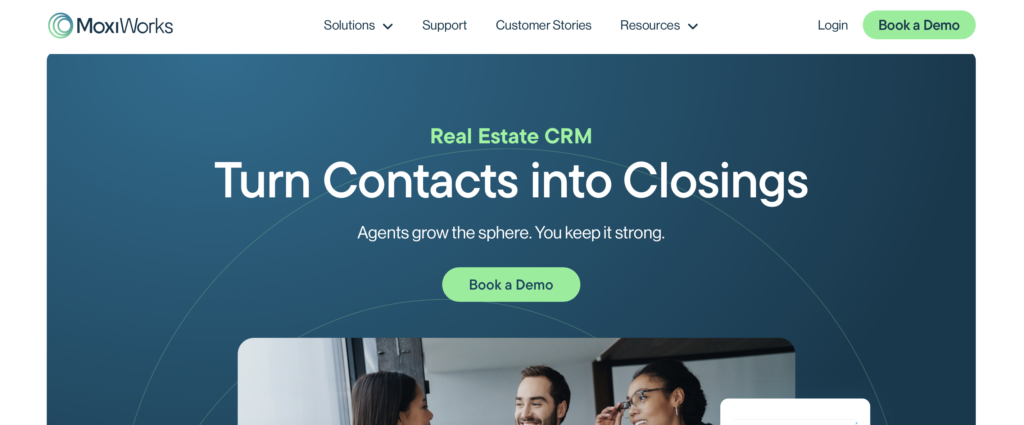
Best for: Brokerages and team leads who need coaching dashboards and daily activity visibility.
MoxiEngage gives agents a daily view of tasks, contacts, and goals, with a manager dashboard built for coaching and performance tracking.
Pros
- Built-in dialer and messenger
- Manager dashboard for coaching
- Integrates with Luxury Presence, Zillow, and major MLS systems
Cons
- No free trial
- Pricing isn't published, so you have to contact MoxiWorks directly
- Less customizable for non-standard workflows
Bottom line: Built for brokerages that want visibility into agent activity. Likely more structure than a solo agent needs.
Rating: Capterra shows a wide split between MoxiEngage-specific reviews (around 2.9/5 on 11 reviews) and the broader MoxiWorks seller page (4.5/5 on G2, 28 reviews, not product-specific). With samples that small, treat both as directional rather than definitive.
BoldTrail (formerly kvCORE)
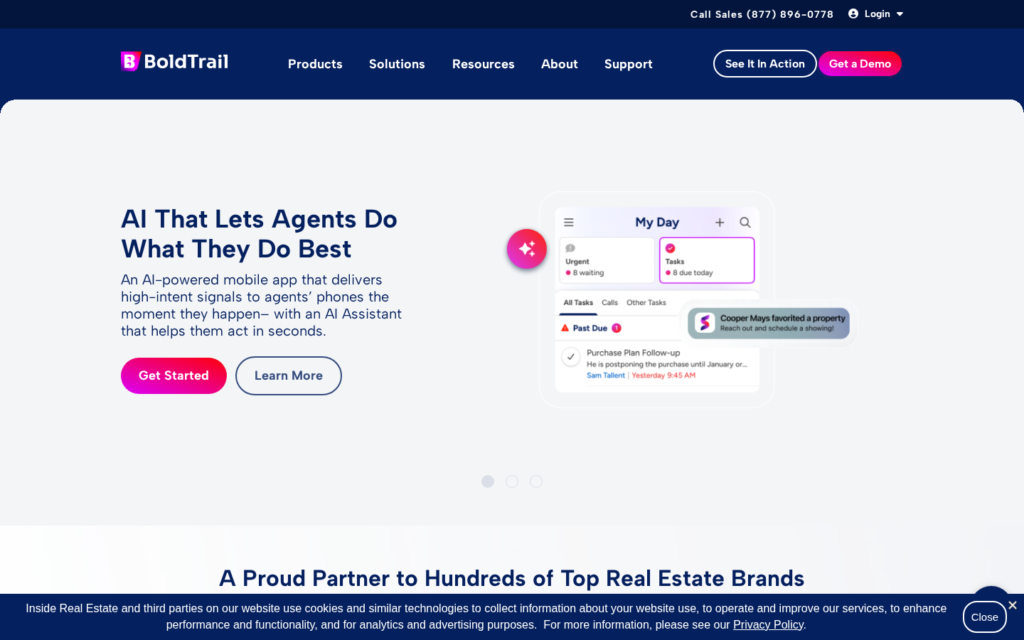
Best for: Teams that want IDX websites, lead generation, and CRM bundled into a single platform.
BoldTrail includes IDX sites, marketing automation, and lead-capture landing pages. BoldTrail doesn't publish a standard monthly rate, so pricing depends on agent count and whether you access it through a brokerage. Some third-party cost trackers cite roughly $500/month for one to two users plus a $1,000 setup fee, but that figure isn't confirmed on BoldTrail's own site. Our BoldTrail (kvCORE) pricing guide collects what's publicly known.
Pros
- AI-driven automation and customizable IDX websites
- Team management tools for brokerages
- Reporting and analytics dashboards
Cons
- No free trial or free version
- Steep learning curve given the feature breadth
- No published price, so you won't know your real cost until you talk to sales
Bottom line: Worth evaluating if you want IDX, lead gen, and CRM from one vendor and have brokerage-level budget. Overbuilt for a solo agent, and you'll need a sales call to get a number.
Rating: 4.5/5 on G2 (1,535 reviews), 4.4/5 on Capterra (564 reviews), as of August 2026.
Lofty (formerly Chime)
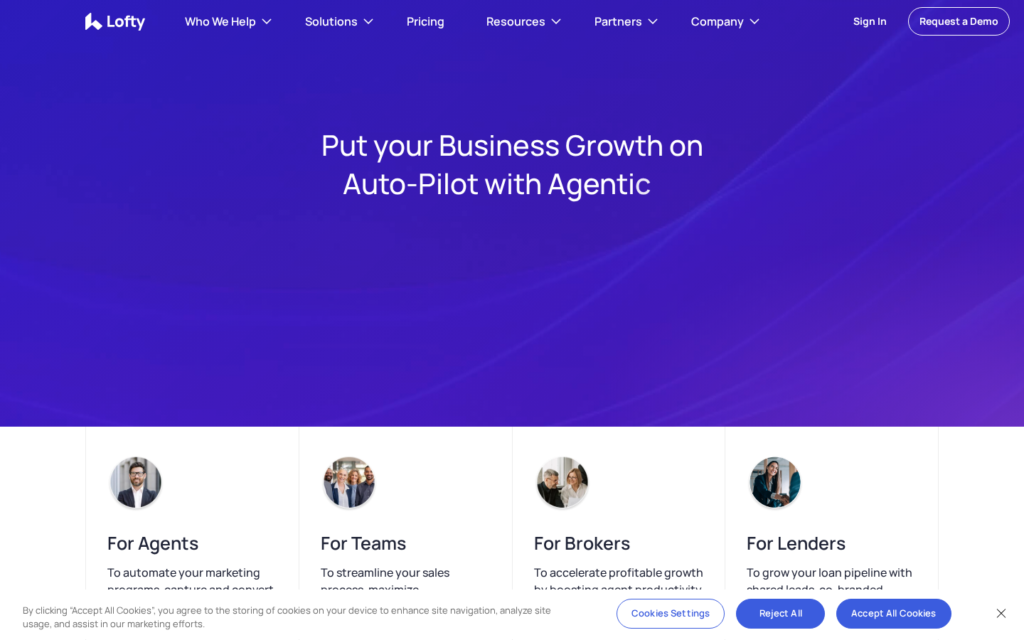
Best for: Agents who want website, CRM, marketing automation, and AI living in one system without stitching together separate tools.
Lofty launched what it calls real estate's first agentic AI operating system in February 2026, coordinating multiple specialized AI agents across sales, social media, and homeowner prospecting. Like BoldTrail, it doesn't publish a starting price. Agent, Team, Broker, and Enterprise packages are all quoted, and cost moves with seat count and any lead-generation program attached.
Our Lofty pricing breakdown collects what's publicly known, and Lofty vs. Follow Up Boss puts it head to head with another platform on this list.
Pros
- IDX website, CRM, marketing automation, and an AI chatbot in one platform
- Behavior-based lead scoring using site activity and engagement
- AI Copilot drafts communications and summarizes conversations
Cons
- No published starting price. Cost is quoted per agent, team, or brokerage
- No free trial
- All-in-one breadth means a learning curve if you only need a CRM
Bottom line: A strong fit if you want website, CRM, and AI-driven nurture from a single vendor and don't mind a sales-assisted quote instead of a self-serve price.
Rating: 4.3/5 on G2 (397 reviews), 3.9/5 on Capterra (127 reviews), as of August 2026.
Realvolve
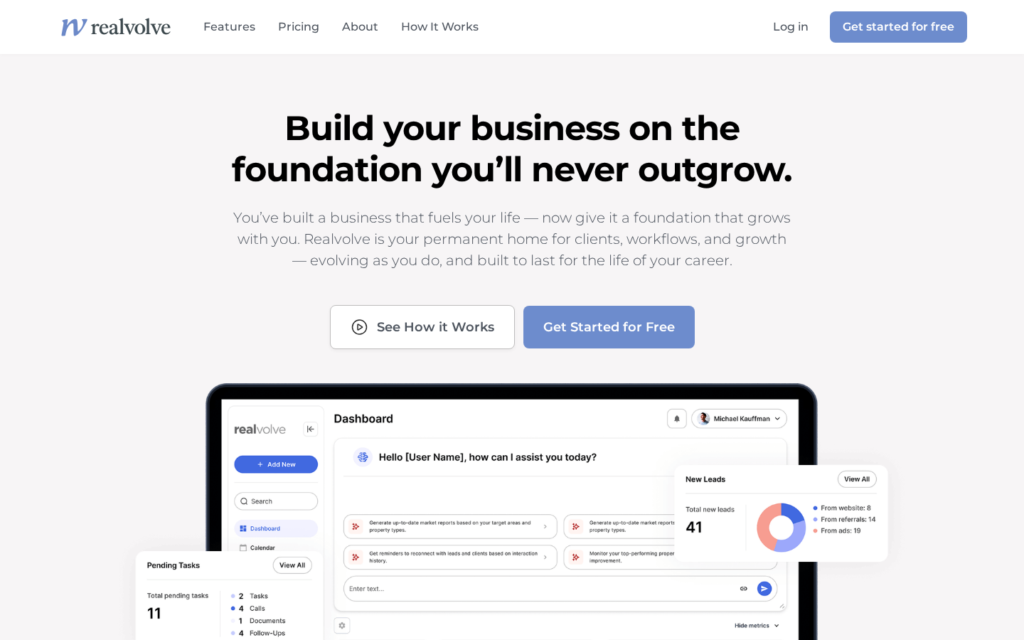
Best for: Process-driven agents who want deep workflow automation and are willing to build it out.
Realvolve specializes in automating transaction workflows, with a large library of prebuilt, customizable templates. Third-party listings show pricing starting around $59/month for the Essential plan, with Professional commonly listed at $99/month. Enterprise pricing is quote-based.
See our Realvolve review for the full cost breakdown and our Realvolve alternatives guide if it turns out not to be the right fit.
Pros
- Large library of prebuilt workflows
- Customizable automated marketing sequences
- Integrates with Luxury Presence and others via Zapier
Cons
- No native website or bundled IDX. IDX is only available through a separate IDX Broker integration
- Steep learning curve when building workflows from scratch
Bottom line: Strong for agents who want granular control over their process. Not a good fit if you want something that works with minimal setup.
Rating: 3.6/5 on G2 (19 reviews), 4.3/5 on Capterra (47 reviews), as of August 2026.
Salesforce Starter Suite
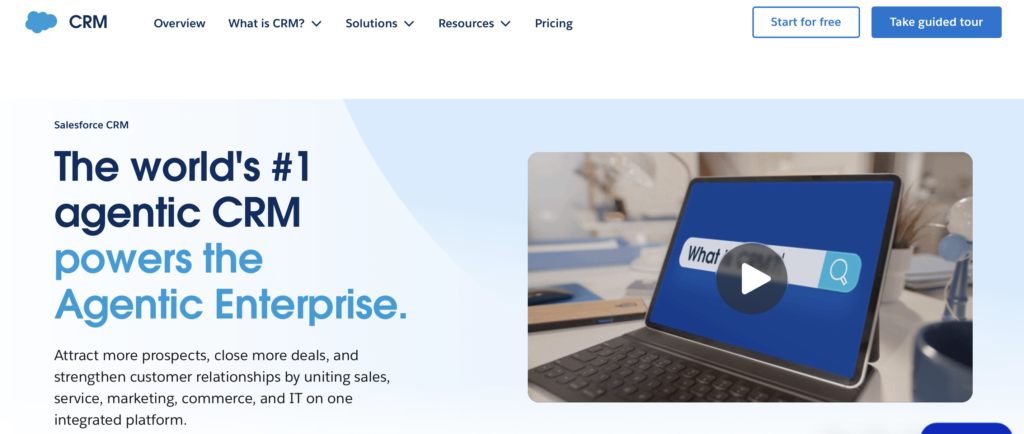
Best for: Large brokerages with dedicated admin support that need an enterprise-grade, highly customizable CRM.
Salesforce has no dedicated real estate product line. Brokerages either configure Starter Suite ($25/user/month) themselves or buy a real estate-specific AppExchange add-on like AscendixRE. It offers a 30-day free trial and thousands of third-party integrations via AppExchange.
Pros
- Highly customizable for any workflow or reporting need
- Advanced analytics
- Massive third-party integration ecosystem
Cons
- Steep learning curve
- Effective customization usually requires a Salesforce admin or consultant
- No real estate workflows out of the box
Bottom line: The most powerful platform here in raw capability, but it demands admin resources most solo agents and small teams don't have.
Rating: 4.4/5 on G2, based on early reviews of the Starter Suite tier specifically, as of August 2026.
HubSpot Smart CRM
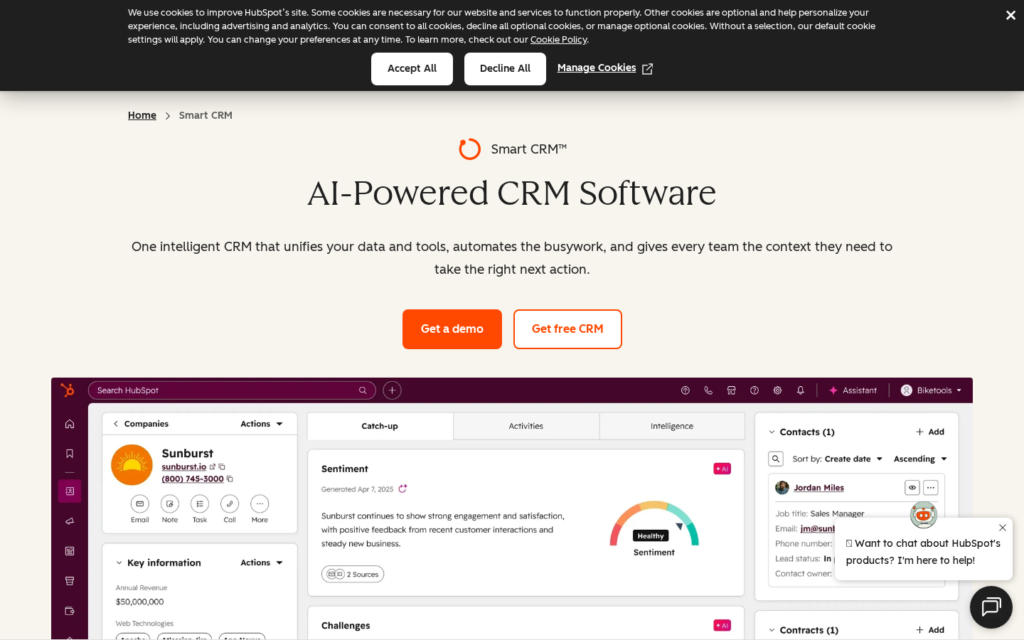
Best for: Small teams that want a free starting point with room to grow into enterprise-grade AI.
HubSpot Smart CRM is free for contact management, email tracking, and deal pipelines, with Breeze AI layered on top for drafting emails and summarizing records. The paid Professional tier starts at $45/seat/month on an annual commitment ($50/seat/month billed monthly), and Enterprise starts at $75/seat/month.
Our HubSpot alternatives for real estate agents covers what to weigh before committing.
Pros
- A genuinely useful free plan, not a limited trial
- Breeze AI and a broad Marketing, Sales, Service, and Commerce ecosystem
- 2,000+ third-party integrations by HubSpot's count
Cons
- Not built around native MLS or IDX workflows, so real estate teams typically add marketplace apps or a separate website/IDX stack
- Real price jump between the free tier and Professional
- No real estate-specific workflows out of the box
Bottom line: Hard to beat for a team just getting started with zero budget and useful if you want enterprise AI without real estate guardrails. Budget for setup work to bridge the MLS and IDX gap.
Rating: HubSpot Sales Hub is 4.4/5 on G2 (13,700+ reviews), and HubSpot CRM is 4.5/5 on Capterra (4,472 reviews), as of August 2026.
Sierra Interactive
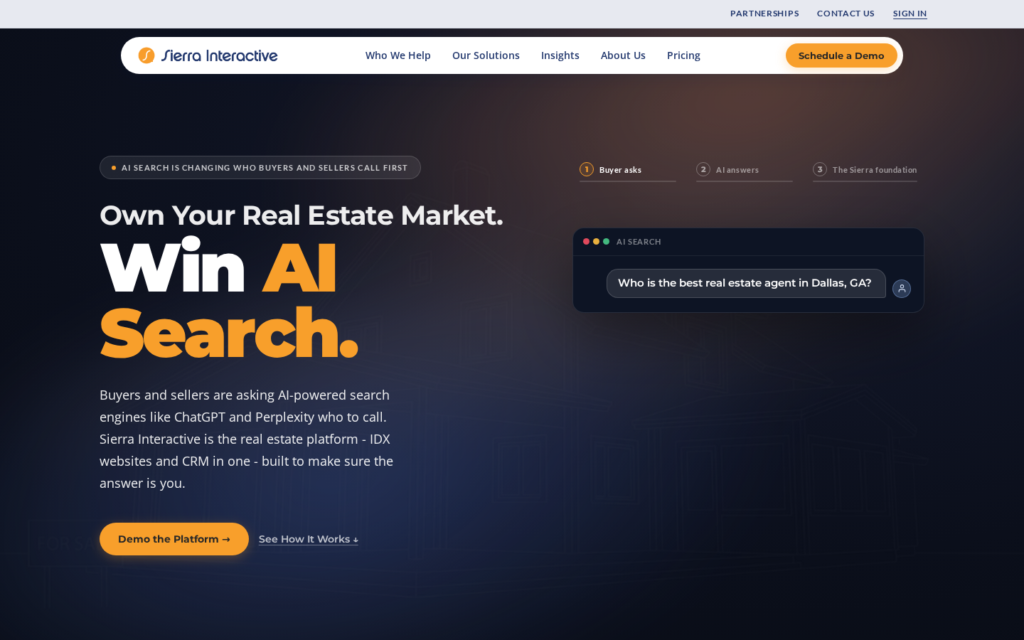
Best for: Teams that want an IDX website, CRM, and paid lead generation bundled under one vendor.
Sierra Interactive starts at $299.95/month for one user on annual billing (monthly billing costs more and adds a $500 setup fee). That base price includes the CRM, one IDX website, and one MLS feed. The auto-dialer, AI texting (Lead Engage, $199/month), and ad management are separate line items.
See our full Sierra Interactive pricing breakdown for the total cost once add-ons are factored in.
Pros
- CRM, IDX website, and MLS feed in one base price
- Lead Engage AI texting handles first-touch nurture
- Strong reporting on lead source ROI
Cons
- Add-ons (extra users, dialer, AI texting, premium designs) increase the real monthly cost quickly
- $500 setup fee on monthly billing
- Requires an annual commitment to get the lowest advertised price
Bottom line: A reasonable one-vendor bundle for teams that want the CRM and their IDX
website from the same provider, as long as you budget past the advertised starting price.
Rating: Sierra Interactive's G2 listings are split across a couple of seller pages with fewer than 20 combined reviews, so we're not citing a score. No independent Capterra rating turned up either.
Real Geeks
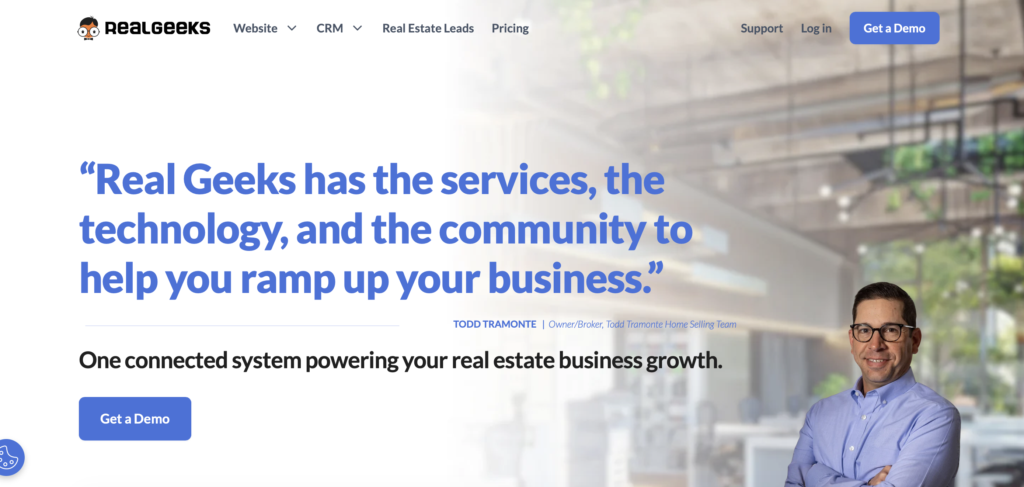
Best for: Agents who want a CRM, IDX website, and a built-in AI lead-engagement tool without stitching together three vendors.
Real Geeks charges $399/month on a 12-month term plus a $500 one-time setup fee, or $3,990/year billed annually. Its standout feature is Geek AI Text, which handles lead response and qualification through AI-driven text conversations. It adds $49/month unless it's bundled with an eligible marketing package.
Read more in our Real Geeks pricing guide.
Pros
- CRM, IDX website, and marketing automation bundled from day one
- Geek AI Text handles initial lead qualification around the clock
- SEO Fast Track generates AI-written, MLS-sourced area and property-search pages
Cons
- No free trial
- 12-month term required to get the advertised monthly rate
- Geek AI Text and other add-ons increase the real monthly cost
Bottom line: Worth it primarily if you want IDX-driven lead capture and AI text engagement at a published price. Skip it if you already have a lead source and just need a CRM.
Rating: 4.5/5 on G2 (109 reviews), 3.0/5 on Capterra (2 reviews, too small a sample to weigh heavily), as of August 2026.
Top Producer
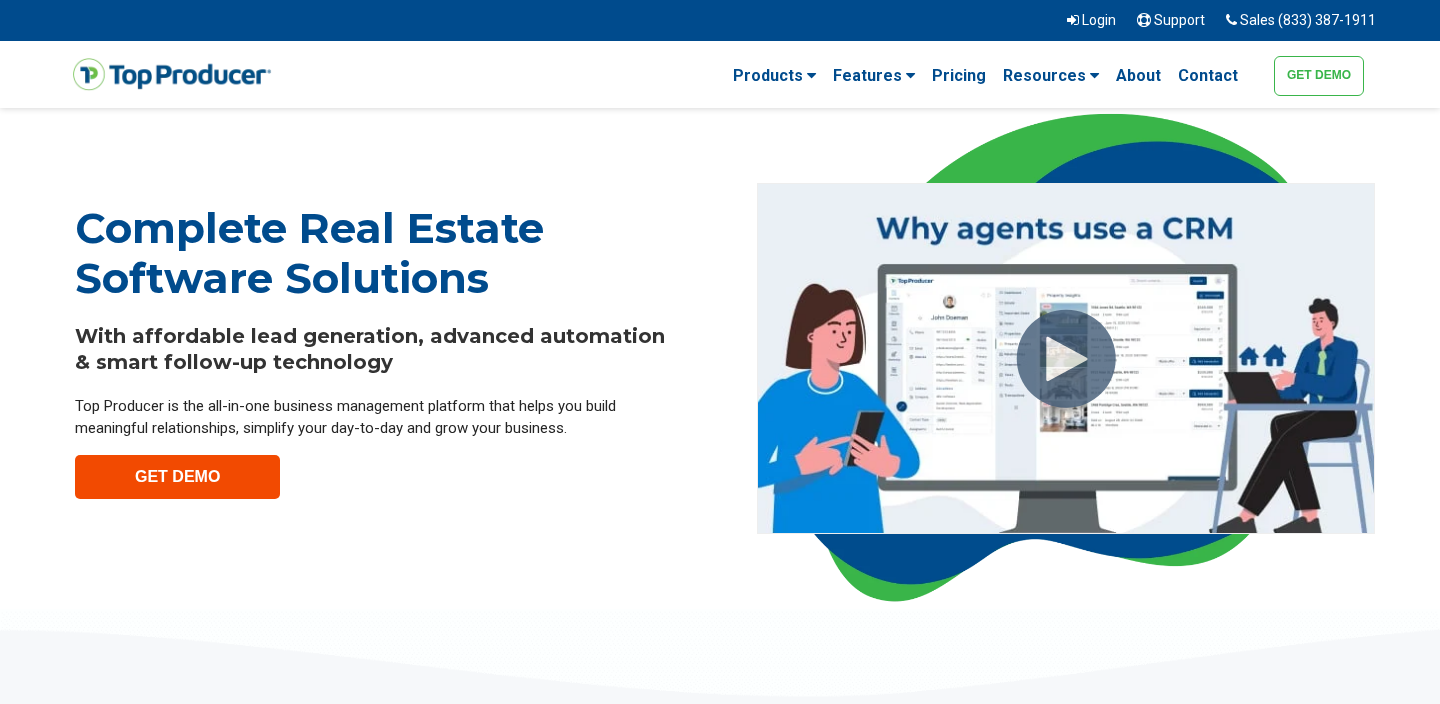
Best for: Agents who lean heavily on MLS data for farming and market reports.
Top Producer starts around $129/user/month for the Pro plan, with bundles like Pro + Farming ($399/month) and Pro + Leads ($429/month) layered on top. Its strongest feature is Market Snapshot, an automated farming report that pulls from 320+ MLS boards. Its website product is sold separately and doesn't include IDX, so most agents end up pairing it with a third-party IDX provider.
See our Top Producer pricing breakdown for what a realistic all-in setup costs.
Pros
- Deep MLS integration across 320+ boards
- Automated market reports for farming
- Established platform with a long track record
Cons
- A fully-featured setup (CRM + website + IDX + leads) can run $500+/month once you add the pieces Top Producer doesn't include natively
- Website product requires a separate IDX vendor
- Some users report rising prices and rigid annual billing terms
Bottom line: A strong fit specifically for farming-driven agents. Less compelling if you want an all-in-one system out of the box.
Rating: 4.0/5 on Capterra (323 reviews), as of August 2026. No reliable G2 score turned up for the CRM product specifically.
ClickUp
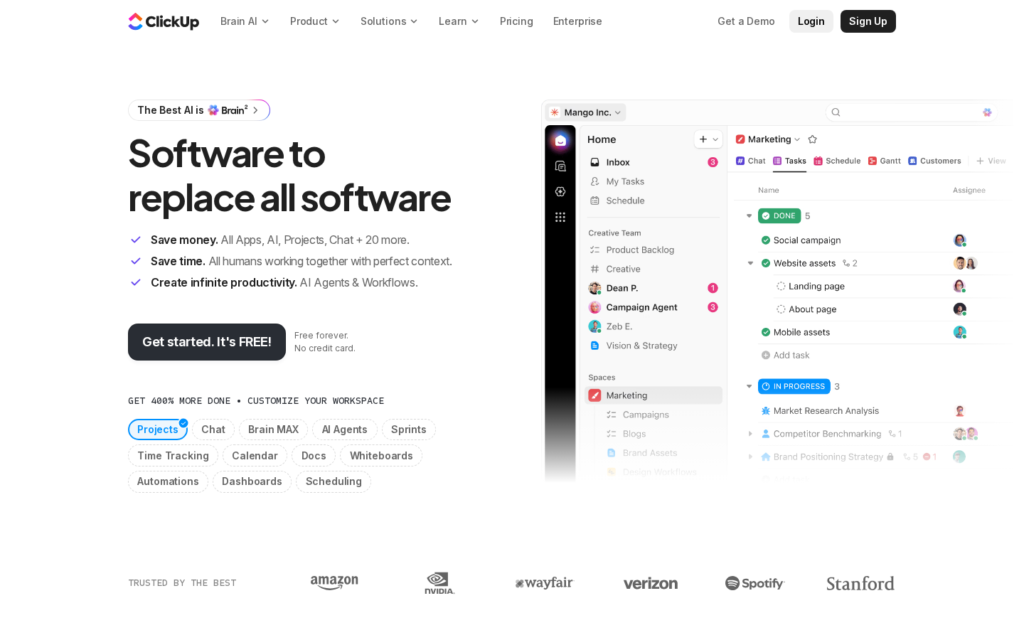
Best for: Tech-savvy solo agents or small teams who want a free, highly customizable workspace and don't mind configuring it themselves. ClickUp is a project management tool with a free CRM template, not a dedicated real estate platform. Its free plan includes one million contacts and unlimited users, which is hard to beat on raw value.
Pros
- Free plan with 1M contacts and unlimited users
- AI assistant for task management
- Highly customizable dashboards
Cons
- Steep learning curve
- Phone support only on the Enterprise plan
- Requires manual setup to fit real estate workflows
Bottom line: Strong value if you're willing to invest setup time. Look elsewhere if you want something that works for real estate on day one.
Rating: 4.7/5 on G2 (10,000+ reviews), 4.6/5 on Capterra (4,554 reviews), as of August 2026.
Choosing the right real estate CRM for your business
Match the CRM to your actual workflow, not the longest feature list. A solo agent usually gets more value from a real estate-specific platform under $100/month, like Wise Agent, Lone Wolf, or Luxury Presence's AI CRM if you're also choosing a website, than from configuring a general-purpose tool like Pipedrive or Salesforce from scratch.
Teams and brokerages that need lead routing, manager visibility, and higher contact volume should expect to spend several hundred dollars a month on platforms like Follow Up Boss, BoldTrail, or Sierra Interactive.
Whatever you choose, test the free trial against your actual daily workflow instead of a demo scenario before you commit.
Note screenshots were captured August 2026. Products may have changed.
FAQs on real estate CRMs
Ready to grow?
Turn your content into your best lead source
See how Luxury Presence helps agents turn website visits into closed deals