

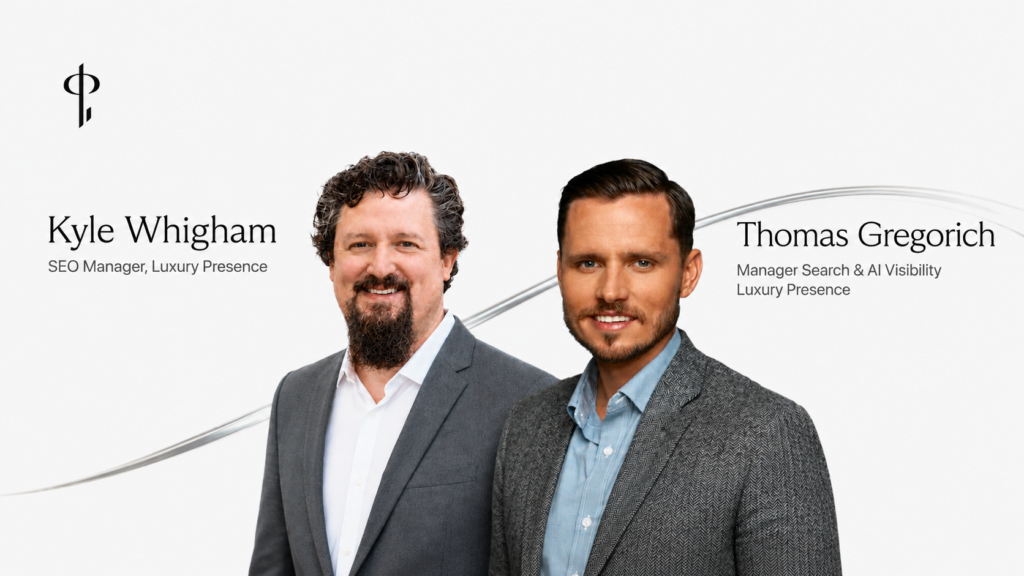
Every real estate agent has heard some definition of E-E-A-T by now. Fewer agents know what to actually do about it. The term gets thrown around as a checklist item, something to satisfy before hitting publish, when it was never meant to be a checklist at all. It's Google's shorthand for a much older idea: content should come from someone who actually knows what they're talking about, and the rest of the internet should be able to tell.
Here we'll cover what E-E-A-T means in plain terms, why real estate gets held to a higher bar than most industries, and which signals, on your site and off it, actually move the needle instead of just looking like they should.
The short version
- E-E-A-T stands for Experience, Expertise, Authoritativeness, and Trustworthiness. Google added the first E, Experience, in December 2022.
- Real estate is a YMYL (Your Money or Your Life) topic because it touches one of the biggest financial decisions most people ever make, so Google scrutinizes it more closely than lower-stakes content.
- The signals that actually move the needle are first-hand transaction experience, proprietary local data, and brand recognition, not title tag tweaks or publishing volume.
- A page doing E-E-A-T well could only have come from one specific person. A page just checking boxes could have come from anyone. Kyle Whigham's gut check: if a competitor could have written the identical page, there's no experience in it.
- Roughly 85% of brand mentions in AI answers come from third-party sites, not an agent's own website, which is why reviews, press, and off-site designations carry so much weight.
What is E-E-A-T in real estate?
E-E-A-T stands for Experience, Expertise, Authoritativeness, and Trustworthiness. Google added the first E, Experience, to what used to be just E-A-T in a December 2022 update to its Search Quality Rater Guidelines, and that addition matters more for real estate than almost any other industry. It's no longer enough to sound like an expert. Google wants proof that you've actually lived the thing you're writing about: closed the deal, walked the neighborhood, sat across the table from the buyer.
As Kyle Whigham, SEO Manager at Luxury Presence, put it during a conversation about how search has changed: "Google has started to really hone in on this idea of genuinely helpful content, especially with the increase in scalability and using AI to write content... Google has to figure out what is genuinely helpful, what is genuinely authoritative, and what proof points help Google's algorithm understand which websites, which types of information to show."
Luxury Presence has written about this directly: "Google's EEAT framework (Experience, Expertise, Authoritativeness, Trustworthiness) looks at whether the final product demonstrates genuine knowledge and adds something useful to the conversation. Whether you typed every word yourself or used an AI tool to help you draft it is irrelevant to that evaluation."
That last point is worth sitting with. E-E-A-T was never really about who or what wrote the words. It's about whether the finished page provides helpful, dependable information coming from firsthand experience. Worth noting: E-E-A-T itself isn't a direct ranking factor. It's a framework Google's human quality raters use to evaluate search results, and Google uses that feedback to tune the systems that do actually rank pages.
Why real estate falls under Google's YMYL rules
Google groups certain subjects into a category it calls Your Money or Your Life, or YMYL. These are topics where bad information can cause real financial or personal harm: medical advice, legal guidance, financial planning, and major purchases. Buying or selling a home checks nearly every box on that list. It's often the single largest financial transaction a person will make, tied directly to where they live, how they build equity, and what kind of debt they carry for the next 15 to 30 years.
That's why Google holds real estate content to a stricter standard than a recipe blog or a hobby site. A wrong answer about mortgage rates or neighborhood safety can cost someone money or put their family in the wrong house. Content that touches a YMYL topic has to demonstrate real credibility, beyond decent writing.
This is also why generic advice performs worse in real estate than in almost any other content category. As Thomas Gregorich, Luxury Presence's Manager of Search and AI Visibility, explains, referencing Google's own updated guidelines: "Google's helpful content guidelines, updated through 2025, recommend offering demonstrable first-hand experience and original insights. Local search is where this matters most because Google is specifically trying to surface local authorities."
Which experience signals actually matter
The signals that count are the ones that are hard to fake. The ones that get overhyped are usually the easy, mechanical stuff people mistake for strategy.
What actually works
Firsthand transaction experience
Content written from real, first-hand transactions. Whigham described what tips the scale for Google when comparing two competing agents: "I think if I had to guess, that most content is written by content writers but not necessarily people with first-hand experience. There have been some notable case studies where websites that just publish a lot of content from content writers but not necessarily experts were demoted in terms of organic ranking visibility. While sites where they had a niche expert who specialized in something and they wrote the content, and it was very clear and demonstrable that they wrote the content, with author bio pages... those kinds of sites increase in visibility."
He's seen the same gap play out industry-wide: "Much of the real estate blog content online in 2026 is written by generalist content writers or generated fully by AI, which is risky. Generic posts like '5 Tips for Buying a Home' without firsthand, practitioner-level clarity or original data give Google no signal that the content is helpful to buyers and sellers."
Whigham draws a clear line on AI-assisted drafts: "Don't copy and paste. Don't straight copy and paste whatever ChatGPT spits out. You still need to put in the time to review it. First of all, make sure it's accurate. LLMs still hallucinate. But then, again, I think having that human touch, what is your unique perspective... is going to distinguish you."
Hyper-specific market detail
Hyper-specific detail that only comes from working a market firsthand. Whigham put it this way in a follow-up conversation with Luxury Presence: "Experience and expertise are probably the biggest factors when it comes to EAT. So I think being able to highlight specifically what somebody who's only worked in a particular market would know."
His example: an agent saying "in the last year I've closed 14 homes in this neighborhood and still I'm getting tripped up on HOA rules regarding short-term rentals for out of state buyers," instead of a generic line like "this is a wonderful community." One is hyper specific in a way an AI can't generate on its own. The other could describe any neighborhood in the country.
Gregorich framed the same shift in terms of what Google itself has started calling out: "Google themselves made a distinction between commodity and non-commodity content. Instead of writing about how to buy a house in Los Angeles, which is something an LLM can kind of answer on their own these days, it's like, 'this is how I sold X amount more houses this year by doing X.' Very specific to your experience kind of stuff, and that's going to perform better because they can't replicate that kind of stuff."
Original, proprietary data
Original, proprietary data instead of recycled MLS numbers. Whigham pointed to neighborhood guides built around topic clusters as the clearest example: "Too often, that's all we put on that page. We're missing out on the ability to add context and copywriting around those... add market insights. Hey, in Q4 2025, this was how long the average home was on the market for. This was the average price."
The same gap shows up on listing pages. An IDX page that's just a filtered list of MLS listings looks identical to every other agent's IDX page in that market, because it is. Whigham's advice was to build something on top of it: "What most IDXs don't have is quick-hitting information that we have on, like, our neighborhood guides... here's the average on-market time, here's the schools in the area... Zillow does a really good job at having some of this information on their pages. Real estate agents typically tend to lack some of this."
Brand recognition
Brand recognition that shows up as search volume. This came up repeatedly across conversations with Luxury Presence's SEO team.
A page doing E-E-A-T well reads like it could only have come from one specific person. A page just checking boxes could have come from anyone.
Whigham said, "I can't emphasize how important it is to have a brand people are raving about every month. I saw a Realtor ranking for a pretty competitive keyword, ranking right at the top of the search results... the article was really short. It didn't look like something that the Realtor had to spend a lot of time on... yet it was outranking all the rest. I was led to believe it's because that Realtor had his own TV show, books, he's on podcasts, and people know his name."
Most agents pour their energy into their own website and stop there. The data says that's a mistake. According to research Luxury Presence has cited from AirOps, roughly 85% of brand mentions in AI answers come from third-party pages, not the agent's own site, and about 48% of those citations come from community platforms like Reddit and YouTube alone.
Gregorich made the same point: "Something like 80% of the times your brand gets mentioned in LLMs is going to be because you were mentioned on some kind of off-site authoritative website, not your own content. It doesn't mean don't create your own content and try to appear there, but part of your strategy definitely should be distribution of your content."
Reviews
Reviews carry outsized weight. Whigham's guidance on Google Business Profile applies just as much to AI search: "I would recommend gathering as many reviews as possible. Finding creative ways and getting proactive about always asking for reviews from people you've helped... In general, the more reviews you have that are positive, the better your chances of ranking."
Gregorich echoed this for AI platforms specifically: "If you have 55 five-star reviews on your Google Business Profile and you're consistently getting new ones, that's a powerful signal. It tells search algorithms you're active, good at what you do, and that real people are vouching for you."
Whigham has also given clients a rough benchmark for the local map pack specifically: a Google Business Profile rating around 4.3 stars or higher, and enough volume behind it. An agent with three reviews is competing at a real disadvantage against one with 300, even at a similar star rating.
Press and digital PR
Press and digital PR feed directly into how AI models decide who to recommend. Whigham pointed to press releases and local backlinks as an underused tactic: "There's… an undervaluation on digital PR. So, if you're a team and you hire a new agent, there's nothing wrong with releasing a press release. Think of the number of journalists in local markets that work for the local online newspaper. They're starved for content to be able to publish."
Whigham went further on why PR matters more now than it used to: "PR helps earn that authoritative editorial mention in links that move the needle way better than low-quality link building does. But I think the bigger reason in this era of AI search is that doing digital PR helps build brand entities and strengthens your online NAP [name, address, phone]. When you're mentioned in these credible publications, you become a more recognized entity, and that's what's going to make AI systems all the more likely and more confident in citing you." He called digital PR and getting on legitimate "best of" lists "probably two of the biggest levers for answer engine optimization than anything right now."
Local sponsorships and directory placements
Local sponsorships and directory placements round out the picture. Whigham's advice on link building doubles as advice on authority building: sponsoring a Little League team, getting listed on a VFW or American Legion resource page as a VA loan specialist, or landing a spot on a lender's or title company's preferred partner list. "These local business, locally relevant links carry a lot of value," he said. "You really typically aren't going to be able to pay for this type of link placement." Luxury Presence has also pointed to independent research backing this up: "A 2024 Ahrefs analysis of 75,000 brands found that branded web mentions showed the strongest correlation with AI Overview visibility."
The throughline across all of it, on-page and off, is the same one Whigham and Gregorich kept returning to: real estate content earns trust the same way an agent earns a listing, by proving, in specific and checkable ways, that you've actually done the work.
What's overstated
Title tags and meta descriptions
Title tags and meta descriptions, treated as a magic lever. "It's kind of a waste of time to do this," Whigham said of obsessing over these fields. "I wouldn't say it's a waste of time, but it might not move the needle because Google doesn't really even necessarily use the title tags and meta descriptions that you recommend these days."
Publishing volume
Publishing volume for its own sake. Asked whether agents should prioritize quality over quantity in their blog output, Whigham didn't hesitate: "100 times, 100 times out of 100." He tied the answer to Google's Scaled Content Abuse penalty, then closed with a line he credited to Bruce Lee: the real risk of publishing at scale is becoming "a jack of all trades rather than being the expert who practices a kick a thousand times versus 1,000 kicks one time."
Evergreen, generic content
Evergreen, generic how-to content. Gregorich put it plainly: "Evergreen content needs to be on your site for user experience and topical authority. But in terms of appearing in LLMs, it might not be worth it, because LLMs can answer those generic top-of-funnel questions themselves. We're seeing evergreen content drop for sites like Wikipedia, while Reddit and YouTube are surging. Google is looking for net-new insights."
The throughline across all of it, on-page and off, is the same one Whigham and Gregorich kept returning to: real estate content earns trust the same way an agent earns a listing, by proving, in specific and checkable ways, that you've actually done the work.
FAQs on E-E-A-T and Agent Authority in Real Estate Content
Ready to grow?
Turn your content into your best lead source
See how Luxury Presence helps agents turn website visits into closed deals