
Your real estate agent email list is the single most controllable asset in your business. Social media algorithms shift, ad costs fluctuate, and portal leads come with strings attached. But an email list you built yourself? That is a direct line to buyers, sellers, and past clients who already raised their hand and said, “I want to hear from you.” In 2026, email marketing for real estate agents still delivers a higher return on investment (ROI) than any other direct channel, with Litmus, an email analytics and testing platform, reporting $36 back for every $1 spent (Litmus, 2024). This guide walks you through exactly how to build a real estate email list from scratch, keep subscribers engaged, and turn that list into a predictable source of closings.
Find It Fast
Key takeaways
- A real estate agent email list gives you a direct, algorithm-free communication channel with buyers, sellers, and past clients.
- Lead magnets, website sign-up forms, social media funnels, and offline networking are the four primary list-building sources you should activate in 2026.
- Segmenting your list by buyer stage, property interest, and geography lets you send the right message to the right person at the right time.
- Automated nurture sequences produce measurable results: one three-email drip campaign for a Chicago agent boosted buyer engagement by 43% with zero unsubscribes (Luxury Presence Case Study: Automated Lead Nurture Email Strategy, 2024).
- Buying email lists, ignoring compliance rules, and sending too frequently are the three mistakes most likely to destroy your sender reputation.
- A CRM built for real estate workflows, like Luxury Presence’s CRM, keeps your list organized and your follow-up consistent without losing the personal touch.
Why a real estate agent email list matters in 2026
As of 2026, email remains the highest-ROI direct marketing channel available to real estate agents. Unlike social media platforms where algorithms decide who sees your content, an email lands directly in your subscriber’s inbox. You own that relationship. You control the timing, the message, and the frequency.
That ownership matters more than ever. According to the National Association of Realtors, 73% of homebuyers in 2024 worked with the first agent who contacted them after an inquiry (National Association of Realtors, 2024). Speed of follow-up wins deals. An email list paired with a CRM gives you the infrastructure to respond fast and stay in front of prospects over weeks and months, not just the first 48 hours.
Here is what a well-maintained email list does for your business:
- Keeps you top of mind between transactions so past clients refer you instead of searching Google for a new agent.
- Delivers market updates and new listings directly to buyers who are actively searching.
- Positions you as the local authority by sharing neighborhood data, pricing trends, and buying or selling advice.
- Creates a predictable pipeline because you can measure open rates, click-through rates, and replies to know exactly who is warming up.
The bottom line: if you do not have an email list, you are renting your audience from platforms that can change the rules at any time. If you do have one, the question is whether you are building it with intention and working it with a system.
Four strategies to build your real estate email list
Building a realtor email list from zero does not require a massive budget. It requires a repeatable process across four channels. Here is the playbook.
1. Create lead magnets that earn the opt-in
Nobody gives you their email address for free. You need to offer something worth trading for. A real estate lead magnet is a specific, high-value resource that solves a problem your prospect has right now.
The best-performing lead magnets for real estate agents in 2026 include:
- A downloadable guide to the homebuying or selling process in your market
- A free comparative market analysis for potential sellers
- Access to off-market or coming-soon listings before they hit the MLS
- A neighborhood relocation guide with school ratings, commute times, and local business recommendations
- A “What Your Home Is Worth” instant valuation tool on your website
Promote these offers on your website, your social channels, and at every open house. The lead magnet is the entry point. Once someone opts in, your nurture sequence takes over.
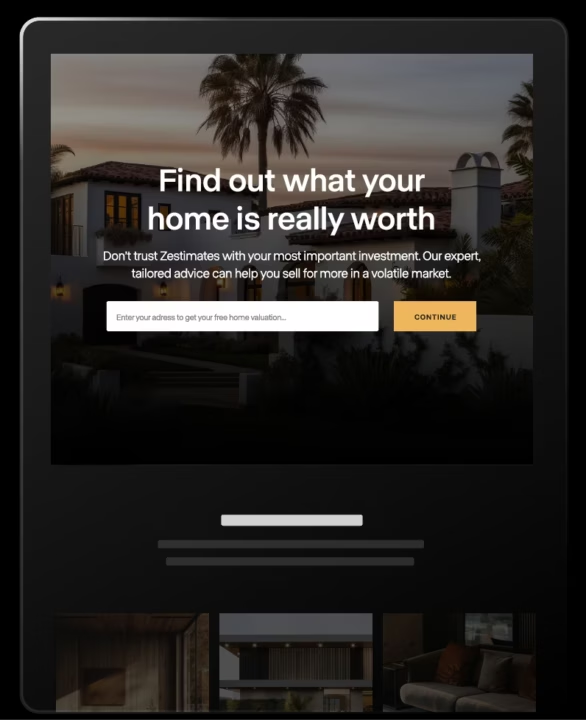
Landing pages generate leads
Our e-book guides you through seven types of landing pages that are engineered to bring in high-quality prospects.
2. Set up your website to capture real estate email sign-ups
Your website is the hub. Every marketing channel you run, whether it is social media, paid ads, or direct mail, should drive traffic back to your site where you can capture an email address. If your site does not have clear, visible sign-up forms, you are leaking leads every single day.
Make sure your site includes:
- Sign-up forms on your homepage, blog posts, and IDX property search pages
- Pop-ups or slide-ins triggered by scroll depth or exit intent, each offering a specific lead magnet
- A strong call-to-action (CTA) on every page that tells visitors exactly what they get when they subscribe
- Forced registration on your IDX search so buyers must enter an email to save listings or see full property details
That is the mindset shift. When your website captures the lead instead of a third-party portal, you own the contact data and the relationship from the first click. Integrate your sign-up forms directly with your CRM so every new subscriber is tagged, segmented, and entered into a follow-up sequence automatically.
3. Use social media to funnel followers into your email list
Social media is a rented audience. Your email list is an owned audience. The goal of every social post should be to move followers from rented to owned. Here is how to do it:
- Pin a link to your lead magnet in your Instagram bio and reference it in Stories with a swipe-up or link sticker.
- Run a Facebook giveaway where the entry requirement is an email opt-in.
- Post short video clips previewing your market report or neighborhood guide, then direct viewers to your website to download the full version.
- Share client success stories and end with a CTA: “Want listings like this sent to your inbox before they hit the market? Link in bio.”
The key metric to track here is not likes or comments. It is how many new email subscribers each social post generates. If a post does not move someone closer to your list, it is entertainment, not marketing.

Free social media templates
Ready to execute on these strategies but need a little design help? Our expert social media team put together three sets of engaging, on-brand post templates you can customize and deploy today.
4. Network offline and collect emails in person
Do not overlook the power of in-person interactions. Open houses, community events, local business partnerships, and even coffee meetings are all list-building opportunities if you have a system in place.
At every open house, set up a digital sign-in form on a tablet. Ask for name, email, phone number, and “Are you currently working with an agent?” At local events, bring a QR code that links directly to your lead magnet landing page. After every networking conversation, send a same-day follow-up email that adds the contact to your list with their permission.
The agents who grow the fastest are the ones who treat every interaction as a database-building opportunity. No conversation should end without an email address and a reason to follow up.
How to keep your email subscribers engaged in 2026
Building the list is step one. Keeping subscribers engaged is where the money is made. An email list full of people who never open your messages is just a number. Here is how to make your list work.
1. Send regular, valuable updates on a consistent schedule
Consistency and automation work together. In one automated three-email nurture sequence built for a top Chicago real estate professional, buyer engagement increased 43% with zero unsubscribes. The first email in that sequence achieved a 31% open rate and 19% click-through rate, while the second email hit a 27% open rate and 43% click-through rate (Luxury Presence Case Study: Automated Lead Nurture Email Strategy, 2024).
Those numbers did not happen by accident. They came from a defined schedule, relevant content, and a clear CTA in every email. Here is a weekly cadence that works for most agents:
| Email type | Frequency | Content focus |
| Market update | Weekly or biweekly | Local stats, median price changes, inventory levels, days on market |
| New listing alert | As listings go live | Property photos, price, key features, and a CTA to schedule a showing |
| Educational content | Biweekly or monthly | Homebuying tips, selling prep checklists, mortgage rate context |
| Past client check-in | Quarterly | Home anniversary note, local market value update, referral ask |
| Community spotlight | Monthly | Local events, restaurant openings, school news, neighborhood features |
Pick a schedule you can maintain. One high-quality email per week beats five rushed ones that train your subscribers to ignore you.
Nurture leads effortlessly with email templates
Our free e-book offers customizable resources and tips to keep your database engaged, move leads through the funnel, and close deals effectively.
2. Segment your list and personalize every send
Segmenting your email list based on where each contact sits in the buying or selling process is what separates agents who get replies from agents who get unsubscribes. A first-time buyer needs educational content about pre-approval and inspections. A repeat investor wants off-market deals and cap rate data. A past client who closed two years ago needs a home value update and a referral prompt.
Your CRM should allow you to tag contacts by stage (new lead, active buyer, active seller, past client, sphere of influence), by geography (zip code, neighborhood, school district), and by property interest (price range, property type, number of bedrooms). When you send a follow-up email that matches the recipient’s exact situation, open rates climb and replies follow.
That is the power of segmentation in action. When a buyer gets an alert for a property that matches their saved criteria, they do not just open the email. They respond. They call. They book a showing. Your list becomes a conversation starter, not a broadcast channel.
3. Write clear CTAs in every email
Every email you send should have one clear goal. Not three. Not five. One. Whether it is scheduling a consultation, registering for an open house, downloading a resource, or replying to a question, make the call to action impossible to miss.
Use a button or a bold, hyperlinked line. Place it above the fold so readers do not have to scroll. And write it in first person: “Show me homes under $500K” performs better than “Click here to view listings.”
4. Track your numbers and adjust
You cannot improve what you do not measure. Track these four metrics for every campaign:
- Open rate: Are your subject lines compelling enough to earn a click? The average open rate for real estate emails hovers around 21% according to Mailchimp’s industry benchmarks (Mailchimp, 2024). If you are below that, test new subject lines.
- Click-through rate (CTR): Are readers taking action inside the email? If your CTR is low, your content or CTA needs work.
- Unsubscribe rate: A small number of unsubscribes after each send is normal. A spike means you sent something irrelevant or too frequently.
- Reply rate: This is the metric most agents ignore and the one that matters most. Replies signal real intent. Track them.
Review these numbers weekly. Make one change at a time, whether that is subject line wording, send time, or content format, so you can isolate what moves the needle.
Turn your email list into a lead nurture system
An email list without a nurture system is just a spreadsheet. The agents who convert the most leads from their list are the ones who build automated drip campaigns that deliver the right message at the right time, without requiring manual effort for every send.
Here is how to create a real estate email drip campaign that works in 2026:
Step 1: Define your segments and triggers
Before you write a single email, map out who gets what and when. Common triggers include:
- A new lead opts in through your website sign-up form
- A buyer saves a search or favorites a listing on your IDX site
- A seller requests a home valuation
- A past client hits their one-year home anniversary
- A sphere-of-influence contact has not engaged in 90 days
Each trigger should launch a specific sequence. Do not send the same drip to a cold internet lead and a warm referral. They are in different places and need different messages.
Step 2: Build a three-email starter sequence
You do not need 15 emails to start. A three-email sequence is enough to establish value, build trust, and prompt a reply. Here is a framework:
- Email 1 (sent immediately after opt-in): Deliver the lead magnet they requested. Introduce yourself in two sentences. Ask one question: “What is your timeline for buying or selling?”
- Email 2 (sent 3 days later): Share a piece of local market data or a recent client success story. Include a CTA to schedule a quick call.
- Email 3 (sent 7 days after Email 2): Offer something specific, like a curated list of homes matching their criteria or a free home value report. End with a direct ask: “Would it be helpful if I sent you listings that match what you are looking for?”
This is the exact structure that produced the 43% buyer engagement increase in the Chicago case study referenced earlier. Simple, specific, and focused on starting a conversation.
Step 3: Connect your list to your CRM
Your email list and your CRM should be the same system, not two disconnected tools. When a subscriber opens an email, clicks a link, or replies, that activity should update their contact record automatically. This is where Luxury Presence’s CRM, a purpose-built real estate CRM, makes a difference. It tracks the full client journey from first opt-in to closing, keeps your follow-up personal even at scale, and ensures no lead falls through the cracks because you forgot to check a spreadsheet.
The integration between your email marketing and your CRM is what turns a list into a system. Without it, you are guessing. With it, you know exactly who to call, when to call them, and what to say.
Common pitfalls that shrink your email list
Building a realtor mailing list takes time and discipline. These three mistakes can undo months of work in a single week.
Buying email lists
Purchased lists are filled with contacts who never asked to hear from you. They will mark your emails as spam, which tanks your sender reputation and makes it harder for your real subscribers to see your messages. Every email on your list should come from someone who voluntarily opted in. There are no shortcuts here.
Ignoring compliance regulations
The Controlling the Assault of Non-Solicited Pornography And Marketing Act (CAN-SPAM) and the General Data Protection Regulation (GDPR) are not optional. Every email you send must include a clear opt-in process, your physical mailing address, and an easy one-click unsubscribe link. Violating these rules can result in fines of up to $51,744 per email under CAN-SPAM. Compliance is not a suggestion. It is a business requirement.
Sending too many emails
There is a line between staying top of mind and becoming noise. If your unsubscribe rate spikes after a send, you are crossing it. For most real estate agents, one to two emails per week is the right cadence. Test your frequency, watch your metrics, and let the data tell you when to pull back.
Building a Real Estate Email List That Converts
When you build your list around valuable lead magnets, clear website capture, smart social funnels, and in-person networking, you create a direct channel you actually own. Add consistent nurture, thoughtful segmentation, and a CRM that keeps follow-up organized, and your email list becomes more than a database — it becomes a reliable source of conversations and closings.
Luxury Presence can elevate your marketing strategy
Learn how we can help take your real estate business to the next level. Schedule a time to speak with one of our branding experts today.

FAQs
Nurture leads effortlessly with email templates
Our free e-book offers customizable resources and tips to keep your database engaged, move leads through the funnel, and close deals effectively.
About the author

Content at Luxury Presence
Kate Evans is a content marketing strategist at Luxury Presence, the leading growth platform for high-performing real estate professionals. She develops data-driven editorial content and supports SEO strategy and brand voice frameworks that help agents attract qualified leads and establish market authority. Her published work covers topics including CRM strategy, social media marketing, and digital growth, supporting thousands of agents in scaling their businesses through modern marketing.