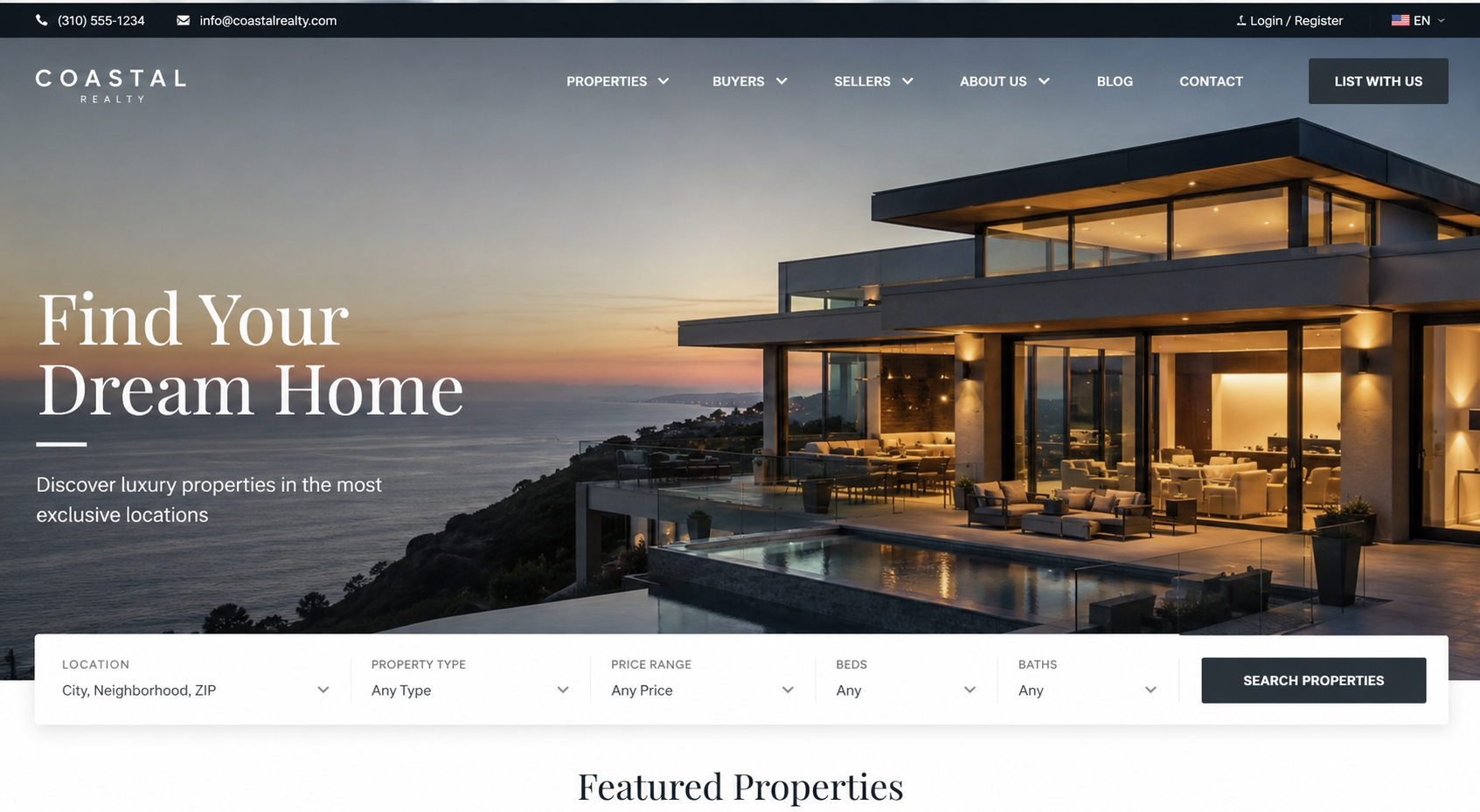
Here’s the uncomfortable truth about premium real estate website platforms: paying more doesn’t automatically mean getting more. Real Estate Webmasters (REW) has built a reputation as a premium, SEO-focused platform. But for many agents and teams, the 22-year-old platform comes with trade-offs that don’t show up on the features list: trade-offs in time, flexibility, and total investment that can undermine the very growth you’re trying to achieve.
REW targets the “top 10% of real estate professionals” with custom websites, advanced CRM capabilities, and a technical approach to organic search that few competitors match. The question isn’t whether REW delivers quality. The question is whether that quality justifies a premium investment that third-party estimates put above $25,000 in year-one cost for some custom builds, and a multi-year commitment, when modern alternatives like award-winning real estate website design platforms launch quickly with a dedicated onboarding team. REW’s own public package pricing, by contrast, starts at $350/month and varies by contract, services, custom work, and promotions.
This review breaks down what REW actually offers, where it excels, where it falls short, and how it stacks up against modern alternatives built for how top producers work today.
Find It Fast
Key takeaways
- REW delivers enterprise-grade capabilities at premium prices. Third-party setup estimates vary: VIP Realty cites $10,000 to $25,000+, while InboundREM cites $5,000+ plus $200/hour custom work, and REW’s own promotional material has offered no setup fee on qualifying 36-month contracts. Public package pricing lists $350/month single-user, $499/month small team, $799/month large team, and $1,000/month brokerage 25+, putting it out of reach for many solo agents and small teams.
- REW is widely positioned as a premium, SEO-focused platform. Its spiderable IDX and the PageSpeed scores it reports are meaningful differentiators for organic traffic, though directly crawlable listing pages, rather than iframe-based ones, are what generally drive the advantage.
- Implementation timelines can create real opportunity costs. Third-party reviews report that some small and mid-sized teams may wait several months for a site and longer for revisions, though timelines vary by package, scope, and account priority.
- Contract terms are typically multi-year. REW has publicly described its contracts as typically 36 months, and third-party reviews report three-year terms, though length can vary by promotion and service.
- Support experiences vary. Public reviews are mixed, with some users reporting strong support and customer care and others reporting a less consistent experience.
- Modern alternatives can move faster. Luxury Presence offers award-winning, custom-designed real estate websites and a dedicated onboarding team built to get top producers live quickly.
Understanding what REW actually offers
Real Estate Webmasters positions itself as a full-stack platform for top-producing agents, teams, and brokerages. Founded in 2004 and headquartered in Nanaimo, British Columbia, the company has spent over two decades building what it calls the “Renaissance platform,” a custom website and CRM system designed for serious organic lead generation.
Core platform components include:
- Custom website design: fully customized sites built by an in-house design team, not template modifications
- Integrated CRM: native customer relationship management with lead routing, automation, and AI-powered call grading
- Spiderable IDX: property listings that search engines can crawl and index, unlike iframe-based alternatives
- PPC management services: full-service paid advertising through REW Agency
- SEO and content services: ongoing optimization and content creation for organic growth
The platform targets agents and teams generating significant GCI who view their website as a strategic asset rather than a digital business card. For brokerages with 700+ agents like J.B. Goodwin, REW provides enterprise-grade routing, multi-office support, and sophisticated admin controls.
What separates REW from budget alternatives is depth. While Real Geeks uses request-based pricing, with third-party sources citing roughly $299/month, REW builds custom from the ground up. The trade-off is time and cost.
REW pricing: what you’ll actually spend
Understanding REW’s pricing requires looking beyond monthly fees. The first-year investment can put this platform in a different category than most competitors, though the all-in figure depends heavily on custom work and services.
REW pricing structure:
|
Component |
Cost | Notes |
|---|---|---|
| Setup/Implementation | Third-party estimates vary | VIP Realty cites $10,000 to $25,000+. InboundREM cites $5,000+ plus $200/hour custom work. REW has promoted no setup fee on qualifying 36-month contracts |
| Monthly Software (Single User) | $350/month | Single user with CRM access |
| Monthly Software (Small Team) | $499/month | Includes five users, and users beyond five cost extra |
| Monthly Software (Large Team) | $799/month | Includes 10 users |
| Monthly Software (Brokerage 25+) | $1,000+/month | Includes 25 users |
| Additional Users | Varies by package | Pricing depends on the package and whether dialer/texting is enabled |
| PPC Management | Quote-based |
Management-fee pricing is not publicly published |
Comparative year-one costs (team of 10):
Year-one totals depend heavily on custom build, services, contract term, and ad spend, so treat the following as directional rather than fixed:
- REW: not published as a single figure. Package pricing starts at $350/month, and InboundREM cites a website build of $5,000+ plus $200/hour for custom work. Any all-in total depends on custom build, custom hours, PPC, SEO, and other services.
- Luxury Presence: pricing available by consultation. Plans include a one-time setup fee that varies by plan and brokerage partnership, with optional add-ons and a separate ad budget if paid campaigns are used.
- Sierra Interactive: public pricing starts at $299.95/month on annual plans and $359.95/month month-to-month, with setup fees varying by subscription type.
- Real Geeks: quote-based on its current official page, with third-party sources often citing approximately $299/month plus advertising and add-ons.
The pricing gap reflects different philosophies. REW’s higher investment funds custom design work and a strong SEO-focused architecture. Whether that investment delivers proportional returns depends on your timeline and growth strategy.
Where REW excels: SEO architecture and technical performance
Credit where it’s due: REW’s technical approach to organic search is a genuine, widely recognized strength. For teams serious about long-term organic lead generation, these capabilities matter.
Spiderable IDX creates real SEO advantages:
Many real estate platforms display property listings through iframes, embedded windows into MLS data. Iframe-based IDX can create SEO and indexation limitations: Google can sometimes process iframe content, but directly crawlable listing pages are generally stronger for SEO, because iframe IDX may mean listing content does not exist as unique, indexable pages on your own site. REW’s spiderable IDX makes property pages directly crawlable. A crawlable IDX can create thousands of potential indexable listing URLs, though actual indexation and ranking depend on implementation, uniqueness, MLS permissions, and Google’s evaluation.
Technical performance backs up the architecture:
REW says its Renaissance platform can score 100 in Google PageSpeed Insights categories. Treat that as a vendor claim unless independently tested on representative live client URLs. Fast performance can support page experience and Search success, but it is one ranking-related factor among many and does not guarantee higher rankings.
Documented client results show potential:
Client testimonials cite traffic increases of 1,000% or more compared to previous providers. One testimonial describes going from “100-200 organic visits” to “20,000-30,000 organic visits per month”. These are individual testimonials, not average outcomes, but at reasonable conversion rates that kind of organic traffic represents significant lead volume without ongoing ad spend.
REW says it received five MUSE awards, including a Platinum award for Smith & Associates Real Estate, reflecting its design quality. For agents who need their website to match their market position, REW’s custom design work competes with luxury platforms.
Where REW falls short: time, contracts, and support
Every platform has weaknesses. REW’s weaknesses tend to show up where high-performing agents feel them most: time and flexibility.
Implementation timelines can create real costs:
Third-party reviews report that some small and mid-sized teams may wait several months for a site, with revisions taking longer, while large teams may receive a functioning site faster. Timelines vary by package, scope, and account priority. Where a build runs long, months of development can mean months without new lead capture from the site, so it’s worth comparing against modern platforms built to launch quickly.
Contract terms can limit flexibility:
REW has publicly described its contracts as typically 36 months, and third-party reviews report three-year terms, though length can vary by promotion and service. Real estate markets shift. Team compositions change. Commission structures get rewritten. A multi-year commitment assumes stability that many agents don’t have, and public reviews are mixed on contract flexibility.
Support experiences vary:
Public reviews are mixed. Some users report strong support and customer care, while other experiences are less consistent. Experiences vary by account size and service tier.
Website ownership models vary:
Third-party reviewers describe REW as a leased website model, where the hosted site may not be owned outright. Ownership, portability, and termination terms vary by agreement. Given the months that can go into custom development, switching costs may extend beyond cancellation fees.
REW’s CRM capabilities: strengths and limitations
REW’s integrated CRM is one of its genuine competitive advantages. Unlike platforms that require third-party CRM integration, REW includes CRM functionality with its subscription. The specific AI, dialer, texting, transcription, grading, and coaching features available can vary by package and contract term.
Notable CRM features:
- Sources-to-Deals tracking: attribute closed transactions back to originating marketing channels and campaigns
- AI-powered call grading: automated evaluation against REW-defined performance criteria such as rapport, qualification, market expertise, call control, next steps, and brand representation
- Sophisticated lead routing: complex rules for team environments, especially multi-office brokerages
- Transaction management integration: REW has stated it is working on an open API and integrations with companies such as SkySlope and BoldTrail for automatic deal data ingestion
For large teams needing complex routing and attribution, REW’s CRM delivers capabilities that simpler platforms lack. The ability to track ROI from initial ad spend through closed commission provides intelligence most agents never access.
Where the CRM is a different fit:
The sophistication comes with complexity. Teams without dedicated admin support may find the learning curve steep. And while the CRM integrates tightly with REW’s website, integration with some external tools may be more limited.
For agents exploring CRM options for real estate, the question becomes whether you need REW’s level of sophistication or whether a relationship-first approach that surfaces hidden opportunities in your existing network delivers better results with less complexity.
Comparing REW to modern alternatives
REW doesn’t exist in isolation. Understanding its position requires comparing it to platforms serving similar and adjacent markets.
REW vs. Luxury Presence:
Both platforms target the premium end of the market, but with different philosophies. REW emphasizes technical SEO and CRM sophistication. Luxury Presence prioritizes brand positioning and done-for-you marketing with agent approval workflows.
Key differences:
- Launch time: Luxury Presence is built to launch quickly with a dedicated onboarding team, while some REW builds are reported to take several months
- Contract flexibility: Luxury Presence plans are 12-month agreements, while REW contracts are typically reported at 36 months
- Marketing approach: Luxury Presence offers done-for-you marketing with Social Media Management (Beta), blog content, SEO & GEO, AI Lead Nurture, and Paid Ads Management deliverables varying by plan and add-on, compared with REW’s self-managed or agency add-on
- Ad management fees: Luxury Presence applies no management fees on ad spend (budget goes directly to Google or Meta), while REW offers managed PPC and may charge management fees, with fee structure varying by arrangement
REW vs. Real Geeks:
Real Geeks serves a different market: budget-conscious agents who need functional websites fast. Its current official pricing is request-based, with third-party sources citing approximately $299/month and modest setup fees that Real Geeks’ own page does not publish. Real Geeks is often positioned as a lower-cost option, but a category-wide “lowest total cost” claim is not verifiable from current public pricing. The trade-off is template-based limitations, basic SEO tools, and features designed for getting started rather than scaling.
Choose Real Geeks if: you need a quote-based, generally lower-cost platform and can keep package, user, and ad-spend costs within budget, with simple needs and speed as priorities.
Choose REW if: SEO is your primary strategy, you need enterprise features, and you can absorb premium setup, custom, and service costs over a multi-year term.
REW vs. Sierra Interactive:
Sierra Interactive occupies the middle ground, with stronger features than Real Geeks and pricing below REW’s custom builds. Sierra’s public pricing starts at $299.95 to $599.95/month on annual plans and $359.95 to $724.95/month on monthly plans, with setup at $0 on annual subscriptions or $500 on monthly ones. It serves growing teams who have outgrown basic platforms but are not ready for enterprise investment.
The comparison between Real Geeks and Sierra often comes down to team size and automation needs. Sierra publicly emphasizes team routing, reporting, and scaling features, while Real Geeks also offers CRM, workflows, and integrations. A direct “scales better” claim would need a feature-by-feature comparison. Neither is positioned around REW’s spiderable IDX or custom design depth.
Who should actually consider REW
REW’s price point and contract terms mean it fits specific profiles rather than serving as a general recommendation. The following are editorial recommendations, not REW requirements.
REW makes sense when:
- You have enough GCI to absorb premium setup, custom, and service costs and can document marketing ROI
- Organic search represents your primary growth strategy rather than one channel among several
- You are confident in a multi-year business plan, since REW commonly promotes and is reported to use multi-year terms
- You have an operations or admin owner to manage feature depth such as routing, sources, deals, automations, and reporting
- You need enterprise features for multi-office or large team environments
- You value SEO architecture over speed to market
REW may not fit when:
- You need to launch quickly and start generating leads within weeks
- Your budget won’t absorb premium year-one costs, which third-party estimates put above $25,000 for some custom builds
- You want flexibility to pivot your marketing strategy
- You prefer done-for-you marketing over self-managed or agency add-ons
- Your technical needs don’t justify the sophistication premium
- You’re uncertain about your multi-year business trajectory
The honest assessment: REW delivers genuine value for the right profile. The problem is many agents who sign up don’t fit that profile. If you’re not generating consistent lead flow from SEO today, starting with a platform that can cost materially more than lower-cost alternatives, once custom build, services, and contract commitments are included, creates pressure that can undermine the long-term SEO strategy REW enables.
The IDX question: does spiderable IDX justify the premium?
REW’s spiderable IDX receives frequent mention as a key differentiator. Understanding what this means helps evaluate whether it justifies the price premium.
What spiderable IDX actually does:
Many real estate websites display MLS data through iframes, embedded windows that look like part of your site but load from external servers. These implementations are not universally “blank” to Google. Google can sometimes render and process iframe content. The more common issue is that iframe IDX may reduce the SEO value of property-search pages because listing content may not exist as unique, indexable pages on your own site.
REW’s architecture makes property listings directly crawlable. Each listing can become a potential ranking page. For a brokerage with 10,000 listings, a crawlable IDX can create thousands of potential indexable URLs, though actual indexation and ranking depend on unique URLs, crawlability, canonical and noindex settings, content quality, MLS rules, duplicate handling, and Google’s evaluation.
When spiderable IDX matters:
- High listing volume where each indexable page compounds organic reach
- Markets where property-specific searches drive significant traffic
- Long-term SEO strategies where ranking pages accumulate over years
- Teams committed to content-rich property descriptions
When spiderable IDX matters less:
- Low listing volume where individual page rankings won’t move the needle
- Markets where brand search and referrals drive most business
- Short-term plays where paid advertising dominates strategy
- Teams without resources for property description optimization
For teams serious about understanding IDX website costs and value, the calculation depends on your specific volume and market dynamics. REW’s IDX advantage is real, but it’s not universally relevant.
Migration and switching considerations
Switching to or from REW involves more complexity than most platform changes.
Migrating to REW:
- Timeline: third-party reviewers report several months for some implementations, with timelines varying by package, scope, and account priority
- Data transfer: CRM import and export rights, fields, format, timing, and fees vary by agreement
- SEO transition: some temporary ranking and traffic volatility can follow a migration, with the timeline depending on URL changes, redirects, crawl frequency, content parity, technical execution, and market competition
- Design work: custom builds require collaboration and revision cycles
Leaving REW:
Third-party reviewers describe a leased website model, which can mean starting fresh elsewhere. The hosted site structure, design files, and platform-specific functionality may not transfer, depending on contract terms. SEO impact is not automatic, though: authority is not simply “lost” because you leave a platform. If you control your domain and implement proper URL mapping and redirects, Google documents ways to minimize negative impact during a site move. Domain ownership, export rights, redirect rights, and CRM export scope can vary by agreement.
This raises the stakes around a long-term commitment. The more you invest in REW’s custom capabilities, the more there is to plan around when switching. For teams uncertain about long-term fit, this argues for starting with a more flexible platform and graduating to REW when you’re confident about the commitment.
Why Luxury Presence offers a modern alternative
For agents and teams evaluating premium platforms, Luxury Presence provides an alternative built around how top producers actually work today.
Speed, backed by a dedicated team:
Luxury Presence is built to launch quickly, with a dedicated onboarding team, so you start capturing leads sooner. The award-winning design team delivers custom sites matched to your brand and market positioning.
Marketing that runs without you:
Depending on plan and add-ons, Luxury Presence can handle blog content, SEO & GEO, Paid Ads Management, and Social Media Management (Beta), with agent approval workflows built into eligible marketing services. You approve what goes live without managing the day-to-day. For agents spending 60+ hours weekly on client work, these done-for-you capabilities deliver much of the output of a marketing department without building one.
Intelligence that compounds:
Presence® AI connects to MLS data, client behavior, brand guidelines, and performance trends across 30,000+ sites and a decade of management. The system gets smarter with every interaction. A dedicated team of experts sets the quality bar while you maintain control over what goes live.
A CRM built for relationships:
AI CRM syncs contacts from email, third-party CRMs, lead sources, and connected channels such as LinkedIn and phone, then organizes them into actionable lists. It surfaces contacts likely to transact based on behavior, life events, and market signals, often before they take their first visible action. Instead of feeding your CRM, your CRM feeds you opportunities.
Results that prove out:
Luxury Presence customers grow 6x faster than peers in the same markets and close nearly 3x more transaction volume per agent than peers. The platform supports 87,000+ agents across 30,000+ sites over a decade of management, and 30%+ of the WSJ Top 100 agents run their business on the Presence Platform.
Flexible investment:
Plans are 12-month agreements rather than the multi-year terms REW commonly promotes. There are no management fees on ad spend, so your budget goes directly to Google or Meta. Plans scale from solo agents building a foundation to large teams, with a one-time setup fee that varies by plan and brokerage partnership. The plans page lists Launch, Brand, Scale, and All In. Book a demo to see how the platform fits your specific situation.
This article is published by Luxury Presence. Where we describe our own platform, it is because we build it. Competitor features and pricing are based on publicly available information as of June 2026 and may have changed since publication. If you spot anything outdated or incorrect, let us know.
Frequently asked questions
About the author

Marketing Manager
Kate Evans is a content marketing strategist at Luxury Presence, the leading growth platform for high-performing real estate professionals. She develops data-driven editorial content and supports SEO strategy and brand voice frameworks that help agents attract qualified leads and establish market authority. Her published work covers topics including CRM strategy, social media marketing, and digital growth, supporting thousands of agents in scaling their businesses through modern marketing.