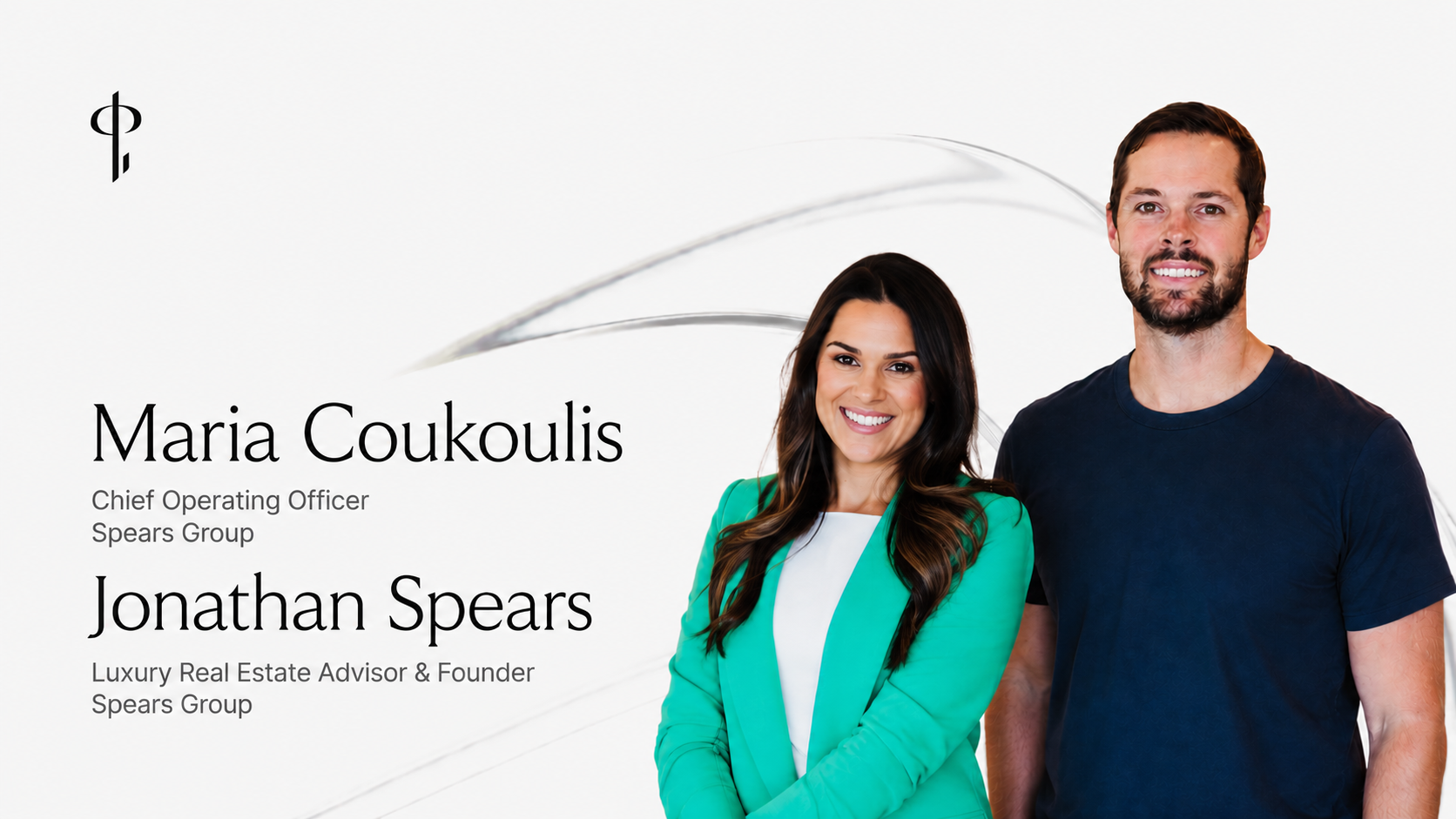
By Jonathan Spears and Maria Coukoulis, Co-Founders of Spears Group and MyOps
We bring very different strengths to the Spears Group, and we built our partnership around that difference on purpose. Jonathan is the producer and founder.
Maria is the COO and head of PR. One of us can crank out 47 ideas before lunch. The other one decides which three we’re actually going to execute this quarter. One of us is wired to chase every opportunity. The other is wired to build the system that makes those opportunities sustainable.
We describe it as the classic operator-producer relationship, and we think the tension between those two different perspectives is the most underrated asset a real estate team can have.
Hire to your weakness (and actually mean it)
When team leaders think about bringing on a partner or an operator, they tend to gravitate toward people they like. Someone with good energy, someone who’s fun at a conference. And then they get into the actual work and realize this person wants to do all the same things they do. The partnership stalls because there’s overlap where there should be contrast.
The fix is simple in theory and hard in practice: figure out what you’re bad at, or simply don’t like, and find someone who’s great at it.
Before you talk to a single candidate, write down the roles and responsibilities you need that person to fill. What will they own? What decisions will they make? What does their Tuesday look like?
Then find the person who gets excited about the things you don’t: the financial tracking, the process documentation, the accountability structures. If they light up talking about that stuff, you’ve probably found the right fit. If they want to talk about listings, you might be hiring yourself again.
Operators and producers have to live in each other’s world
This is where most partnerships break down, and it’s the thing we figured out early.
A lot of operators build systems from their own perspective. They design processes that make perfect sense in a spreadsheet, then can’t understand why agents won’t follow them.
The reason is that an agent’s day looks nothing like an operator’s day. Clients call without warning. Showings shift. Negotiations happen on someone else’s timeline. If a process can’t work when an agent is between appointments or walking into a listing, it doesn’t matter how elegant it looks in a manual.
So we pressure-test every process from both sides before it goes to the team. Will this work in the field? Will this give operations the data it needs? If the answer to either question is no, we go back to the drawing board.
The producer side has to make the same effort. Learning to value operational work when it doesn’t produce an immediately visible result is one of the harder shifts a producer can make.
Building a system doesn’t generate a commission check the way a closing does. But without that system, the closings are chaos. When both sides genuinely understand that the other person’s work makes their own work possible, that’s when the partnership starts compounding.
Define the lanes, then stay in them
So what happens when we disagree? The honest answer is that we built a structure that prevents most disagreements from becoming a real problem in the first place.
We call it decentralized command. Operations has its own authority. Production has its own authority. Our team-lead owns culture and leadership decisions. When a new process needs to happen, it happens. When a new strategic direction makes sense, it gets honest feedback about what’s realistic and what’s going to break.
We talk things through, but we don’t step on each other’s lanes.
The important part is that the authority has to be real. If you bring on an operator and then reverse their calls every time you disagree, you’ve hired an expensive assistant. Decentralized command only works when the person in charge of a domain makes the final decision in that domain, even when the other person might have chosen differently.
The proof showed up when agents started choosing us
We had imagined a version of the Spears Group that was different from the traditional real estate team model, where one agent at the top feeds business down and everyone else waits for the next deal.
And then agents doing 20, 30, 40, 50 million in production started coming to us. People who could have been successful on their own. They had the talent and the track record. They were joining because they saw a structure that would make them better. That was when we knew the partnership had clicked.
It only happened because we brought completely different talents to the problem. One of us could see what a modern real estate team should look like. The other could build the machine that made it real.
That same combination is what led us to build MyOps. We had all of these systems and processes working for Spears Group, but everything was spread across different tools with no single place for it to live. The question became obvious: why keep this to ourselves?
We knew what the industry needed because we’d already built it for our own team. The operator brain knew how to structure it. The producer brain knew what agents would actually use. Half operator, half agent.
Find your counterpart
If you’re a producer thinking about bringing on an operator, figure out what your actual weaknesses are. Then find the person who’s strong in those areas and let them own it. If you’re an operator, find a producer whose ambition pushes the business forward while you build the systems to support it.
You have to be able to bounce off each other. If the relationship is too siloed, you’ll never speak the same language, and you’ll never build processes that work for both sides.
We got here because we took the time to learn each other’s world. Find your counterpart, define the lanes, and trust each other enough to stay in them.
About the authors

Real Estate Advisor; Founder of Spears Group
Jonathan Spears is the founder of Spears Group, a luxury real estate team serving Florida's Scenic Highway 30A and surrounding coastal communities. Known for his market expertise, strategic approach, and commitment to client service, Jonathan has built a reputation for representing distinctive properties and delivering exceptional results for buyers and sellers alike. Through Spears Group, he combines deep local knowledge with innovative marketing and personalized guidance to help clients navigate one of the country's most sought-after luxury real estate markets.

Chief Operating Officer of Spears Group
Maria Coukoulis is the Chief Operating Officer of Spears Group, where she oversees operations, public relations, and strategic initiatives for one of Florida’s leading luxury real estate teams. With a background spanning real estate, communications, and brand strategy, she has played a key role in expanding the company’s national visibility and operational excellence. Prior to joining Spears Group, Coukoulis worked with prominent hospitality and real estate brands and later founded her own boutique public relations firm. A licensed real estate professional and former Division I athlete at Florida International University, she brings a disciplined, results-driven approach to leadership, team development, and business growth.