

You know the feeling. A lead comes in during a showing, a call, or a school pickup line, and by the time you sit down to reply, three hours have passed. NAR data shows 78% of buyers end up working with whichever agent responds first, and Harvard Business School research on more than 2,000 companies found that responding to a lead within an hour makes you seven times more likely to qualify it than responding even a little later.
Most agents care plenty. Luxury Presence chief product officer Zac Hays puts the real problem this way: "Every agent has the same three questions: who do I reach out to, when is the right moment, and what should I say?" These 11 real estate email templates answer the third one, on demand.
That's what this list of real estate email templates is for. No strategy lectures, no advice on choosing an email platform, no list-building tactics. Just 11 real estate email templates for the situations that come up every week, each one ready to copy, paste, and personalize in under a minute.
A quick note on the numbers before you dive in. Real estate emails average a 30-40% open rate and a 1-3% reply rate industry-wide, and reply rate matters more than open rate now that Apple's Mail Privacy Protection inflates opens for roughly half of all recipients. Track replies, showing requests, and booked calls instead. The templates below are built to earn a reply, not a look.
How to use these real estate email templates
Every template follows the same structure: the exact situation to send it in, the full copy in a block you can lift straight into your inbox, and one line on why it works. Swap in your own name, brokerage, and property details before you hit send, and keep the subject lines. They're doing real work.
1. The five-minute new lead response
Send this when: A lead just submitted a form, requested a showing, or messaged you through your website or a portal like Zillow.
Subject: Already pulling info on [Property Address]
Hi [Name],
Saw your request come through on [Property Address / neighborhood] and wanted to jump on it before anything else lands in your inbox. I can send you everything on this one, plus two or three comparable listings you probably haven't seen yet.
One quick question so I point you at the right homes: are you looking to move in the next few months, or just starting to explore?
[Your Name] [Phone Number]
Why it works: It's fast, specific, and asks one easy question instead of pitching. Speed is the whole strategy here. Most buyers work with whichever agent gets there first, so the win is being that agent, not writing a better paragraph.
2. The "should I stop reaching out" re-engagement email
Send this when: A lead has gone quiet for a couple of weeks, whether this is your second follow-up or your fifth. Most agents give up here. Don't.
Subject: Should I stop reaching out about [Neighborhood]?
Hi [Name],
Haven't heard back in a while, so I want to check one thing before I stop following up: are you still looking in [Neighborhood], or has the plan changed? If the timing's off, tell me and I'll go quiet until you're ready, no hard feelings.
If you're still looking, I found a couple of new listings in [Neighborhood/Price Range] that fit what you described. Want me to send them over?
[Your Name]
Why it works: Asking permission to stop gets more replies than asking permission to continue. It's the "breakup email" sales teams have used for years because it removes the guilt of ignoring one more check-in. Eighty percent of sales take five or more follow-up touches, and 44% of agents stop after just one. Agent Ben Belack describes what happens to the leads who never get this email: "people go to a status or a bucket, and that's where the leads go to die." This template is built for touch three, four, or five, so a quiet lead never lands in that bucket.
3. The post-showing buyer follow-up
Send this when: Right after you've shown a buyer a property, ideally within a couple of hours.
Subject: What did you think of [Property Address]?
Hi [Name],
Thanks for touring [Property Address] with me today. I'd love your honest take: a strong contender, or back to the drawing board?
If it's a contender, I'd like to move quickly. Homes in [Neighborhood] priced like this one have been going under contract in [X] days. If it's not the one, tell me what was off and I'll adjust what I show you next.
[Your Name]
Why it works: The either/or framing gets a real answer instead of a polite "we'll think about it," without asking the buyer to score their reaction like a satisfaction survey. Naming a local pace-of-market fact, not a made-up urgency claim, gives the buyer a reason to decide now.
4. The seller consultation follow-up
Send this when: You've just finished a listing presentation or a CMA walkthrough with a potential seller.
Subject: Two decisions for [Address] this week
Hi [Name],
Great talking through [Property Address] today. Attached is the comparable sales analysis we discussed, along with the marketing plan I'd run if we list together.
The two things I'd want to lock in this week: your target list date and whether you're open to [pre-listing recommendation, e.g., staging/inspection]. Can we grab 15 minutes to finalize both?
[Your Name]
Why it works: The subject line tells the seller exactly what the email requires of them before they even open it. It recaps the meeting so nothing gets lost, then narrows the decision to two concrete items instead of leaving "let me think about it" open-ended.
5. The open house follow-up
Send this when: Within 24 hours of an open house, to everyone who signed in.
Subject: What you asked about at [Address] today
Hi [Name],
Good to meet you at the open house today. You asked about [specific question they raised, e.g., the school district or HOA fees], so I looked into it: [answer]. Happy to dig up more if that's useful.
Also curious: is this the kind of home and neighborhood you're targeting, or still narrowing things down? Either way, I can set you up with new listings in [Area] as they hit the market.
[Your Name]
Why it works: Referencing the exact question a person asked, not a generic recap, shows you remember them individually rather than as a name on a sign-in sheet. That's what turns an open house contact into a real conversation.
6. The price reduction announcement
Send this when: A listing's price just dropped and you're re-alerting buyers or buyer's agents who showed interest earlier.
Subject: $[Old Price] to $[New Price] on [Address]
Hi [Name],
Wanted you to hear it from me first: [Property Address] just dropped to $[New Price], down from $[Old Price]. If this was close to working before, it might be worth a second look now.
I can set up a showing this week if you'd like to see it again, or send updated comps to help you think through the number.
[Your Name]
Why it works: Putting both numbers in the subject line does the anchoring math before the email is even opened. "Hear it from me first" makes the recipient feel prioritized instead of one name on a mass alert list.
7. The expired listing outreach
Send this when: A listing just expired in your market and the seller hasn't relisted yet.
Subject: [Address]: what happened, and what I'd do differently
Hi [Name],
I noticed [Property Address] came off the market. Homes don't sell for a lot of reasons: price, timing, exposure, condition, and most of them are fixable.
I'd like to walk you through what I saw happen with the listing and what I'd change if we relisted. No pressure to sign anything, just a straight conversation about what didn't work. Are you open to 15 minutes this week?
[Your Name]
Why it works: It names the seller's likely frustration directly instead of pretending it doesn't exist, then offers information, not a pitch, as the low-commitment first step.
8. The FSBO outreach
Send this when: Reaching out to a For Sale By Owner listing early in its time on market.
Subject: A quick offer on [Address], no strings
Hi [Name],
Saw you're selling [Property Address] on your own. Good luck with it. I work FSBOs in [Neighborhood] often enough to know most owners aren't looking for a full listing pitch, so I'll keep this short.
If you ever want a second opinion on pricing, showing feedback, or handling an offer, I'm glad to help with just that piece, no obligation. And if a buyer of mine ends up interested, I'll reach out directly.
[Your Name] [Phone Number]
Why it works: Acknowledging upfront that they don't want a pitch removes the defensiveness FSBO sellers usually bring to agent outreach, which is what actually gets a reply.
9. The past-client check-in
Send this when: A year (or more) after closing, or around a birthday, home purchase anniversary, or local market shift.
Subject: [X] years in the [Street Name] house
Hi [Name],
Can't believe it's been [X] year(s) since we closed on [Property Address]. Hope the [specific detail: renovation, new addition to the family, neighborhood] has been treating you well.
One quick market note: homes in [Neighborhood] are up/down [X]% since you bought, so if you're ever curious what your place is worth today, just ask.
[Your Name]
Why it works: NAR data shows 82% of real estate transactions come from repeat and referral business, and a specific personal detail plus a genuine market data point keeps you top of mind without asking for anything. Matt Breitenbach, who built a billion-dollar real estate team, puts a number on why this email is worth sending every year: "That's the main thing agents should be doing, following up with past clients or business development. It should be more than 50% of your time."
10. The referral request
Send this when: Shortly after closing, once the client has had a good experience, or during a past-client check-in that's going well.
Subject: A favor, if you don't mind
Hi [Name],
Glad we got [Property Address] closed and you're settled in. I'm reaching out because most of my business comes from people like you telling a friend or family member about their experience. I don't have a big ad budget, referrals are it.
If anyone in your world mentions buying or selling, would you mind passing along my name? I'll take great care of them, same as I did with you.
[Your Name] [Phone Number]
Why it works: Being direct about why you're asking (no ad budget, referrals are the business model) reads as honest rather than salesy, and it's specific enough that the client knows exactly what to do with it.
11. The closing-day thank-you and review ask
Send this when: The day of or the day after closing.
Subject: Congrats on [Address], [Name]
Hi [Name],
Congratulations, [Property Address] is officially yours. It's been a pleasure working through this with you, especially [specific moment: the inspection negotiation, the multiple-offer situation, the fast close].
One small ask: if you have two minutes, a short review on [Google/Zillow] helps other buyers and sellers find me the way you did. Here's the link: [Review Link]. And if you ever need anything, a contractor recommendation, a question about the house, I'm one text away.
[Your Name] [Phone Number]
Why it works: Naming a specific moment from the transaction makes the thank-you feel earned rather than templated, and asking for the review while the experience is fresh gets a noticeably higher response than asking weeks later.
How Smart Actions helps you get specific about who to email next
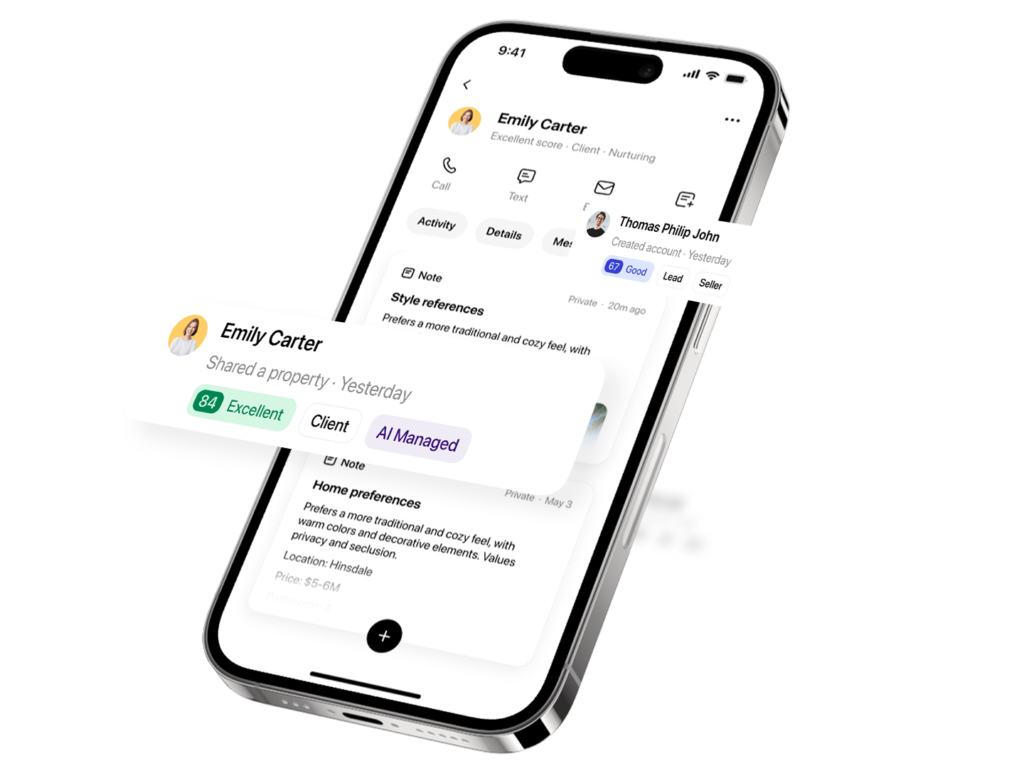
Every template above works best with one ingredient: a real, specific detail about the person you're emailing. That's easy for your top 20 clients. It gets hard once your database holds hundreds or thousands of contacts, and most of them end up on the same generic newsletter because there's no obvious reason to reach out to any one of them today.
That's the gap Smart Actions, a feature inside Luxury Presence's AI CRM, is built to close. Each morning, it reviews your entire contact database and checks the signals that show someone is getting closer to a move: a job change, a relocation, a spike in saved searches, a past client revisiting a listing on your site.
Across Luxury Presence clients, the system evaluates roughly 225,000 of these signals a day, then narrows the results to a ranked list of up to 10 contacts worth reaching out to right now, each paired with the reason it surfaced and a ready-to-send message drafted in your voice. You stay in control of what actually goes out. Nothing sends without your review.
The specificity is the point. In one account, Smart Actions flagged a past client mid-relocation: a Florida home listed, then pulled off market, with a plan to relist before a move to Arizona, all visible through signals the agent hadn't been tracking by hand. The email that went out that morning referenced the exact situation instead of a generic "thinking of you," and the client could tell someone had actually been paying attention.
Clearing a day's worth of Smart Actions takes about 40 seconds each, and close to one in three actions each week points to a contact the agent hadn't reached out to in over a month.
Pair that with the real estate email templates above: Smart Actions tells you who to send the "should I stop reaching out" or "past-client check-in" email to and why, and the template gives you the exact words to send.
Pick one and send it now
Every real estate email template above gives the reader something specific to react to: a real number, a real detail from your last interaction, or a real reason you're reaching out.
Katy Thielke Straser, founder and CEO of the Straser Silicon Valley Team, is right that the words alone aren't the whole job: "You can't manufacture that from a follow-up email sequence. You earn it, one person at a time, over the entire arc of a relationship." Copy the words. Bring the relationship yourself. Look at your pipeline, find the lead who matches one of these 11 situations, and send that email before you close this tab.
Ready to grow?
Turn your content into your best lead source
See how Luxury Presence helps agents turn website visits into closed deals