

REALTOR® is a membership designation, not a separate type of real estate license: a real estate agent or broker who has joined the National Association of REALTORS® (NAR), agreed to its Code of Ethics, and pays dues for the right to use the trademarked title.
That answers the search. It doesn’t answer why the distinction matters, what changed after the 2024 NAR settlement, or how to verify who you’re actually working with.
This guide covers all of it, sourced directly from NAR, the U.S. Bureau of Labor Statistics, and the settlement documents themselves.
Key takeaways
- A real estate agent is licensed by the state. A REALTOR® is a real estate professional who has also joined NAR and agreed to its Code of Ethics. REALTOR® is a membership designation, not a license level.
- REALTOR® is a registered trademark, written in all capital letters with the ® symbol. Using it for someone who isn’t an active NAR member is a trademark violation, not a stylistic nitpick.
- The 2024 NAR settlement changed how buyer’s agents get paid, not who qualifies as a REALTOR®.
- Title alone doesn’t guarantee quality, and REALTOR® membership doesn’t automatically guarantee MLS access either. Both vary by market. Track record and responsiveness matter just as much as credentials.
Real estate agent vs. REALTOR® vs. broker, at a glance
Agent, REALTOR®, and broker get used almost interchangeably in casual conversation. That’s exactly why the confusion persists.
Agent and broker describe license status. REALTOR® describes something different: membership in the National Association of REALTORS®, layered on top of that license.
A REALTOR® can be an agent, a broker, or a broker-associate. The membership itself isn’t a license tier.
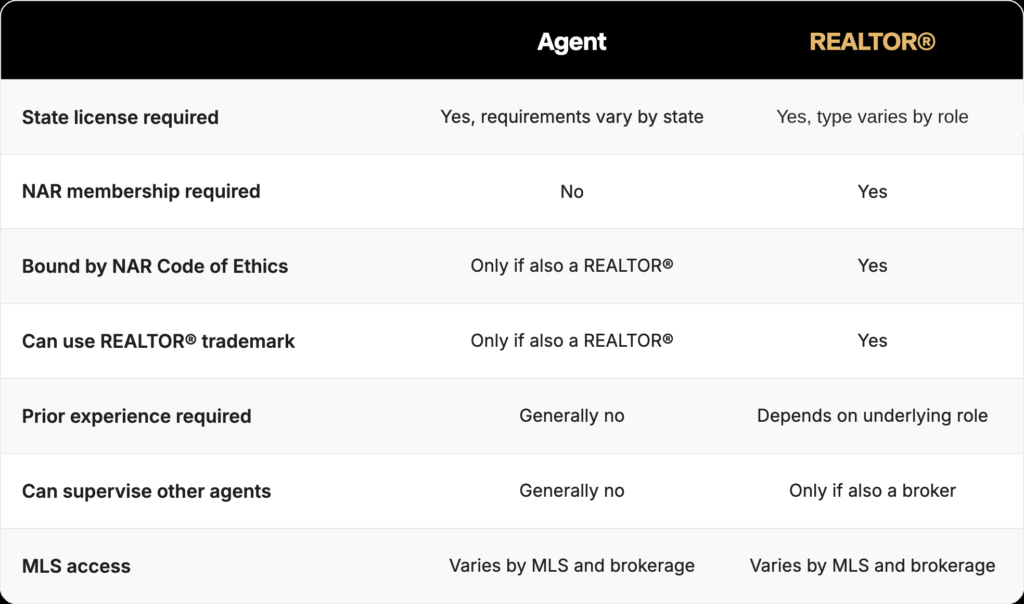
A broker is the next license tier up from agent, not a competing category. Every broker started as an agent, and plenty of brokers are also REALTORS®.
For a deeper breakdown of the two license levels, see our full real estate broker vs. agent comparison.
What is a real estate agent?
A real estate agent has completed their state’s pre-licensing coursework, passed the licensing exam, and holds an active license to represent buyers or sellers.
Every state requires this license, but the path isn’t standardized. Coursework ranges from roughly 40 hours in states like Massachusetts to well over 150 hours in states like Texas, per state boards referenced by the Bureau of Labor Statistics.
Once licensed, an agent works under a supervising broker. They can’t operate independently or hold client funds in escrow.
If an agent later moves states, license reciprocity rules determine how much of that original licensing carries over.
Licensing is the only legal requirement to sell real estate. Everything past that, including NAR membership, is optional.
What is a REALTOR®?
A REALTOR® is a real estate agent or broker who has joined NAR, agreed to its Code of Ethics, and pays membership dues at the local, state, and national level.
REALTOR® is a registered trademark, not a job title or skill level, coined in 1916 by Charles N. Chadbourn, a past president of the Minneapolis Real Estate Board, to distinguish members bound by an ethical code.
NAR secured exclusive federal trademark rights to the term in 1949 and 1950. That’s why it’s written in all caps with the ® symbol, and why it can’t legally be applied to a non-member.
NAR is explicit that REALTOR® should never imply a profession on its own, as in “Jane the REALTOR®.” It exists solely to indicate NAR membership, always tied to a specific person or firm’s name.
What membership actually includes:
- A binding Code of Ethics, adopted in 1913, covering duties to clients, the public, and other REALTORS®.
- MLS access in many markets, though participation rules are set by each local MLS, not by NAR membership alone. NAR’s own 2025 policy changes let some MLSs open participation to non-members too, so REALTOR® status alone was never a guarantee.
- Continuing ethics training every three years to stay in good standing.
- Dues. Currently $156 in national dues plus a $45 advertising assessment, for $201 total per year, per NAR’s dues page. Local and state dues are billed on top and vary by market.
New agents budgeting for dues, MLS fees, and other startup costs can find a full breakdown in our real estate agent expenses guide.
Membership changes who a real estate professional has agreed to answer to, not what they’re legally allowed to do.
What is a real estate broker?
A broker completes the same licensing path as an agent, then passes a second, more advanced exam after gaining experience, typically two or more years as a licensed agent, though the exact requirement varies by state.
Brokers can work independently, open their own brokerage, and supervise other agents. Every agent works under a broker’s license, whether or not that broker is also a REALTOR®.
For the full picture, see real estate broker vs. agent and how broker salaries compare to agent pay.
A brief history
The terminology dates back further than most people assume, and the timeline explains why it still matters today.
- 1908: The organization now known as NAR was founded as the National Association of Real Estate Exchanges, with 120 founding members.
- 1913: NAR adopted its Code of Ethics, one of the first of its kind for any American trade group.
- 1916: Charles N. Chadbourn coined the term “Realtor” to distinguish ethical, association-affiliated members from the rest of the industry.
- 1949–1950: NAR registered exclusive federal trademark rights to “REALTOR®” and “REALTORS®” with the U.S. Patent and Trademark Office.
That history is why NAR still treats the title so protectively. It was built as a trust signal from the start, not a marketing flourish added later.
How to verify a real estate professional’s credentials
You don’t have to take either title on faith. Both are checkable in a couple of minutes.
To confirm a license is active, search your state’s real estate commission website. Most post a free public lookup tool.
To confirm NAR membership specifically, use NAR’s own REALTOR® directory, which lists every active member by name and market.
Neither check tells you whether someone is good at their job. It confirms they are who they say they are, a reasonable first filter before a major transaction.
How real estate agents and REALTORS® get paid
Both agents and REALTORS® typically earn commission, split with their supervising broker, rather than a salary.
Per the Bureau of Labor Statistics (May 2025), the median annual wage is $52,830 for sales agents and $73,220 for brokers. For a market-by-market breakdown, see average real estate agent salaries.
Commission splits between agent and broker commonly range from 50/50 for newer agents to 80/20 or better for high-producing agents with more negotiating room.
NAR dues are a separate cost, layered on top of that commission structure. That’s exactly why the 2024 settlement, covered next, is a different conversation entirely.
The 2024 NAR settlement: what actually changed
In 2024, NAR settled a set of antitrust lawsuits, including Sitzer/Burnett, alleging its MLS rules artificially inflated commissions paid to buyer’s agents. NAR agreed to pay $418 million over roughly four years while continuing to deny any wrongdoing.
Two practice changes took effect on August 17, 2024, and still apply today:
- Cooperative compensation offers can no longer appear on the MLS. A seller’s broker can still offer to pay a buyer’s broker. That offer no longer appears inside the listing itself.
- Buyers must sign a written agreement before touring a home. It has to spell out compensation and disclose that commissions are fully negotiable.
The settlement changed how buyer-side compensation gets negotiated and disclosed. It didn’t change who qualifies as a REALTOR® or what membership means.
Agents adjusting to the new rules can find practical strategies in our guide to the settlement’s impact, including how buyer agent commission conversations now typically happen.
Common myths, debunked
“Hiring a REALTOR® costs the client more.” Dues are paid by the professional, not billed to a client as a line item. Commission is negotiated independently of NAR membership.
“Only REALTORS® can access the MLS.” Access depends on each local MLS’s own rules. Some require REALTOR® association membership, and NAR’s 2025 policy changes let some MLSs open participation to non-members too. Confirm directly with a specific agent to be sure.
“The title guarantees quality.” Neither licensing nor REALTOR® membership measures how responsive, skilled, or locally knowledgeable someone actually is.
Should you hire a REALTOR® or a real estate agent?
If ethical accountability and a formal dispute-resolution process matter most, prioritize a REALTOR®. NAR’s Code of Ethics gives you recourse a non-member license alone doesn’t.
If track record and local market fit matter most, the title alone won’t tell you that. You’ll get more signal from client reviews and recent closed transactions in your neighborhood.
In practice, most professional agents in the U.S. are REALTORS®. NAR counts well over a million members nationwide. The right question is which specific person, with which track record, should represent you, not whether they carry the REALTOR® title.
Why the distinction matters even more in luxury real estate
At the luxury end of the market, the gap between title and substance widens. Off-market deals and high-stakes negotiations reward agents who bring a deep referral network, discretion, and specialized designations like the CLHMS to the table.
The role of the real estate agent is changing fastest in this segment, as buyers and sellers increasingly evaluate agents by their online presence before they ever meet in person.
Thinking about becoming a REALTOR®?
If you’re considering a career in real estate rather than hiring someone, the path is straightforward, even if it takes real time to complete.
- Complete your state’s pre-licensing coursework and pass the licensing exam.
- Find a supervising broker and activate your license.
- Apply to your local REALTOR® association, which enrolls you in your state and national associations.
- Agree to NAR’s Code of Ethics and pay dues at all three levels.
Our full how to become a real estate agent guide walks through each step, including state-specific requirements.
If you’re weighing the financial side, our real estate agent expenses guide and the BLS data above are a more reliable starting point than the inconsistent salary figures that circulate online.
How top agents stand out beyond the title
Once you’re licensed, and you’ve decided whether NAR membership is right for you, the title stops being the differentiator.
What separates a thriving agent or REALTOR® from one who’s struggling has almost nothing to do with which credential they hold.
It comes down to how fast they respond to a new lead (buyers increasingly expect minutes, not hours), and how consistently they follow up with their own database instead of letting past clients go cold.
It also comes down to how easily a prospective client can find their name and track record online before ever picking up the phone.
That’s a big part of why more agents are investing in building a strong reputation that outlasts any single transaction. That means a website and search presence that reflects the business they’ve actually built, plus technology that responds to inbound leads within minutes and flags which past clients are quietly ready to move again.
Showing up consistently, not the title on a business card, is what actually sets one agent apart from another.
FAQs on a REALTOR® vs real estate agent
Ready to grow?
Turn your content into your best lead source
See how Luxury Presence helps agents turn website visits into closed deals