By Kyle Whigham, SEO Manager
For years, the plan was simple: rank higher, earn the click, convert the visitor. I still believe in that plan, but it only covers part of the job now. More than two out of three Google searches end today without anyone clicking through to a website, and AI Overviews are the biggest reason why. Here’s what the data shows, and what I’m telling clients still gets them found.
Find It Fast
The Short Version
- In the first four months of 2026, 68.01% of Google searches ended without a click, according to SparkToro. In 2024, that figure was 60.45%. A decade ago, it was closer to 45%.
- AI Overviews are the accelerant. Ahrefs found that when an AI Overview appears, click-through rate for the top-ranking page drops by roughly 58%, nearly 60%. That drop has moved faster in the last two years than it did across the whole decade before it.
- Ranking well isn’t the finish line anymore. The job now has two parts: become a source AI platforms trust enough to cite, and win the branded, local, and transactional searches where buyers are already ready to act.
- Both depend on the same foundation: brand awareness, brand demand, and showing up where your audience already spends time. From there, your website has to be built to turn that visibility into leads.
The click is disappearing, and it’s happening faster than ever
Google is doing more of the answering itself these days, right on the results page, before anyone needs to click through to a website.
A SparkToro report on this landed in June 2026. It found that 68.01% of Google searches in the first four months of the year ended without a click. Two years earlier, that number sat at 60.45%. A decade ago, it was closer to 45%.
SparkToro called the jump from 2024 to 2026 the fastest acceleration of this phenomenon in the last decade, and pointed to one clear driver: AI Overviews, now showing up on more than 20% of all searches, cut click-through rate by nearly 60% when they appear.
That 60% figure lines up almost exactly with Ahrefs’ own numbers. When Ahrefs re-ran its study in February 2026 across 300,000 keywords, it found the presence of an AI Overview now correlates with a 58% lower click-through rate for the page ranking in position one, up from 34.5% just a year earlier.
Put simply, for every 100 clicks a top-ranking page could once expect, Google now keeps 58 of them. The pain spreads well beyond position one, too. Position two lost roughly half its clicks. Even position 10 was down close to 20%.
People didn’t stop searching for real estate agents, neighborhoods, or homes for sale, but a growing share of those searches get answered before anyone lands on a website, including yours.
AI Overviews are the accelerant, but the pattern isn’t new
Zero-click search predates AI Overviews by years. Featured snippets, the local map pack, and instant answers have been quietly keeping searchers inside Google for a while now.
AI Overviews just sped everything up, and Google’s own product changes in 2026 confirm the direction. AI Mode alone crossed one billion monthly users this year, with query volume more than doubling every quarter.
Agents ask me all the time whether this makes SEO pointless. My answer is no, and the data backs it up.
Organic visibility and AI citation rates tend to move together. When a page ranks well in traditional search, it’s also more likely to get pulled into an AI-generated answer, because the retrieval systems behind ChatGPT, Gemini, and Google’s AI Overviews lean on the same signals traditional search already rewards: fresh, well-structured, genuinely useful content written by someone who clearly knows the subject.
I go deeper on this in Does ChatGPT hurt your SEO rankings?, but the short version is that good SEO and good AI visibility are, in practice, close to the same job.
Ranking well isn’t the only finish line anymore
For years, the goal of SEO was straightforward: rank on page one, earn the click, convert the visitor. That equation still matters, but it’s no longer the whole job. With well over half of searches ending before a click happens, the work now splits in two directions at once.
Job one: become a source AI platforms trust enough to cite
When someone asks ChatGPT or Google’s AI Overview “who’s the best real estate agent in my area,” the platform is deciding who to cite as the answer, a different job than ranking ten blue links ever was. When I think about real estate agents, I think you want to be the source AI pulls from.
That’s harder than it sounds, because most of the credit doesn’t happen on your own site. Research from AirOps found that roughly 85% of brand mentions inside AI-generated answers come from third-party pages, not the agent’s own website, and about 48% of those citations come from community platforms like Reddit and YouTube alone.
I’ve seen the same pattern in my own client work: about 85% of your mentions in ChatGPT are going to come from off-site sources, not your own content. I wrote more on this in 85% of AI brand mentions come from sites you don’t own.
That changes what “SEO” means in practice. Beyond your own site, the work looks like getting listed on the directories and best-of lists AI platforms already cite, earning locally relevant backlinks from community organizations and business partners, showing up in local press, and participating honestly in the forums where your buyers already ask questions.
On your own site, structure still matters just as much. Topic clustering, the practice of building one thorough pillar page supported by focused, interlinked subtopic pages, has been an SEO fundamental for over a decade.
It matters more now because of what my colleague and fellow SEO expert Thomas Gregorich explains why this is: “Google’s AI mode uses something called query fanout, where when you ask it something, it generates all these related searches, and it will cite the website that covers all those different angles of the main topic.”
A site built around focused, connected clusters is simply easier for an AI platform to recognize as an authority.
None of this works if the content itself is generic. I’ve watched agents publish 20 AI-written articles a week and wonder why nothing ranks. Without human review, you’re just shouting into the ether, and not contributing to the conversation.
What AI platforms are consistently rewarding instead is first-hand, verifiable expertise, the kind of detail only someone who actually works a market would know.
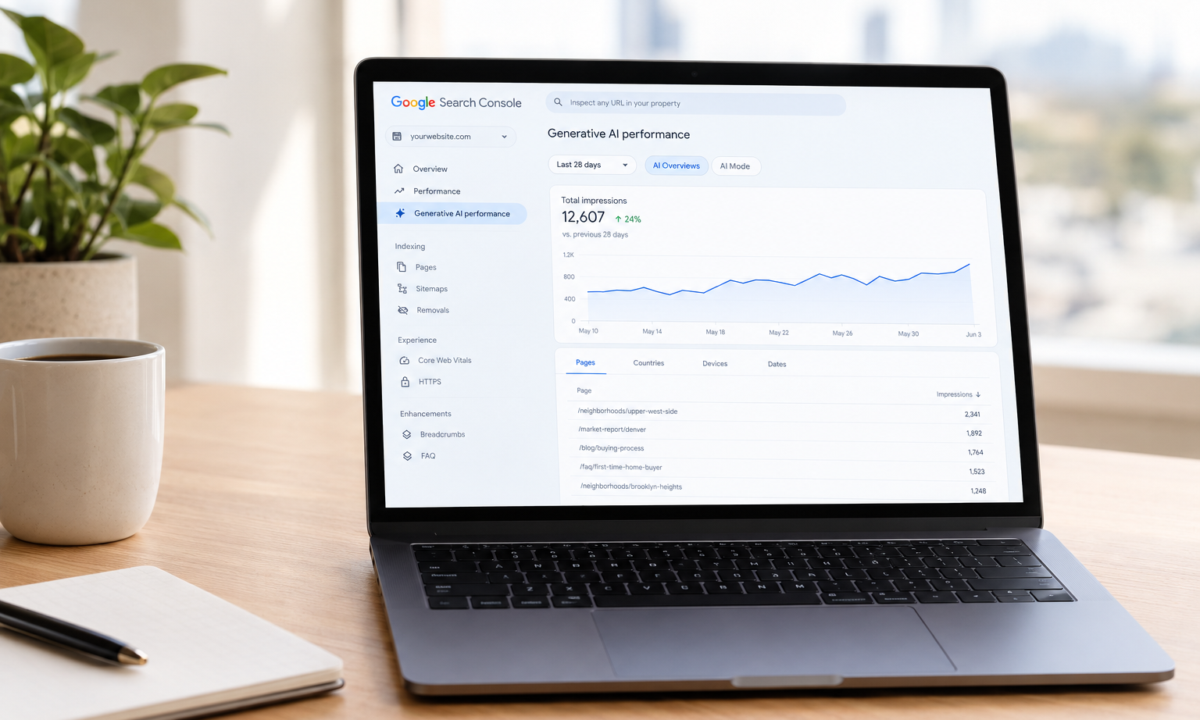
Because none of this shows up in a traditional rank tracker, measuring whether it’s working takes a different approach. I broke down the two signals worth watching for free, AI referral traffic in GA4 and branded search impressions in Google Search Console, in How to track AI search visibility for real estate agents.
Job two: capture the searches that still convert
Not every search is disappearing into a zero-click answer. The searches that still send a click, reliably, are branded, local, and transactional: someone typing your name, your team’s name, or “homes for sale in [neighborhood]” because they’re ready to act rather than gather information.
The gap between these two kinds of visibility is enormous. A study I like to point clients to found that the average click-through rate from AI platforms across all industries is around half a percentage point.
Compare that to what happens when someone searches for an agent by name: click-through rates run 70 to 80%. That’s not a small difference. It’s the difference between a search that might mention you and a search that reliably puts a buyer on your website.
This is also where local search earns its keep. A complete, verified, review-rich Google Business Profile remains one of the most reliable ways to show up when someone searches for an agent in your market, and it’s still one of the most commonly neglected assets on an agent’s site. I go through the specific fixes in 7 common mistakes in local SEO, but an incomplete profile is consistently the single biggest gap agents leave on the table.
Both jobs run on the same foundation
Becoming an AI-trusted source and winning branded, local, and transactional search both come down to the same thing: how well known and how well regarded your name already is before someone starts searching.
I’ve seen this play out with clients directly. I once watched a real estate agent outrank far more thorough competing articles with a short, first-hand piece, and traced the reason back to the agent’s visibility everywhere else. That Realtor had his own TV show, had published books, and was a regular on podcasts. People knew his name, so search engines treated him like he mattered. Brand awareness works more like fuel than a finishing touch.
As Thomas puts it in Local real estate SEO strategies, “On-page SEO is the car. Brand popularity, mentions and backlinks are the gasoline that fuels the improvements to your Google rankings.”
That correlation extends into AI visibility too. There’s a documented relationship between how often people search for a brand by name and how often that brand shows up in AI-generated answers.
Practically, that means podcast appearances, local press mentions, community involvement, and consistent reviews all feed the same signal, whether the platform reading it is Google or ChatGPT. I laid out 13 specific strategies for building that foundation, from Google Business Profile setup through structured data, in Maximize your real estate SEO. Treat it as a checklist rather than a menu. Most of it compounds together.
Then you need a site built to turn visibility into leads
Brand awareness and AI citations get someone curious about you. What converts that curiosity into a lead is still your website, and specifically, the searches that land on it with real intent behind them.
This is where a lot of agent sites quietly fall short. An MLS-synced IDX page that looks identical to every other agent’s IDX page in the market gives Google, and a prospective buyer, no reason to pick yours.
I cover how to fix that in IDX SEO strategy: custom property descriptions, local context wrapped around your listings, and deliberate internal links connecting your blog content, neighborhood guides, and listing pages into one connected system rather than a set of disconnected pages.
That internal linking matters more than most agents assume. The biggest mistake I see is endlessly linking to the homepage while neglecting what I call your money pages, the transactional listing pages built to convert a visitor into a lead. Pointing authority and traffic toward those pages, deliberately, is one of the highest-value moves available on a site you already have.
The bottom line
Search is splitting into two lanes. A growing share of it now gets answered without ever sending a click, and no amount of on-page optimization changes that on its own. What still works is building a brand people already search for by name, earning the kind of off-site recognition that gets you cited when someone asks an AI platform for a recommendation, and making sure your site is built to convert the branded, local, and transactional searches that still reliably arrive with a buyer attached.
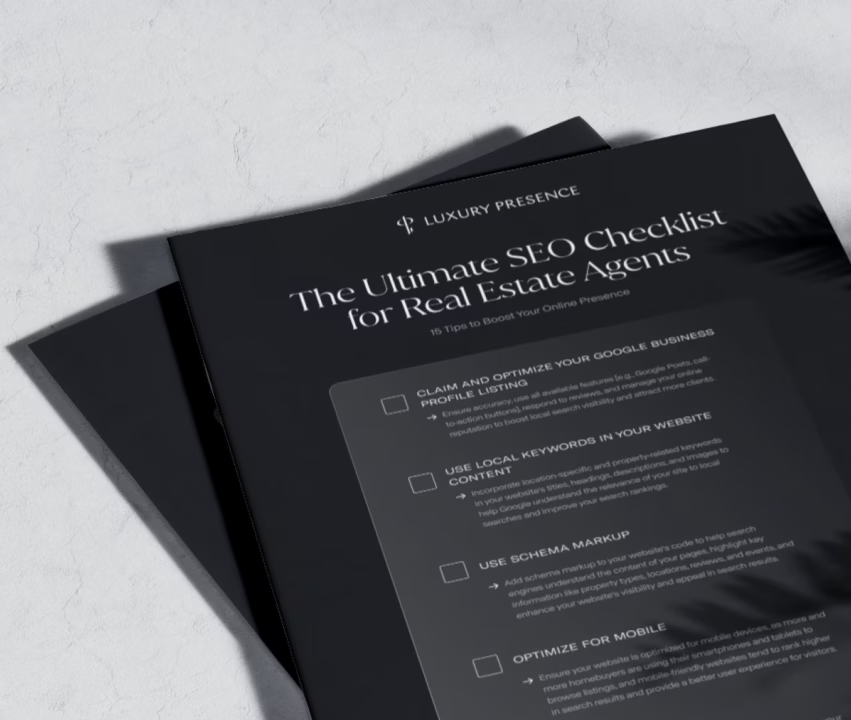
The right way to DIY SEO
If you want to optimize your search engine rankings, follow our team’s expert advice.
FAQs
About the author

SEO Manager
Kyle Whigham is a digital marketing professional with a background in SEO, content strategy, and brand growth. He brings a disciplined, results-driven approach to his work, shaped by years of experience collaborating with teams to deliver measurable outcomes. Kyle focuses on helping organizations strengthen their digital presence and connect more effectively with their audiences.