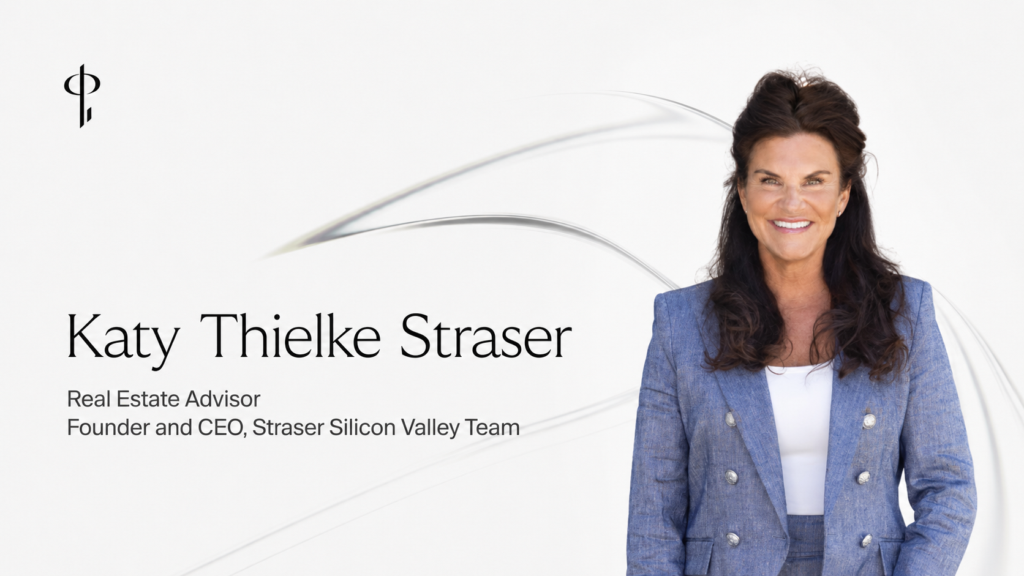
By Katy Thielke Straser, Founder and CEO, Straser Silicon Valley Team
It was my first open house. My mother had been in real estate for years and, when she had too many listings one afternoon, she asked me to get my license. So I did. That weekend, she handed me keys to one of her properties in the Silicon Valley and said, "Just treat it like you're at a luncheon. Introduce yourself. Show them around."
Two hours in, a buyer walked through the door and said, "I want to buy this house."
I called my mom from the driveway. She was at another listing and flew over, and the two of us sat at the kitchen table with that buyer and wrote it up on the spot. She walked me through everything. By the time it was over, I had earned more from that single transaction than I had in an entire year at Coca-Cola.
I haven't looked back since. But here's what I've come to understand: the reason I was ready for that moment had nothing to do with real estate training. It had everything to do with what I did before it.
Nordstrom trained me before real estate ever did
All through college I worked at Nordstrom, moving through different departments and going through their training program. At the time I thought I was just paying for school. Looking back, I was learning the single skill that separates good agents from great ones: how to make someone feel genuinely taken care of.
They teach you that the client is always right, and then they teach you what operating from that belief actually looks like in practice. How to listen. How to make them feel like they walked into exactly the right place. People who feel comfortable in your camp want to stay there, and the whole job is keeping them there.
I didn't know it at the time, but I was building the core of what luxury real estate actually requires: the ability to make a client feel genuinely taken care of.
There's a difference between simply guiding someone through a transaction and genuinely caring for them. Most clients can tell which one they're getting. And only one of those builds the kind of trust that brings them back for every major transaction in their lives.
If you came to this career from a service background, go back and think about the specific lessons you absorbed there. The instincts you built in those jobs are probably your best competitive advantage. Don't leave them on the shelf.
What the Olympics taught me about staying in the room
After college, I moved to Atlanta with five suitcases, knocked on a stranger's door, and said, "Hi, I'm your roommate for the next eight months." I had signed up to work at the 1996 Olympic Games.
I ended up as the venue manager for the indoor volleyball arena. Twelve to sixteen hour days, 99,000 attendees, an enormous team, and people flying in from every country on earth expecting everything to run perfectly. After the torch went out, I moved to New York for three months to work the US Tennis Open.
What I was really learning was how to read a room at scale, how to stay calm when large things were on the line, and how to build trust fast with people from completely different backgrounds and expectations.
Those skills transfer directly. When you're sitting with a family who has owned their home for 65 years and they're crying because they don't know what comes next, you have to hold that room. When you're competing against four other top agents for a listing and the sellers are elderly siblings scattered across three time zones in China, you have to read what they actually need and give them a reason to trust you above everyone else.
That's a human skill, built through years of high-pressure environments, and it shows up in how you conduct yourself in every listing presentation, every emotional walkthrough, every tense negotiation.
Real estate school teaches you the mechanics. Working for the Olympic Games taught me how to stay calm, solve problems under pressure, and deliver when the stakes were highest.
What selling Coca-Cola taught me about response time
After the Olympics and U.S Tennis Open, I landed at Coca-Cola, where I was part of the team launching Dasani water. That's a real sales job. Calls, targets, accounts to manage, a product that needed a clear story and a rep who showed up.
Corporate sales taught me what real estate training never fully addresses: everybody wants everything yesterday, and your response time tells clients who they hired. I built the habit during those years, and I kept it.
Today, whether it's a phone call, a text, or an email, my response time is within three to five minutes. Every time. That's not a personality trait. It's a standard I set because I was trained in environments where losing an hour meant losing the deal.
Sales also taught me to figure out what the person across the table is actually trying to accomplish before I open my mouth. The pitch is always second. The understanding comes first. In real estate, that shapes the listing presentation, the offer strategy, the negotiation. In Coca-Cola, it shaped every sales call. The underlying skill is identical.
What nobody tells you about switching industries
When I made the move into real estate, I thought I was starting over. I wasn't. I was bringing every lesson, every skill, and every experience with me.
A lot of agents come up through this business with a clear, predictable path: get licensed, join a team, learn by doing. There's nothing wrong with that path. But the agents who came from somewhere else, from hospitality, from corporate sales, from event management, from service industries, carry a different set of instincts.
They know what exceptional service actually looks like, because they were trained to deliver it in environments where it mattered every single day. They know how to hold steady when things get complicated. They know how to make a person feel seen, because they learned that before they ever held a key.
The best training I ever got had nothing to do with real estate
If you had told me in Atlanta, sweating through a 14-hour shift at the Olympic volleyball venue, that I was building toward a career in luxury real estate in Silicon Valley, I would not have believed you.
But when I look back, every moment counted. The customer service. The event management. The sales calls. The international relationships.Every piece of it shaped the agent I became.
I know agents who came up through banking, through medicine, through the military. And the ones who brought that experience with them, who didn't try to erase it to look like a "real" agent, are often the ones who are still standing a decade in and building the kind of client base that sustains a career.
Whatever you did before this, it's working for you right now. The question is whether you know how to use it.
Ready to grow?
Turn your content into your best lead source
See how Luxury Presence helps agents turn website visits into closed deals