
Writing email campaigns that sound like you, land in the right inbox at the right time, and actually get opened is one of the hardest recurring tasks in real estate marketing. Most agents either spend hours drafting a single email or default to generic templates that read like they were written for no one in particular. In 2026, ChatGPT, a large language model developed by OpenAI, gives real estate professionals a faster way to draft subject lines, structure drip campaigns, and personalize outreach at a scale that would otherwise require hours of manual writing. This guide breaks down the best practices for using AI to write email content and provides 15 ChatGPT prompts for email marketing that you can copy, paste, and customize for your business right now.
Key takeaways
- These prompts are built for GPT-5, the current 2026 ChatGPT model, and work best when you feed them specific details about your market, audience, and brand voice.
- AI-generated email drafts are starting points, not final sends. Always review, edit, and approve every message before it goes to your list.
- A three-email automated drip campaign built for a top Chicago real estate professional achieved a 31% open rate on the first email and a 43% click-through rate on the second, with zero unsubscribes (Source: Luxury Presence Case Study: Automated Lead Nurture Email Strategy, 2026).
- A/B testing, which compares two versions of an email to see which performs better, is the single fastest way to improve open rates on subject lines.
- Drip campaign sequencing matters as much as the copy itself. Spacing, order, and calls to action (CTAs) determine whether a lead stays engaged or unsubscribes.
- Every email you send must comply with the CAN-SPAM Act, the U.S. law that governs commercial email requirements, including opt-out links and accurate sender information.
Why use ChatGPT for real estate email marketing in 2026?
The math is simple: ChatGPT can help you produce in 10 minutes what used to take an hour. Whether you are drafting a one-time announcement or building an automated email campaign, AI can assist with the following tasks:
- Generating attention-grabbing subject lines with multiple variations for split testing
- Writing persuasive email copy that matches your brand voice
- Structuring follow-up sequences with logical spacing and escalation
- Personalizing messages for different audience segments, from first-time buyers to luxury sellers
- Refining tone and style so every email reads like it came from you, not a robot
To put the opportunity in concrete terms: a three-email automated drip campaign built for a top Chicago real estate professional achieved a 31% open rate on the first email and a 43% click-through rate on the second, with zero unsubscribes (Source: Luxury Presence Case Study: Automated Lead Nurture Email Strategy, 2026). That kind of performance does not happen by accident. It happens when good prompts meet good strategy, and the agent reviews every message before it goes out.
By using AI as a drafting partner, real estate agents can keep their email marketing messages consistently well-crafted, on-brand, and focused on the actions they want readers to take.
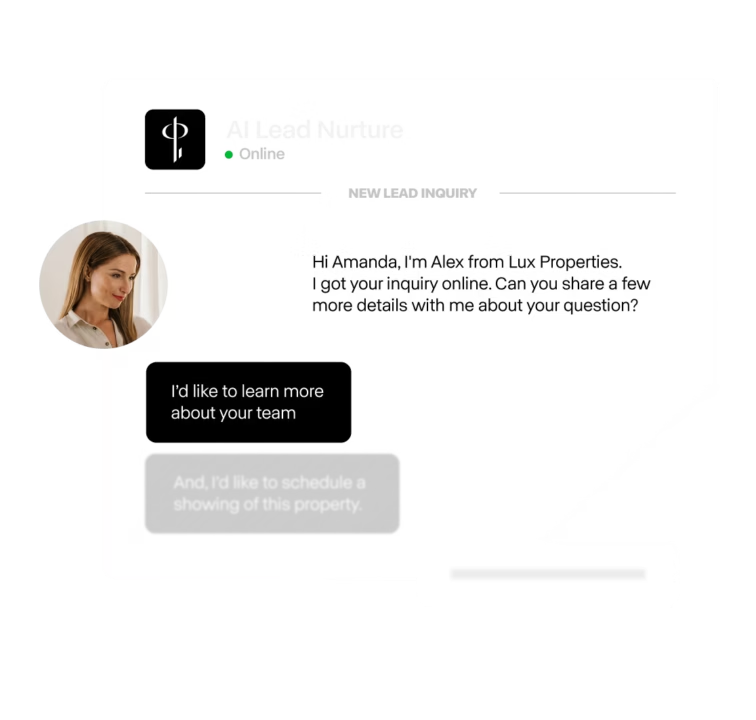
AI Lead Nurture
Luxury Presence’s artificial intelligence tool replies to inbound messages quickly and automatically, increasing lead reply rates to over 50%.
Best practices for using ChatGPT in real estate email marketing
ChatGPT is a powerful drafting tool, but the quality of your output depends entirely on how you use it. Here is the playbook that separates agents who get real results from agents who get generic filler.
That observation from Malte Kramer captures the biggest mistake agents make. ChatGPT is not a search engine. It is a writing partner. The more context you give it, the better the draft you get back. Here are the rules to follow:
- Always review AI-generated content before sending: ChatGPT can produce awkward phrasing, inaccurate details, or copy that drifts from your brand voice. Read every draft out loud. Edit anything that does not sound like something you would actually say to a client.
- Input accurate market data, especially in 2026: AI-generated content is only as good as the information it receives. If your email includes market updates or statistics, paste the latest local real estate data directly into your prompt. Pull from your local board of Realtors, your Multiple Listing Service (MLS) reports, or recognized industry sources. Never trust ChatGPT to generate current market numbers on its own.
- Personalize where it counts: ChatGPT can generate strong templates, but adding personal touches, such as addressing recipients by name or referencing their specific property search criteria, is what turns a good email into one that gets a reply.
- Test different variations: AI lets you generate multiple versions of any piece of content in seconds. Use A/B testing to compare subject lines, calls to action, and messaging styles, then let the data tell you what your audience responds to.
- Comply with the CAN-SPAM Act: Every commercial email you send must follow email marketing laws and regulations, including the CAN-SPAM Act, the U.S. law that governs commercial email requirements. That means including a working opt-out link, accurate sender information, and a valid physical mailing address in every message.
Prompt reference table
Before you start copying prompts, use this table to find the right one for your situation. Each prompt maps to a specific use case, target audience, and campaign type so you can jump directly to what you need.
| Prompt | Use case | Target audience | Campaign type |
| 1 | Subject line generation | Any segment | Any email |
| 2 | Welcome new subscribers | New leads | Single send |
| 3 | Newsletter template | Full database | Monthly recurring |
| 4 | Post-showing follow-up | Buyer leads | Single send |
| 5 | Nurture seller leads | Potential sellers | Single send |
| 6 | Buyer drip campaign | Buyer leads | 5-email drip |
| 7 | Open house invitation | Local prospects | Single send |
| 8 | Reengagement email | Inactive leads | Single send |
| 9 | Client appreciation | Past clients | Single send |
| 10 | Year-in-review | Full database | Annual send |
| 11 | Seller drip campaign | Potential sellers | 4-email drip |
| 12 | First-time buyer seminar | First-time buyers | Event invitation |
| 13 | Post-closing follow-up | Recent closings | Single send |
| 14 | Investment opportunities | Investors | Single send |
| 15 | Free home valuation offer | Potential sellers | Single send |
These prompts are built for GPT-5, the current 2026 ChatGPT model. Results may vary with earlier model versions.
15 ChatGPT prompts for real estate email marketing in 2026
Each prompt below is ready to copy and paste into ChatGPT. Swap the bracketed placeholders with your own details, review the output, and edit it until it sounds like you. Every prompt also includes a specific tip for getting a stronger result.
1. Generate compelling subject lines
Prompt: “Create 10 engaging subject lines for a real estate email message focused on helping {target audience} achieve {real estate goal}. Make them concise and attention-grabbing.”
Tip: Run A/B tests on your top two subject line options before sending to your full list. Most email platforms let you test with a small segment first, then automatically send the winner to the rest. Even a 2-3% lift in open rate compounds over dozens of sends per year.
2. Welcome new email subscribers
Prompt: “Write a warm and professional welcome email for new subscribers to my real estate email list. The tone should be friendly and informative. Include a call to action to schedule a consultation. My name is {name}, I serve {market area}, and my specialty is {specialty}.”
Tip: Your welcome email typically gets the highest open rate of any message you will ever send. Include one clear next step, not three. If the CTA is to book a call, do not also ask them to follow you on social media and read your blog. One action, one link.
3. Create a real estate newsletter template
Prompt: “Create a template for a monthly real estate newsletter that includes sections for market updates, featured listings, homebuyer tips, and a call to action.”
Tip: Use the same section order every month so subscribers develop a reading habit. Consistency in format builds familiarity, and familiarity builds trust. Change the content, not the structure.
4. Develop a follow-up email after a home showing
Prompt: “Write a follow-up email for a prospective homebuyer after a showing. The email should express appreciation, highlight {property features}, and invite them to ask questions or schedule another visit.”
Tip: Send this email within two hours of the showing while the property is still fresh in the buyer’s mind. Add one specific detail about something the buyer reacted to during the tour, such as the kitchen layout or the backyard size. That single detail signals you were paying attention and separates your follow-up from every other agent’s template.
5. Nurture seller leads
Prompt: “Write an email for homeowners who are considering listing their property but have not committed yet. Include market insights from {source} and an invitation to discuss their options. Focus on addressing common seller concerns, such as timing and pricing.”
Tip: This prompt lives or dies on the data you feed it. Follow these rules for the strongest output:
- Paste in specific numbers: recent comparable sales, median days on market, and year-over-year price changes from your local board of Realtors or MLS reports.
- When sourcing market data in 2026, prioritize Q1 2026 MLS reports and current inventory levels over national averages.
- Always double-check every statistic ChatGPT includes in the draft. AI can fabricate numbers that look plausible but are completely wrong.
Seller leads are making a six- or seven-figure decision. Vague market commentary will not move them. Specific, sourced data will.
6. Generate an automated drip campaign for buyers
Prompt: “Create a five-email drip campaign for nurturing homebuyer leads. The campaign should educate buyers on the process, provide helpful tips, and encourage them to work with me. My market is {market area} and my target buyer profile is {profile}.”
Tip: Space the emails 3-5 days apart for the first three messages, then stretch to 7-10 days for emails four and five. Front-loading the sequence keeps new leads warm while they are most engaged. Stretching the back half prevents fatigue and unsubscribes.
7. Announce an upcoming open house
Prompt: “Draft an email invitation for my upcoming open house. Include the following details about the property and event: {listing and event details}”
Tip: Add high-quality images or a video tour link directly in the email body. Emails with visual property content consistently outperform text-only invitations because they give the reader a reason to click before they even arrive at the open house.
8. Create a reengagement email for inactive leads
Prompt: “Write an email that will prompt action from real estate leads who have not engaged with my messages in a while. The email should be friendly, explain {market insights}, and encourage them to reconnect.”
Tip: Offer something of concrete value, such as a free market analysis or an off-market listing alert, to give inactive leads a reason to reply. A reengagement email with no clear benefit to the reader will get ignored just like the last five emails they did not open.
9. Generate a client appreciation email
Prompt: “Write a heartfelt email to past clients thanking them for their business. Include a referral request and a reminder that I am available for any of their own future real estate needs.”
Tip: Reference the specific property address or neighborhood where you helped the client close. A message that says “I hope you are still loving the kitchen in your Elm Street home” lands differently than “Thank you for your past business.” Specificity is the difference between a referral and a delete.
10. Write a year-in-review email
Prompt: “Create a year-in-review email for my real estate business. Highlight {achievements}, {market trends}, and express gratitude to clients and prospects.”
Tip: Use visuals like infographics or client testimonials to break up the text. A year-in-review email is one of the few messages where longer is acceptable, because readers expect a summary. But keep each section scannable with bold headers and short paragraphs.
11. Develop a seller-focused drip campaign
Prompt: “Create a four-email drip campaign for homeowners, covering topics like preparing a home for sale, pricing strategies, marketing techniques, and closing the deal.”
Tip: Include location-specific data in at least two of the four emails. Reference your city or neighborhood by name, cite local comparable sales, and mention area-specific staging advice. This positions you as the agent who knows the market, not just an agent who knows how to send emails.
12. Promote a first-time buyer seminar
Prompt: “Draft an email invitation for a first-time homebuyer seminar, including key topics, a compelling reason to attend, and the following event details: {date}, {time}, {venue}, and {RSVP instructions}.”
Tip: Name any guest speakers, such as a lender or home inspector, and mention any free resources attendees will receive. First-time buyers are information-hungry. Telling them exactly what they will learn is more persuasive than a generic “join us” invitation.
13. Create a post-closing follow-up email
Prompt: “Write an email to send to clients after closing on their real estate transaction, thanking them for their business and providing helpful next steps for settling in.”
Tip: Include a direct link where the client can leave a Google review or online review. The 48 hours after closing is the window when clients are most willing to write a testimonial. Make it as easy as one click.
14. Write an email about real estate investment opportunities
Prompt: “Create an email introducing real estate investment opportunities to potential investors, highlighting {market trends} and these available properties: {link}, {link}, {link}.”
Tip: Investors respond to numbers, not narratives. Include at least two of the following in your prompt: recent appreciation rates, rental yield percentages, cap rates, or vacancy rate trends for your market. Pull these figures from your local MLS or a recognized data provider and paste them directly into the prompt so ChatGPT can weave them into the copy.
15. Offer a free home valuation
Prompt: “Write a persuasive email offering a free comparative market analysis for homeowners considering selling. Emphasize the benefits of knowing their property’s market value.”
Tip: End the email with a single, prominent CTA button that links to an online home valuation tool or a consultation booking page. Do not bury the link in a paragraph of text. The CTA should be the most visually obvious element in the entire email.
Using AI to Write Better Real Estate Emails
ChatGPT can save you time and help you create stronger email campaigns, but the best results still come from clear inputs, accurate local data, and careful human editing. Use it to generate subject lines, draft nurture sequences, and tailor messages for each audience segment, then review every email for tone, compliance, and relevance before you hit send. When you combine thoughtful prompts with a consistent email strategy, you can create messages that feel personal, stay on brand, and keep leads moving forward.
FAQs
Ready to grow?
Turn your content into your best lead source
See how Luxury Presence helps agents turn website visits into closed deals