I’ve been doing SEO since 2012, and in that time, SEO has “died” about a dozen times, yet I’m still here. So when people ask me what’s changed about search in the last year, my honest answer is: a lot.
The biggest shift is in how people actually search now. Many searches are now zero-click, meaning the user gets their answer right on the results page or in an AI overview and never visits a website. I’d argue much of that traffic wasn’t the most qualified to begin with, because those people were gathering information, and were not inclined to convert anyway.
The real benefit to showing up in those zero-click results isn’t necessarily leads. It’s brand awareness and trust. When those same people are ready to act six months from now, yours is the name they already know.
The question is how you get there. In SEO and AI search, there are many factors, but one big one is topic clustering.
TLDR
- Topic clustering is a content structure where one comprehensive pillar page is supported by focused subtopic pages, all linked together. It has been an SEO best practice for over a decade, but it matters more now than ever.
- Google’s emphasis on topical authority, AI overviews, and zero-click search results all reward sites that demonstrate deep, organized expertise on a subject.
- Clustering works because of link equity, anchor text signals, and Google’s query fanout in AI mode, which favors sites that cover multiple angles of a topic.
- Your cluster content should include more than blog posts. Think neighborhood guides, calculators, buyer/seller guides, and market reports with original analysis.
- Pick one topic you own. Stay focused. Keep your content updated. That is the strategy.
Why content structure matters
Keywords are important, but they’re not enough on their own
For a long time, you could get away with a pretty simple content approach: find a keyword people are searching for, write a blog post targeting it, rinse and repeat. You’d take one broad topic and splice it into 10 or 15 different posts, each going after a slightly different keyword variation. Keywords still matter. They’re the foundation of how people find anything through search. But a keyword-first, structure-second approach doesn’t cut it anymore on its own.
Google is looking for authority, not just relevance
Google has gotten really smart about recognizing genuinely helpful content, especially now that AI makes content writing accessible to anybody. You don’t have to be a professional writer anymore, which means Google has to work harder to figure out what’s genuinely authoritative, what has real proof points behind it, and what deserves to rank. When everybody can produce content, the differentiator isn’t just what you write about. It’s how you organize it.
Topic clustering isn’t new, but it’s newly critical
That’s where topic clustering comes in. Topic clustering isn’t new. SEOs have been talking about it for over a decade. But the forces shaping search right now (AI overviews, zero-click results, Google’s emphasis on topical authority) have arguably made it more important than it’s ever been. If you’ve been meaning to get serious about structuring your content this way, now is the time.
What is a topic cluster?
The pillar page: your comprehensive anchor
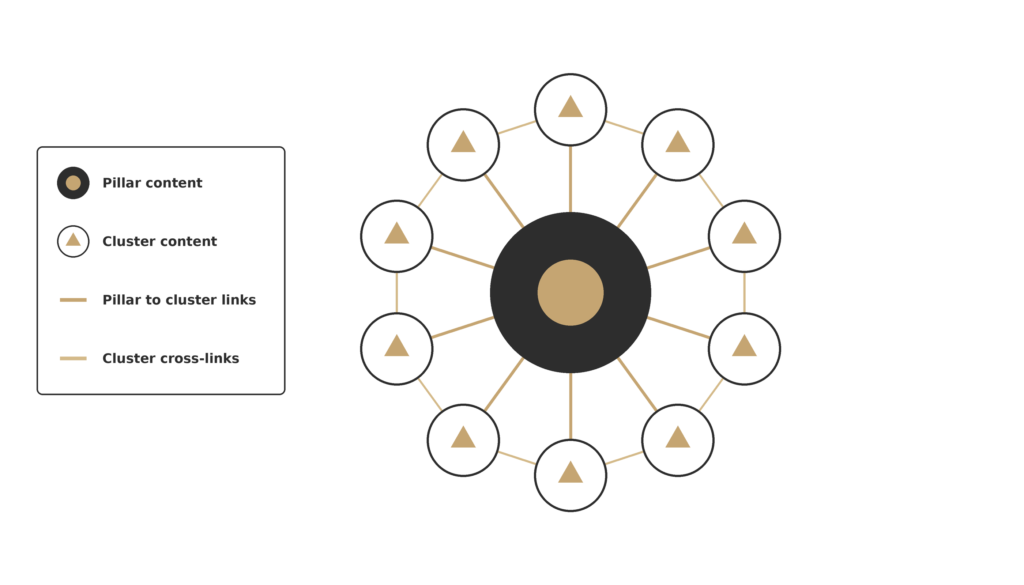
A topic cluster is a deliberate content architecture built around one central, comprehensive page (your pillar) supported by a set of related, more focused pages that branch off from it. Everything in the cluster is connected through internal links, creating a web of content that signals deep expertise on a subject.
Your pillar page is an expansive piece of long-form content, typically two to three thousand words or more, that confidently answers the most pressing questions about a topic in one place.
I’ll use my own backyard as an example. Say you’re an agent in Charleston, South Carolina. Your pillar might be a guide on what it’s like to live in Charleston. You’d cover demographics, school ratings, outdoor recreation, walkability, the restaurant scene, and market trends, all on one page. Google can look at a long-form article like that and recognize, “This person really knows their stuff. There are all sorts of proof points in here.”
Supporting pages: going deeper on the subtopics
Your supporting pages are the content that branches off that pillar. Shorter pieces, maybe 1,500 words each, that go deeper on specific subtopics: “Is Charleston a good place for young families?” “Family-friendly activities in the lowcountry.” “Charleston vs Summerville: which town fits your lifestyle?”
Internal linking is the glue
Here’s the critical part: you link everything together. Your pillar mentions family-friendly activities briefly and then sends readers to the full supporting article for the details, and your supporting articles link back to the pillar. That connected web of content is what tells Google you’re a topical authority.
You also have to think about where the user is on their journey. Someone searching “what’s it like to live in Charleston?” is at the top of the funnel. You want them to land on that pillar, stay engaged, and start building trust with you right away.
Why topic clustering works on a technical level
Link equity and anchor text
For the technical details, my colleague and SEO expert Thomas Gregorich offers a helpful explanation: “When a page links to another page, it’s passing link equity, which helps the linked page rank. This is still a factor because Google’s PageRank algorithm, which looks at links in this way, is still actively guiding what pages they surface in search results. If you’re linking them all together, you’re basically passing that link equity around your cluster to help the pages rank. This is in a sense old-school SEO, and it probably still works to some level.”
The words in your links, known as anchor text, also matter. Google reads your anchor text and the surrounding context to understand what each connected page is about. You’re basically drawing a map that says: “This brand covers this entire subject.” You’re telling Google you’re an authority.
Query fanout and the retrieval window
There’s also a more modern reason this structure matters. Thomas notes that “Google’s AI mode uses something called query fanout, where when you ask it something, it generates all these related searches, and it will cite the website that covers all those different angles of the main topic. If you have all those pages in a cluster, you’re more likely to get pulled into the retrieval window and shown in AIO answers.”
Does topic clustering help you show up in AI search?
This is where nuance matters. There's growing conversation around "GEO," "AEO," and other emerging terms, and it's worth understanding how they relate to what we already know. Optimizing for AI isn't an entirely separate discipline from SEO, but it's not a perfect one-to-one match with traditional SEO either.
Here’s what we do know. Thomas and I are seeing in the data that organic search visibility and AI citation rates tend to move together. When your organic rankings go up, your ChatGPT citations often follow, and when organic drops, citations frequently drop with it. That correlation makes sense: AI platforms like ChatGPT use retrieval systems that pull from the web, and the content that performs well for retrieval tends to be the same stuff that ranks well in Google. Fresh, well-structured, genuinely authoritative writing that answers questions directly.
Your cluster content is bigger than blog posts
Think beyond the blog
The word “content” gets used as a synonym for “blog posts,” but in practice you need to decouple those two ideas, especially when building a topic cluster.
Neighborhood guides are content. A mortgage calculator is content. Buyer and seller guides tailored to your specific audience are content. If you’re working with retirees who are downsizing, your seller’s guide is going to be much more focused on how you’re going to market their property and what you do differently than the agent down the street. That specificity is what makes it useful, and what makes it a strong supporting page in your cluster.
Add real copy to your data pages
Here’s something I see all the time with our clients. They have gorgeous neighborhood guide pages with great data widgets: demographics, school ratings, points of interest, restaurants, shopping. But too often, that’s all they put on that page. When a client comes to me and says they’re not happy with their performance, the first thing I look at is whether their neighborhood guides have actual copywriting on them. If they don’t, that becomes priority number one.
Add a few paragraphs about what you personally love about the area and drop in some recent market data. “In Q4 2025, the average home in this neighborhood sat on the market for 22 days, and the median sale price was $485,000. During this same period, clients who listed with me were only on the market for 13 days, and the median sales price was $600,000.” That kind of context turns a data page into a genuinely authoritative resource that showcases your unique value proposition, and becomes a meaningful part of your topic cluster.
Original insight beats generic evergreen
Thomas made a point about this that stuck with me: “Evergreen content needs to be on your site for user experience and topical authority. But in terms of appearing in LLMs, it might not be worth it, because LLMs can answer those generic top-of-funnel questions themselves. We’re seeing evergreen content drop for sites like Wikipedia, while Reddit and YouTube are surging. Google is looking for net-new insights.”
That lines up exactly with what I’m seeing. Your pillar content matters, but you need to support it with proprietary information and original perspective. Every agent I talk to does market reports. The ones who win are the ones explaining why that data matters to their audience.
Building your cluster: how to pick your topic and stay focused
Own your lane
The agents who succeed with topic clustering know their lane. They’re locked in on their target clientele, locked in on their target property type, and they’re showcasing their expertise toward that specific group.
When you try to be a master of all things real estate in your market, you become a master of none, and your cluster falls apart. A topic cluster only works when it’s genuinely focused. If your pillar is about living in Charleston and your supporting content drifts into vacation rentals, you’re diluting the signal you’re sending to Google.
Match your cluster to your value proposition
If you only want to work with first-time homebuyers, write the content that makes you the first-time homebuyer expert. Build your pillar around that. Create supporting pages that address every question a first-time buyer in your market would have. Leave downsizing-after-55 to someone else. That’s their lane and their cluster.
Understand your unique value proposition and create a cluster that proves it, consistently.
Consistency and freshness: the two things that make clusters work over time
SEO is not an overnight win
If you’re doing SEO well, it’s not an overnight win. You typically don’t see the fruits of your labor for anywhere from one to several months after you’ve made optimizations and added content. It takes time for Google to crawl, index, and understand the full context of what you’re building. That delay makes it easy to get discouraged.
The ones who give up want results quickly, and I get it. If you’re sinking $8,000 into a website and you don’t feel like you’re seeing ROI, that’s absolutely discouraging.
Your cluster is a living thing
But a topic cluster isn’t something you build once and walk away from. Thomas noted that 70% of pages cited by AI platforms were updated within the last 12 months. If you published a neighborhood guide two years ago and haven’t touched it, it’s losing ground to someone who updated theirs last quarter.
Keep adding supporting content. Keep refreshing your pillar with new data and insights. The agents who are sharing that work on social media, building brand loyalty with the people who already know them while attracting new audiences through search, are the ones compounding their results every quarter.
Using AI to build your cluster (without wasting your time)
Google won’t reward hastily made content
The biggest risk with using ChatGPT for content is that it’s really easy to crank out 20 articles a week. But if you’re not putting those through human review (specifically expert review where you’re adding your own experience and perspective) you’re just shouting into the ether with information people can find on hundreds of other pages. A topic cluster built on generic AI content isn’t really effective. You should AI to assist in writing but make your own first-hand experience and proprietary data as the basis of the article.
Better prompts, better drafts
The quality of your AI draft depends entirely on what you feed it. “Write a 1,500-word blog post about living at the beach” will get you generic filler. Treat your prompt like a creative brief instead. Every prompt you write should include:
- A specific angle, not just a topic. “Best sunset viewing spots along the Outer Banks, focusing on Corolla, Duck, and Kill Devil Hills” beats “living at the beach.”
- Your target audience. Are you writing for relocating families? Retirees? Second-home buyers? The tone, examples, and emphasis should all shift accordingly.
- Your own data and observations. Feed in stats from your own deals, local market trends, or personal experience. This is what makes the output yours instead of everyone else’s.
- Where it fits in the cluster. Tell the AI which pillar page this supports and what related pages it should reference. That context shapes the draft around your existing content strategy.
The more specific your brief, the less editing you have to do on the back end, and the more likely the draft actually fits into your cluster as a useful supporting page.
Build topical authority with content clusters
My recommendation is to move away from scattered content and start building topic clusters around your main offerings as a real estate agent. Choose the subject you're the clear expert on. Build your pillar page. Support it with content that goes deeper on the subtopics your audience actually cares about. Link everything together. And keep it updated.
Whether someone finds you through Google, ChatGPT, or whatever platform comes next, the agents who've built that foundation of connected, genuinely helpful content are the ones who will keep showing up.
FAQs
Ready to grow?
Turn your content into your best lead source
See how Luxury Presence helps agents turn website visits into closed deals