For decades, the best agents won because they held the keys, the MLS access, the neighborhood knowledge, and the network. Buyers and sellers needed an agent to get information, and that informational advantage was the moat that protected every top producer’s business.
That moat has been drained. And most agents haven’t realized it yet because the consumer changed faster than the industry did.
I’ve spent 20 years watching technology disrupt industry after industry. SaaS rewired enterprise software. Mobile rewired retail. Right now, AI, hyper-personalization, and instant access to data are doing the same thing to real estate.
The agents who understand what’s actually happening will build businesses that compound for a decade. The ones clinging to the old playbook will spend the next two years wondering where their pipeline went.
The Consumer You’re Selling To No Longer Exists
Here’s what’s actually happening on the buyer and seller side, and most agents underestimate how radical the shift has been.
Today’s buyer doesn’t call you to ask about a listing. They’ve already toured the home on video. They’ve pulled the comps on Zillow. They’ve read the neighborhood school ratings, checked the walkability score, looked at price history, and compared you to three other agents on Instagram and Google. All of that happened before you knew they existed.
They arrive at the table as decision-makers. They’ve already formed opinions about the property, the market, and you.
The old model assumes a consumer who is waiting for information, a lead who calls and needs you to educate them through the funnel. That consumer is gone.
The data supports this shift. According to the National Association of REALTORS®, 100% of home buyers now use the internet at some point during their home search, and 43% say their very first step was looking for properties online. The buying journey no longer begins with an agent. It begins with a search bar.
The sharpest agents I know have already noticed this in their own data. They look at their last ten closed deals and ask one question: at what point did this client first reach out, and what did they already know? The answer is almost always the same. The client showed up late, informed, and opinionated. That pattern tells you everything about where the market is heading.
The agents I see with the highest conversion rates from their digital presence share a consistent trait. Their websites, their social profiles, their video content all communicate a clear, specific authority within seconds.
The generalists, the ones whose digital presence could belong to any agent in any market, consistently underperform. The consumer isn’t evaluating you. They’re filtering you. And if your digital presence doesn’t register as worth stopping for, they’ve already moved on.
Zillow’s Consumer Housing Trends research found that online research increasingly shapes how buyers and sellers choose agents before the first conversation ever takes place. Many consumers effectively make their shortlist before picking up the phone. In a market where buyers can compare agents, reviews, content, transaction history, and expertise in minutes, visibility alone is no longer enough. Relevance wins.
Information Arbitrage Was Your Moat, and It’s Been Drained
I use the term “information arbitrage” deliberately. It’s how a portfolio manager would describe what agents actually sold for the last 30 years. You held an asset the consumer couldn’t access: data. You had MLS access they didn’t have. You had context they couldn’t build on their own.
The spread between what you knew and what they knew was the foundation of your value proposition. And like any arbitrage, once the other side gets access to the same information, the spread collapses.
We’ve seen this movie before. Travel agents lost their information advantage when booking platforms emerged. Financial advisors lost it when market data became universally accessible. SaaS companies lost it when software became easier to compare and evaluate. Real estate is experiencing the same shift. Information asymmetry is disappearing.
Every major technology platform in real estate has been quietly closing that gap. Zillow gave them the comps. Redfin gave them the touring tools. Social media gave them direct access to agents’ track records, client reviews, and market opinions. AI is now giving them the ability to synthesize all of it in seconds, without picking up the phone.
What once required multiple conversations, research sessions, and weeks of investigation can now be summarized in minutes. Consumers increasingly arrive informed, armed with pricing history, neighborhood insights, school data, market trends, and competing agent options before ever reaching out. AI is not replacing the consumer’s decision-making process. It’s accelerating it.
The agents who are still leading with “I have access to off-market listings” or “I know this neighborhood better than anyone” are betting the information gap will hold, and it won’t.
The replacement for information arbitrage is authority.
The agents who own a position of trust in the consumer’s mind, who are known as the go-to expert in a specific market or property type before the first conversation even starts, have an advantage that no platform can replicate.
But building that authority requires a fundamentally different approach than the one most agents are running today.
The SaaS Playbook Already Showed Us How This Ends
Hear this, because it matters. I watched this exact pattern play out in SaaS over the last decade. Companies that built their businesses around proprietary data access, around being the only ones who could see or interpret certain information, got displaced fast.
The winners were the ones who built the most trust, not the ones with the most data.
HubSpot didn’t become the dominant inbound marketing platform because they had better software.
HubSpot’s founders understood something many industries eventually learn: category leadership often matters more than product leadership. They built authority through education, research, thought leadership, and community long before buyers entered the purchasing process. By the time prospects were evaluating software, HubSpot had already become the default choice in their minds.
As HubSpot co-founder Brian Halligan famously said, “The internet changes the way people buy, not the way people sell.”
The companies that adapted to that reality won. The ones that didn’t eventually became invisible.
The agents who will dominate their markets over the next decade will follow the same pattern. They will become the go-to voice in their market, the person other people reference when someone asks, “Who should I talk to about buying in this neighborhood?”
Here’s the uncomfortable truth about this pattern: it rewards first movers disproportionately.
In every SaaS category I’ve watched, the companies that moved early to build authority captured market share they never gave back.
The ones who waited spent twice the budget to get half the results.
Every major technology shift rewards early authority builders. Search engines rewarded the first content creators. Social media rewarded the first audience builders. Today’s AI-driven discovery environment is beginning to reward the first credible experts.
Authority compounds. Late entrants pay a premium to catch up.
The same pattern is forming in real estate right now.
Most agents are still running a 2015 playbook in a 2026 consumer environment.
That gap between the old approach and what’s actually required is a window.
The early movers are already climbing through it.
The agents moving fastest all started the same way: they picked the one market or property type where they had the most credibility, looked at who was already showing up on Google, Instagram, YouTube, and increasingly AI search results, and found that in most cases, nobody owned the space yet.
So they claimed it.
And every week that passes, their authority in that niche becomes harder to catch.
The Question That Matters Now
The consumer has changed.
The information gap has closed.
The era of winning on access is over.
Technology will keep changing. Platforms will keep shifting. AI will keep giving consumers more power.
But the agent who owns a position of trust in the consumer’s mind has an advantage no algorithm can replicate.
Technology is rapidly commoditizing access to information. What remains scarce is trust.
The next decade of real estate will be won by the agents who become the most trusted source of interpretation, guidance, and expertise.
Jeff Bezos captured this perfectly when he said, “Your brand is what people say about you when you’re not in the room.”
In a world where consumers can access nearly unlimited information, your reputation becomes the filter through which they evaluate everything else.
Information is becoming abundant.
Authority is becoming the moat.
The question is no longer whether consumers will use technology and AI before contacting an agent.
They already are.
The question is whether they’ll discover you when they do.
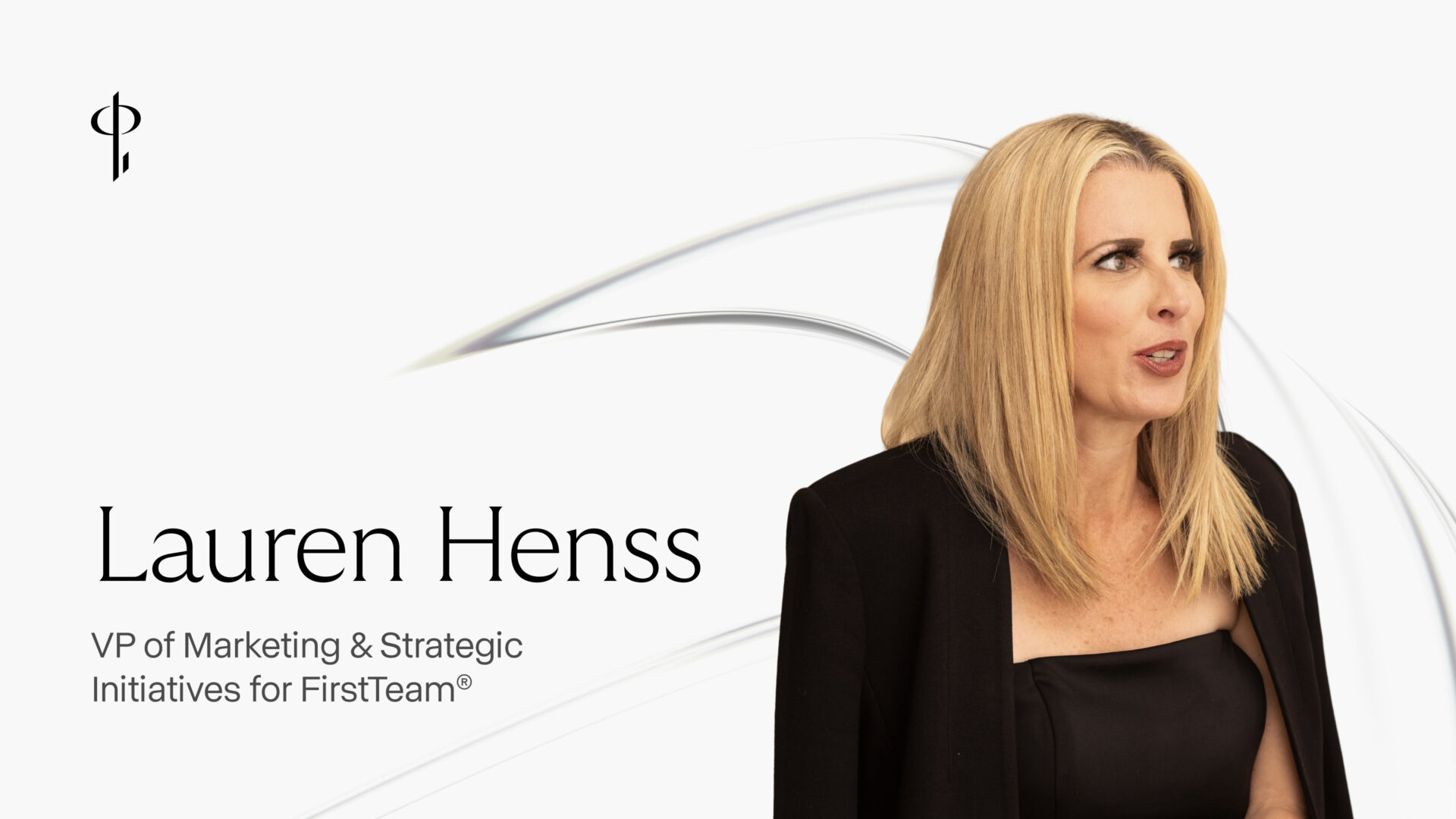
About the author

VP, Marketing & Strategic Initiatives at First Team Real Estate
Lauren Henss is a leading Strategy and Marketing Executive who has led brand, marketing, and growth strategy for real estate, PropTech, SaaS, and large consumer brands for more than 20 years. Her career has centered on the intersection of brand technology and human behavior, helping companies translate long-term vision into strategy, measurable growth, and impact. She currently serves as the VP of Marketing and Strategic Initiatives for FirstTeam®.
Through operational excellence, strategic alignment, M&A integration, digital transformation (AI), and strategic partnerships, Henss enables organizations to scale sustainably and future-proof growth. These initiatives drive global expansion, go-to-market success, and long-term enterprise value.
Henss has led high-performing teams for global brands and high-growth companies, blending Fortune 150 discipline with startup agility. Her work consistently translates strategy into measurable outcomes, including 3X revenue growth, global market expansion, and sustained competitive advantage. In her current role, she leads marketing and communications,
digital transformation, GTM, partnerships, and strategic growth initiatives, aligning brand, recruitment, revenue operations, and partnerships into a single growth engine that drives agent acquisition, retention, and market expansion. At COMPASS and Toll Brothers, she played a key role in accelerating sales volume ($6 billion+) and expanding regional market share (28% increase).
Her experience spans both B2B and B2C, partnering with Fortune 500 companies and global brands including Amazon, Salesforce, Nike, CHANEL, Hyatt, DreamWorks, WPP (VML), CBRE, Zoho, Zillow, and LPL Financial.
Henss was named a 2025 HousingWire Marketer of the Year for driving marketing innovation, digital transformation, and measurable GTM impact.