
A lead capture form is a short web form on your real estate website that collects visitor contact information, typically a name and email address, in exchange for access to listings, home valuations, or market reports. In 2026, this small piece of your site carries outsized weight. Every dollar you spend on ads, every hour you invest in content, and every listing you showcase funnels toward one question: did the visitor give you their information? If the answer is no, that traffic disappears.
A well-placed, well-designed lead capture form is the mechanism that converts anonymous clicks into named contacts you can actually follow up with. The data backs this up. Across the Luxury Presence platform, websites generated nearly 500,000 exclusive leads in a single year, and the majority of those came through forms embedded in home search tools, valuation pages, and behavior-triggered popups. This article breaks down exactly where to place your forms, what makes them convert, and how to build a capture system that turns your website into a pipeline, not a brochure.
Find It Fast
Key takeaways
- A lead capture form is the single highest-impact element on a real estate website because it is the point where anonymous traffic becomes a named, contactable prospect.
- The five highest-performing placements for lead capture forms in 2026 are home search tools, home valuation pages, exit-intent popups, listing inquiry forms, and gated resource downloads.
- Forced registration, where visitors must enter contact details after viewing a set number of listings, is consistently the top-volume lead source on agent websites.
- Google One Tap integration reduces form friction and accounted for 228,000 leads across Luxury Presence client sites in 2024 performance data.
- Short forms win. First-touch forms should ask for a name and email only. Every additional field reduces completion rates.
- Luxury Presence clients averaged nearly 25 transactions per agent, compared to the industry median of 10 reported by the National Association of Realtors (NAR), and a significant share of that gap traces back to better lead capture infrastructure.
2024 Luxury Presence platform results at a glance
| Metric | Result |
| Total exclusive leads generated | Nearly 500,000 |
| Leads from home search tool | More than 186,000 |
| Leads from Google One Tap integration | 228,000 |
| Leads from home valuation tool | More than 28,000 |
| Website sessions tracked | More than 100 million |
| Average transactions per client agent | Nearly 25 (vs. industry median of 10) |
| Total client transaction volume | Over $300 billion |
| RealTrends “The Thousand” ranked clients | 127 professionals, including 31 of the top 100 individual agents |
All figures reflect Luxury Presence internal performance data from 2024, the most recent full-year dataset available as of 2026.
Why your website traffic is leaking leads in 2026
More than 100 million website sessions were tracked across Luxury Presence websites in a single year. That is an enormous volume of prospective clients landing on agent sites, scrolling through listings, and reading neighborhood content. The question is whether those visitors leave with nothing more than a memory, or whether they leave as a contact in your database.
Most agent websites lose the majority of their traffic. Visitors browse, get the information they came for, and close the tab. Without a lead capture form placed at the right moment, you have no way to follow up. No email. No phone number. No opportunity. The form is the conversion point where passive browsing becomes a relationship you can nurture.
In 2026, with digital marketing costs rising and consumer attention fragmenting across more platforms, every visitor who leaves your site without identifying themselves represents wasted spend. A lead capture form placed within your home search tool, on your valuation page, or triggered by scroll behavior is the mechanism that stops that leak.
The five highest-performing placements for lead capture forms
Knowing that lead capture forms matter is not enough. The placement, timing, and context of each form determine whether it converts or gets ignored. Here are the five locations that consistently produce the highest volume and highest quality leads on real estate websites.
Home search tools with forced registration
The single highest-volume lead source on most agent websites is the property search tool. Forced registration means that after a visitor views a set number of listings (typically three to five), they must enter their contact information to continue browsing. This works because the visitor has already demonstrated intent by actively searching properties. They are invested in the experience and willing to exchange their information to keep going.
Luxury Presence’s home search tool is consistently the top lead source across client websites, based on 2024 internal performance data. The volume it produces is not accidental. It is the direct result of placing a lead capture form at the exact moment a buyer’s intent is highest.
That principle applies whether you are working with first-time buyers or high-net-worth clients. The forced registration model works because it aligns the ask with the value the visitor is already receiving.
Home valuation pages
Sellers are among the most motivated visitors on any real estate website. When someone enters their address into a home valuation tool, they are signaling that they are thinking about selling. That is a decision-stage action, not a casual browse. More than 28,000 leads came directly from Luxury Presence’s home valuation tool in 2024 (Luxury Presence internal data). These leads tend to be higher intent because the visitor initiated the interaction with a specific property in mind.
Exit-intent popups and scroll-triggered forms
Exit-intent popups appear when a visitor’s cursor moves toward the browser’s close or back button. Scroll-triggered forms appear after a visitor has scrolled past a defined percentage of the page. Both capture attention at moments when the visitor might otherwise leave without taking action.
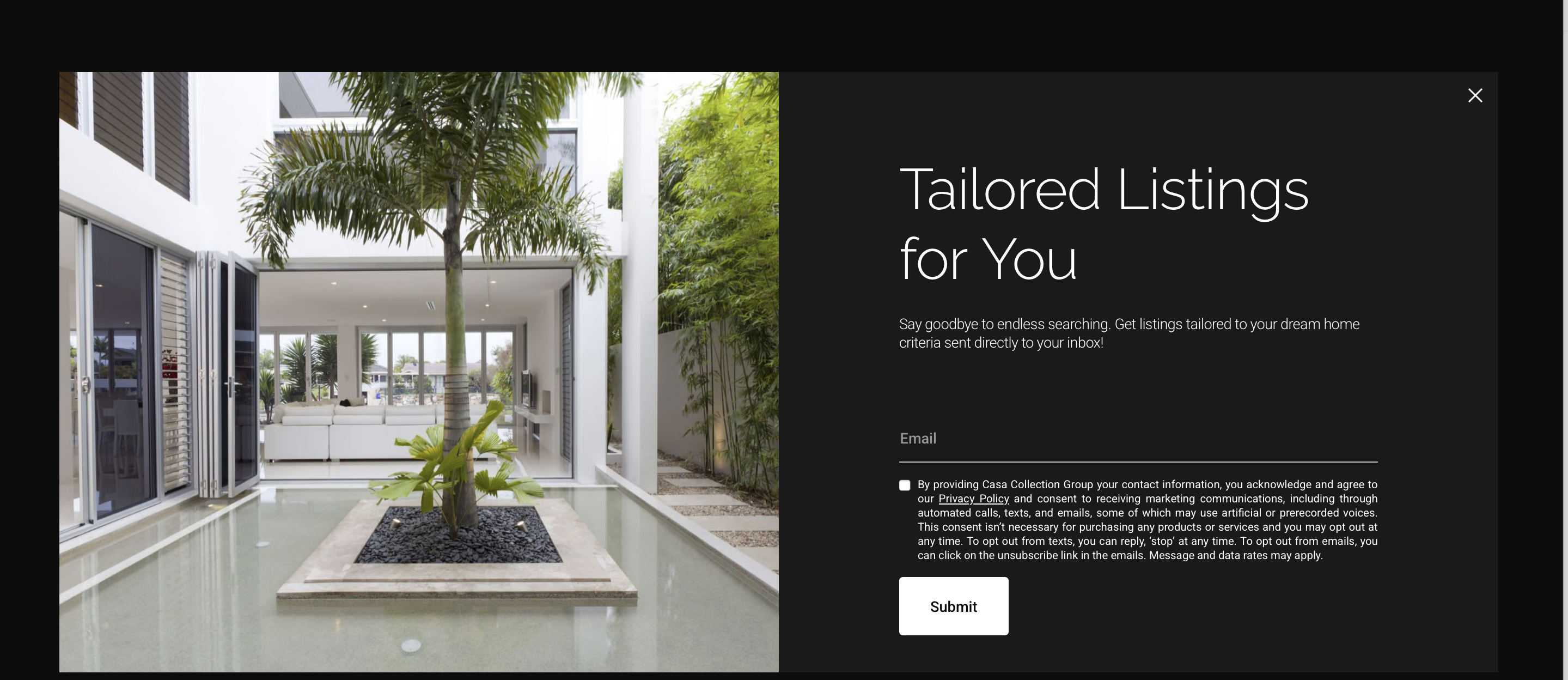
The distinction between these two form types matters. Exit-intent popups are a last-chance capture mechanism. They work best with a single field (email only) and a clear, concise offer such as “Get new listings in [neighborhood] sent to your inbox.” Scroll-triggered slide-in forms, by contrast, appear while the visitor is still engaged. They can carry a slightly longer message and are well suited for newsletter signups or market report downloads.
A/B testing, which means comparing two versions of a form to see which produces more conversions, is how you determine the right trigger point, copy, and field count for each form type. Luxury Presence runs these tests continuously across client sites to refine timing and messaging.
Contact and inquiry forms on listing pages
Every individual listing page is a conversion opportunity. When a buyer is looking at property photos, reading the description, and checking the price, a short inquiry form placed beside the listing details gives them a direct way to request more information. These forms should load fast, ask for minimal information (name, email, optional phone), and include a clear call to action such as “Schedule a showing” or “Ask about this property.”
Gated resource downloads
Offering something of value, such as a market report, neighborhood guide, or buyer checklist, in exchange for an email address allows you to grow your database while positioning yourself as a local authority. These forms work especially well in blog content and landing pages where the visitor arrived through search or social media. The exchange is straightforward: the visitor gets useful information, and you get a contact to nurture.
These five placements are not alternatives. They are a system. The highest-performing agent websites use all five in combination, creating multiple capture points across the visitor journey so that no matter where someone enters the site or how they browse, there is a form ready at the right moment.
Conversion is mechanics, not magic
Across the Luxury Presence platform, websites generated nearly 500,000 exclusive leads in 2024. The home search tool accounted for more than 186,000 of those leads. Google One Tap, a frictionless login tool from Google that lets visitors sign in with a single click using their existing Google account, drove 228,000 leads. That level of output is the result of deliberate design, not luck.
Too many agents rely on generic contact forms that ask for too much information too early. A form that requests name, email, phone number, address, budget range, and timeline on the first interaction creates friction. Friction kills conversions. The mechanics of a high-performing lead capture form are specific and measurable.
What a high-performing lead capture form looks like in 2026
The following guidelines reflect patterns from Luxury Presence’s ongoing conversion testing across thousands of agent websites.
- First-touch forms: Ask for name and email only. Every additional field you add reduces the completion rate. You can collect more information later through follow-up sequences in your CRM.
- Exit-intent popups: Use a single email field with a short, specific headline. “Get weekly listings in [neighborhood]” outperforms “Contact us” every time.
- Mobile placement: The primary form or CTA button must appear above the fold on mobile screens. If a visitor has to scroll to find your form, you are losing conversions on the device where most real estate searches begin.
- Google One Tap: Embedding this login option into your lead capture forms removes the need for visitors to type anything at all. One click, and their Google account information populates the form. This single integration accounted for nearly half of all leads on the Luxury Presence platform.
- Forced registration timing: Set the trigger at three to five listing views. Fewer than three feels aggressive. More than five lets too many visitors browse without converting.
Luxury Presence continuously runs A/B tests on form placement, field count, button copy, and trigger timing. Client feedback informs ongoing adjustments to both the user experience and lead quality. The point is that conversion is not a one-time setup. It is an ongoing process of testing and refining.
What high-performing agents understand about lead capture
The top-producing agents and teams in the country treat their website as a lead generation system, not a digital business card. Of the professionals ranked in the RealTrends + Tom Ferry “The Thousand” list, 127 are Luxury Presence clients. That includes 31 of the top 100 individual agents and more than 25 percent of teams across all size categories.
Luxury Presence clients averaged nearly 25 transactions per agent in 2024, compared to the industry median of 10 reported by the National Association of Realtors (NAR) Member Profile. They closed over $300 billion in total transaction volume, outpacing competitors in their markets by a wide margin.
These agents do not outperform because they work twice as many hours. They outperform because their websites are built to capture and convert traffic at every stage of the visitor journey. When a buyer searches listings, there is a forced registration form. When a seller checks their home value, there is a valuation form. When a visitor reads a blog post and starts to leave, there is an exit-intent popup. The system works together.
The difference between a website that looks good and a website that produces business comes down to conversion infrastructure. The lead capture form is where that production happens.
Why timing and intent matter more than ever in 2026
Consumer confidence in the housing market is shifting, and digital competition among agents continues to intensify. In 2026, the lead capture form is not a nice-to-have feature. It is your first point of data collection and often your first impression on a prospective client.
Platforms that integrate home valuation forms and Google One Tap login options generate higher-intent leads because they reduce the gap between interest and action. A visitor who enters their home address into a valuation tool is not casually browsing. They are closer to a transaction decision. A visitor who clicks Google One Tap to save a listing has identified themselves with zero typing friction.
The agents who will win in 2026 are the ones who treat every page on their website as a potential conversion point. That means placing forms where intent is highest, keeping those forms short, and testing them regularly to make sure they are performing.
What to look for in a lead capture system
Not all lead capture setups are equal. As you evaluate your website’s form strategy in 2026, here are the features that separate a high-performing system from a basic contact page.
Behavior-triggered forms
Your website should be able to display different forms based on visitor behavior. A first-time visitor who has viewed three listings should see a forced registration prompt. A returning visitor who lands on a blog post should see a newsletter signup. A visitor whose cursor moves toward the close button should see an exit-intent popup. Static forms that appear the same way for every visitor, regardless of context, leave conversions on the table.
Mobile-first design
The majority of real estate website traffic comes from mobile devices. Your forms must render correctly on small screens, load quickly, and place the primary CTA above the fold. Forms that require pinching, zooming, or excessive scrolling on a phone will not convert.
CRM integration
A lead capture form that collects information but does not route it into a follow-up system is a dead end. The form should feed directly into your CRM so that new leads receive a response within minutes, not hours. Luxury Presence’s CRM is built for this workflow, connecting form submissions to relationship nurturing sequences that maintain a personal touch at scale while tracking the entire client journey from first contact to closing. Agents review and approve all communications before they go out.
Ongoing testing and refinement
A form you set up once and never revisit will decay in performance over time. The best lead capture systems include regular A/B testing of headlines, field counts, button copy, and trigger timing. This is not a one-time project. It is a recurring discipline.
AI-assisted follow-up
In 2026, the speed of your response to a new lead matters as much as the form that captured them. Luxury Presence’s SEO & GEO, Social Media Management, and Paid Ad Management work continuously in the background to maintain your brand presence and keep lead generation running. Nothing publishes without your approval, but the system ensures that your marketing does not stop when you are showing homes or negotiating contracts. The result is human-quality marketing delivered faster, saving agents 10 or more hours per week on marketing tasks.
How Luxury Presence builds lead capture into every website
Luxury Presence supports over 15,000 real estate businesses and more than 80,000 agents across the country. The platform manages over 40,000 live websites, each built with lead capture infrastructure designed to convert traffic into contacts.
That infrastructure includes forced registration on home search tools, landing pages with embedded inquiry forms, home valuation tools, exit-intent and scroll-triggered popups, Google One Tap integration, and newsletter modals. Every form is monitored, tested, and refined based on performance data.
The agents and teams who use Luxury Presence are not average. They represent the segment of the market that generates the majority of business in their territories. If you are ready to compete at that level, the lead capture form on your website is where it starts.
Your guide to the perfect homepage
Leverage our data and expertise to craft an online presence that delivers high-quality leads and best-in-class brand recognition.
Build a Lead Capture System That Converts
The strongest real estate websites do not rely on a single contact form. They place the right forms in the right moments, keep the friction low, and use behavior, timing, and mobile-first design to turn browsing into identifiable leads. If you treat lead capture as a system instead of a widget, your website can start working like a true pipeline for new business.
FAQs
About the author

Marketing Manager
Kate Evans is a content marketing strategist at Luxury Presence, the leading growth platform for high-performing real estate professionals. She develops data-driven editorial content and supports SEO strategy and brand voice frameworks that help agents attract qualified leads and establish market authority. Her published work covers topics including CRM strategy, social media marketing, and digital growth, supporting thousands of agents in scaling their businesses through modern marketing.