If you've researched real estate newsletter ideas, you've probably already read a dozen posts telling you to "mix content types" and "send consistently." Fine advice, but it skips the question that actually matters: is a newsletter still worth the effort?
Tricia Lee, the Brooklyn broker known as the borough's honorary mayor, gets asked about her marketing constantly, and her answer still catches people off guard: "my website and my newsletters. A lot of people are shocked by that, but I love a newsletter." It took her seven months to land a single lead from it. It's now her strongest source of business.
Below are 14 real estate newsletter ideas and examples from real senders, including Redfin, Chris McGuire, Blue Elephant Realty, and CRE Daily, organized by the strategy each one runs on, so you can find the model that fits your business before you build your own.
Local authority: real estate newsletter ideas that build on community trust
The fastest way to make a real estate newsletter feel like spam is to fill every issue with listings. These two examples use community content to earn the right to sell.
Pay attention to the content you’re sending. Chirag Shah, who has trained more than 30,000 agents through his coaching practice, puts it bluntly: "I bought a house. I don't care about your open house. I don't care about 'just listed.' And the worst email to send is price reduction." His fix is the same principle both examples below run on: "Talk about the things that are important to them, not the things that I want to talk about."
Smith & Berg Partners (Los Angeles) This Los Angeles luxury team, part of the city's top-producing Westside real estate group, opens its newsletter with a lifestyle recommendation, a restaurant or local spot, before introducing an open house or new listing. It reads more like an editorial email than a sales pitch, which keeps the team relevant to subscribers who aren't actively house-hunting. Borrow the order: value first, the ask second.
Chris McGuire, Keller Knapp Realty (Atlanta) Chris McGuire's newsletter pairs neighborhood stories with current and upcoming listings, so a reader scrolling through gets Intown Atlanta community news alongside the properties McGuire has on the market. The listings never disappear, but they sit inside a local narrative instead of leading it. Steal the sequencing: let community content set the tone, and let the listings ride along instead of leading.
Full-journey lead nurture: real estate newsletter ideas that meet buyers where they are
Not every subscriber is ready to see a listing. These two newsletters route each reader to whatever step matches where they actually are in the buying or selling process.
Redfin Redfin's newsletter skips the single-focus listing email entirely. Instead, it runs a modular, card-based layout that stacks affordability tools, home valuation resources, agent consultation offers, and property alerts side by side. A reader who's just curious about their home's value and a reader who's actively touring houses both find their next step in the same email. The move worth copying: build modular sections so one newsletter can serve buyers, sellers, and browsers at once.
Zillow (personalized recommendations) Rather than a static template, Zillow's newsletter pulls from a subscriber's browsing history to surface specific rooms, styles, and design ideas that reader has already shown interest in. The grid layout is built for exploration, with related-content blocks that give a reader multiple reasons to click back in. Take the cue: use behavior data you already have, like saved searches or page visits, to personalize even a few sections of the send.
Listing roundup: real estate newsletter ideas that curate instead of dump
A full inventory of active listings crammed into one email overwhelms readers. These two examples show how to feature fewer properties without losing impact.
Blue Elephant Realty (Toronto) Blue Elephant Realty, a boutique brokerage that's part of the Berkshire Hathaway HomeServices network, keeps its newsletter to a small, handpicked set of listings rather than a full inventory dump. Large photography and short, specific descriptions do the work, and category-based browsing lets readers jump straight to the kind of home they're after. The lesson: fewer listings, bigger photos, and a clear browsing path beat a long scroll of thumbnails.
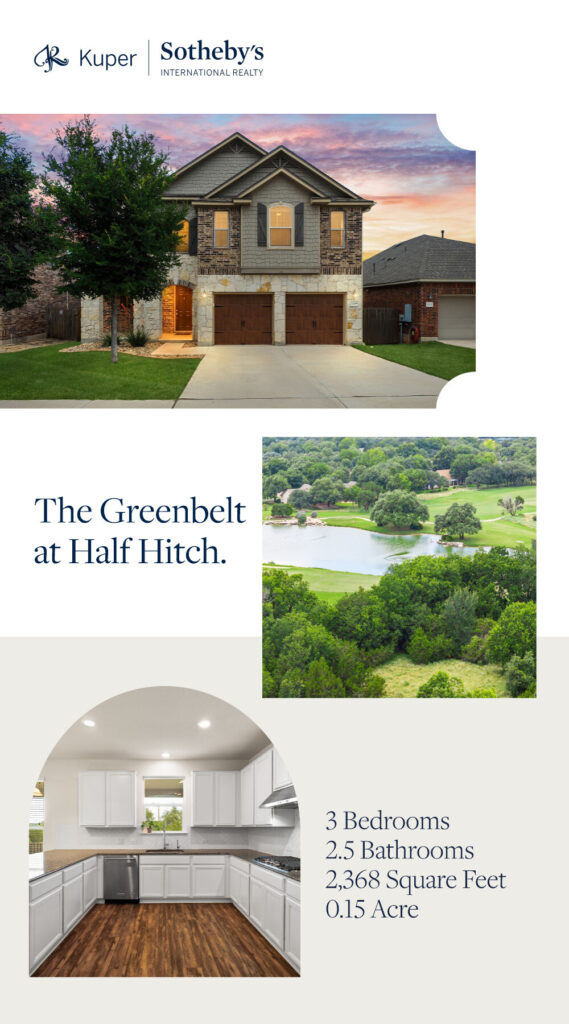
Bryan Thomas, Kuper Sotheby's International Realty (Austin, Texas) Bryan Thomas takes curation a step further by dedicating an entire send to one listing: 1209 Half Hitch Trail in Georgetown, a $425,000 home backing to a natural greenbelt. There's no competing content and no secondary call to action, just a full-bleed hero photo, the property's defining feature front and center in the headline ("The Greenbelt at Half Hitch"), bed, bath, and square-footage stats laid out in a single glance, and one button linking to the property website. His own headshot and contact info close the email, so replying feels like replying to a person, not a brand. Worth trying on your next big listing: a one-property email built around its single best feature can outperform a roundup, because it removes every distraction from the ask.
A recent single-property send from Bryan Thomas, Kuper Sotheby's International Realty.
Interactive engagement: real estate newsletter ideas that ask instead of tell
These two newsletters treat the send as a two-way conversation, using interaction to learn what a subscriber wants next.
Trulia Instead of pushing listings, Trulia's campaign asks subscribers to vote between two similarly priced homes. It takes little effort from the reader, but it hands Trulia real signal about that person's taste in floor plans, finishes, and price point, intel that shapes what gets sent next. Copy the mechanic: a simple either/or quiz question can double as a preference survey.
Zillow (sharing and referrals) Zillow's referral-focused newsletter resurfaces properties a subscriber has already viewed and puts a share action right next to each one, nudging the reader to get a second opinion from a friend or partner. It keeps the home search conversation alive outside the inbox and extends the listing's reach for free. Make it standard practice: put a share action on every listing instead of treating it as an afterthought.
Credibility and press: a real estate newsletter example that sells trust before it sells a listing
Not every newsletter is chasing a transaction. This one sells the team first, and lets the listings come later.
Ricardo Rodriguez & Associates, Coldwell Banker Realty (Boston) A recent send from this Boston team skips listings entirely and leads with proof. A 2026 Agents' Choice Award from Boston Agent Magazine for "Best Real Estate Website" gets its own badge and a paragraph on what earned it. Below that, a mention of Ricardo's appearance on Inman News and The Real Estate Insiders Unfiltered podcast comes with a pull quote from the interview itself. The email closes with a full roster of 14 agents, each linking out to their own page. Borrow the structure: when you've got awards or press worth mentioning, let the newsletter build credibility first and make the ask later, or not at all.
A recent issue from Ricardo Rodriguez & Associates.

Elena Gartz of Holland Group Real Estate shared a panel with Ricardo Rodriguez on a Luxury Presence webinar and makes the same case from the brand side: a newsletter is one piece of a promise you're making across every channel a client touches. "It starts on day one. … Our potential clients are so excited to work with us and so excited to use our tools that we set the stage: This is how we work; this is how we communicate," she said. "We make sure it's communicated in our e-blasts, our newsletters, our social media, our direct mail, and our websites. It's a part of our ecosystem, it's a part of our brand identity."
Professional development and industry intelligence: real estate newsletter ideas built for the trade, not the client
The last group isn't aimed at buyers and sellers. These are newsletters built to keep real estate professionals sharp, and if you lead a team or want to build authority with other agents, this is the model to study.
Zillow Premier Agent Zillow's monthly agent newsletter runs like a trade magazine, with market reports, product updates, webinars, and educational content, and no property promotion in sight. The goal isn't a transaction this month. It's staying the resource agents open every time, regardless of what they're working on. The parallel for you: a newsletter aimed at your peers or your own team can build authority the same way a client newsletter builds trust.
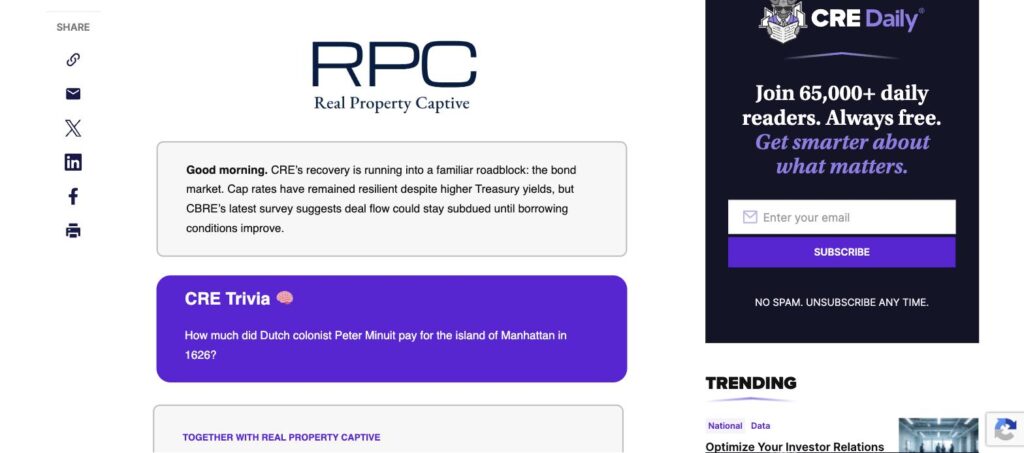
CRE Daily CRE Daily delivers commercial real estate news every weekday morning in a smart-brevity format, concise briefs with no fluff, readable in under five minutes, to more than 65,000 investors, developers, brokers, and lenders. The entire value proposition is speed: readers get the day's need-to-know trends without digging through ten other sources first. If your audience is time-starved professionals, treat brevity as the feature, not the compromise.
A recent CRE Daily issue, pulled from their public archive.
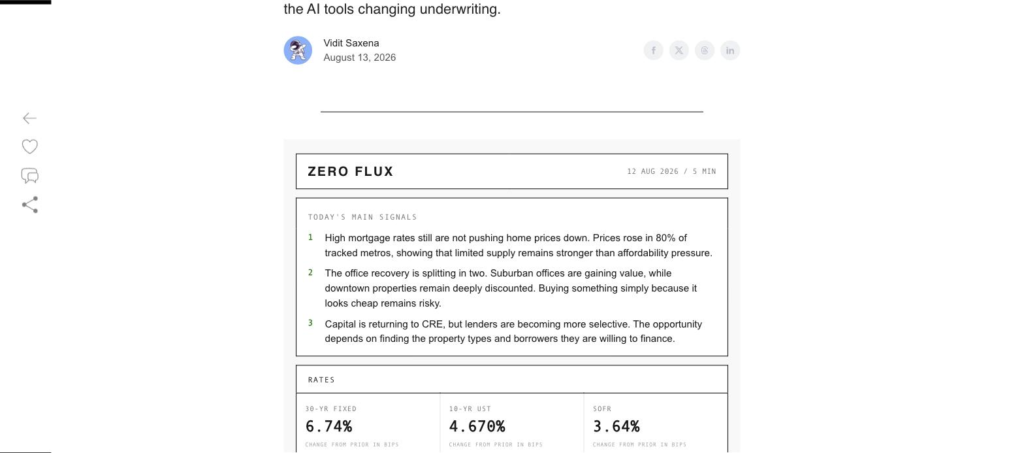
ZeroFlux ZeroFlux curates six to twelve real estate trends daily from more than 100 sources, including paywalled ones, and presents them as data and facts without added opinion or spin. It functions like a daily industry briefing more than a traditional newsletter, and its 30,000-plus subscriber base treats it that way. The reminder here: aggregation itself is a service. You don't have to originate every idea to be the one who delivers it first.
A recent ZeroFlux issue, pulled from their public archive.
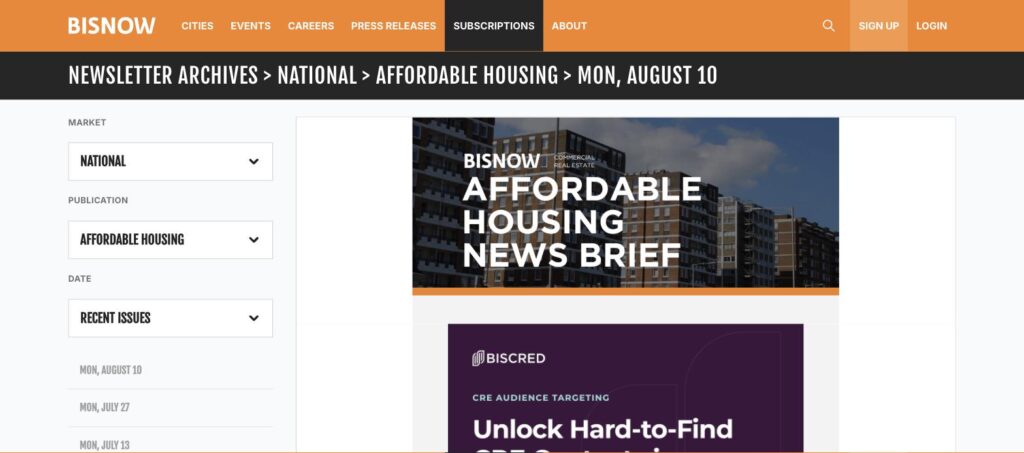
Bisnow Bisnow splits its newsletter lineup by metro market and by sector, covering affordable housing, industrial, hospitality, data centers, and more, so a subscriber in one city's office market isn't wading through headlines about a warehouse deal three time zones away. Apply this before anything else: segment by geography or specialty first. Relevance beats volume.
A recent Bisnow issue, pulled from their newsletter archive.
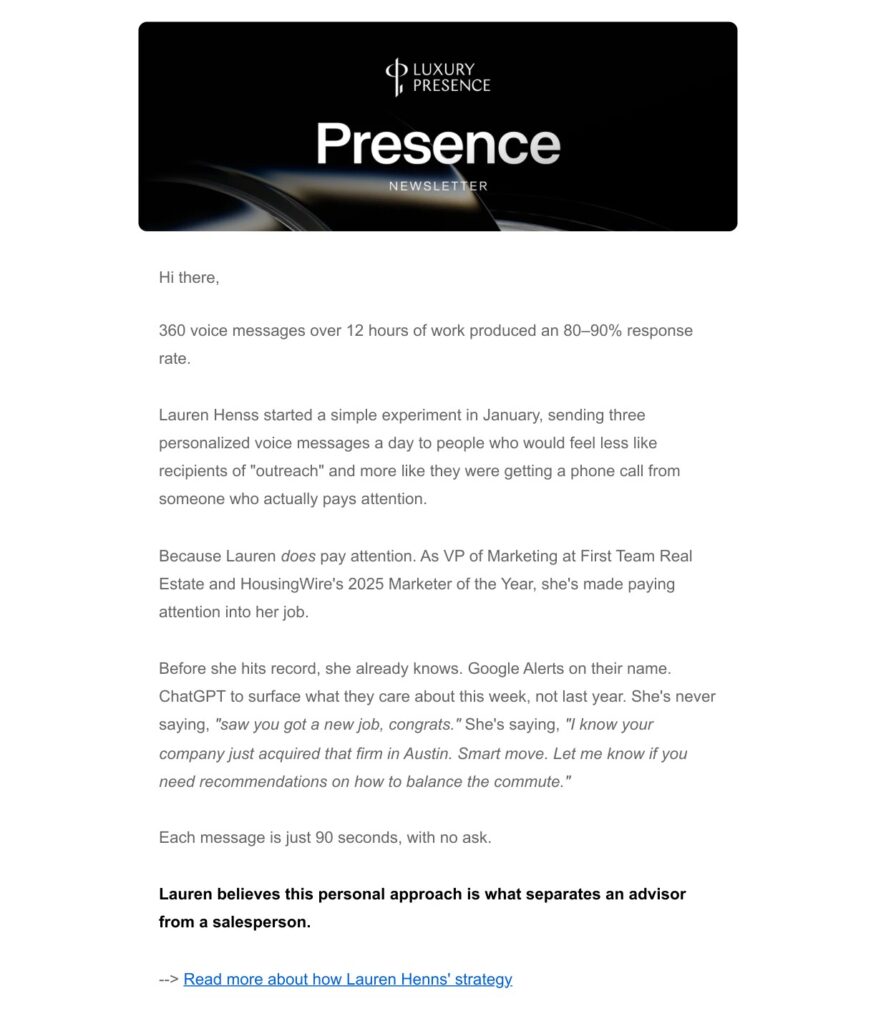
Presence, Luxury Presence's newsletter Our own newsletter runs on a model none of the others above use: one deep story leads every issue, then a numbered "Playbook" turns that story into steps a reader can act on the same day. A recent issue led with Lauren Henss, VP of Marketing at First Team Real Estate and HousingWire's 2025 Marketer of the Year, turning 360 personalized voice messages into an 80 to 90 percent response rate. The issue broke her method into five steps, from setting weekly Google Alerts to logging every reply in a CRM, then closed with client wins, a company milestone, and a couple of industry links worth a reader's time. Read the full story behind the 360 voice messages. The takeaway: pair one deep story with an immediate action plan, so a reader leaves with proof it works and a way to try it themselves.
A recent issue of Presence, Luxury Presence's own newsletter.
What real newsletter routines look like, from two people who actually run them
Most of the newsletter advice out there is theoretical. Judy Limekiller, a real estate advisor in Sarasota who's spent 20 years working the Pelican Cove condo market, checks in daily. "I track it all, using the whole dashboard with Luxury Presence," she says. "It's huge. You start getting so many people, and it really picks out the ones who are actually looking. I wake up and I'm like, I've got to check that dashboard. I want to see what's new." She pairs that dashboard habit with her monthly newsletter, watching who opens it and keeps coming back to the site, so she knows exactly who's paying attention and ready for a call.
When I asked her how she reads that signal, she laid it out step by step: "The first week a newsletter goes out and then from there I can actually see the people that are looking at properties a couple times a week. They're the ones reading the newsletter the longest. So, it's sending out the newsletter and then seeing, okay, who's really looking?" That's the real payoff of a newsletter: staying top of mind while knowing which names on your list are worth a phone call this week.
Tricia Lee, introduced above, runs a simpler setup than Judy's dashboard and gets a similar result. Her monthly send is built around one idea: keeping people posted. "My newsletters are telling you what I'm doing now, what I'm up to, what I've been up to since we last connected, and I do them once a month." Her rule for getting there is just as simple: "Make sure you show up as that, though. Don't give one person and then show up as another."
When you do launch a newsletter, celebrate it like Glennda Baker does here with her Glennda Gazette.
Popular real estate newsletter topics
Every example above draws from the same short list of topics. Mix and match based on your audience:
- Local market updates and neighborhood news
- Lifestyle recommendations: restaurants, events, and local spots worth knowing about
- New and updated listings, curated rather than dumped in bulk
- Single-property spotlights and open house invitations
- Home valuation tools and affordability resources
- Personalized property and design recommendations based on browsing behavior
- Awards, press mentions, and team news
- Market reports and professional education for other agents
- Industry trends and data aimed at other real estate professionals
- Personal updates on what you've been doing since your last send
- Interactive content like polls, quizzes, or either/or questions
- Referral prompts that make listings easy to share
How often to send a real estate newsletter
The examples above split into two clear camps. Client-facing newsletters run monthly: Tricia Lee sends hers once a month, Judy Limekiller does the same, and Zillow Premier Agent's trade-magazine format lands in agents' inboxes on the same schedule. Industry-intelligence newsletters run daily: CRE Daily and ZeroFlux both hit inboxes every weekday morning, because speed is the entire value proposition for that audience.
Frequency matters less than follow-through. Tricia Lee's newsletter, mentioned above, took seven months to land its first lead before becoming her strongest source of business. A monthly newsletter you actually send beats a weekly one you abandon by month three.
Tie your real estate newsletter to the rest of your marketing
None of the newsletters in this roundup operate alone. Elena Gartz's point earlier in this piece, that a newsletter is one piece of a promise made across every channel a client touches, shows up in how these examples actually work. Ricardo Rodriguez & Associates' newsletter drives straight to a CTA button for RicardoHome.com. Zillow's referral newsletter puts a share button next to every listing, turning the newsletter itself into a social touchpoint. And Judy Limekiller's newsletter opens feed directly into the same dashboard she uses to track leads, so a newsletter open shows up as a signal in the exact system where her leads already live.
If you're building that kind of system from scratch, Luxury Presence's guide to the customer journey in real estate email marketing walks through how a newsletter fits alongside your website, CRM, and social channels.
Find the real estate newsletter example that matches your business
None of the newsletters above are built the same way, because none of these senders are solving the same problem.
A solo agent building neighborhood trust should look at Chris McGuire or Smith & Berg Partners before touching a template built for a national portal like Redfin or Zillow.
A brokerage sitting on a big inventory should study how Blue Elephant Realty curates its whole list, while an agent with one great listing should study how Bryan Thomas curates down to a single property.
A team with awards or press to its name should study how Ricardo Rodriguez & Associates leads with credibility instead of a listing. And if your subscribers are other professionals, your team, your referral network, your market, the brevity and authority behind CRE Daily, Zillow Premier Agent, and our own Presence newsletter will do more for you than another listings blast.
If you want help turning any of these strategies into your own send, Luxury Presence's guides on real estate newsletter ideas, real estate email marketing, and email marketing subject lines go deeper on execution, from list-building to what to actually write in the subject line.
Ready to grow?
Turn your content into your best lead source
See how Luxury Presence helps agents turn website visits into closed deals