

A real estate value proposition is a clear, specific statement that tells prospective clients what you do, who you do it for, and why you are the right agent for the job. In 2026, with more than 1.5 million active real estate licensees in the United States competing for the same pool of buyers and sellers, a vague promise of "great service" or "local expertise" will not win you business. Your unique value proposition (UVP) is the single sentence, or short paragraph, that answers the question every potential client is already asking: "Why should I hire you instead of the agent down the street?" This guide walks you through how to build a real estate value proposition that is specific, honest, and strong enough to carry your personal brand, which is the public-facing identity you create through your marketing, reputation, and client experience, across every channel where clients find you.
Key takeaways
- A UVP is not a slogan. It is a specific statement that names your audience, your method, and the outcome you deliver.
- Start by reviewing your last 10 closed transactions to identify the three skills that actually show up in your work, not the ones you assume sound impressive.
- Generic claims like "I provide great customer service" fail because every agent says the same thing. A strong UVP names a measurable result or a specific client type.
- Your UVP must appear consistently on your website, social media profiles, email campaigns, and listing presentations.
- Client testimonials and documented results turn a UVP from a claim into a credible promise.
- In 2026, your digital presence is where your value proposition gets tested. If your website and marketing do not reflect what you say you offer, clients will notice the gap.
Why your value proposition matters in 2026
The real estate industry has never been more crowded. According to the National Association of Realtors (NAR), 2025, the majority of home buyers interview only one agent before making a hiring decision. That means the first impression your brand makes, often through a Google search, a social media profile, or a referral conversation, is frequently the only impression you get. If your messaging sounds like every other agent in your market, you lose the opportunity before a conversation even starts.
A personal brand is the sum of how clients perceive you based on your marketing, your reputation, and the experience you deliver. Your UVP is the engine of that brand. It is the specific promise that gives a prospective client a reason to choose you. Without it, your website copy, your social posts, and your listing presentations all default to the same generic language that buyers and sellers have learned to ignore.
That question is the one your UVP needs to answer. Not with buzzwords or broad claims, but with a specific description of who you serve, how you serve them, and what result they can expect. The rest of this guide gives you a repeatable framework for building that answer.
How to create your real estate value proposition
Building a real estate value proposition is a four-step process. Each step narrows your focus so that the final statement is specific enough to be memorable and honest enough to be believable. I call this the Clarity Framework: Strengths, Audience, Competition, Message.
Step 1: Identify your actual strengths
Most agents start by listing the skills they think sound impressive. That approach leads to generic claims. Instead, look at the evidence your career has already produced.
Write down your last 10 closed transactions. For each one, note the single skill that made the biggest difference in the outcome. Maybe you negotiated a price reduction that saved your buyer $40,000. Maybe you staged and marketed a listing that sold in four days. Maybe you guided a first-time buyer through a complicated inspection process without a single surprise.
Once you have all 10 notes, look for the three skills that appear most often. Those are your actual strengths, not the ones you assumed. They form the foundation of your UVP because they are backed by real results, not aspirational thinking.
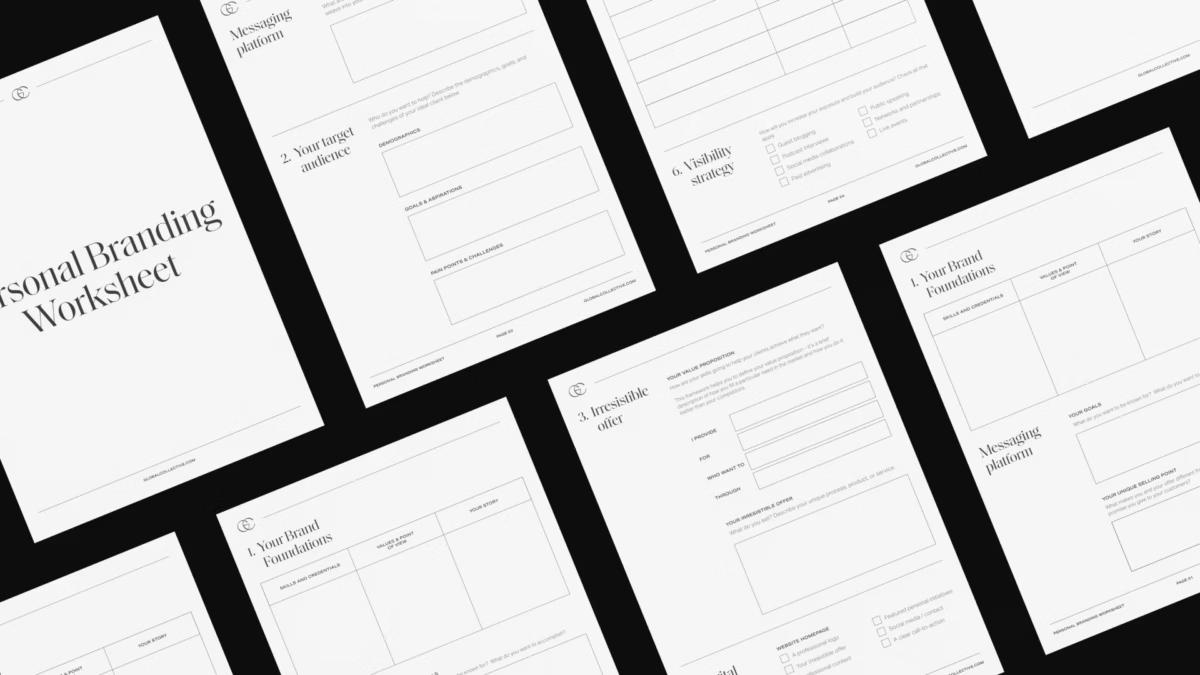
If you want a structured way to work through this exercise, download the free branding worksheet below.
Step 2: Define your target audience
A UVP that tries to speak to everyone ends up resonating with no one. You need to name the specific type of client you serve best.
Survey your last five clients with one question: "What was the one thing I did that you could not have done yourself?" Their answers will reveal the specific value you deliver, and the type of client who needs that value most. A relocating executive has different concerns than a downsizing retiree. A first-time buyer needs different guidance than a real estate investor buying their tenth rental property.
Once you identify your strongest client type, build your UVP around their specific needs. If your best clients are move-up buyers in a particular school district, say that. If your strongest results come from marketing waterfront properties, say that. Specificity is what makes a UVP believable.
Step 3: Analyze your competition
Pull the websites of the top five agents in your market. Write down the first claim each one makes on their homepage. You will likely see patterns: "dedicated to client satisfaction," "years of experience," "local market knowledge."
If any of those claims match what you were planning to put in your UVP, remove them from your draft. A value proposition only works if it describes something your competitors cannot credibly say. Look for the gaps. What are they not talking about? What service, skill, or market knowledge do you have that none of them mention? That gap is where your UVP lives.
Step 4: Write a clear, specific message
Your UVP should pass one test: read it out loud to someone who is not in real estate. If that person cannot tell you what you do and who you do it for in one sentence, rewrite it. A strong value proposition names a specific outcome, a specific audience, and a specific approach. Here are three examples that follow that structure.
| Agent type | UVP example | Why it works |
| Negotiation specialist | "I have represented buyers and sellers in over 200 transactions in [market]. My clients consistently close at a higher sale-to-list ratio than the market average because I treat every negotiation as a preparation problem, not a reaction problem." | Names a specific outcome (sale-to-list ratio), a specific audience (buyers and sellers in a named market), and a specific method (preparation-first negotiation). |
| Tech-forward agent | "I use data-driven pricing models, targeted paid advertising, and property-specific content to market your home to the right buyers before it ever hits the MLS." | Describes three concrete tools and names the benefit (reaching the right buyers) without relying on vague technology claims. |
| Relocation specialist | "I specialize in helping corporate relocating families find the right home in [city] within 30 days. I know the school districts, commute patterns, and off-market inventory that most agents never see." | Names a specific client type, a specific timeline, and specific knowledge assets that are hard to replicate. |
Notice what all three examples have in common. None of them use phrases like "dedicated to excellence" or "committed to your satisfaction." Each one makes a claim that can be verified by looking at the agent's track record. That is the difference between a UVP and a slogan.
As real estate strategist Noble Black framed it: "You're not hiring me to sell your apartment. You're hiring me to sell it for the best price." That kind of directness is what a strong value proposition sounds like. It names the outcome the client actually cares about.
Communicate your UVP across digital channels in 2026
Writing a strong value proposition is only half the work. The other half is making sure it shows up everywhere a prospective client encounters your brand. In 2026, that means your digital marketing, which includes every online channel you use to reach and communicate with potential clients, needs to carry the same message consistently. A UVP that lives only in your head or on a single page of your website is not doing its job.
Your website
Your website is the first place most clients will verify whether your brand matches what they heard about you. Your UVP should appear above the fold on your homepage, in your bio, and in the language you use to describe your services. High-quality listing photos, virtual tours, and client testimonials should all reinforce the specific promise your UVP makes.
In 2026, buyers and sellers expect a mobile-friendly site that loads quickly and feels intentional. If your website looks generic, clients will assume your service is generic too.
That kind of brand-to-website alignment is what makes a UVP credible online. When a client reads your value proposition and then lands on a site that visually confirms it, trust builds before you ever speak to them.
Social media
Platforms like Instagram, LinkedIn, and Facebook are where your UVP gets tested in real time. Every post, story, and comment is an opportunity to reinforce or undermine your stated value. If your UVP is about negotiation expertise, share short breakdowns of how you approached a recent deal. If your UVP is about relocation knowledge, post content about school ratings, neighborhood walkability scores, and commute data.
In 2026, short-form video on platforms like Instagram Reels and TikTok is one of the fastest ways to demonstrate your expertise rather than just claim it. A 60-second video walking through a pricing strategy or a neighborhood comparison does more for your brand than a dozen posts that say "I love helping clients." Social media management tools can help you maintain a consistent posting schedule so your brand stays visible between transactions.
Email marketing
A strong email marketing strategy keeps your UVP in front of past clients and active leads between transactions. Every email you send, whether it is a market update, a new listing alert, or a quarterly check-in, should reflect the specific value you promise.
If your UVP centers on market data expertise, your emails should include original analysis, not just links to third-party reports. If your UVP is about white-glove relocation service, your emails should include neighborhood guides, school enrollment timelines, and local vendor recommendations. The content of your emails is a direct test of whether your UVP is real or just marketing language.
Luxury Presence's CRM, a relationship management system built for real estate agents, can help you maintain these touchpoints at scale. It tracks the full client journey from first contact to closing and sends agent-approved, personalized follow-ups so that no relationship goes cold. Nothing sends without your review, which means every message stays consistent with your brand voice.
Social proof
Client testimonials and documented results are what turn a UVP from a claim into evidence. Ask every client for a review that speaks to the specific value you delivered, not just a general "great agent" endorsement. A testimonial that says "She negotiated $30,000 off the asking price and found an issue in the inspection that would have cost us $15,000" is worth more than ten five-star ratings with no detail.
Share these stories on your website, in your listing presentations, and across your social profiles. In 2026, video testimonials carry particular weight because they are harder to fabricate and easier for prospective clients to trust.
Your UVP validation checklist
Before you publish your UVP anywhere, run it through these five checks.
- You identified your top three skills through client feedback and transaction review, not self-assessment alone.
- You reviewed the UVPs of your five closest competitors and confirmed yours does not overlap with any of them.
- Your UVP names a specific client type, a specific outcome, and a specific method.
- A person outside the real estate industry can explain what you do after reading your UVP once.
- Your UVP appears consistently on your website, your social profiles, your email signature, and your listing presentations.
Building a UVP That Clients Remember
A strong real estate value proposition is specific, credible, and rooted in the results you actually deliver. When you define your strengths, narrow your audience, compare your message to the competition, and carry that promise consistently across every channel, you give clients a clear reason to choose you. The more your UVP reflects your real expertise, the easier it becomes to build trust before the first conversation even begins.
FAQs
Rewrite your brand strategy
Our free resources can help you define your personal brand, level up your marketing plan, and reach your target audience.
Ready to grow?
Turn your content into your best lead source
See how Luxury Presence helps agents turn website visits into closed deals