
If you've searched "AEO for real estate" to land here, you're already asking the right question. Homebuyers and sellers used to type a query into Google and scroll through ten links. Now a growing share of them ask ChatGPT or Google's AI Mode a question and get a single answer with a name or two attached to it. Agents want to know if that means learning a whole new discipline, or if the SEO work they're already doing (or should be doing) covers it.
The short version: it mostly covers it. Here's the breakdown.
Briefly
- SEO, AEO, and GEO are not three separate skill sets. AEO (answer engine optimization) and GEO (generative engine optimization) is essentially the same practice with the goal to show up in AI platforms.
- Google search still shows a list of results you can click. AI search shows one synthesized answer built from a handful of sources, and often skips the click entirely.
- About 85% of the time an AI tool mentions your brand, it's citing a third-party site, not your own website, according to research from AirOps.
- The most effective moves right now are answer-first content structure, getting listed on the "best of" pages AI tools already cite, consistent reviews, and writing from real first-hand experience instead of recycled information.
- You do not need a second strategy or a new budget line. Strong SEO fundamentals, helpful content, a healthy website, and a recognizable brand, already do most of the work for AI search too.
What's the difference between SEO, AEO, and GEO?
What is SEO?
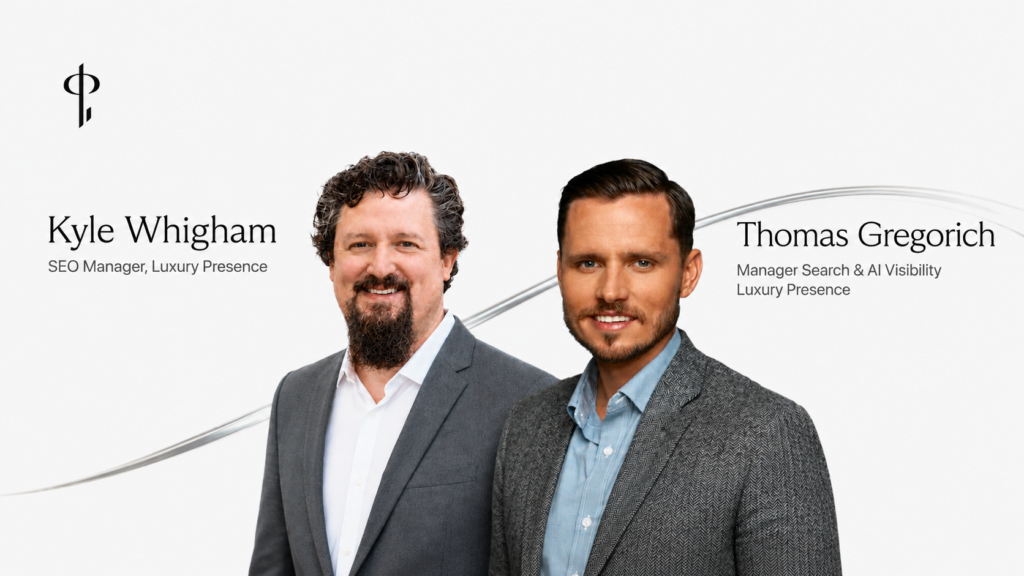
SEO, search engine optimization, is the practice of making your website visible when people search on Google. It rewards original content written by someone with real expertise, a technically sound site, and trust signals like reviews and backlinks. None of that is new, and none of it is going away. Kyle Whigham, SEO Manager at Luxury Presence, has been doing this work since 2012, and as he put it, "SEO's not dead. It just changes." He's watched the "SEO is dead" headline resurface about a dozen times in his career.
What is AEO (and GEO)?
AEO stands for answer engine optimization. GEO stands for generative engine optimization. Both describe getting your brand mentioned, cited, or recommended inside the answers that tools like ChatGPT, Perplexity, and Google's AI Overviews generate, instead of (or in addition to) a blue link on a results page.
Whigham draws a technical distinction between the two terms: "The answer engine is when you are the direct answer to a question. And generative engine is your information being used to source that generative answer rather than your brand being mentioned. An answer engine is you're truly the answer. The generative, the GEO part, is your thoughts, your pieces of content, helping generate that answer."
Why AEO and GEO are really the same thing
That distinction matters in theory. In practice, the two blur together almost immediately, and Whigham's own colleague makes the case for why. Thomas Gregorich, Luxury Presence's Manager of Search and AI Visibility, put it this way: "It seems like to be the person that gets sourced in an answer in the AEO sense, you actually have to work on the GEO part, which is being an authority. They just seem too connected and similar to be distinguished with these different names."
Whigham goes a step further and questions whether the industry needs the acronym at all. "I don't even think you need to have GEO, if I'm being honest," he said. "I think SEO, instead of being search engine, you change it to search everywhere. That's essentially what this practice has morphed into. It's no longer just about your website and being found in Google. It's being able to be surfaced in ChatGPT. It's being able to be surfaced in Google's AI Mode. It's about brand building and how people are finding your brand."
Both agree the underlying work barely changes. "The misconception that AEO... is that much different from SEO gets people in trouble," Gregorich said, "because they want to find the tactics and strategies that work for AEO, but the fact is, most of what works for AEO overlaps with what works for SEO."
What does searching for an agent actually look like now?
Traditional Google search: links, the map pack, and reviews
A Google search for "best real estate agent in [city]" still surfaces the familiar stack: a few ads, a local three-pack pulled from Google Business Profiles, then ten organic results. A prospect clicks through, compares a few sites, and reaches out to whoever looks most credible.
AI search: one answer, built from other people's pages
Ask the same question in ChatGPT or Google's AI Mode and you get something different: a short, synthesized answer that names a handful of agents or teams, sometimes with links to the sources it pulled from, sometimes without. According to Kyle Scott, SVP of Partnerships, Brand and Community at Luxury Presence, during a recent Luxury Presence webinar on hyper-local search, "67% of potential home buyers are now using AI search tools as their primary agent research tool, which is up from just 17% 18 months ago." Across Luxury Presence client websites, he added, "traffic from AI search platforms is up 300% year-over-year."
Google itself has leaned into this shift. As covered in Google's biggest search changes in 25 years, AI Mode has crossed a billion monthly users, and 88% of AI Overviews now cite three or more sources.
That comes at a cost to the click: one field study found AI Overviews cut organic clicks by 38% on the queries where they appear, with zero-click searches rising from 54% to 72%.
The upside is that brands who do get cited see 35% more organic clicks and 91% more paid clicks than competitors left out of the same results page. The surface has changed from "get on the list" to "get named directly," and being left off that shorter list costs more than it used to.
How does AI search actually decide who to show?
This is the part that trips agents up most, because the mechanics genuinely differ from how Google ranking works, even when the inputs overlap.
Google ranks pages. AI cites passages, and mostly from sites you don't own.
Whigham described the shift in what actually gets rewarded: "The unit of optimization has shifted away from 'rank this page' to, when you're writing a page, make this specific claim extractable, attributable, and authoritative." AI Overviews and chat answers pull a sentence or two, not a whole page, and stitch several of those fragments together with attribution.
Here's the part most agents miss entirely: most of that attribution doesn't point back to your own website. According to research from AirOps, about 85% of brand mentions in AI answers come from third-party pages, not the brand's own site, and roughly 48% of those citations trace back to community platforms like Reddit and YouTube alone.
Gregorich has seen the same pattern in Luxury Presence's own data: "Something like 80% of the times your brand gets mentioned in LLMs is because you were mentioned on some kind of off-site, authoritative website, not your own content. It doesn't mean don't create your own content. Part of your strategy definitely should be distribution of your content once you create it."
Jimmy Pal, founder of the marketing agency GTM820 and a guest on that same Luxury Presence webinar, framed how AI tools actually decide who to trust: "Think of your most helpful and most resourceful friend, in terms of how and why you trust that friend. First, how much do they know about a topic and how long they've been talking about it. Secondly, how many other people say that person knows what they're talking about. And third, how well organized they are in reciting their information."
LLMs, he said, were built by humans, "so that human nature was built into the LLMs of how the data is sourced."
Why you can't track your "AI ranking" the way you track a Google ranking
Google Search Console tells you your average position for a keyword. There's no equivalent for AI answers, and Whigham encourages agents to stop looking for one. "You have to get out of your mind of AI ranking," he said. "There is no AI search ranking. It is truly visibility. If you don't show up one day, it's not the end of the world, because you could be showing up for somebody down the road. It is just so volatile right now."
The volatility is documented. A SparkToro study led by Rand Fishkin ran the same 100 prompts repeatedly and found the most-cited brand for any given prompt showed up about 65% of the time, and the odds of brands appearing in the same order across separate runs were roughly one in a thousand.
That's why Whigham is skeptical of anyone selling precise "AI rank tracking." What you can measure reliably is directional: referral traffic from AI platforms in GA4, and branded search impressions in Google Search Console. Luxury Presence has a full walkthrough on how to track your AI search visibility using both.
What AEO tactics actually work for real estate agents right now?
Given how much AEO and SEO overlap, most of what follows will look familiar. The difference is in emphasis.
Structure your content so AI can lift the answer
AI tools favor content that leads with the answer instead of building up to it. Whigham recommends headings phrased as the actual question, followed immediately by a direct answer, then supporting depth.
He's also a believer in FAQ schema, even though "Google has outright said they're no longer using FAQ schema for rich snippets because people in the SEO world have abused it."
His reasoning: "I still think it's important to have FAQ schema. This is a great way for AI platforms to understand question and answers. AI tools are consistently leaning on schema, particularly FAQ schema. They view it as a way of trust."
Build a topic cluster instead of scattered blog posts
A pillar page covering a broad topic in depth, supported by focused pages that link back to it, still outperforms a pile of disconnected posts. Gregorich explains the mechanism behind it: "Google's AI mode uses something called query fanout, where when you ask it something, it generates all these related searches, and it will cite the website that covers all those different angles. If you have all those pages in a cluster, you're more likely to get pulled into the retrieval window and shown in AI answers."
Freshness matters here too. Gregorich has found that 70% of pages cited by AI platforms were updated within the last 12 months, so a cluster you build once and never touch again loses ground quickly. Luxury Presence has a deeper walkthrough on how to build a topic cluster for a local market, and a broader guide to building a real estate content ecosystem if you're starting from scratch.
Get on the lists AI is already citing
Since most AI mentions trace back to someone else's page, the fastest lever isn't always your own website. Whigham calls this "borrowed authority," and it starts with finding what's already cited. "Get on a legit top best-of list, and figure out your lane," he said. "Find which online publications are producing these lists and get on the legit ones, because they help these AI platforms qualify that phrase 'best' or 'top.'"
Pair that with digital PR: "PR helps earn that authoritative editorial mention and links that move the needle way better than low-quality link building does. I think getting on best-of lists and digital PR are probably two of the biggest levers for answer engine optimization right now." A lot of that authority comes from the same relationships that earn traditional local backlinks: lenders, inspectors, community sponsorships, and local press.
Keep your reviews and Google Business Profile current
Reviews carry more weight than most agents assume, in both traditional and AI search. Whigham puts a rough number on it: "I think the threshold is to have a 4.3 or higher. But if all your competition is 4.7 and higher, if you're at a 4.5, you're likely not going to be promoted there."
Pal made a similar point on the webinar: "This one's pretty obvious, which is reviews. Positive reviews over everything wins the game. So if you haven't been doing this proactively, please ask your clients to always leave you a review."
Start by setting up your Google Business Profile if you haven't already, then build a habit around asking for reviews at the right moment. Name, address, and phone consistency across every directory matters too, not because it's a ranking factor exactly, but because, as Whigham said, "if Google or these AI platforms can't reconcile a business being who they say they are, they're not prone to showcase you."
Write from real experience, not recycled information
The single clearest theme across every source, and the one that shows up in nearly every interview and published post referenced here, is that AI tools can already answer generic questions on their own. What they can't generate is your first-hand experience.
Gregorich pointed to Google's own framing of this: "Google made a distinction between what they call commodity and non-commodity content. Instead of writing about how to buy a house in Los Angeles, which is something an LLM can kind of answer on their own these days, it's more like, 'this is how I sold X amount more houses this year by doing X,' very specific to your experience. That's going to perform better because they can't replicate that."
This is also where using ChatGPT to draft content becomes a genuine risk if it's the whole process rather than a starting point. Whigham's advice on prompting is direct: "Don't copy and paste whatever ChatGPT spits out. You still need to review it, make sure it's accurate, LLMs still hallucinate. Having that human touch, your unique perspective, is going to be what separates you."
The same logic extends to listing pages. Rather than letting an MLS feed sit untouched, IDX pages should include original descriptions and local context, since an identical listing synced across fifty agent sites gives neither Google nor an AI tool a reason to pick yours.
How do you do SEO and AEO without doubling your work?
Given everything above, the practical answer is that you don't build two strategies. You build one, and add a short list of AEO-specific habits on top.
Whigham's own framing sums up the mindset shift better than a checklist could: "If you have always been practicing SEO, by which I mean producing good authoritative content, showcasing your unique value proposition, your unique experience, and providing genuinely helpful content, I think that is what wins. And we have proof that that is what wins. Don't buy into the growth hack."
Gregorich frames the investment as risk mitigation rather than a bet on any one platform's future dominance: it's "better to have a foothold, get a foothold in there now before competitors lock in before you," even though nobody can guarantee ChatGPT will ever out-drive Google in traffic.
The two channels also tend to move together, which makes prioritizing easier than it sounds. "Organic search and how often you're being cited in things like ChatGPT, they go up and down together," Gregorich said. "If you're not working on your organic search, your citations aren't going to increase either."
In practice, that means:
Keep doing the fundamentals that already cover both: helpful, original content built around your actual market knowledge, a technically healthy website, and a Google Business Profile with strong, current reviews.
Add the handful of moves that are more AI-specific: structuring content to lead with the answer, adding FAQ schema, and actively pursuing the off-site mentions, best-of lists, and local SEO strategies that build the kind of brand recognition AI tools pull from when they decide who to cite.
Track both with the same handful of free tools: Google Search Console for branded impressions, GA4 for referral traffic, and a monthly manual check of what ChatGPT and Google's AI Overview say when you search your own market.
None of this requires a separate budget line or a brand-new skill set. It requires treating "search everywhere" as one job instead of two.
FAQs on AEO vs SEO vs GEO for real estate agents
Ready to grow?
Turn your content into your best lead source
See how Luxury Presence helps agents turn website visits into closed deals