
Asking clients for reviews can feel awkward, but it does not have to be. The key to how to ask clients for reviews in real estate is simple: make the request personal, reduce friction, and time it well. In 2026, buyers and sellers research agents across Google Business Profile, major real estate portals, and social media before making contact, and a strong portfolio of client reviews is often what determines who gets the call. Your testimonials are not just nice words on a page. They are working marketing assets that build credibility, attract new clients, and strengthen your online presence across every platform where people search for an agent.
Find It Fast
Key takeaways
- The best time to ask for a review is right after closing, when client satisfaction is at its highest.
- Reducing friction with direct links and simple prompts significantly increases the number of clients who follow through.
- Collecting reviews across multiple platforms, including Google Business Profile and other major real estate portals, strengthens both local search rankings and social credibility.
- Detailed, location-specific reviews perform better in search than generic praise because they contain the keywords buyers and sellers actually search for.
- Responding professionally to negative reviews signals accountability and can build trust with prospective clients.
- Testimonials work hardest when you distribute them across your website, social media, email campaigns, and listing presentations, not when they sit on a single third-party platform.
Why client reviews still matter in 2026
Reviews are one of the most powerful assets in your real estate marketing strategy. They do more than make you look good. They directly influence whether a prospect picks up the phone or scrolls past your name. Here is what the data tells us.
- Social proof drives decisions: According to a 2022 study published in Frontiers in Psychology, 93% of consumers say online reviews impact their purchasing decisions (Frontiers in Psychology, 2022). That number has only grown as more buyers begin their agent search online.
- Search engine optimization (SEO) benefits: Reviews on your Google Business Profile contribute to local search ranking factors, making you easier to find when someone searches for agents in your market. Google’s own documentation confirms that review quantity and quality influence local pack rankings (Google Business Profile Help, 2026).
- Trust at scale: According to a 2023 Experian survey, 72% of people say that positive reviews make them trust a local business more (Experian, 2023). For real estate agents, where the transaction is deeply personal and high-stakes, that trust factor carries even more weight.

The bottom line: in 2026, your reviews are doing the selling before you ever get a chance to introduce yourself. They are the first impression for most prospects, and they carry more weight than any ad or brochure you could create.
That is exactly what a strong review portfolio builds for you. When a prospect reads five detailed testimonials about how you guided a first-time buyer through a competitive market or sold a home above asking price in a week, they are already forming a positive impression of your ability before you have a single conversation.
When to ask for a review
Timing is everything when it comes to getting client testimonials. The best time to request a review is when a client is still feeling the high of a successful transaction. According to the National Association of Realtors (NAR), the post-closing period is when client satisfaction and agent loyalty are at their peak, making it the strongest window for a review request (NAR, 2025).
Here are four strong moments to make the ask:
- Right after closing: The excitement of securing a dream home or successfully selling a property is at its highest. This is your single best window.
- When they express satisfaction unprompted: If a client tells you they are thrilled with your service, that is your cue. Their enthusiasm is fresh, and the words will come easily.
- During a follow-up email or call: Checking in after closing is already a relationship-building habit. Use this touchpoint to request feedback or referrals.
- At key milestones: For buyers, this might be their move-in anniversary. For sellers, it could be one year after a successful sale. These moments reignite positive feelings about the experience.
The common thread: ask when the positive emotion is real and recent. The longer you wait, the less likely a client is to follow through, not because they did not have a great experience, but because life gets busy and the urgency fades.
How to ask clients for reviews
The way you frame your request has a direct impact on whether a client takes action. A vague “Would you mind leaving me a review?” often gets overlooked. Here is a four-step approach that makes the process feel natural for both you and your client.
Step 1: Make it as easy as possible
If there is friction in the process, people will put it off or forget entirely. To increase your response rate:
- Provide a direct link to your preferred review platform (Google Business Profile, a major real estate portal, LinkedIn).
- Offer a simple prompt for inspiration, such as “What did you enjoy most about working together?”
- Let them know a few sentences are all it takes. Most people overestimate how much they need to write.
Step 2: Explain why it matters
Clients are more likely to leave a review if they understand how it helps. Try a simple note like this:
“Your feedback helps future buyers and sellers find the right agent, and it also supports my business in a real way. If you had a great experience, I would love for you to share it.”
This framing makes clients feel like they are giving back to their community, not just doing you a favor. That small shift in perspective makes a big difference in follow-through.
Step 3: Personalize your request
Make your ask specific and heartfelt. Instead of a generic message, reference details about their experience working with you.
- Instead of: “Would you be willing to leave me a review?”
- Try: “I loved working with you on the sale of your home in [neighborhood]. I hope you are enjoying the [feature of the home or area]. If you have a moment, I would be so grateful if you could share a few words about your experience. Here is a direct link to leave a review: [insert link].”
The more specific you are, the more the client feels seen, and the more detailed and useful their review will be.
Step 4: Show genuine gratitude
Always express appreciation, both before and after they leave a review. A handwritten thank-you note, a quick text, or even a small gift card to a local coffee shop can go a long way in building long-term goodwill. Remember, the review is a gift of their time. Treat it that way.
Where to collect reviews in 2026
To build the strongest possible online presence, collect reviews across multiple platforms rather than relying on just one. Each platform serves a different audience and a different purpose in your marketing. Here is how they compare:
| Platform | Best for | SEO impact | Primary audience |
| Google Business Profile | Local search visibility | High (directly influences local pack rankings) | All consumers searching Google |
| A major real estate marketplace | Agent-specific research | Medium (profiles on major real estate portals can rank well in Google Search) | Active homebuyers and sellers |
| Realtor.com (NAR’s consumer-facing portal) | Agent-specific research | Medium | Active homebuyers and sellers |
| Yelp and Facebook | Social credibility | Low to medium | Local consumers and social media users |
| Professional recommendations | Low | Industry professionals and referral partners | |
| Your own website (dedicated testimonials page) | Brand credibility and conversion | High (you control the content and schema markup) | Prospects evaluating you directly |
A good rule of thumb: ask your most enthusiastic clients to leave reviews on Google Business Profile first (for SEO value), then on whichever major real estate marketplace is most popular in your market. Rotate fresh testimonials across your website, social media, and marketing materials to keep them visible and relevant.
Following up when a client doesn’t respond
Even happy clients get busy, and sometimes your initial request gets lost in the shuffle. A friendly follow-up is not pushy. It is a gentle reminder that most clients actually appreciate. Here are two templates you can adapt.
A light reminder (3 to 5 days later)
“Just a quick follow-up. If you have a moment to leave a review, I would be truly grateful. Here is the link again: [insert link]. Your feedback makes a real difference for future buyers and sellers in our community.”
A final check-in (after 2 weeks)
“Hey [client’s name], I hope you are settling in well. If you have not had a chance to leave a review yet, I would love to hear your thoughts. It only takes a minute, and it helps future clients know what to expect. Thanks so much.”
Two follow-ups is the right number. If a client has not responded after two reminders, let it go. You want to protect the relationship above all else, and there will be other opportunities.
How to put testimonials to work for your brand
Collecting great reviews is only half the job. The real value comes from putting those testimonials to work across every touchpoint where a prospect might encounter your brand. Here is how to do that in 2026.
Feature reviews on your website
- Create a dedicated testimonials page where prospects can read multiple reviews in one place.
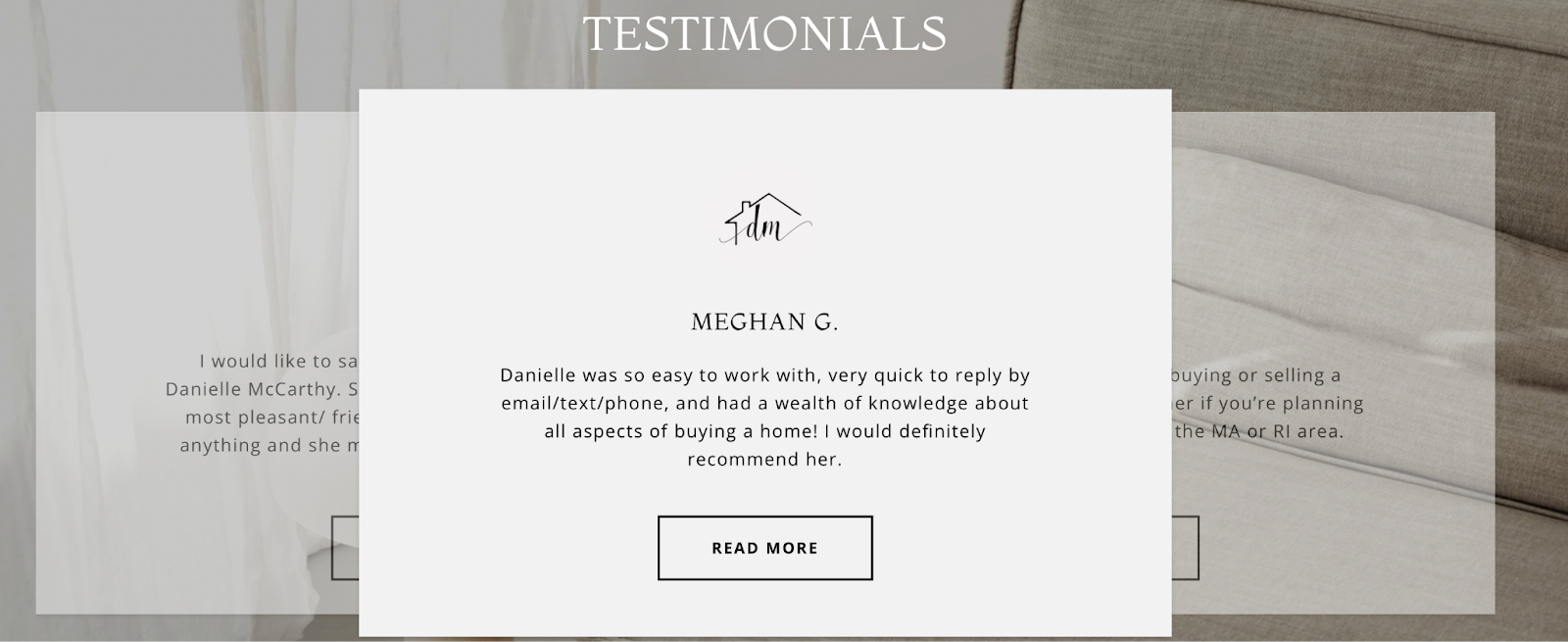
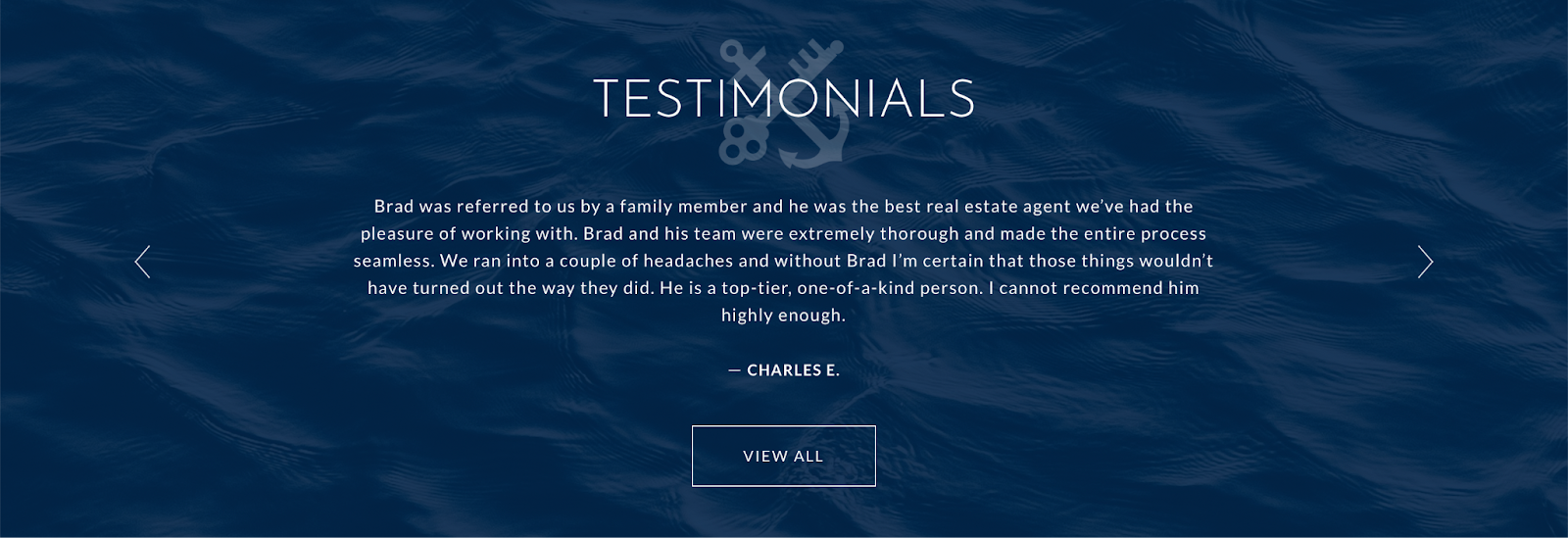
- Showcase the best quotes on your homepage. Luxury Presence website designs keep testimonials front and center. The example below is from one of our templates that displays testimonials in a carousel format.
- Use client success stories as inspiration for blog posts or case studies that show your process in action.

Share them on social media
- Turn reviews into eye-catching quote graphics with your branding.
- Add them to Instagram Stories and Highlights so they are always accessible.
- Include them in property listing promotions to build trust with new audiences.
Bally’s point applies directly to testimonials. When you share a client’s words about how you marketed their home, negotiated their deal, or guided them through a stressful process, you are giving prospects a window into what it is actually like to work with you. That is far more persuasive than any self-promotional statement you could write.
Include testimonials in email marketing
- Add a client spotlight section in your newsletters.
- Use a short testimonial as a P.S. line in emails to reinforce your value without being heavy-handed.
Integrate them into your listing presentations
- Show prospective sellers how past clients felt about your service.
- Present reviews as proof that your approach delivers results. A slide with three to five strong quotes can be more convincing than a page of market data.
Expert website design services
Every day, Luxury Presence creates and manages real estate websites for some of the biggest agents, teams, and brokerages in the country. Learn how we can transform your online presence.

Handling negative reviews with professionalism
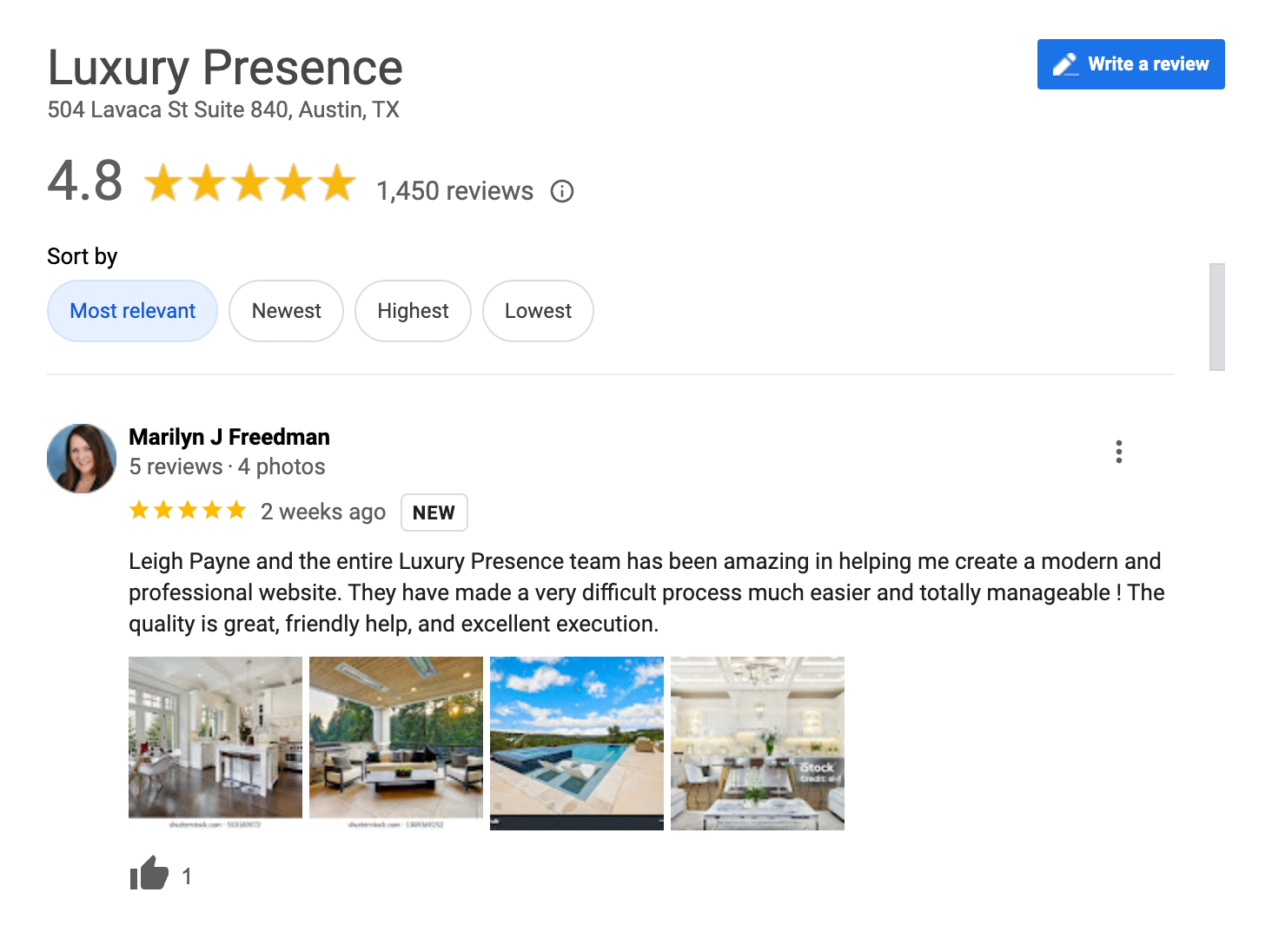
Not all reviews will be glowing, and that is okay. How you respond matters just as much as the review itself. A thoughtful, professional response to a negative review can actually strengthen your reputation because it shows prospective clients that you take feedback seriously and handle difficult situations with grace.
How to respond to negative feedback
Stay professional
Thank the reviewer for their feedback, even if it feels overly critical. Your response is public, and future clients will judge you by your tone more than by the complaint itself.
Acknowledge their concern
Show that you take their experience seriously. Avoid defensive language or attempts to explain away the issue in a public forum.
Offer a path forward
If possible, offer to resolve the issue. If the conversation needs to go deeper, suggest a private phone call or email exchange.
Sample response template
You can customize this example for your own business:
Making reviews work for search engine optimization
Beyond credibility, reviews play a direct role in how well you rank in search results. In 2026, Google continues to weigh review signals as a factor in local search rankings. Here is how to make your testimonials work harder for your SEO.
Encourage detailed, keyword-rich reviews
A review like “Great experience with [agent name]” is fine, but “[agent name] helped us sell our home in [city] above asking price in just a week” is far more valuable for search. The second version naturally includes location keywords and transaction details that other sellers might be searching for. You can guide clients toward more detailed reviews by asking a specific question in your request, such as “What was the most helpful part of the buying or selling process?”
Keep reviews fresh
Search engines favor businesses with a steady stream of recent reviews over those with a large batch of old ones. Build a habit of requesting reviews after every closing so your profile always reflects recent activity.
Add schema markup to your website testimonials
Schema markup is a standardized code added to your website’s HTML that tells search engines exactly what your content represents. When you add Review or AggregateRating schema to your testimonials page, search engines can display star ratings and review counts directly in search results, which increases click-through rates. Google’s structured data documentation provides the exact format to follow (Google Search Central, 2026).
FAQs
Your brand starts here
Use this companion to Josh Flagg’s masterclass to elevate your marketing and sharpen your online presence.

About the author

Marketing Manager
Kate Evans is a content marketing strategist at Luxury Presence, the leading growth platform for high-performing real estate professionals. She develops data-driven editorial content and supports SEO strategy and brand voice frameworks that help agents attract qualified leads and establish market authority. Her published work covers topics including CRM strategy, social media marketing, and digital growth, supporting thousands of agents in scaling their businesses through modern marketing.