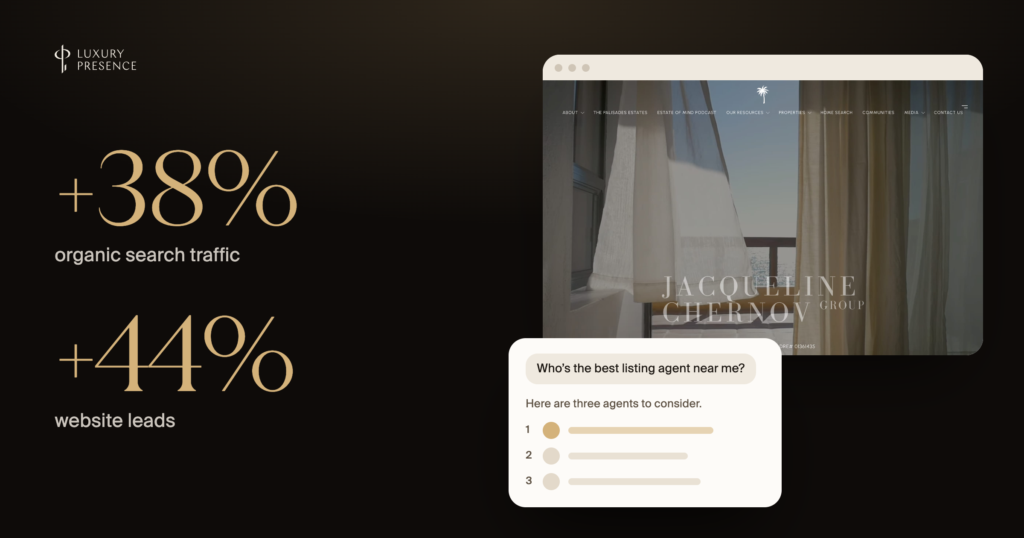
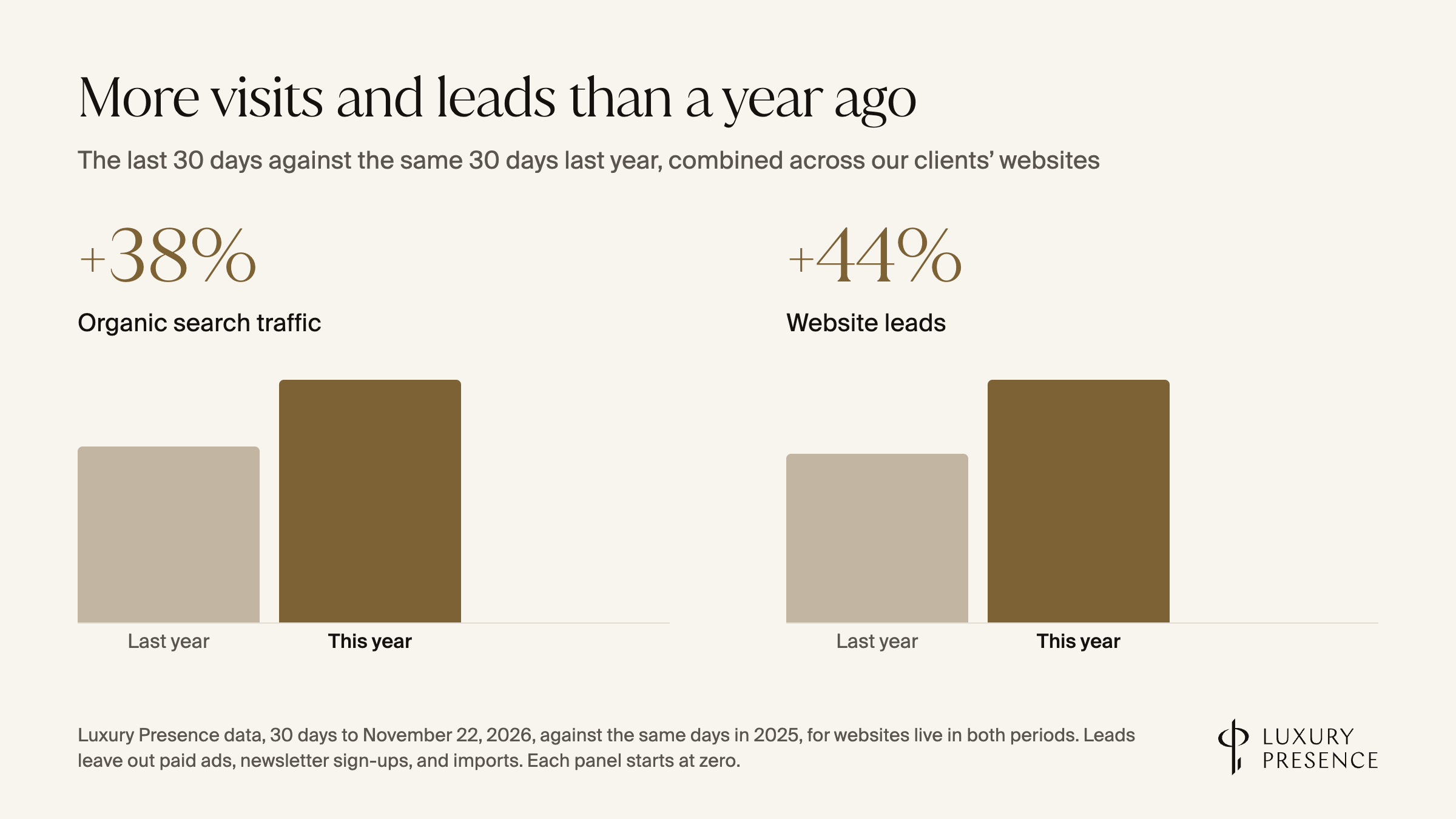
Combined across our clients’ websites, organic search traffic in the last 30 days was up 38% on the same 30 days last year, and leads from those websites were up 44%. That growth follows a year of steady work on SEO and AI visibility, including dozens of technical upgrades to our platform and several new features built for the ranking factors emerging in AI search. Here’s what’s changing in search, what we built, and how each piece helps buyers and sellers find you.
Your next client may ask ChatGPT for an agent
Picture a seller in Naples who wants to list her home this spring. A few years ago, she would have searched Google and clicked through a page of results. Today, she might ask ChatGPT for the best listing agents in her neighborhood and get back three names.
That shift is moving fast.
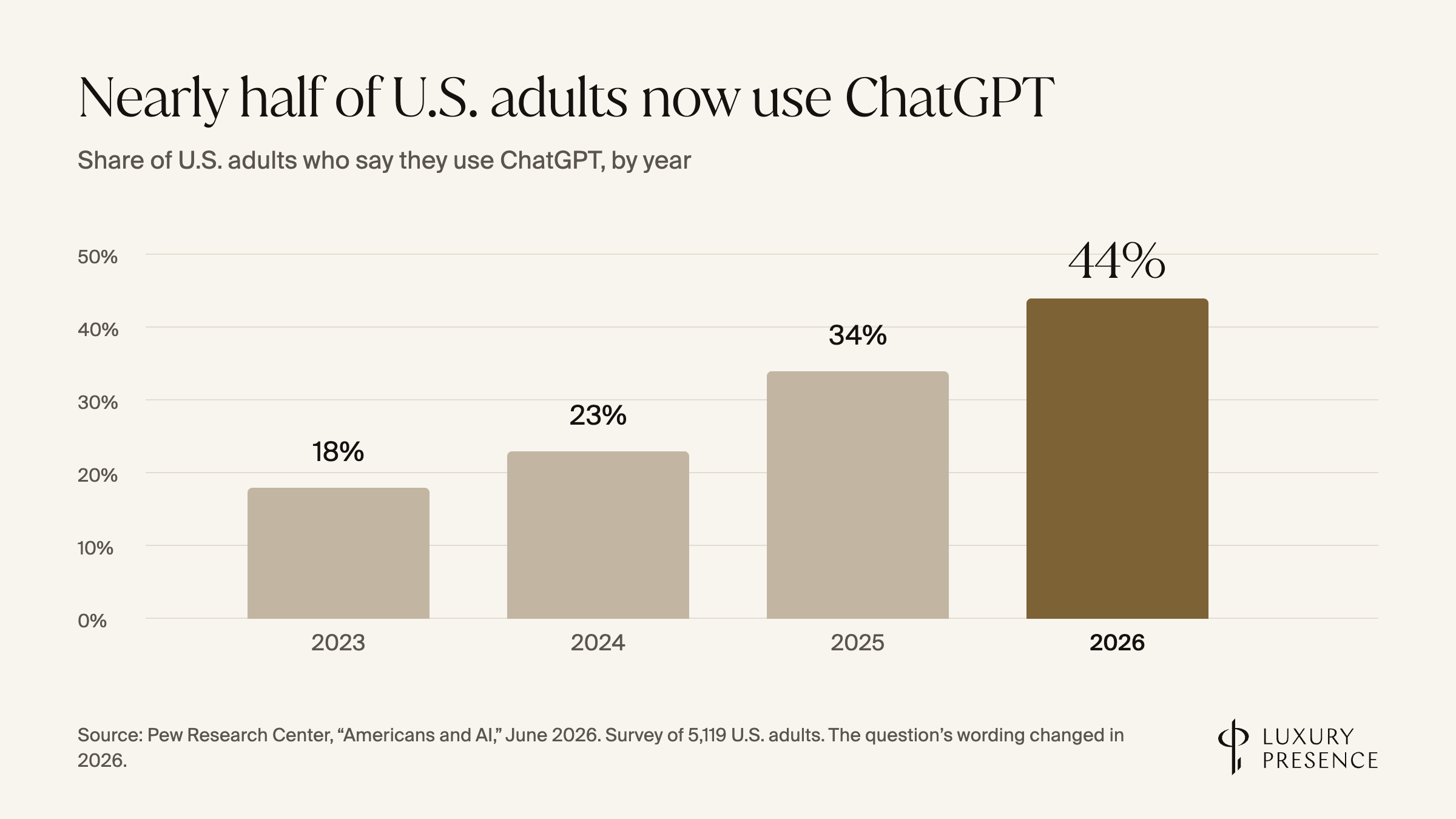
- 44% of U.S. adults now use ChatGPT, up from 18% in 2023, according to Pew Research Center.
- ChatGPT has 1.2 billion weekly users, OpenAI said in September.
- 82% of home buyers use AI, and 61% of them have used it while buying a home, according to Zillow.
Google hasn't gone anywhere. It still sends our clients' websites far more visitors than AI tools do, and it now shows AI answers at the top of its own results. Being found today means showing up in both places.
What AI search sees on your website
When someone asks ChatGPT or Google’s AI Mode to recommend an agent, the tool doesn’t browse your website the way a person does. It searches the web, reads a handful of pages, and writes an answer from the sources it understands best, often with links back to them.
To do that, it checks a few things about your website.
- Whether it can access the site. Your robots.txt file tells AI crawlers what they may read, and your sitemap lists every page worth reading, including the homes you have for sale.
- Whether it can read the page. Some AI crawlers don’t run JavaScript, so the words need to be in the page itself, with clear headings.
- Labels that explain the page. Structured data, titles, and descriptions say who you are, where you work, and what each page covers.
- Answers to real questions. Neighborhood guides, listings, and blog posts give it something worth quoting.
- Whether it’s current. Fresh pages and accurate update dates show it the information is up to date.
AI tools also look beyond your website, at reviews, directory listings, and local press. But your website is the one source you fully control, so it has to be easy to find, read, and trust.
How we made websites easier for AI to understand
We test constantly to find what helps websites show up in Google and AI search. When we find new ways to optimize performance, we build them into the platform and roll them out to all of our clients. Then we look for the next ranking factor to improve.
Every upgrade serves one of three goals.
- Easy to find. Google and AI tools can reach every page that matters, including each home for sale in your market.
- Easy to understand. Every page tells them who you are, where you work, and what the page covers.
- Ready to recommend. Your website stays clean and current, so people who find you land on a page that works.
The upgrades behind the growth
Some of this work is the technical SEO that has always mattered, kept right automatically across every page and listing. The rest is built for the newer factors AI search depends on. All of our clients get both, on every plan and at no extra cost, and the newest are marked New.
The fundamentals, on every page
Search engines and AI tools both rely on the basics of technical SEO. Our platform keeps them in place on every page, automatically, as your site grows and changes.
- A robots.txt file that guides search engines and AI tools through your site.
- An XML sitemap with accurate update dates, and an HTML sitemap of your pages.
- Index control that shows search engines the pages that should rank, each under one canonical URL, and keeps previews and low-value pages out. Our team can fine-tune it for your website.
- A meta description on every page, sized so it isn’t cut off in search results.
- Clear titles and descriptions on your Home Search pages.
- Alt text that describes your images.
- Previews that look right when your pages are shared on social media.
- Automatic link monitoring that catches broken or redirecting links and fixes them for you.
- Clear replies to search engines and AI tools when a page no longer exists.
- Links and buttons labeled for screen readers.
Built for AI search
AI tools read the web differently from people. These optimizations help them find your pages, understand who you are and what each page covers, and keep up when something changes. This work is often called GEO and AEO, short for generative engine optimization and answer engine optimization.
- Schema markup on your website, labels in each page’s code that tell Google and AI tools who you are and what the page covers.
- Schema markup on your Home Search listings, so each home’s details are clear to Google and AI tools.
- An llms.txt file, an emerging standard that gives AI tools a plain-text guide to who you are and which pages to read.
- New: An llms.txt editor, so you can change what your guide says.
- New: Markdown versions of your pages, clean text that AI tools can read quickly and accurately.
- New: HTTP Link headers that point AI tools to your XML sitemap and llms.txt file.
- New: XML sitemap controls that add the Home Search listing pages for homes in your market, and let you choose which areas go in.
- New: Instant alerts to Bing and other search engines through IndexNow whenever your site changes.
How thousands of websites make each one better
A single website only sees its own visitors, so it’s hard to tell what’s working in search and what’s luck. Across thousands of websites, patterns show up quickly, such as which pages Google and AI tools read, which searches bring buyers to listings, and what turns a visitor into a lead.
Our platform collects about 15 billion data points a year. Our team uses those patterns to decide what to improve next, then rolls each improvement out to all of our clients.
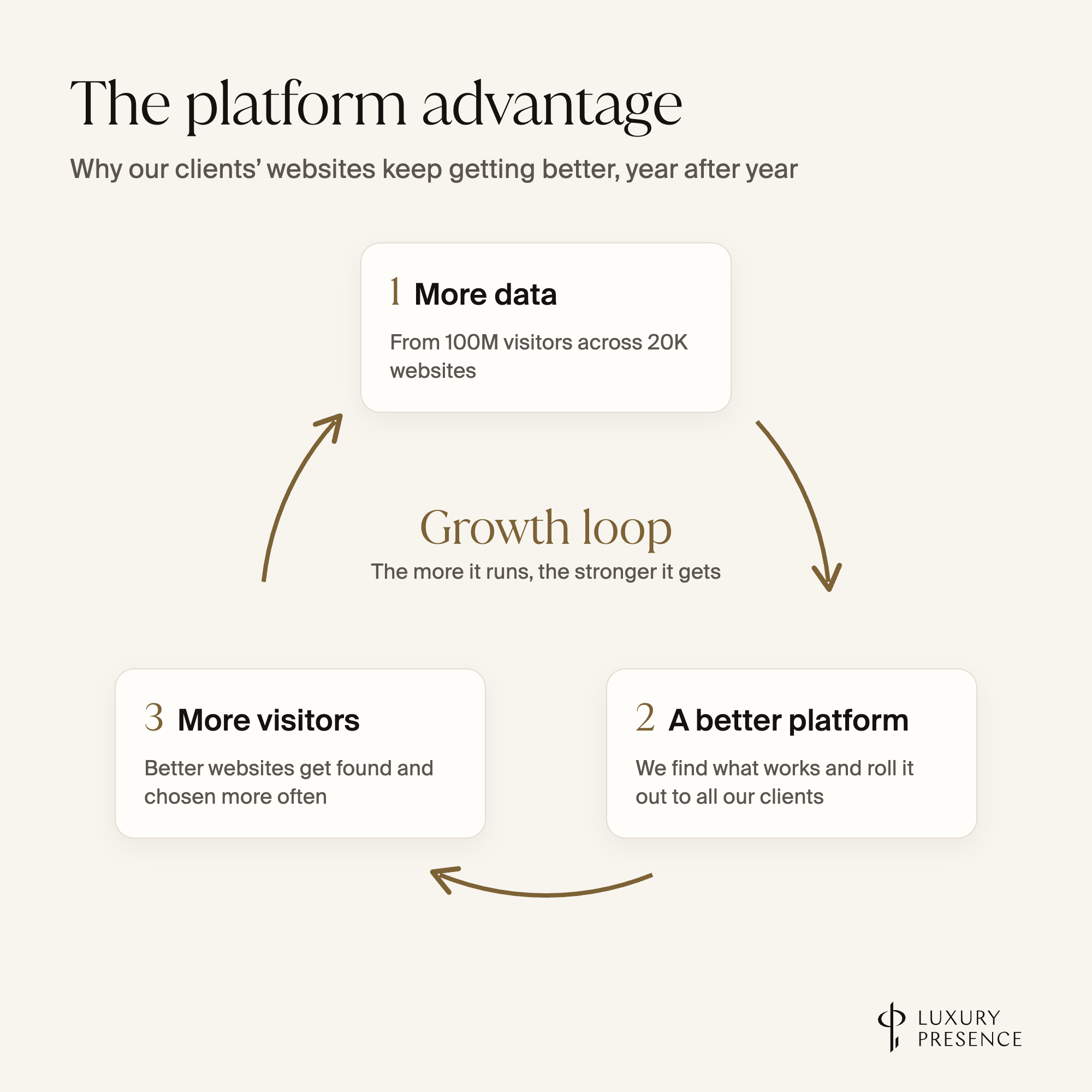
This kind of compounding is often called a growth loop. Better websites draw more visitors. More visitors create more data. More data points to the next improvement, and all of our clients get it.
38% more organic traffic than a year ago
Combined across every client website that was live in both periods, here’s how the last 30 days compare with the same 30 days last year. Leads don’t include paid ads, newsletter sign-ups, or imported contacts.
- Organic search traffic rose 38%
- Website leads rose 44%
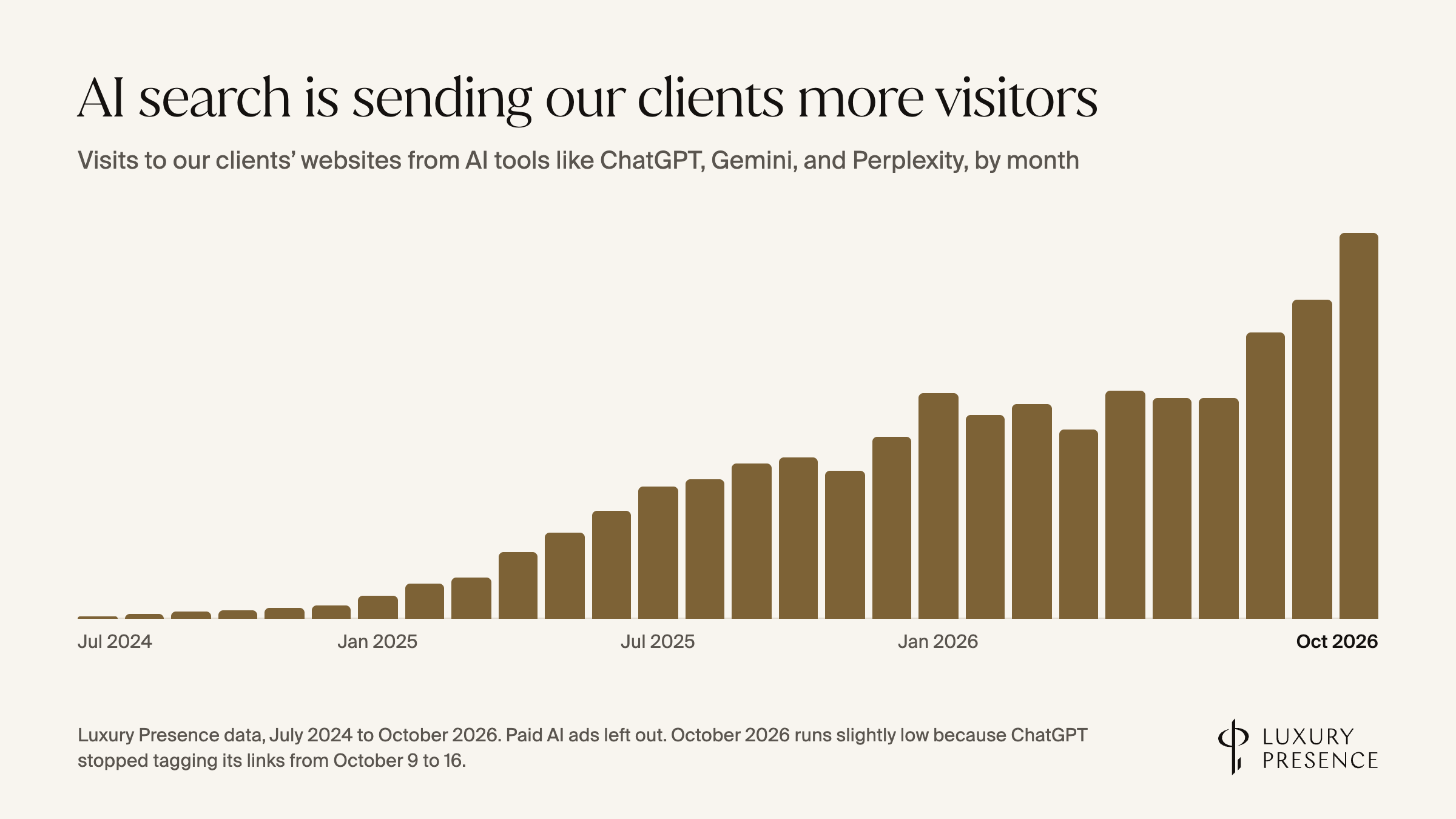
AI assistants like ChatGPT also fetched our clients’ pages about 270,000 times a day in late October to answer people’s questions.
Visits from ChatGPT and other AI tools nearly tripled in a year
These results build on a strong year for our clients.
- Visits to our clients' websites from AI tools like ChatGPT nearly tripled over the last 12 months.
- Our clients' websites get 100 million visitors a year.
- Our clients received 1.2 million buyer and seller leads last year.
- The typical SEO & AI Visibility client grew their search traffic 51% in the past year.
How our clients are getting found on Google and AI
Barry Cohen Homes, Toronto. The brokerage's site ranks on Google's first page for 38,587 search terms that don't include the Cohen name, and Google has sent it 477,405 visitors since January 2023. Read the Barry Cohen Homes story.
Guthrie Schofield Group, Cape Cod. Six months after the team launched a new site with a hyperlocal SEO strategy, it ranked in Google's top 10 for 6,147 search terms that don't include the team's name. Monthly traffic rose 48% from November to April. Read the Guthrie Schofield Group story.
Holly Meyer Lucas spent ten years building her website before she moved it to Luxury Presence. In the month after the move, her homepage drew 148% more visitors from search, and the number of searches it ranked for grew from 28 to 127. Read Holly's story.
Nile Lundgren, New York. The SERHANT. associate broker had built his own websites for years before he moved to Luxury Presence. In six months, his keyword rankings rose 575%, with 1,289 more rankings and 161% more clicks. Read Nile's story.
Gavin Ernstone was already one of the top luxury brokers in Las Vegas. With our SEO and ads, his monthly visitors from organic search grew from 390 to 2,493, and his website reached #1 on Google for "top luxury listing agent in Las Vegas." Read Gavin's story.
See where you show up when clients ask AI
Search will keep changing, and so will the way people choose an agent. We'll keep improving your website so it's ready before your next client asks.
Talk to your Luxury Presence team to see how your website shows up in Google and AI search today. If you want to go further, our SEO & AI Visibility team builds on this work every week with content for your market, written in your voice.
Sources: Pew Research Center, "Americans and AI" (June 2026). OpenAI DevDay (September 29, 2026), as reported by Engadget. Zillow, Consumer Housing Trends Report 2026: Buyers (October 2026). Client results are from Luxury Presence data across our clients' websites.
Ready to grow?
Turn your content into your best lead source
See how Luxury Presence helps agents turn website visits into closed deals