Key takeaways
- Your website is your highest-converting marketing channel when it is built around clear calls to action, IDX integration, and mobile-first design.
- In 2026, 88% of consumers will leave a site with poor user experience, making UX the single biggest factor in whether visitors stay or go.
- IDX and MLS listing feeds keep property data current on your site and give buyers a reason to return repeatedly.
- SEO-driven content (neighborhood pages, blog posts, market reports) brings organic traffic that costs nothing per click.
- A website planning checklist covering branding, lead capture, analytics, and social integration prevents costly gaps during a build or redesign.
- Tracking visitor behavior through analytics tools tells you which pages convert and which need attention, turning guesswork into informed decisions.
Why your real estate website matters in 2026
A real estate agent who does not have a dedicated website is leaving money, visibility, and credibility on the table. Below are the specific ways a well-built site pays for itself.It drives qualified traffic to your brand
Buyers and sellers start their search online. According to the National Association of Realtors, 97% of homebuyers used the internet during their home search in 2024 (NAR, 2024). A website that ranks for neighborhood keywords, school district queries, and “homes for sale in [city]” searches puts your name in front of those buyers before they ever contact an agent. Organic search traffic is also free on a per-click basis, which means every page you rank compounds your return over time.It generates leads around the clock
Your website works while you sleep. A home valuation form, a “schedule a showing” button, or a gated market report can capture contact information at 2 a.m. on a Tuesday. The key is placing calls to action where visitors naturally pause: below hero images, beside listing details, and at the end of blog posts. When those forms feed directly into Luxury Presence’s CRM, every new lead enters a nurture sequence that keeps your name in front of them with personalized, agent-approved follow-ups.It educates buyers and sellers before the first conversation
Informed clients make faster decisions and trust their agent more. A blog section, video walkthroughs, neighborhood guides, and downloadable checklists position you as the local authority. When a prospect reads your breakdown of closing costs or watches your market update, they arrive at the first meeting already confident in your knowledge.It keeps communication open without requiring your time
Contact forms, chatbots, and integrated social media platforms let visitors reach you on their schedule. Linking your Instagram, Facebook, and LinkedIn profiles to your site gives prospects multiple ways to engage, and it signals that you are active and accessible. Post-sale clients can also use these channels for referrals and reviews, which feeds your pipeline without a single cold call.It gives you data you cannot get anywhere else
A website connected to Google Analytics (or a similar tool) shows you exactly which pages visitors view, how long they stay, and where they drop off. That data tells you whether your listing pages need better photos, whether your blog topics resonate, or whether your contact form is buried too deep. Without a website, you are guessing. With one, you are making decisions based on real visitor behavior.It builds credibility before you ever shake hands
Most real estate teams do not struggle because they lack traffic. They struggle because their site does not help visitors make confident decisions quickly (Unicorn Platform, 2026). Testimonials, press mentions, transaction volume, and professional photography all serve as trust signals. A polished site with clear proof of results tells a prospect, “This agent is serious,” before you ever pick up the phone.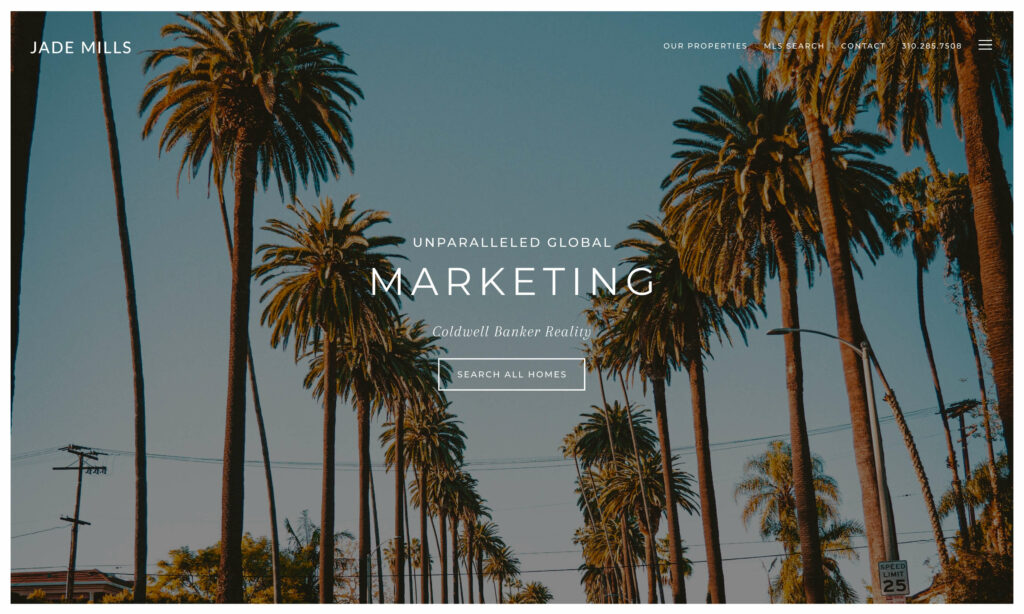
Case study: what happens when design meets strategy
Data is useful. Seeing the data play out in a real business is better. When Maggie Gold Seelig of The MGS Group partnered with Luxury Presence for a full site redesign, the results showed what a purpose-built real estate website can do in a short window.| Metric | Result |
| Lead volume increase | 371% more leads |
| Engagement rate | 55% |
| Property views | 3.5x more views |
| Visibility growth (6 months) | 9,285% |
Real estate agent website checklist for 2026
Before you build or redesign, use this checklist to make sure nothing falls through the cracks. Each item maps to a specific section later in this guide.- Custom domain and branding: Secure a domain that matches your name or team name. Use consistent colors, fonts, and logo placement across every page.
- Mobile-responsive design: Every page should render cleanly on phones and tablets without horizontal scrolling or broken layouts.
- IDX/MLS listing integration: Connect your site to your local Multiple Listing Service (MLS) so property data stays current and searchable.
- At least three lead capture forms: Include a home valuation tool, a general contact form, and a property inquiry form at minimum.
- Neighborhood or area pages: Create dedicated pages for each market you serve, targeting local search terms buyers and sellers actually type.
- SEO-ready page titles and meta descriptions: Write a distinct title tag and meta description for every page, including your target keyword and location.
- Google Analytics or equivalent tracking: Install analytics on day one so you can measure traffic, bounce rates, and conversions from the start.
- Social media profile links: Add icons linking to your active profiles so visitors can follow you on the platforms they already use.
- Client testimonials or reviews: Display at least three client quotes with names and transaction details to build trust.
- Blog or resource section: Publish at least one piece of local market content per month to build organic search authority over time.
The elements of a high-performing real estate website
A real estate agent website is made up of several interconnected parts. Below is a breakdown of each one, why it matters, and what to prioritize when building or improving yours.Web design: the foundation of first impressions
Three design priorities for real estate agents:- Hero image or video: Use a high-resolution photo or cinematic video of your market above the fold. This sets the emotional tone before a visitor reads a single word.
- Visual hierarchy: Guide the eye from headline to call to action using size, contrast, and whitespace. The best sites rely on structure and hierarchy to do the talking, not stacked animations.
- Consistent branding: Your logo, color scheme, and font choices should match your print materials, social profiles, and email signatures so that every touchpoint feels like the same brand.
User interface and user experience (UI/UX): keeping visitors on your site
UI refers to the visual elements a visitor interacts with: buttons, menus, forms, and navigation bars. UX refers to how easy and satisfying it feels to move through your site. Together, they determine whether someone stays long enough to become a lead or leaves in frustration. In 2026, 88% of consumers will abandon a site with poor UX, and 79% will immediately search for a competitor (HousingWire, 2026). Practical UX improvements for agent websites:- Keep your main navigation to five or fewer top-level items (e.g., Home, Listings, About, Blog, Contact).
- Make your phone number and contact form accessible from every page, not just the contact page.
- Design for mobile first. More than half of real estate site traffic in 2026 comes from phones, so test every page on a small screen before publishing.
“As a Bay Area realtor, I’m impressed by Luxury Presence’s professionalism and speed. They built a beautiful, modern site with smooth IDX integration, clear neighborhood pages, and lead forms that actually convert.”
— Jill Chen, Bay Area Realtor, 2025
Website copy: the words that convert visitors into clients
Website copy is the text on your core pages: homepage, about page, listing pages, and service pages. It is different from blog content. Copy has one job: move the visitor closer to taking action, whether that means filling out a form, calling your office, or scheduling a showing. Three rules for strong real estate website copy:- Lead with the client’s problem, not your resume. Instead of “I have 15 years of experience,” try “Selling a home in [City] is complicated. Here is how I make it simple.”
- Use specific numbers. “$42M in closed volume last year” is more persuasive than “top-producing agent.”
- End every page with a clear call to action. Tell the visitor exactly what to do next: “Schedule a free consultation,” “Get your home’s value,” or “View all listings in [Neighborhood].”
Search engine optimization (SEO): getting found without paying per click
SEO is the set of practices that help your site appear near the top of Google, Bing, and other search engines when someone types a query related to your market. With the cost to acquire a single website visit climbing year over year, organic search is one of the most cost-effective ways to fill your pipeline in 2026. Where to focus your real estate SEO efforts:- Local keyword targeting: Create pages for “[City] homes for sale,” “[Neighborhood] real estate agent,” and “[School District] housing market” to capture searches with buying or selling intent.
- On-page fundamentals: Write a distinct title tag (under 60 characters) and meta description (under 155 characters) for every page. Include your target keyword naturally in the first 100 words of each page’s body text.
- Content velocity: Publish at least two blog posts or market updates per month. Each piece should target a specific long-tail keyword and answer a question your clients actually ask.
Social media integration: extending your reach beyond the site
Your website and your social media profiles should work as a connected system, not as separate silos. Embedding your Instagram feed on your homepage, linking to your YouTube channel from listing pages, and adding share buttons to blog posts all create pathways that keep your brand visible even after a visitor leaves your site. Social integration also builds social proof. When a prospect sees an active Instagram grid with recent listing photos, client celebrations, and market commentary, it reinforces the credibility your website establishes. The goal is not to replace your website with social media. It is to use social media as a distribution channel that drives traffic back to your site, where your lead capture forms do the work.“The website’s back end is very simple and easy for me to use. It allows me to easily distribute leads. It allows me to easily update the website with information for our agents, but our agents also can use it as an incredible marketing tool.”
— Maria Coukoulis, Real Estate Broker
Internet Data Exchange (IDX) integration: keeping listings current
IDX is the technology that allows real estate agents to display MLS (Multiple Listing Service) listings directly on their own website. Without IDX, your site is a brochure. With it, your site becomes a property search destination that gives buyers a reason to return daily. What to look for in an IDX integration:- Map-based search: Let visitors draw boundaries on a map to search by location, not just by zip code.
- Saved search alerts: Allow registered users to save criteria and receive email notifications when new listings match, which brings them back to your site repeatedly.
- MLS listing feeds that update automatically: Stale listing data erodes trust. Make sure your IDX pulls updates at least once per hour.
FAQs
Expert website design services
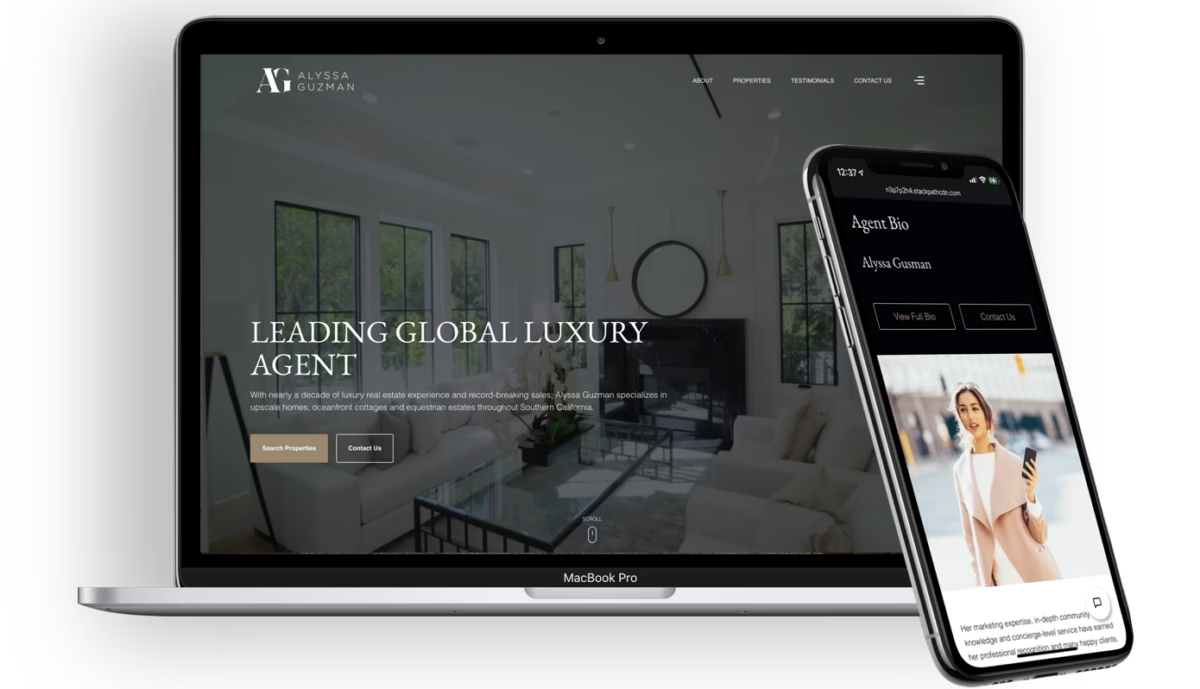
Every day, Luxury Presence creates and manages real estate websites for some of the biggest agents, teams, and brokerages in the country. Learn how we can transform your online presence.
About the author

Marketing Manager
Kate Evans is a content marketing strategist at Luxury Presence, the leading growth platform for high-performing real estate professionals. She develops data-driven editorial content and supports SEO strategy and brand voice frameworks that help agents attract qualified leads and establish market authority. Her published work covers topics including CRM strategy, social media marketing, and digital growth, supporting thousands of agents in scaling their businesses through modern marketing.