

Most real estate leads don't convert on the first email. They convert on the fourth, the fifth, or the one following-up three months after a homeowner requested a valuation and went quiet. Below are 12 real estate follow-up email examples for 2026, organized by the exact moments they're built for: a new lead, an open house, a price drop, a lead who's gone cold, the one-year mark, and a referral ask. Copy any one of them, fill in the brackets, and send it today.
Key takeaways
- Most non-routine purchases in real estate close after five or more follow-ups, yet 44% of agents stop reaching out after a single no.
- Ryan Coyne of SERHANT. says the average agent converts 65 of every 1,000 leads. The gap between that number and a much higher one usually comes down to follow-up, not lead volume.
- Specific subject lines under 50 characters display in full on mobile and outperform generic ones like "Checking In."
- The templates below are grouped by scenario: open house, listing feedback, price reduction, an unresponsive lead, the one-year mark, and a referral ask, plus six more for the moments in between.
- Copy any template, drop in the details in brackets, and send it today. Personalizing around what a lead actually did works better than personalizing around trivia.
- NAR's 2025 Profile of Home Buyers and Sellers found that 87% of sellers would recommend their agent again. Staying visible enough to be the one they call, or refer, when that moment comes is most of the work.
Why follow-up still decides who gets the deal in 2026
Ryan Coyne, Chief Experience Officer at SERHANT., put it plainly on a Luxury Presence panel: "Follow-up is the silver bullet." His reasoning comes from an uncomfortable number he cites from NAR data: the average agent closes 65 of every 1,000 leads.
The industry's answer for the past 20 years has been to buy more leads instead of fixing what happens after the first one comes in. Coyne asks the more useful question: "Why not 500 out of 1,000?"
The math on persistence backs him up. Most non-routine purchases, and a home is about as non-routine as a purchase gets, close after five or more follow-ups. Yet 44% of agents stop after a single no.
Two numbers explain most of the gap between agents who close and agents who give up too soon.
Lauren Henss, CMO and Chief Strategy Officer at FirstTeam, who joined Coyne on that same panel, connects the dots between marketing and follow-up: "Ads create the visibility; the brand and storytelling create the belief... but you've got a lot of people in your sphere and contacts that you're just not talking to." Her advice is to play the long game, because a lead rarely converts on the first touch. Staying visible with the people already in your sphere of influence is exactly what most of the templates below are built for.
Top-producing agent Matt Breitenbach builds his entire business around this idea. "I think follow up is big, and I try to be the best at it, that's where technology comes in for me with the CRM, because you can't remember everything, and as you grow, you need that, so I set follow up frequency, depending on who the contact is," he says.
He treats it the way he'd treat a fitness goal, something to keep improving. His warning about what happens without a system is worth sitting with: "That's why there's always that percentage out there of buyers that buy a house with an agent and they sell with somebody else for a reason. It's because you're not staying in touch and you're not nurturing that relationship."
The data backs him up too. NAR's 2025 Profile of Home Buyers and Sellers found that 87% of sellers would recommend their agent again. Most of that repeat and referral business depends on staying visible enough to be the one they call when the moment actually arrives, which is exactly what the anniversary, referral, and post-closing templates below are built for.
Five habits every strong follow-up email shares
These show up across every template below, and they're the same habits behind Luxury Presence's guide to expert lead follow-up.
Subject lines stay under 50 characters. Most phones cut off subject lines around 40 to 50 characters, so anything longer gets truncated. Short and specific beats long and clever.
Specific beats generic. "Just checking in" asks the reader to do all the work of remembering why you're emailing and deciding whether to respond. "Thoughts on 742 Elm Street?" tells them exactly what you're asking and signals that a one-line answer is a complete answer.
The message gets to the point fast. A short email signals that a short reply is fine. A long one signals that responding will take real effort, and most leads will put that off indefinitely.
Personalization follows intent, not trivia. A property a lead viewed, a feature they mentioned, a showing they attended, or a question they asked all make better personalization than a random fact from their LinkedIn profile. Chirag Shah, who coaches Compass agents, put the alternative bluntly: "I don't care about your open house. I don't care about just listed.
And the worst email to send is price reduction, 'cause you're literally marketing that you did your job wrong the first time." His point is to make those topics specific to the person receiving them instead of blasting the same line to an entire database.
Every email gives the reader a reason to answer. That reason can be a new listing, a market shift, a question only they can answer, or genuine curiosity about how they're doing. It should never be "we haven't talked in a while."
12 real estate follow-up email examples you can copy and send today
Each template below is built for a specific moment in the buyer or seller relationship. Swap in your own details and send. For a bigger swipe file, see the full library of real estate email templates.
Buyer and lead follow-ups
1. New lead, first touch
Best for: A new inquiry who hasn't responded to your first outreach
Subject: Quick question about your search
Hi {first_name},
I noticed you were looking at homes in {area}. Before I send over a list of options, I want to make sure I'm pointed in the right direction.
What matters most to you right now: price, location, or finding the right home?
Reply with one of the three and I'll take it from there.
{agent_name}
Why it works: This gives the lead three doors to walk through instead of an open-ended question to compose an answer to. It also hands the agent real qualification information without ever asking, "So what are you looking for?" It's the same idea behind a good lead magnet: give the lead an easy first step, not an open-ended one.
2. Open house follow-up
Best for: Someone who toured a specific property at an open house
Subject: Thoughts on 742 Elm Street?
Hi {first_name},
Thanks for stopping by {address} this weekend. I'd love to hear what stood out to you, good or bad.
I also have two other homes nearby with a similar layout that haven't hit the open house circuit yet. Want me to send them over?
{agent_name}
Why it works: Naming the actual address does more work than any line about the market. It tells the reader this is about the home they just walked through, not a template blast, and it makes replying with one honest sentence feel easy. Pull the name straight from your open house sign-in sheet so the follow-up goes out the same day.
3. Post-showing feedback request
Best for: A buyer after a private showing, when you need real feedback to keep the search moving
Subject: Two things about {address}
Hi {first_name},
After seeing {address} with you, two things stood out to me: {specific positive} and {specific tradeoff}.
That second one made me think of another property that might be a closer fit. Want me to send it over?
{agent_name}
Why it works: This does the buyer's thinking for them instead of asking, "What did you think?" and waiting. Naming a real tradeoff signals that you were paying attention and gives the reader something specific to react to. A compliment alone invites a one-word reply.
4. Price reduction alert
Best for: A buyer who showed real interest in a specific home that just dropped in price
Subject: {address} just dropped to {price}
Hi {first_name},
{address}, the one you asked about a few weeks ago, just came down to {price}.
That puts it back in the range you mentioned. Want me to set up a second look before the weekend?
{agent_name}
Why it works: A price reduction email only works when it's about one buyer and one home. Sent as a mass blast, it reads the way Chirag Shah described, as an admission that the listing was priced wrong.
Sent to the one buyer who already asked about that address, it reads as good news timed well. If the price moved because of what a comparative market analysis turned up, say so. It gives the buyer a reason beyond "the seller got nervous."
5. Unresponsive lead re-engagement
Best for: A lead who has gone quiet after early engagement
Subject: What's changed on your end?
Hi {first_name},
I've been thinking about your search in {area}.
At this point, what's the biggest thing holding you back? Not finding the right home, timing, financing, or something else?
If I know what's changed, I can make the search useful again instead of just sending more listings.
{agent_name}
Why it works: Silence usually means friction, not disinterest. Offering three specific categories helps someone identify their own situation faster than an open-ended "How's the search going?" ever will. This is also the moment to check whether a drip campaign would serve them better than one-off emails.
A lead who goes quiet for 60 days and then shows even minor activity, like one property view, is exactly the kind of return-from-dormancy signal Smart Actions is built to catch and surface. The system doesn't reach out to cold leads on a schedule on its own, so a template like this one is still what closes that gap.
6. Market update touch
Best for: Long-term buyer or seller nurture, especially leads who are watching the market without an active search
Subject: Something shifted in {area} this week
Hi {first_name},
A quick update on {area}: {specific market or listing development}.
Here's why that matters for you: {one-sentence explanation}.
If you're still thinking about a move, I can send a few homes that make sense in the current market.
{agent_name}
Why it works: This is a useful update first and a pitch second, which is what turns an agent from a salesperson into a source. Luxury Presence's AI CRM can flag these moments automatically through Smart Actions, which evaluates every contact daily and surfaces who to reach out to based on signals like a career change picked up through enrichment data or a lease about to expire.
On a Luxury Presence panel about AI and CRM tools, agent Kyle Scott described a case where a contact's flagged job change led to a listing appointment and a signed listing the following week, a deal that would have been missed without the prompt.
Seller and long-term relationship follow-ups
7. Home valuation follow-up
Best for: A homeowner who requested an online valuation and went quiet
Subject: A closer look at {address}
Hi {first_name},
I pulled together more detail on {address} after looking at recent sales nearby.
The online estimate is a starting point, but things like {condition or upgrades} can move that number quite a bit.
I can put together a more realistic range based on your home specifically, no listing conversation required. Would that be helpful?
{agent_name}
Why it works: This acknowledges a real objection. An algorithm doesn't know a house the way its owner does. Offering a more accurate number, with no strings attached, lowers the commitment enough for most people to say yes. This is the exact moment a home valuation lead either turns into a conversation or goes cold. Luxury Presence's AI CRM already sends past clients an automatic monthly value estimate. This template is for the homeowner who wants a real person's take instead of just the number.
8. Neighborhood comp update
Best for: Past clients, geographic farming, or anyone who has mentioned thinking about selling
Subject: What {nearby address} sold for
Hi {first_name},
{nearby address} just sold for {price}. I thought you'd want to know because it's similar to your place in a few ways: {brief similarity}.
That doesn't mean your home would sell for the same number, but it's a useful data point.
I can pull the three most relevant recent sales and show you where I think your home would land. Want me to?
{agent_name}
Why it works: A nearby sale is real, timely information, not a sales pitch dressed up as one. It gives the homeowner a reason to want the answer, which makes them the one asking for more. Pulling those comps is a lot faster with a solid comparative market analysis process already in place.
9. Not-ready-to-list nurture
Best for: A seller who is hesitant because they aren't ready to commit
Subject: You don't have to list yet
Hi {first_name},
Homeowners considering a move don't need to be ready to list before they start preparing.
If selling is on your radar at all, we can look at what your home could realistically sell for, what I'd recommend doing now, and what I'd leave alone. Then you decide if and when it makes sense to move forward.
Would a quick conversation like that be useful?
{agent_name}
Why it works: This removes the objection behind most stalled seller leads. Talking to an agent doesn't have to mean committing to a listing date. Taking that pressure off is often what gets the reply, and it's the same low-pressure approach behind a good seller's guide.
10. One-year anniversary check-in
Best for: Any past client, buyer or seller, at the one-year mark
Subject: Happy homeiversary, {first_name}
Hi {first_name},
It's been a year since you closed on {address}. I hope the {specific detail, a room, a project, a season in the home} has turned out the way you pictured it.
If you've thought about what your home might be worth in today's market, or if you know anyone starting their own search, I'm always glad to help.
{agent_name}
Why it works: The one-year mark is one of the most overlooked follow-ups in real estate, and it doubles as a natural, low-pressure opening for both a valuation conversation and a referral ask. It's a small but reliable way to keep a past client active in your sphere of influence instead of letting the relationship go cold. It's also one of the specific triggers Luxury Presence's Smart Actions watches for on its own, since a home purchase anniversary is exactly the kind of signal the system is built to catch.
11. Referral request
Best for: Past clients and sphere contacts, especially after a closing or a personal touchpoint
Subject: A favor, if you know anyone
Hi {first_name},
Working with you on {address} was one of the highlights of my year. I hope everything about the move is settling in well.
If a friend, coworker, or family member ever mentions buying or selling, I'd appreciate the introduction. I'll take good care of them the way I did for you.
{agent_name}
Why it works: Matt Breitenbach's highest-performing outreach wasn't a polished campaign. It was a personal, unpolished email he sent to about 100 top referral partners after a networking retreat, and it outperformed, in his words, "the most beautiful curated marketing" he had ever sent. His explanation: "It's your voice." A referral ask works best when it sounds like you, not like a template, even though this one is one. For more ways to prompt the ask, see Luxury Presence's real estate referral strategies.
12. Post-closing check-in
Best for: A client a few weeks or months past closing, before the one-year mark
Subject: How's {address} treating you?
Hi {first_name},
I've been thinking about how the move into {address} is going.
Last time we talked, you mentioned {specific detail about their plans or priorities}. I'd love to hear how that's shaping up, no real estate agenda here.
{agent_name}
Why it works: This is the one template on the list with no ask attached, and that's the point. A genuine, no-strings check-in is what makes the next email, the anniversary check-in or the referral request, land as a relationship rather than a sequence. It's the kind of small touch that adds up to strong real estate customer service long after closing.
Build the system behind the templates
Jonathan Spears and Maria Coukoulis, who lead Spears Group, built their team's process around consistency instead of individual scripts. Every new website lead gets a call within three minutes, regardless of whether the agent reaches the person, and it gets logged into their CRM immediately with the owner tagged.
"No matter who gets that lead on the team, we know they're handling it quickly and they're handling it the same way," Jonathan Spears says. "That's the difference between an internet lead coming in and it being a dud or converting." See how the rest of their process works in the systems that power Spears Group's $2B business.
The templates above work best inside a system like that one: a CRM that reminds you who's due for a touch, tags that keep leads from falling through, and a follow-up frequency you set on purpose instead of by accident. Matt Breitenbach's approach is to set that frequency by contact type and let the CRM carry the reminder.
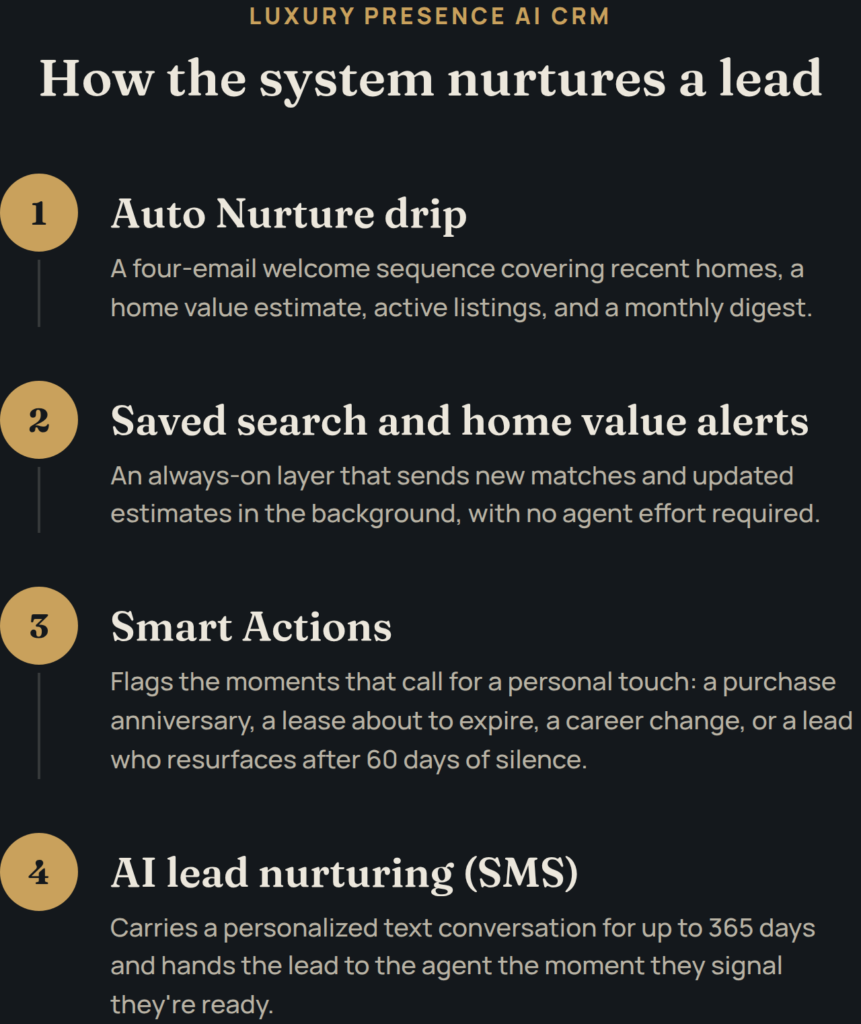
Luxury Presence's own AI CRM builds a version of this automatically. A new contact starts in an Auto Nurture drip, a four-email welcome sequence covering recent homes, a home value estimate, active listings, and a monthly digest. From there they graduate into saved search and home value alerts, which run in the background indefinitely and send new matches or updated estimates without any agent effort.
On top of that always-on layer, Smart Actions watches for the moments that call for a personal touch instead of an automated one: a past client's purchase anniversary, a lease about to expire, a career change picked up through enrichment data, or a lead who returns after 60 days of silence. Its AI lead nurturing layer can also carry personalized SMS conversations with a lead for up to 365 days, referencing their actual search criteria, and hands them to the agent the moment they signal they're ready to move.
That progression breaks down into four steps.
Send the next one
The follow-up that converts a lead rarely looks impressive. It's short, specific, and it goes out on schedule instead of whenever it happens to cross an agent's mind. Pick the template above that matches whichever lead has been sitting in your CRM the longest, fill in the brackets, and send it today.
FAQs
Nurture leads effortlessly with email templates
Our free e-book offers customizable resources and tips to keep your database engaged, move leads through the funnel, and close deals effectively.
Ready to grow?
Turn your content into your best lead source
See how Luxury Presence helps agents turn website visits into closed deals