

Brand storytelling is the practice of using narrative to communicate your values, experience, and mission so that clients choose you before you ever speak with them. In 2026, every real estate agent has access to the same listing platforms, the same market data, and many of the same marketing tools. The agents who win are the ones who give prospects a reason to connect with them on a personal level. By sharing the values that drive you, the experiences that shaped you, and the defining moments of your career, you create a brand that feels human, memorable, and worth trusting. This guide walks you through a clear framework for uncovering your story, shaping it for the right audience, and expressing it consistently across every branding touchpoint.
Key takeaways
- Brand storytelling in real estate goes beyond a polished logo or tagline. It is the narrative thread that connects your values, your experience, and the way you serve clients.
- A simple five-part template (Origin, Values, Client Impact, Proof Points, Call to Action) gives you a repeatable structure for telling your story across any channel.
- Different client segments respond to different messaging, tone, and proof points. Matching your story to your audience makes it resonate rather than fall flat.
- Consistency matters more than perfection. Clients trust agents whose actions, branding, and words all tell the same story.
- Measuring the impact of your narrative through specific KPIs (social engagement, About page traffic, inbound lead attribution) turns storytelling from a feel-good exercise into a growth strategy.
Why brand storytelling is essential in 2026
In real estate, relationships are the foundation of every closed deal. In 2026, buyers and sellers have more agent options than ever, and most of them start their search online. Your story is often the first thing a prospect encounters, and it shapes whether they see you as someone worth calling or just another name on a search results page.
Sharing your narrative lets potential clients see you as more than a service provider. It humanizes your brand and gives people a reason to remember you. According to the National Association of Realtors, the majority of buyers in 2025 chose their agent based on reputation, referrals, or a sense of personal connection rather than transaction fees alone (National Association of Realtors, 2025). That pattern holds true in 2026, and it means your story is part of what makes that first impression count.
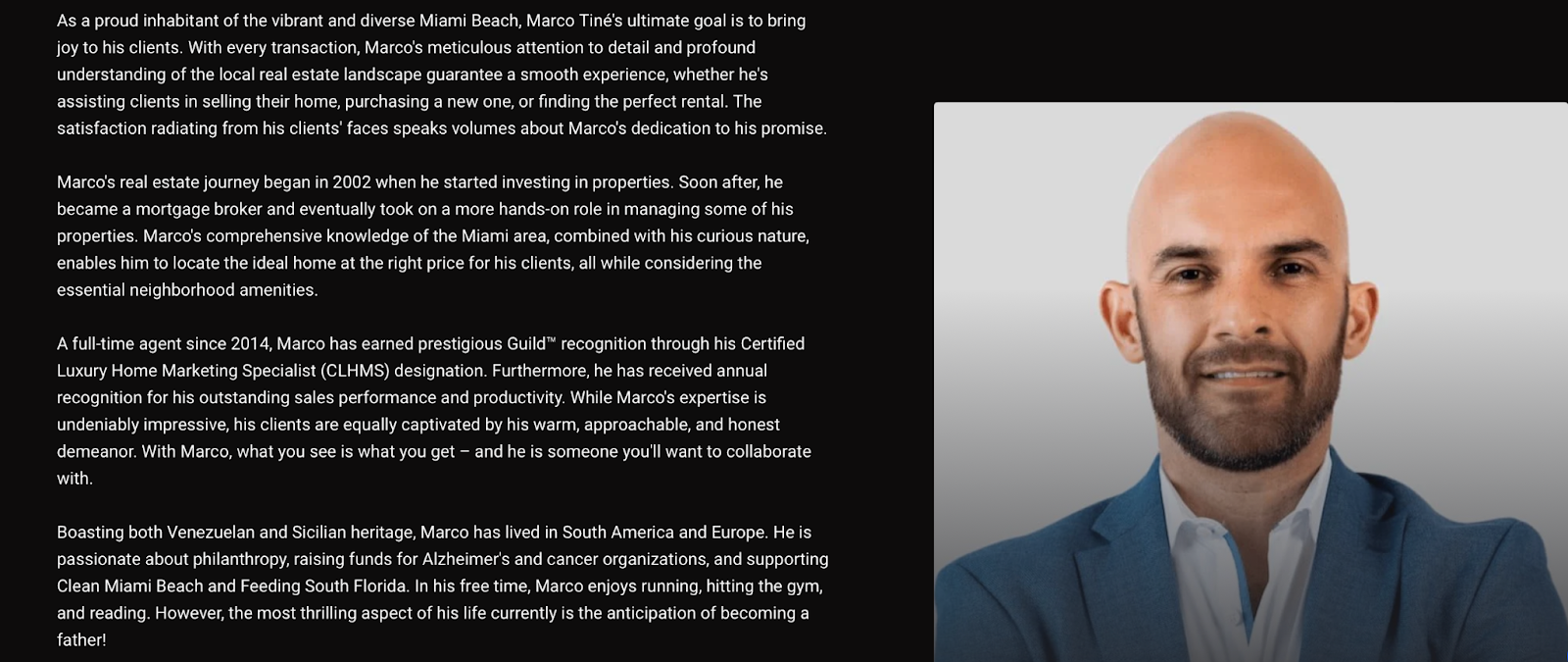
As of 2026, Marco Tiné from SERHANT., the real estate brokerage founded by Ryan Serhant, weaves his story and his values together on his website. His visitors learn how he found his way into real estate. They also gain insight into his pride in his Sicilian and Venezuelan heritage, his hobbies and philanthropic work, and his excitement about fatherhood. Tiné builds a narrative that lets leads and prospects know exactly who he is and how his “ultimate goal is to bring joy to his clients.”
A 5-part brand story template for real estate agents
If you have ever stared at a blank About page and wondered where to start, this framework gives you a repeatable structure. Work through each step in order, and you will have the raw material for a brand narrative you can use on your website, in videos, on social media, and in conversations with prospects.
- Origin: Describe what drew you to real estate and why it matters to you personally. One to two sentences that answer the question: why are you here?
- Values: Name two to three principles that guide every client interaction, such as integrity, community, or transparency. These are the non-negotiables of how you work.
- Client impact: Explain specifically how your values translate into a better experience for the people you serve. Connect your “why” to their outcome.
- Proof points: Cite a result, milestone, or recognition that validates your approach, such as years in market, transaction volume, or a client success story.
- Call to action: Tell the reader what working with you looks like and invite them to take the next step.
You do not need to write a novel. A strong brand story can be five sentences long, as long as each sentence carries weight. The goal is clarity, not length.
Identify your values and traditions
The first step to integrating brand storytelling into your digital marketing strategy is articulating what you stand for. Take time to reflect on what drives you both personally and professionally. The three questions below will help you surface the material you need.
What inspired you to pursue real estate?
Maybe a memorable experience with buying or selling a home sparked your passion for the field. Maybe it is about expanding economic opportunity in your community. Whatever the answer, this is your origin story, and it is the most human part of your brand.
What values guide your business?
Whether it is integrity, creativity, or a commitment to community, use these principles to define your approach to clients. Write them down. If you cannot name your values in a single sentence, your audience will not be able to either.
Are there meaningful traditions in your work?
Perhaps you come from a family of real estate professionals, have deep ties to a specific neighborhood, or prioritize sustainable practices in every listing. These traditions add texture to your narrative and make your brand feel grounded rather than generic.
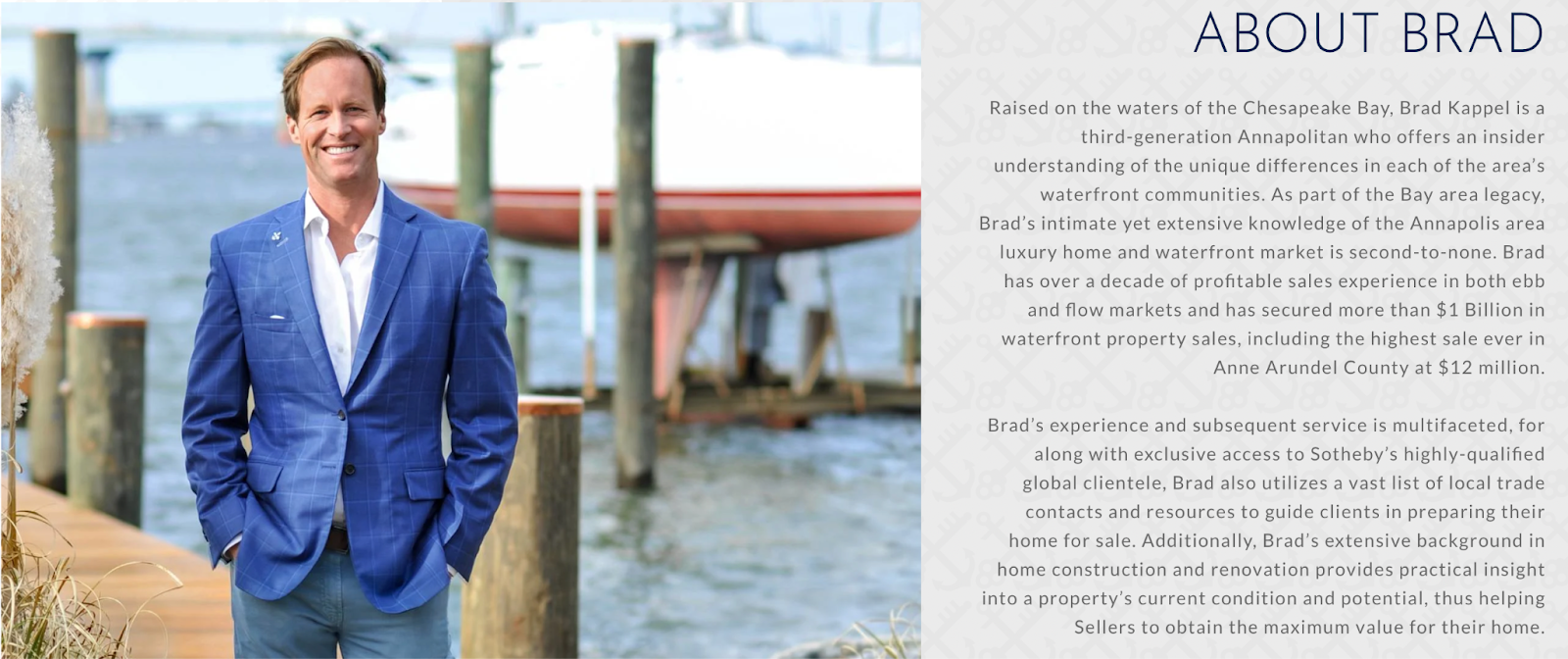
As of 2026, Brad Kappel taps his deep roots in the Chesapeake Bay area to integrate his love for his community into both his story and his brand. His narrative is not about credentials alone. It is about a lifetime of connection to a place he knows better than anyone.
Connect your story to your audience
Once you have defined your values, shape your story to align with the aspirations and priorities of your ideal clients. Think about what truly matters to them and show how you deliver on those needs.
For first-time buyers: highlight how you simplify the purchase process, guiding them with patience and care at every step. For luxury clients: showcase your track record with high-value properties and your commitment to discretion. For move-up buyers: lean into your neighborhood knowledge and your ability to manage the complexity of buying and selling at the same time.
Tone and language matter just as much as content. A family-focused audience will connect with a warm, approachable voice. High-net-worth clients may respond to polished, precise language that reflects their standards. The table below breaks down how your storytelling approach should shift by segment.
| First-time buyers | Move-up buyers | Luxury clients | |
| Messaging focus | Simplicity, patience, guidance through complexity | Life-stage transition, trust in your local expertise | Exclusivity, discretion, track record with premium properties |
| Proof points | Client testimonials from first-time buyers, step-by-step process transparency | Neighborhood knowledge, upgrade success stories | Sales volume, high-value transactions, referral network |
| Preferred channels | Social media (Instagram, TikTok), email nurture | Email newsletters, community content, video | Private referral, polished website, video biography |
| Tone | Warm, reassuring, jargon-free | Confident, community-focused | Polished, precise, understated |
The goal is balance: resonating with your audience while staying true to who you are. When your story feels both authentic and aligned with their needs, it becomes a powerful way to build trust. As of 2026, Luxury Residential Management uses video to explain not only the team’s deeply held values, but how those values directly impact their clients.
Maintain consistent authenticity in your brand storytelling
Clients can sense when a story feels polished to perfection but lacks sincerity. Instead of curating a highlight reel, embrace the real moments that shaped your journey, challenges and all. These are the stories that make you relatable and inspire confidence in your ability to guide others through their own high-stakes decisions.
Research from the Edelman Trust Barometer shows that the vast majority of consumers need to trust a brand before they will buy from it (Edelman, 2025). In 2026, that principle applies to individual real estate agents just as much as it does to global companies. Your story is one of the most direct ways to earn that trust before a prospect ever picks up the phone.
As of 2026, Jade Mills, Coldwell Banker’s top-producing luxury agent, continues to share her story of humble beginnings as a trust-building tool. In the interview below with Luxury Presence founder and CEO Malte Kramer, Mills opens with a narrative of tenacity, hunger, survival, and dedication. While she is one of the most successful agents in the country, she is not shy about where she started.
That kind of trust does not come from a tagline. It comes from showing up the same way, every time, across every interaction. If you highlight your commitment to community, let it show in tangible ways: support local events, collaborate with organizations, and champion causes that reflect your personal beliefs. Consistency connects the dots between your values and your business, creating a brand that people remember and return to.
How a branding partner can help you tell your story
Sometimes the hardest part of brand storytelling is not knowing what to say. It is knowing how to say it in a way that looks and feels like you. That is where working with a branding partner makes a real difference. When Maggie Gold Seelig of The MGS Group partnered with Luxury Presence, her team saw a 371% increase in leads and a 55% engagement rate within nine months. Over six months, her online visibility grew by 9,285% (Source: Luxury Presence Case Study: The MGS Group, 2025). Those numbers did not come from a generic template. They came from a brand that was built to reflect who Maggie actually is and how she wants to be perceived.
Share brand storytelling across marketing channels in 2026
Your story should be present wherever your brand exists. The key is adapting your narrative to fit the format and expectations of each channel while keeping the core message consistent.
Website
Your About Me page, the biography section of your website where visitors learn who you are and what you stand for, is the natural home for your brand story. Use it to explain your journey, your values, and the traditions that shape your work. This is where the five-part template above pays off. A strong About Me page does more than list credentials. It tells visitors why you do what you do and what sets you apart.
Social media
In 2026, short-form video on Instagram Reels and TikTok continues to be the highest-reach format for personal brand content. Algorithm signals increasingly favor authentic, face-to-camera storytelling over polished promotional posts. Share snippets of your story through posts, videos, and reels. Behind-the-scenes glimpses, community involvement, and client success stories make your brand relatable and keep you top of mind.
Email campaigns
Use email campaigns and newsletters to share insights, personal anecdotes, and client experiences that reflect your values. A short story in your monthly newsletter, even just two or three sentences, can build rapport in a way that market stats alone never will.
Property listings
Incorporate your story where it fits naturally. If sustainability is part of your brand, highlight green features in your property marketing. If you are known for your neighborhood expertise, weave local context into every listing description.
By integrating your narrative across multiple platforms, you create a brand that feels consistent no matter where someone encounters you.
Evaluate the impact of your story
Sharing your story is not just about self-expression. It is about connecting with the right people and turning that connection into business. To understand how well your narrative is working, track these specific metrics.
| Metric | What to measure | Target range | Tool or source |
| Social engagement rate | Likes, comments, shares, and saves on story-driven posts | 3-6% per post | Instagram Insights, Meta Business Suite |
| Website About page traffic | Monthly unique visitors to your About Me page | Month-over-month growth of 10%+ | Google Analytics 4 |
| Inbound lead attribution | Leads who mention your story, values, or video in their first message | Track via intake form or CRM note | Luxury Presence's CRM, intake form field |
| Email open rate | Open rate on newsletters featuring personal anecdotes or values content | 25-35% | Your email platform's analytics dashboard |
| Referral rate | Percentage of new clients who came via a past client referral | 30%+ for relationship-driven agents | CRM contact source tracking |
How to use this data
Review these numbers monthly. If your About page traffic is climbing but your inbound lead attribution is flat, your story may be interesting but not compelling enough to prompt action. If your social engagement rate spikes on posts where you share personal values or behind-the-scenes content, that is a signal to create more of it. The numbers tell you what is resonating and where to adjust.
Brand storytelling + Luxury Presence
Luxury Presence helps you translate your story into a brand that performs across your website, social channels, and marketing campaigns. With our SEO & GEO, Social Media Management, and Paid Ad Management running in the background, your brand stays visible and consistent while you focus on serving clients. Nothing publishes without your approval, so your voice always sounds like you.
Schedule a call with our team to see how we can present you to the world the way you want to be seen. Explore the platform and book a demo to get started.
FAQs
Your brand starts here
Use this companion to Josh Flagg’s masterclass to elevate your marketing and sharpen your online presence.

Ready to grow?
Turn your content into your best lead source
See how Luxury Presence helps agents turn website visits into closed deals