

Real estate reputation management is the single most important investment you can make in your career. Not your next listing. Not your next closing. Your reputation. It is the reason one agent gets the call and another gets passed over. In 2026, the North American luxury residential real estate market is projected to reach USD 606.84 billion (Luxury Home Marketing, March 2026). In a market of that scale, the agents who win the best clients are not necessarily the most experienced. They are the most trusted. Whether you are working with first-time buyers, high-net-worth sellers, or industry peers, your reputation determines your referral flow, your client retention, and the quality of opportunities that come your way. This guide breaks down the specific actions that build credibility, earn trust, and create the kind of brand equity that compounds over time.
Key takeaways
- Your reputation is your most valuable business asset. Every interaction, review, and online impression either builds it or erodes it.
- Fiduciary-level service, meaning acting in your client’s best interest at every turn, is what separates agents who get referrals from agents who chase leads.
- A strong online presence, including a polished website, active social media, and consistent content, is now a baseline expectation for serious buyers and sellers in 2026.
- Client reviews are the new word of mouth. Actively requesting, managing, and showcasing them is a non-negotiable part of real estate agent reputation management.
- Staying current on market data, technology, and industry trends signals competence and builds the kind of authority that attracts high-value clients.
Here is the direct answer: a real estate agent builds a strong reputation by consistently delivering fiduciary-level service, maintaining a visible and credible online brand, earning and showcasing client reviews, and staying current on market conditions. Reputation is not a soft concept. It is a measurable business driver. According to HousingWire’s 2026 analysis, about 65% of agents report a positive outlook for their career, and more than 86% expect to still be in business next year (HousingWire, 2026). The agents who feel most confident are the ones who have invested in the trust signals that make clients choose them before the first conversation ever happens.
Deliver service that earns referrals
Consistently providing outstanding service is the foundation of how to build a strong reputation as a Realtor, which is a licensed real estate professional and member of the National Association of Realtors®. Every interaction with a client or prospect should reflect your competence and your commitment to their outcome. That means going beyond the generic advice of “be responsive” and holding yourself to a specific standard.
The customer experience in luxury real estate, and in every price point, comes down to a few non-negotiable behaviors:
- Respond within five minutes. Research consistently shows that the speed of your first response has a direct impact on whether a lead converts. Do not let inquiries sit for hours.
- Offer honest, transparent advice. Tell clients what they need to hear, not what they want to hear. That candor is what earns long-term loyalty.
- Go beyond the expected. Anticipate questions before they are asked. Provide market data before it is requested. Follow up after the closing when most agents disappear.
- Keep clients informed at every stage. Silence creates anxiety. Proactive updates, even when there is nothing new to report, signal that you are in control of the process.
Happy clients are more likely to refer you to others and leave positive online reviews. Those referrals and reviews are the compound interest of your reputation. They cost you nothing to earn, but they are worth everything to your pipeline.
Demonstrate integrity and professionalism in 2026
As a fiduciary (a professional legally and ethically bound to act in a client’s best interest), your responsibility goes beyond transactions. You are held to a higher standard, and in 2026, clients know it. They are more informed, more skeptical, and more willing to walk away from an agent who does not earn their confidence quickly. According to Revaluate’s 2026 Future Report, “Agents are being asked to prove value beyond showing homes… Consumers expect transparency, not mystery” (Revaluate Blog, 2026).
That shift means integrity is no longer just a professional obligation. It is a competitive differentiator. The agents who earn client trust in real estate are the ones who demonstrate it through specific, visible behaviors:
- Be transparent about market conditions, pricing, and potential challenges. Share the data. Walk clients through your pricing rationale. Do not hide behind vague language.
- Handle negotiations with fairness. Your reputation with other agents matters as much as your reputation with clients. Agents who are known for fair dealing get better cooperation on both sides of the table.
- Respect client confidentiality. In high-value markets especially, discretion is a form of currency. Never share details about a client’s financial situation, motivation, or personal circumstances without explicit permission.
- Honor commitments and follow through on promises. If you say you will call at 3 p.m., call at 3 p.m. Small promises kept consistently build more trust than grand gestures made once.
Build a strong online presence as a real estate agent
In 2026, your online reputation is often the first impression a prospect forms, long before they ever meet you. A well-built digital presence positions you as a credible authority and makes it easy for potential clients to choose you with confidence. As The PR Net reported, “Real estate companies [should] invest in their corporate brand to establish credibility and trust, so they remain the preferred choice when buyers return to the market” (The PR Net, 2026). That advice applies to individual agents just as much as it does to brokerages.
Website and search engine optimization
Your website is the hub of your real estate personal branding. It is where prospects go to validate you after hearing your name from a friend, seeing your ad, or finding you in a search result. If it does not immediately communicate credibility, you lose them.
- Maintain a professionally designed website that showcases your track record, client testimonials, and current listings.
- Invest in search engine optimization (SEO) so that your site appears when prospects search for agents in your market. Optimize your Google Business Profile for local searches.
- Regularly publish valuable content such as market insights, homebuying guides, and neighborhood spotlights to demonstrate local knowledge.
“My website is a true reflection of my brand, my standards, and the level of excellence I deliver to my clients.”
— Marco Colantonio, Top-Producing Agent, Southern California
That kind of alignment between your digital presence and your real-world service is what separates agents who attract clients from agents who chase them. When your website communicates the same level of care and attention that you bring to a transaction, prospects trust you before the first phone call.
Social media and content
- Stay active on social media platforms like Instagram, Facebook, and LinkedIn to engage with potential clients and industry professionals.
- Use high-quality property photography and videography across every channel. Visual quality signals the quality of your service.
- Maintain consistent branding across all platforms. Your colors, tone, and messaging should be instantly recognizable whether someone finds you on Google, Instagram, or major real estate platforms.
Advertising and mobile
- Deploy targeted digital ads to reach potential clients who are actively searching in your market.
- Invest in a branded mobile app that delivers a polished, on-brand experience for clients searching on their phones.
The Shannon Gillette Group offers a clear example of what happens when online reputation management for real estate agents is done right. After investing in a professionally designed website and a consistent digital brand, the Gillette Group saw a 2.6x increase in website traffic, generated nearly 2,000 leads in nine months, achieved a 91% lead reply rate, and closed a $4.3 million transaction from a single website lead (Source: Luxury Presence Case Study: Shannon Gillette, 2025). Those numbers did not come from a bigger ad budget. They came from a brand that communicated trust before the first conversation.
| Reputation signal | What it communicates to prospects | Where it lives |
| Professionally designed website | Credibility, attention to detail, market authority | Your domain, Google search results |
| Consistent social media presence | Active in the market, approachable, current | Instagram, LinkedIn, Facebook |
| Positive client reviews | Proven track record, client satisfaction | Google Business Profile, major real estate platforms, your website |
| Published market content | Local knowledge, willingness to educate | Blog, email newsletters, social posts |
| Fast lead response time | Professionalism, respect for the prospect's time | Email, phone, CRM follow-up |
| Video testimonials | Emotional proof, real client relationships | Website, YouTube, social media |
Build and nurture relationships
Real estate is a relationship-driven business. The agents who build the strongest reputations are the ones who treat every relationship as a long-term investment, not a one-time transaction. Networking is not about collecting business cards. It is about maintaining meaningful connections over months and years so that when someone needs an agent, your name is the first one that comes to mind.
Some of the most effective ways to nurture those relationships include:
- Attending industry events and local networking groups where you can build peer credibility.
- Following up with past clients through personalized messages, home anniversary check-ins, and market updates relevant to their neighborhood.
- Collaborating with other professionals in the real estate orbit, such as mortgage brokers, home inspectors, and estate attorneys.
- Supporting local businesses and community events to build visibility and goodwill in your market.
A relationship management system built for real estate, like Luxury Presence's CRM, can help you maintain a personal touch at scale. It tracks the entire client journey from first contact to closing and keeps you connected with past clients through timely, agent-approved touchpoints. You stay top of mind without losing the personal feel that earned their trust in the first place.
Turn client reviews into your strongest trust signal
Testimonials are one of the most powerful forms of social proof in real estate agent credibility and trust building. When a prospect sees specific, positive feedback from past buyers and sellers, it reduces the perceived risk of working with you. Reviews do the selling before you ever pick up the phone. Here is how to get more real estate client reviews and make them work harder for your reputation:
- Ask at the right moment. The best time to request a review is right after a successful closing or a particularly positive interaction. A timely ask produces a more detailed, more emotional response.
- Showcase reviews where they matter most. Do not just collect them. Feature your strongest testimonials on your website, in listing presentations, and across social media. A dedicated reviews page or testimonial section on your homepage can make a measurable difference in conversion.
- Incorporate video testimonials. Video adds an emotional layer that written reviews cannot replicate. A short, genuine clip from a satisfied client creates a connection with prospects that text alone cannot match.
- Prioritize Google reviews for visibility. Positive reviews on Google improve your local search ranking and give prospects immediate proof of your track record before they even click through to your website.
- Respond to every review, especially negative ones. A prompt, measured reply shows that you take feedback seriously and are committed to resolving concerns. How you handle criticism often says more about your character than the criticism itself.
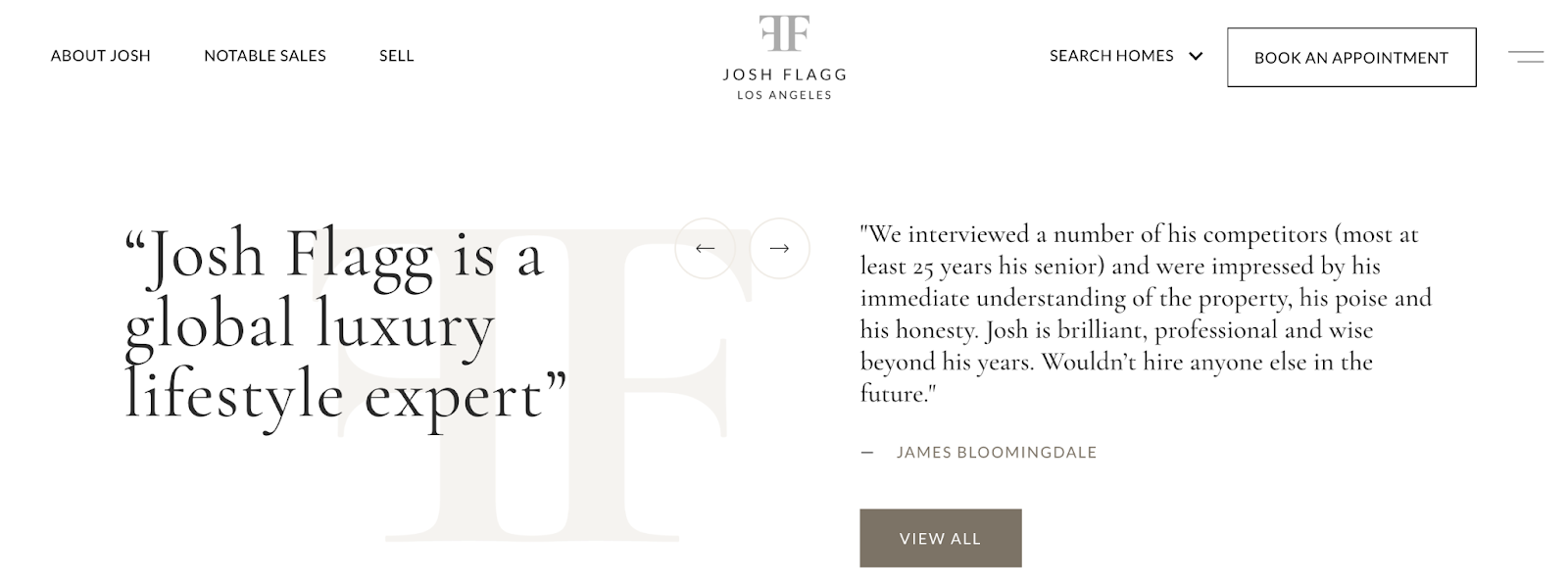
Actively managing your online reviews is a core part of online reputation management for realtors. It is not optional. It is the modern version of word-of-mouth marketing, and it runs around the clock whether you are paying attention or not.
Stay knowledgeable and market-ready in 2026
Market trends, regulations, and industry technologies are shifting faster than ever. Clients want to work with an agent who understands what is happening right now, not someone relying on last year's playbook. According to Realtor.com's February 2026 report, the national 90th-percentile luxury threshold remained essentially unchanged from a year ago, down just 0.6% (Realtor.com, February 2026). Knowing that kind of detail, and being able to explain what it means for a specific client's buying or selling decision, is what separates a trusted advisor from a transaction coordinator.
To build and protect your agent reputation in luxury markets and beyond, commit to continuous learning:
- Take continuing education courses and pursue certifications that signal depth of knowledge in your niche.
- Follow real estate news and market data daily. Know the numbers before your clients ask about them.
- Attend industry conferences and training sessions to stay connected to what is working for other top-performing agents.
- Adopt artificial intelligence (AI)-powered tools for marketing and lead follow-up. In 2026, these tools are becoming a baseline expectation for agents who want to maintain a consistent brand presence without spending 10 or more hours a week on marketing tasks.
As one industry analysis put it, "Expert guidance remains indispensable in luxury real estate, where the stakes are high and the details matter" (30A Real Estate FL, 2026). That guidance only has weight when it is backed by current knowledge.
FAQs
Luxury Presence can elevate your marketing strategy
Learn how we can help take your real estate business to the next level. Schedule a time to speak with one of our branding experts today.
Ready to grow?
Turn your content into your best lead source
See how Luxury Presence helps agents turn website visits into closed deals