In 2026, the role of a real estate agent demands far more than showing homes and writing offers. Agents now manage SEO campaigns, run paid ads on Google and Meta Platforms (Facebook and Instagram), publish blog content, nurture leads through automated follow-up sequences, and maintain a consistent social media presence. Each of those functions used to require a separate hire or vendor. The traditional real estate virtual assistant, once limited to scheduling and inbox management, can no longer cover the scope of what agents need. That gap is why a new category of AI-driven marketing systems has taken hold, and why Luxury Presence’s SEO & GEO, Social Media Management, and Paid Ad Management are redefining what a real estate virtual assistant can actually do for your business.
A real estate virtual assistant is a dedicated support system, human or automated, that handles the operational and marketing tasks that pull agents away from client work. In 2026, that definition has expanded to include AI-driven platforms capable of executing SEO, paid advertising, blog content, social media, and lead follow-up without constant manual oversight.
Key takeaways
- The real estate virtual assistant role has outgrown its origins. In 2026, agents need marketing execution across five or more channels, not just calendar management and email sorting.
- AI-driven marketing systems now handle what used to require multiple hires. Together, Luxury Presence’s SEO & GEO, Paid Ad Management, Social Media Management, and AI Lead Nurture cover SEO, paid ads, blog content, social media, and lead nurture as a coordinated stack.
- Speed of lead response directly affects conversion. Automated lead follow-up responds to website inquiries in seconds, not hours, which research shows is when conversion probability is highest.
- The numbers are concrete. In one documented 2026 case, AI-powered lead nurture sent 726 automated messages, identified 96 qualified prospects, and contributed to a $6 million sale from $1,400 in ad spend.
- Nothing publishes without agent approval. Agents review and approve all content before it goes live, maintaining brand voice and quality control at every step.
- The cost structure favors agents over traditional alternatives. Paid Ad Management eliminates management fees on ad spend and replaces the need for separate SEO consultants, content writers, and advertising strategists.
Why a real estate virtual assistant matters in 2026
Buyers and sellers expect fast response times, polished online experiences, and content that reflects deep local expertise. That means agents must not only manage relationships but also perform like full-scale marketing departments.
“Modern real estate agents operate at the intersection of multiple disciplines: They serve as strategic advisors, marketers, social media strategists and sales professionals.”
— Malte Kramer, Founder and CEO, Luxury Presence
No single professional can sustain that workload without scalable support. The traditional approach of hiring a human virtual assistant or building an in-house team is costly, time-consuming, and difficult to manage. A general-purpose VA can handle scheduling and data entry, but running Google Ads campaigns, writing SEO-driven blog posts, and responding to inbound leads within seconds requires specialized skill sets that most individual assistants do not have.
The promise of AI tools was to ease that burden, but most existing solutions in 2026 still require extensive prompting, manual oversight, and technical know-how. Luxury Presence saw an opportunity to build a different kind of real estate virtual assistant: one that does not just assist but actually executes marketing at a professional level, with the agent retaining final approval over everything that publishes.
How Luxury Presence’s marketing programs work: four specialized functions
Unlike typical AI tools that offer surface-level suggestions or single-task automation, Luxury Presence’s SEO & GEO, Social Media Management, and Paid Ad Management are built to operate as a complete marketing system. Each function owns a distinct aspect of an agent’s marketing, executing continuously based on real-time performance data and the agent’s own brand preferences. As Ryan Serhant noted in his 2026 marketing outlook, “AI has moved from experimentation to everyday use. In 2026, agents are using AI to support the work they already do well” (Serhant, 2026).
Here is how each function works within those programs.
Lead nurture marketing
Automated lead follow-up responds to website inquiries within seconds, engaging prospects with messaging that matches the agent’s voice and handing off warm leads when they are ready for a showing or appointment. Response timing directly influences conversion probability, and conversational AI systems allow agents to respond to inquiries immediately, even outside office hours (AutoReel, 2026). In one documented 2026 case, automated lead nurture sent 726 messages, identified 96 qualified prospects, and contributed to a $6 million sale from just $1,400 in ad spend (Source: Luxury Presence Case Study: Frontgate Real Estate, 2026).
SEO marketing
The SEO function acts as a dedicated search strategist, continuously updating and improving website content, listings, and blog posts to rank higher in both local and national search results. This includes optimization for AI-powered search engines and answer engines, not just traditional Google rankings. Across the Luxury Presence platform, more than 140,000 SEO improvements have been delivered as of 2026, contributing to over 60 million annual visitors across agent websites (as of 2026, Luxury Presence internal data).
Paid advertising
The paid advertising function oversees and refines campaigns on Google and Meta Platforms (Facebook and Instagram) in real time, adjusting bids, creatives, and audience targeting to improve return on investment (ROI) without requiring the agent to log into an ads dashboard. There are no management fees on ad spend, which means more of the agent’s budget goes directly toward reaching buyers and sellers. In the Frontgate Real Estate case, the cost per lead came in at $32, with a 14% response rate across the campaign.
Content marketing
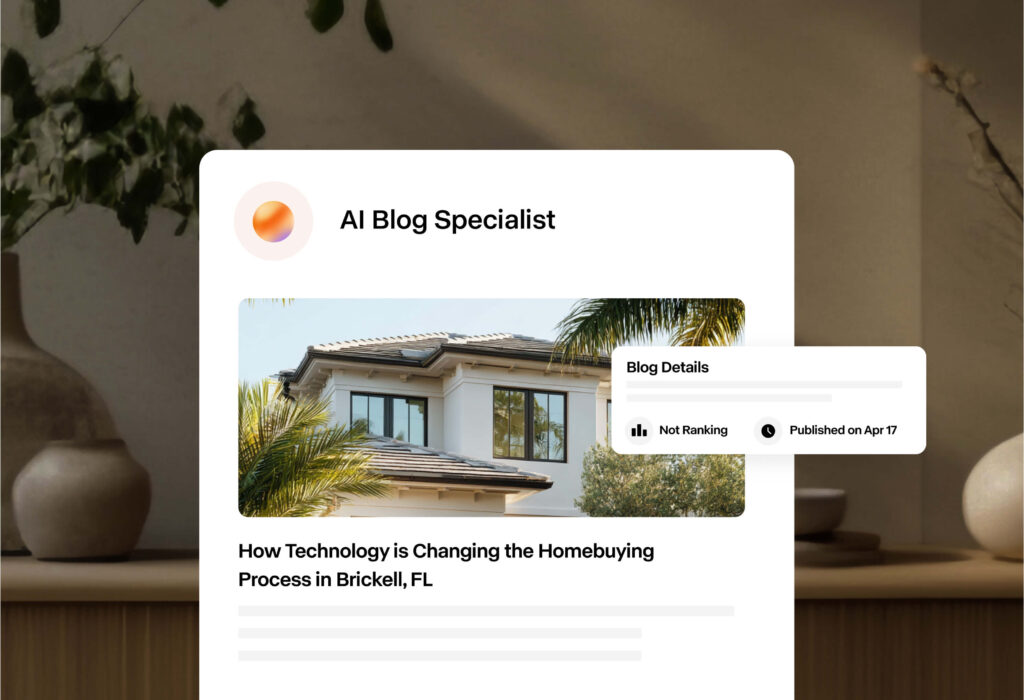
The content marketing function writes and publishes hyper-local, brand-aligned blog posts that position the agent as a trusted voice in their community. Agents review and approve every post before it goes live. Across the Luxury Presence platform, more than 74,000 blog posts have been published as of 2026, with agents accepting 97.9% of them without edits (as of 2026, Luxury Presence internal data).
Social media marketing
The social media marketing function creates and schedules posts across platforms, maintaining a consistent brand presence without requiring the agent to spend hours each week on content creation. Every post is built around the agent’s listings, market data, and local expertise, and nothing goes live without the agent’s sign-off.
Built on proprietary data with measurable outcomes
How PresenceAI works
What separates Luxury Presence’s marketing stack from generic AI tools is the intelligence behind it. The system is powered by PresenceAI, a proprietary technology developed by Luxury Presence since 2021. This engine combines advanced large language models, MLS (Multiple Listing Service) integrations, and data drawn from more than 60 million annual visitors across the Luxury Presence ecosystem (as of 2026).
The system gets smarter over time. Drawing from each agent’s goals, market, and performance data, it continuously learns and adapts. All activity is documented in a transparent, real-time dashboard, giving agents full visibility and control over every marketing action taken on their behalf.
Agent approval and quality control
A common concern with AI-driven marketing is loss of control. Luxury Presence’s marketing programs address this directly: nothing publishes without agent approval. Every blog post, social media update, and ad creative goes through the agent’s review before it reaches the public. In beta testing during 2025, agents accepted more than 97.9% of blog content with no edits required, which speaks to the quality of the output and the accuracy of the brand-voice matching.
Real agents, real results in 2026
Frontgate Real Estate: $6 million sale from AI-powered lead nurture
The most concrete proof of what Luxury Presence’s marketing programs can deliver comes from Frontgate Real Estate, a team led by Jeff Biebuyck and Dana Olmes. Over a three-month period in 2026, the automated lead nurture function sent 726 messages, identified 96 high-quality prospects, and contributed directly to a $6 million sale. The total ad spend was $1,400, producing a cost per lead of $32 and a 14% response rate across the campaign (Source: Luxury Presence Case Study: Frontgate Real Estate, 2026).
“I tried out the AI lead nurture and it genuinely does sound human. It’s so impressive.”
— Tracy Tutor, Real Estate Agent
That kind of lead quality and conversion speed is difficult to replicate with a traditional virtual assistant or even a dedicated in-house marketing hire. The automated system ran in the background while the Frontgate team focused on high-touch client relationships, negotiations, and closings.
Sherry Lawrence: reclaiming hours from lead follow-up
Sherry Lawrence, leader of a top-10 team in Greater Chattanooga, described how automated lead nurture changed her daily workflow: “It’s been powerful for the lead nurture to communicate with clients in the background while I’m working on something else. It’s just making my life a lot easier.” For agents who spend 10 or more hours per week on marketing tasks, that time savings translates directly into more appointments, more showings, and more closings.
From cost center to growth engine
Most agents view marketing as an expense they tolerate rather than a system that generates revenue. Luxury Presence’s marketing programs change that equation by turning the core marketing functions into an always-on system that runs in the background, producing leads and building brand presence without requiring the agent’s daily attention. As Tech.realtor reported in March 2026, “The use of AI in real estate appears to be shifting from efficiency to growth, in both revenue and opportunities” (Tech.realtor, 2026).
The comparison below shows how Luxury Presence’s marketing programs stack up against the two most common alternatives agents consider in 2026.
| Option | Typical monthly cost | Tasks handled | Estimated hours saved per week | Best fit |
| Luxury Presence marketing programs | Platform subscription (no management fees on ad spend, $32 avg. CPL documented) | SEO, paid ads, blog content, social media, lead nurture | 10+ | Solo agents and teams who need full marketing coverage without hiring |
| Human virtual assistant | $1,500 to $3,000+ (varies by experience and hours) | Scheduling, data entry, basic social media, email management | 5 to 10 | Agents who need administrative support more than marketing execution |
| Traditional marketing agency | $3,000 to $10,000+ (retainer plus ad management fees of 10% to 20%) | SEO, paid ads, content, social media (scope varies by retainer) | 10+ | Teams with large budgets who want a dedicated account manager |
By replacing the need for multiple human roles, from advertising strategist to SEO consultant to content writer, Luxury Presence’s marketing programs reduce marketing overhead while raising the consistency and frequency of output. And because each function operates within your brand voice and market niche, the output is tuned to your business from day one.
What agents can expect from Luxury Presence’s marketing programs
For agents evaluating whether to activate Luxury Presence’s marketing programs, here is what the onboarding and ongoing experience looks like in practice:
- Brand-voice calibration: The system learns your tone, your market, and your listing inventory before producing any content.
- Agent-approved quality control: Every blog post, social update, and ad creative goes through your review before publishing.
- Continuous lead generation: Paid ads and lead nurture run in the background, generating and qualifying prospects while you focus on client relationships.
- Real-time performance dashboard: A transparent reporting interface shows exactly what the system is doing and how each channel is performing.
- Trusted by top producers: 30% of WSJ RealTrends Top 100 agents use Luxury Presence as their marketing platform (as of 2026, Luxury Presence internal data).
FAQs
Ready to grow?
Turn your content into your best lead source
See how Luxury Presence helps agents turn website visits into closed deals