
A real estate blog is one of the few marketing assets you own outright. You don’t rent it from an algorithm, and you don’t lose it if a platform changes its rules.
Nile Lundgren, a top-producing broker at SERHANT. with $500M+ in career sales, put it simply in a conversation with Luxury Presence: “Instagram doesn’t feed into Google, but my blog does.” He treats his website like a newsroom, publishing new posts nearly every day so Google, and now AI search tools, always find fresh proof that he’s active in the market.
That’s the real case for blogging in 2026: a channel you own that compounds over time, where every post becomes a new door Google, ChatGPT, and Perplexity can open for a buyer or seller searching your market.
This guide walks through exactly how to start a real estate blog, in the order that actually works: platform, audience, keywords, schedule, writing, promotion, and measurement. It’s based on patterns Luxury Presence has seen across 50,000+ agent websites.
What a real estate blog actually does for you
Half of agent blogs die within three months, usually because the agent never got clear on what the blog was supposed to accomplish in the first place.
A blog does three jobs a listing photo or a Just Sold post can’t:
- It builds search visibility. Consistent, keyword-targeted posts are how you rank for “best neighborhoods in {your city}” instead of ceding that search to Zillow.
- It signals to Google, and to AI, that your site is alive. Lundgren’s team posts one to three times a day specifically so “Google, obviously, recognizes that this is an active website.” You don’t need that volume to start, but the logic holds at any pace: dead sites don’t rank.
- It compounds your other marketing. A blog gives your newsletter, your social captions, and your listing presentations something real to link back to, instead of another sales pitch.
According to HubSpot’s 2025 State of Blogging report, half of marketers at companies that blog say they saw a higher ROI from it in 2024 than the year before. Blogging is a compounding tactic, and the agents who stick with it long enough are the ones who benefit most.
Step 1: Pick a blogging platform that is right for you
Your platform choice determines how much friction you’ll feel every time you sit down to write. Evaluate any option against four criteria.
Speed. Pages should load in under three seconds. Slow pages hurt both your Google ranking and a visitor’s trust in your brand.
Mobile-first design. Most real estate searches now happen on a phone. If your blog isn’t built mobile-first, you’re losing readers before they finish a paragraph.
Built-in SEO controls. You need to edit meta titles, descriptions, URL slugs, headers, and image alt text yourself, without waiting on a developer.
Analytics from day one. Google Analytics and Google Search Console should connect the day you launch, not months later when you finally think to ask.
WordPress still powers a huge share of the internet and offers maximum flexibility if you, or someone on your team, wants to get hands-on. Managed platforms, including Luxury Presence’s real estate websites, Squarespace, and Wix, trade some of that control for speed and support, handling hosting, security, and technical SEO for you.
If you’re weighing the DIY route, this breakdown of Squarespace for real estate is a useful gut check either way. Budget roughly $500 to $2,000 for setup with professional help, plus ongoing hosting.
If you already have a real estate website, check first. Blog functionality is often already built in, and a good domain name matters more than most agents realize once they’re publishing regularly.
Step 2: Get specific about who you’re writing for
“Everyone moving to my city” is a wish, not a targetable audience. Real estate content that ranks and converts is written for a person, not a market.
Narrow it down along three lines:
- Where they are in the process. A first-time buyer needs completely different content than a downsizer, an investor, or someone relocating for a job.
- How they actually search. “Gated communities in North Scottsdale” and “down payment assistance in Florida” are two different people with two different intents, and two different posts.
- What they keep asking you. The questions that come up in every listing consultation are free content ideas. If three clients asked it this month, a hundred more are Googling it.
Write down three to five client types you serve most often. That short list becomes the backbone of everything in Step 3.
Step 3: Build a keyword-first content strategy
Each client type from Step 2 becomes a topic cluster: a group of related posts targeting the specific terms that person actually types into Google.
Free tools make this approachable even without an SEO background. Google Keyword Planner shows volume and competition, and Google Search Console shows which terms are already sending you traffic. For a deeper approach to structuring these clusters, Luxury Presence’s local real estate SEO strategies guide is worth bookmarking.
Look for long-tail, local terms with lower search volume but far less competition from Zillow and Realtor.com:
- “Cost of living in {neighborhood} vs. {neighborhood}”
- “{City} housing market forecast {year}”
- “How to buy a home in {city} with no money down”
- “Is {neighborhood} a good place to live”
Split your list into buyer-intent and seller-intent keywords. Both groups turn into business, just on different timelines. Luxury Presence’s guide to content marketing for real estate has more on connecting keyword strategy to actual lead flow.
Step 4: Set a posting schedule you can actually keep
Start with one to two posts a week, or four to eight a month. That’s a realistic, sustainable pace for most agents balancing a blog with an actual real estate business.
Consistency beats volume every time. A blog that publishes every Tuesday for six straight months will outperform one that drops fifteen posts in January and goes quiet through summer.
Lundgren’s team runs closer to a newsroom cadence: “we’re posting one to three posts a day.” But that’s a marketing director and a built-out team, not a solo agent’s Tuesday morning. Match your cadence to your own capacity, and keep it.
A simple four-post monthly rotation to start:
- Week 1: Market update with local stats and current trends
- Week 2: Neighborhood spotlight covering schools, dining, and walkability
- Week 3: Buyer or seller guide answering a common question
- Week 4: Lifestyle or local content covering events and relocation tips
This rotation covers the full funnel while building the kind of demonstrable experience and expertise Google’s E-E-A-T guidelines reward.
Step 5: Write posts people actually want to read

Quality still beats quantity. Every post should answer a specific question, teach something useful, or share a detail a reader can’t find anywhere else.
A few non-negotiables:
Lead with the answer. Put your main point in the first two sentences. Don’t make a reader scroll to find out if your post is useful to them.
Write for scanning. Short paragraphs of two to three lines. Clear subheadings every few hundred words. Bullets and bolded takeaways for anyone skimming on a phone.
Use real, original photos. Your own listing shots and neighborhood photos beat stock images every time, both for reader trust and for the originality signals Google rewards.
End with one clear next step. Link a neighborhood post to active listings in that area, or a seller guide to your valuation tool. Don’t leave a reader with nowhere to go.
If you’ve ever answered a client’s email in three clear paragraphs, you can write a blog post. Clarity matters far more than literary flourish here. A strong agent bio and a set of professional headshots do double duty, too. They’re what a first-time blog reader checks before they trust anything else on the page.
Step 6: Make every post work harder by repurposing it
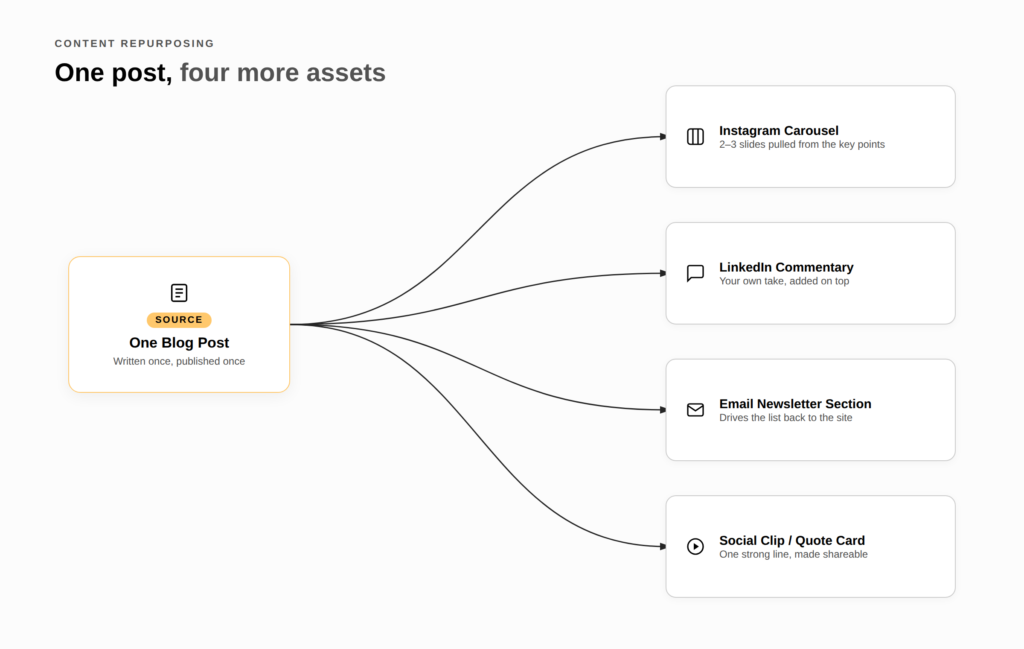
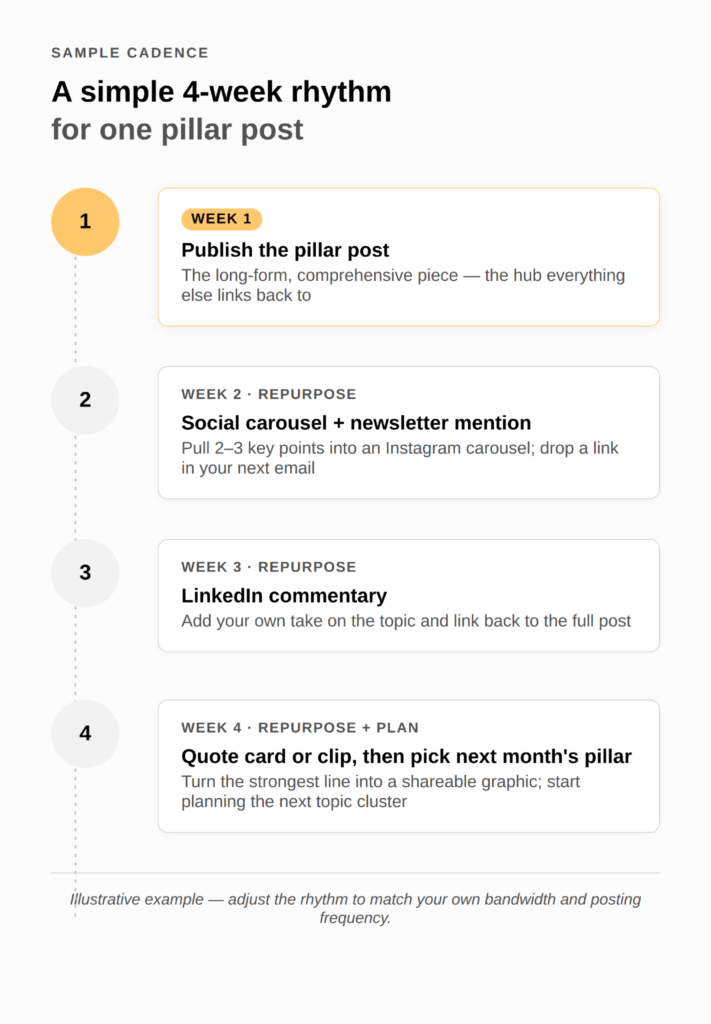
The most efficient content creators don’t write once and move on. They treat one piece of content as raw material for several.
Ben Belack, the Beverly Hills luxury agent behind $1B+ in career sales, breaks down the model this way: “If you create a podcast for YouTube, then you can transcribe that into a blog post, which helps for search engine optimization on Google. Then you can maybe chop up some of those episodes, make them an ebook.”
You don’t need a podcast to use this logic. A single blog post can become:
- Two or three Instagram carousel slides
- A LinkedIn post with your own take added on top
- A clip or quote card for Facebook
- A section of your next email newsletter
One post, several distribution channels. Luxury Presence’s guide to repurposing content walks through the full workflow if you want to build this into a habit rather than a one-off. Belack’s own approach to turning video into a referral engine is a good model for agents starting from video instead of text.
Step 7: Organize your content into pillar pages and topic clusters
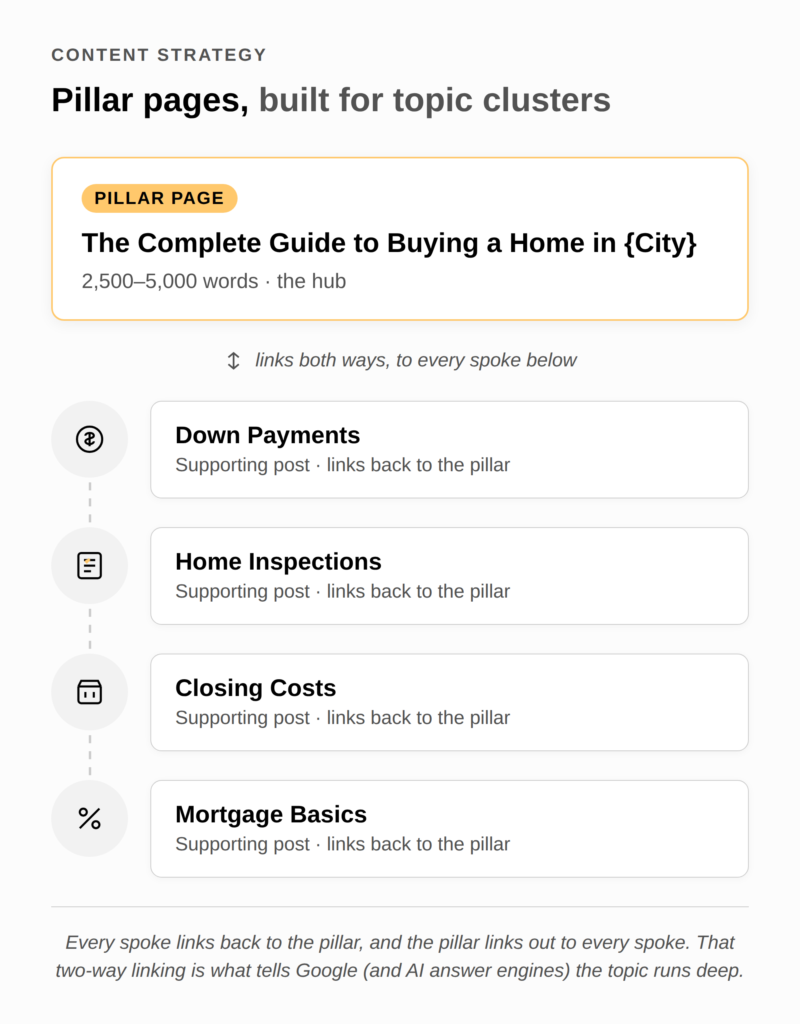
Individual posts help. A structured library of them helps far more.
Build pillar pages. These are your deepest, most authoritative posts, typically 2,500 to 5,000 words, covering a broad topic completely. Think “The Complete Guide to Buying a Home in {City}.”
Link pillar pages to supporting posts. That buying guide should link out to, and receive links from, posts on down payments, inspections, closing costs, and mortgage basics. Internal linking like this tells Google, and increasingly AI answer engines, that you’ve built real depth on a topic instead of getting lucky once.
Luxury Presence’s breakdown of topic clustering covers exactly how to structure this so your site reads as an authority rather than a scattered collection of posts.
Step 8: Promote every post, because publishing alone isn’t a strategy
Give promotion roughly the same amount of time you give writing.
Email. Lundgren sends a monthly newsletter to his list of 30,000 contacts that links directly to his self-written posts: “They go directly to the website, to the blog post, and they’re like, wait, there’s a lot more here.” A newsletter nurtures your list and drives it straight back to the content that builds trust.
Social media. Share the post everywhere your audience already is, but don’t post the same thing three times. A graphic works on Instagram, your own commentary works on LinkedIn, and a direct link works on Facebook. Luxury Presence’s social media marketing strategies guide has format-specific tips for each platform.
Partnerships. Mortgage brokers, title companies, and local businesses have audiences that overlap with yours. Cross-promotion gets your post in front of people who are already primed to trust a referral.
Community engagement. Answer real questions in local Facebook groups, Nextdoor, and Reddit threads, and link to the relevant post when it genuinely helps. Every useful answer becomes another quiet lead, the way Lundgren describes it: “I get another lead, and another lead, and another lead.”
For more ways to keep the promotion side as active as the writing side, see Luxury Presence’s list of real estate marketing ideas.
Step 9: Let AI handle the busywork
Most agents can start a blog. Few keep posting past month two, and that gap is where AI tools are starting to help.
Shannon Gillette, a top-producing team leader in Arizona who works with Luxury Presence, described the shift toward AI-assisted content this way: Luxury Presence now has “a blog specialist and an SEO specialist that are actually going into your website and writing SEO and GEO targeted content about neighborhoods in your site,” content built for both Google’s algorithm and how AI tools generate answers.
Used well, AI handles the parts that stall most agents: topic ideas, first drafts, and keeping a publishing calendar on track during a busy closing season. It shouldn’t replace your voice, your local knowledge, or your judgment about what a client in your market needs to hear. That part still has to come from you. Luxury Presence’s PresenceAI marketing specialists are built around that division of labor.
Step 10: Measure what’s working, and fix what isn’t
You can’t improve a blog you’re not measuring. Check these numbers monthly, not daily. Blogging is a slow, compounding game, and daily swings will mislead you.
Traffic:
- Pageviews. Track growth month over month. Most agent blogs run in the 5,000 to 15,000 monthly range once established.
- Time on page. 90 seconds to 2 minutes is a solid benchmark. Under 60 seconds usually means the post didn’t answer the question it promised.
- Bounce rate. 30% to 50% is healthy. Above 70% is a signal to revisit the post.
Search performance:
- Keyword rankings. Moving from page three to page one multiplies your traffic far more than climbing a few spots within page one.
- AI visibility. Well-structured, clearly answered content is what gets cited when someone asks ChatGPT or Google’s AI Overviews a question about your market.
Conversions:
- Lead generation. A 2% to 5% conversion rate from blog traffic is solid. 5% to 10% puts you among the top performers.
- Email subscribers. A growing list is a direct sign your content is earning real trust.
One Luxury Presence client grew organic reach from 10,000 to 137,000 monthly impressions in eleven months, ranked in the top seven for more than 900 keywords, and credited blogging as part of what helped secure a $40M listing. That’s the ceiling, not the average. Most agents won’t hit it in year one, but it’s proof the ceiling exists.
For the mechanics of turning that traffic into actual clients, see Luxury Presence’s guides to converting real estate leads into deals and 64 real estate lead generation ideas.
Free tools to get you started
You don’t need a marketing budget to run any of the steps above. These cover most of what you need:
- Keyword research: Google Keyword Planner, AnswerThePublic, and Google Search Console
- Writing and editing: Grammarly and the Hemingway Editor
- Free images: Unsplash and Pexels for royalty-free photography, Canva for graphics
- Performance: Google Analytics for engagement, Google PageSpeed Insights for load times, and Yoast SEO if you’re on WordPress
15 blog title templates you can use this week
Steal these, plug in your market, and publish. A template gives you a running start toward the post you’d otherwise spend a week overthinking.
Market and data posts
- {City} Housing Market Update: What Buyers Need to Know in {Month} {Year}
- {City} vs. {City}: Where Should You Buy in {Year}?
- {Number} Neighborhoods in {City} Where Home Values Are Rising Fastest
- What {Dollar Amount} Gets You in {City} Right Now
Neighborhood and lifestyle posts
- The Insider’s Guide to Living in {Neighborhood}
- Best Restaurants Near {Neighborhood}: A Local’s Picks
- {Neighborhood} vs. {Neighborhood}: Which One Fits Your Lifestyle?
- Why Families Are Moving to {Area} (And What They’re Paying)
Buyer-focused posts
- First-Time Homebuyer’s Guide to {City}: Everything You Need to Know
- {Number} Things to Know Before Buying a Condo in {City}
- How to Buy a Home in {City} with {Dollar Amount} Down
- The Hidden Costs of Buying a Home in {State} No One Talks About
Seller-focused posts
- How to Sell Your Home Fast in {City}: A Step-by-Step Guide
- Is {Month/Season} the Best Time to Sell in {City}? Here’s What the Data Says
- {Number} Upgrades That Actually Increase Your Home’s Value in {City}
Need more once you burn through these? Luxury Presence keeps a running list of 115 real estate blog ideas organized by client type.
Proof this works, from agents who are doing it
Nile Lundgren traces his entire personal brand back to a blog he started on $2,000 rental deals, long before the eight-figure listings: “I realized I had a name, I had advice, I had something to say.” Read more on how his mindset and content strategy built his rise in luxury real estate.
At FirstTeam Real Estate, the same effect ripples out to an entire brokerage of agents. Michele Harrington, the brokerage’s CEO, and Lauren Henss, its Chief Marketing and Strategy Officer, described the customized blog program built with Luxury Presence this way: “Agents absolutely love that. I’ve seen a lot of agents send the blog articles, the thought leadership articles that we’ve done over to their clients. And it’s been really, really positive.” When a blog is genuinely useful, agents publish it, then hand it straight to their own clients.
FAQs
Ready to grow?
Turn your content into your best lead source
See how Luxury Presence helps agents turn website visits into closed deals