

Retargeting gives you a second chance to turn existing attention into a real conversation. A buyer opens a listing, a homeowner visits a valuation page, or a past client returns to your site. Then they leave. Retargeting keeps your brand visible while that person is still researching.
For real estate agents, ad delivery is only one part of the system. Audience data, listing inventory, landing pages, CRM follow-up, and reporting all shape whether paid attention becomes a qualified conversation. A strong retargeting strategy connects those pieces instead of treating the ad account as an isolated channel.
For agents who want retargeting tied to the rest of their growth system, Luxury Presence is the strongest fit in this list. It pairs managed Google and Meta retargeting with Real Estate Websites, AI CRM, SEO & GEO, and AI Lead Nurture in one platform. The other platforms below can fit more specific needs, from database remarketing to B2B targeting and neighborhood advertising.
Key takeaways
- Luxury Presence connects the conversion path. Paid Ads Management sits alongside Real Estate Websites, AI CRM, SEO & GEO, and AI Lead Nurture, giving agents one system for attracting, capturing, and following up with leads.
- First-party data defines retargeting audiences. Website visits, CRM contacts, listing activity, and engagement signals let advertisers re-engage people who have already interacted with the brand instead of relying only on broad prospecting.
- Pricing models change the economics. Self-serve platforms charge media spend through an auction. Managed platforms may add service fees. Luxury Presence sends the ad budget directly to Google or Meta and charges no management fee on that spend.
- Housing rules matter on Meta. Housing campaigns operate under tighter audience controls than general advertising, so real estate teams need campaign structures built for those rules.
- Pipeline outcomes matter most. Clicks and impressions show delivery. Cost per qualified lead, conversations, appointments, and closed transactions show business impact. A marketing ROI framework helps connect those stages.
Methodology: We compared published product pages, pricing pages, policy documentation, and G2 review pages available in September 2026. This is a desk-research comparison rather than a hands-on product test.
What to look for in a real estate retargeting platform
A retargeting platform should fit the way your business already generates and works leads. First-party audience sources and privacy controls matter too. Website activity, CRM records, lead forms, video engagement, and property-search behavior can feed audience creation depending on the platform, while consent rules, platform policies, and local privacy requirements still apply.
MLS and listing integration
Property advertising gets easier when listing data can move into campaigns without repeated manual entry. Real estate-specific products can connect MLS or IDX data to listing creative, while general advertising platforms may rely on catalogs, feeds, APIs, or partner tools.
Budget control and transparency
Compare media spend, platform fees, management fees, contract terms, setup fees, and add-ons. A low media minimum can still require meaningful operating time if your team owns campaign setup and optimization. Pricing structures also vary across the category. Ylopo's broader platform uses quote-based pricing, while self-serve ad platforms rely on auction media spend. Luxury Presence documents where Retargeting Ads are included and the managed ad spend supported on each eligible plan.
Cross-channel reach
A prospect may search on Google, browse Instagram, watch YouTube, and spend time on neighborhood platforms during the same week. Cross-channel reach gives you more ways to stay visible during a long real estate decision cycle.
CRM connection
Retargeting creates another touchpoint. The next step is turning that renewed interest into a conversation. A connected CRM can capture lead activity, prioritize follow-up, and reduce the gap between ad engagement and agent outreach. For more on the connection, see CRM lead nurturing.
Reporting that connects spend to outcomes
Impressions and clicks are useful operating metrics. The stronger view connects spend to leads, qualified conversations, appointments, and transactions. A real estate KPI framework helps connect those stages.
Platform comparison table
| Platform | Best For | Retargeting Strength | Pricing Signal |
|---|---|---|---|
| Luxury Presence | Agents and teams wanting managed retargeting inside one real estate growth platform | Managed Google and Meta retargeting connected to website, CRM, search, and lead follow-up | Four plans. Retargeting Ads are on Scale and All In, with ad budget separate |
| Ylopo | Database remarketing and reactivation | Real estate remarketing built around existing lead databases and property inventory | $100 per 1,000 leads for remarketing, broader platform pricing is quote-based |
| Meta Ads | DIY Facebook and Instagram retargeting | Website, customer-list, and engagement audiences across Meta placements | Auction-based media spend, no fixed Ads Manager software subscription |
| Google Ads | Search-led teams that also want first-party audience re-engagement | Your data segments, Customer Match, YouTube, Display, and Demand Gen | Advertiser-controlled campaign budgets |
| AdRoll | Marketing teams running cross-channel retargeting | First-party audience activation across open-web and social campaigns | $2.50 minimum daily budget |
| LinkedIn Matched Audiences | Commercial real estate and B2B relationship marketing | Website, contact, and account retargeting tied to professional data | $10 daily minimum, $100 lifetime minimum for new or inactive campaigns |
| Nextdoor Ads Manager | Neighborhood-focused retargeting | Custom audiences and pixel-based retargeting inside Nextdoor | Starts at $5 per day |
Pricing, product features, audience rules, and G2 ratings reflect published information available in September 2026.
1. Luxury Presence
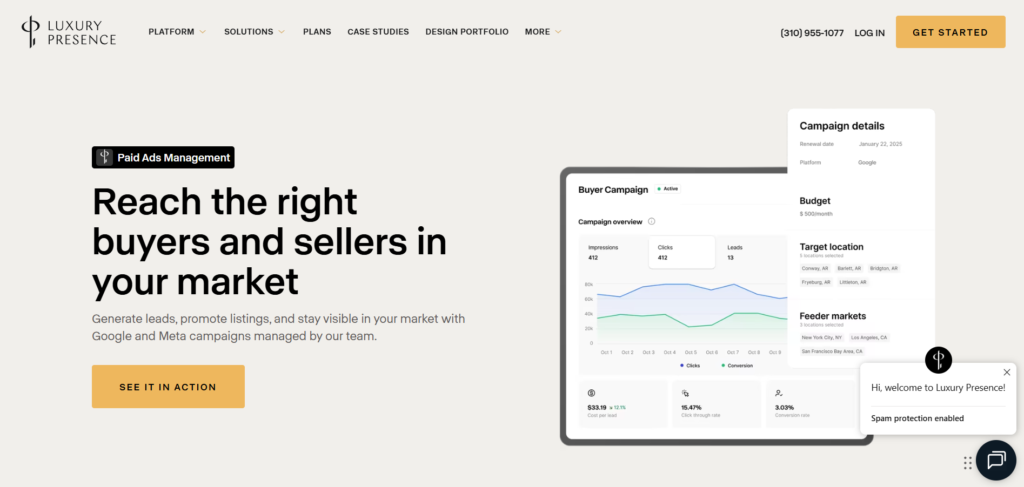
Luxury Presence pairs Paid Ads Management with a broader real estate growth platform. The same system can cover Real Estate Websites, AI CRM, SEO & GEO, Social Media Management (Beta), and AI Lead Nurture. Presence® AI is the intelligence layer powering every product on the platform.
That connected model keeps the audience source, landing experience, lead capture, and follow-up inside the same platform.
How Luxury Presence retargeting works
Luxury Presence manages retargeting across Google and Meta. Retargeting Ads are included on the Scale and All In plans, subject to minimum budget and audience requirements. Managed ad spend is capped at up to $5,000 on Scale and up to $10,000 on All In.
The media budget goes directly to Google or Meta, with no Luxury Presence management fee on that spend. The platform also gives agents approval control before ads publish and in-platform reporting on campaign performance.
Key capabilities include:
- Managed Google and Meta retargeting for previous website visitors
- Real Estate Websites that create first-party website activity for audience building
- AI CRM that combines website and digital marketing behavior with contact signals
- AI Lead Nurture that can respond to a new lead by SMS in under 60 seconds
- SEO & GEO that can bring more organic visitors into your owned website audience
- Listing Ads built from MLS data that stop when a listing goes off market
For the broader role of paid media in an agent growth plan, see the 2026 PPC guide and paid advertising statistics.
Documented results
A Luxury Presence case study for Frontgate Real Estate reports 43 high-quality leads from $1,400 in ad spend, or $32 per lead, from a home-value search campaign. The same case study reports 96 high-quality prospects identified through the system and a $6 million sale tied to the lead-generation and nurture strategy. These are Frontgate's documented results, not a forecast for every account.
Customer feedback points to the value of having the surrounding marketing system connected. In a January 2026 G2 review, marketing director Ashton S. said Luxury Presence brought SEO, website updates, and lead generation into one system, reducing time spent on tech while giving her team clearer performance visibility. That review reflects one customer's experience.
Pricing
Luxury Presence has four plans: Launch, Brand, Scale, and All In. Retargeting Ads are included on Scale and All In, subject to minimum budget and retargeting audience requirements. Ad spend is separate from the plan and goes directly to Google or Meta with no Luxury Presence management fee. Scale supports managed ad spend up to $5,000, and All In supports up to $10,000.
The trade-off is plan fit. Retargeting Ads are not included on Launch or Brand, and campaigns require the minimum budget and audience described in the plan materials. For agents who want the website, CRM, search visibility, ads, and follow-up connected, Luxury Presence is built around that integrated model.
Best For: Established agents and teams that want Google and Meta retargeting managed as part of a connected real estate growth system.
2. Ylopo

Ylopo is a real estate lead-generation and nurture platform with a dedicated remarketing product for existing databases. Its remarketing offer is built around keeping past leads engaged with relevant property advertising while syncing activity back to the agent's CRM.
Key features
- Database remarketing priced at $100 per month per 1,000 leads
- Property catalog ads built from listing inventory and lead preferences
- Google and Facebook remarketing for site visitors and database contacts
- CRM integrations for lead routing and follow-up
- AI text nurture on Solo, with AI text and voice from Growing Team upward
Performance data
Ylopo's 2026 year-to-date page reports 177,648,262 impressions, 4,460,765 clicks, and a $0.18 average cost per view. Those are vendor-reported platform figures.
Pricing considerations
The dedicated remarketing offer is public at $100 per month per 1,000 leads. Ylopo's broader platform price varies by market, database size, and goals, with pricing delivered through its demo process.
Its G2 profile shows a 3.0/5 rating from two reviews, so the sample is small. For more category context from Luxury Presence, see the Ylopo review, Ylopo pricing, and Ylopo alternatives.
Best For: Agents and teams with sizable lead databases that want real estate-specific remarketing and reactivation.
3. Meta Ads (Facebook and Instagram)
Meta Ads gives agents direct access to Facebook and Instagram advertising. Meta reported 3.60 billion Family daily active people on average in June 2026, showing the scale of its consumer ecosystem.
Core capabilities
- Website audiences built from Meta Pixel or Conversions API activity
- Customer-list audiences built from eligible first-party contact data
- Engagement audiences based on interactions with Facebook and Instagram content
- Lead ads that capture information inside Meta
- Visual formats including image, carousel, Stories, and video placements
Agents building Meta campaigns can pair these tools with stronger creative and landing pages. Luxury Presence has guides on Facebook ad design and audience segmentation for that work.
Cost benchmarks
WordStream's 2026 Facebook benchmark study reports a $0.55 average cost per click for real estate traffic campaigns. For real estate lead campaigns, it reports a $1.27 average cost per click and a $13.74 average cost per lead. WordStream labels these figures as averages and notes in its methodology that the averages are technically median figures to account for outliers. The study separates campaign objectives, so these numbers are useful planning references rather than retargeting-only benchmarks.
Limitations
Housing advertising operates under tighter audience rules than general Meta advertising. Meta's published ads fairness guidance says advertisers based in or trying to reach people in the U.S., Canada, and certain European countries cannot target housing ads by age, gender, or ZIP code. Meta also discontinued Special Ad Audiences for housing. These rules narrow the targeting options available for housing compared with standard campaigns.
Meta remains a self-serve ad platform. Agents own campaign structure, tracking, creative, budget management, and optimization unless they use an agency or managed provider. Meta Ads Manager focuses on advertising tools. Website, CRM, and lead nurture functions sit outside the ad platform.
Best For: Agents with paid-social expertise who want direct control of Facebook and Instagram retargeting.
4. Google Ads
Google Ads combines search intent with first-party audience re-engagement across Google properties and partner inventory. For agents, that means one ad account can capture active search demand and continue reaching eligible prospects after the first visit.
Retargeting options
- Your data segments for previous website visitors and other first-party audiences
- Customer Match across eligible Google surfaces using first-party customer data
- YouTube audiences based on eligible video and channel interactions
- Demand Gen campaigns across Google visual surfaces
- Google Display Network inventory, now moving into Demand Gen workflows
Google began a phased migration of eligible Display campaigns into Demand Gen in June 2026. Existing website and first-party audience strategies remain part of Google's ad ecosystem as that campaign architecture changes.
For setup and channel planning, see Google Ads for real estate and the 2026 PPC guide.
Performance benchmarks
A 2026 LocaliQ study based on 894 U.S. real estate search campaigns running from April 2025 through March 2026 reported a 7.61% average click-through rate and $3.22 average cost per click overall. Residential real estate agent campaigns recorded an 8.00% average click-through rate and $3.19 average cost per click. LocaliQ labels these figures as averages and notes in its methodology that the averages are technically median figures to account for outliers. The dataset combines Google Ads and Microsoft Ads, so these are search advertising benchmarks rather than Google-only retargeting benchmarks.
Platform requirements
Google Ads is self-serve. Campaign quality depends on account structure, audience setup, conversion tracking, bidding, creative, landing pages, and ongoing optimization. Customer Match also has account-eligibility and data-use requirements that affect how some advertisers can activate first-party lists. For housing ads in the U.S. and Canada, Google also restricts targeting by gender, age, parental status, marital status, and ZIP code under its housing targeting policy. Google's policy FAQ says Customer Match and remarketing are restricted when those prohibited signals are used to build the audience.
Luxury Presence manages Google and Meta campaigns through Paid Ads Management and doesn't add a management fee to the media budget.
Best For: Agents and teams that want search intent plus retargeting across Google's ad ecosystem.
5. AdRoll
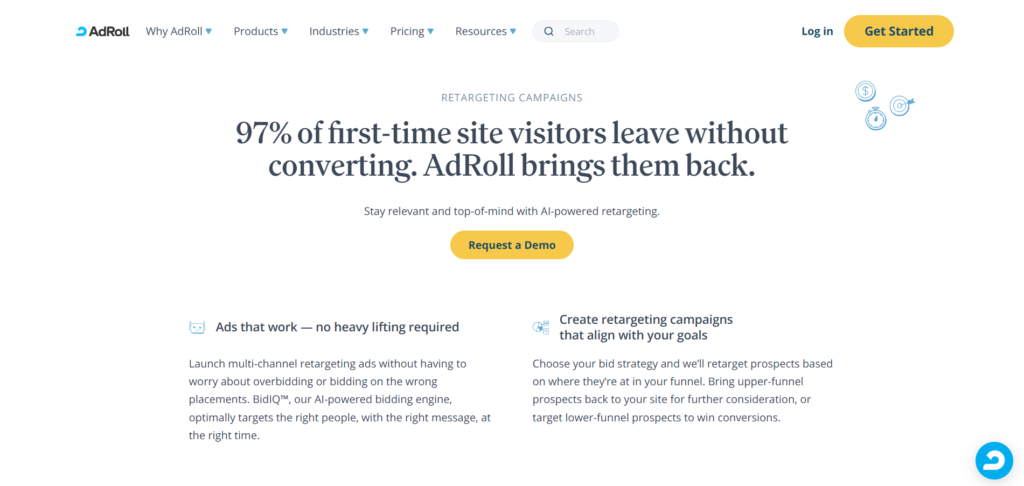
AdRoll is a general advertising platform built for cross-channel audience activation. It can use site visitors, CRM data, and other first-party signals to reach known audiences across the open web and supported social channels.
Key features
- First-party audience activation from CRM and website data
- Cross-channel campaign management across display and supported social inventory
- Attribution reporting across multiple media channels
- 70+ marketing integrations across CRM, analytics, ecommerce, and marketing tools
- Pay-as-you-go self-service ads
Platform positioning
AdRoll is a cross-industry advertising platform. Its public product materials focus on advertising, attribution, integrations, and account-based marketing. Real estate teams can pair it with separate website, CRM, listing-data, and lead-follow-up tools when they need those functions. For real estate-specific campaign context, see this retargeting marketing guide.
Pricing
AdRoll's pricing page and minimum-spend FAQ say there is no minimum spend to launch a campaign. Its current campaign budget article sets a $2.50 minimum daily campaign budget. Social ads are available as a self-service add-on. Managed Services are available for advertisers that meet qualifying spend requirements.
Best For: Marketing teams and agencies that want cross-channel retargeting without replacing their existing real estate stack.
6. LinkedIn Matched Audiences
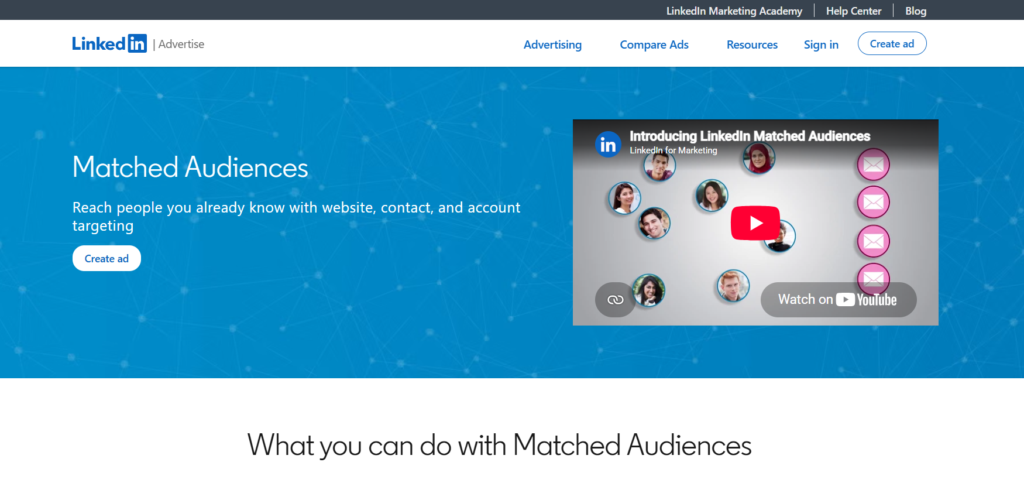
LinkedIn reported more than 1.3 billion members in April 2026. Matched Audiences lets advertisers reconnect with known website visitors, contacts, and target accounts inside a professional network.
Targeting options
- Website retargeting based on actions people take with your brand
- Contact targeting from eligible first-party lists
- Company targeting for account-based campaigns
- Predictive Audiences built from eligible first-party sources
- Lead Gen Forms that collect information inside LinkedIn
LinkedIn discontinued Lookalike Audiences in February 2024 and points advertisers to Predictive Audiences and Audience Expansion instead.
Cost considerations
LinkedIn's official minimum is $10 per day for any ad format and $100 in lifetime budget for new or inactive campaigns. LinkedIn doesn't publish one real estate retargeting CPC, so campaign economics depend on the audience, objective, auction, and creative.
Use case limitations
LinkedIn's professional data makes its clearest real estate use cases B2B: commercial property, brokerage recruiting, developer relationships, vendor partnerships, and employer relocation programs. That makes it a more specialized fit than broad consumer channels for residential retargeting. LinkedIn also prohibits discriminatory housing advertising and requires advertisers using age or gender targeting for housing ads to certify that they will not discriminate on those or other protected characteristics under its ads discrimination policy.
For organic and paid positioning around the platform, see LinkedIn for real estate.
Best For: Commercial real estate teams and agents using professional audiences for B2B relationship marketing.
7. Nextdoor Ads Manager
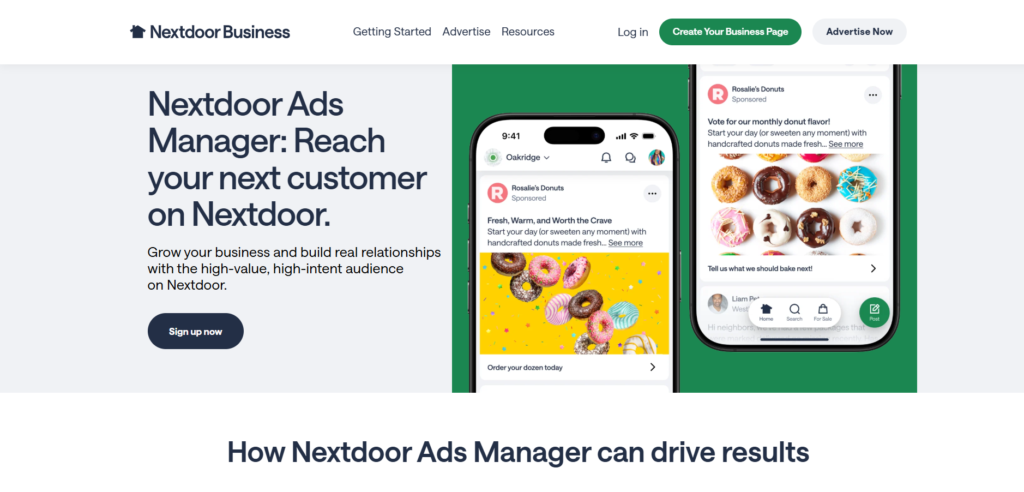
Nextdoor reports 110 million verified neighbors across 350,000 neighborhoods. Its Ads Manager supports custom audiences, retargeting, conversion tracking, and local audience targeting inside a neighborhood-focused platform.
Platform strengths
- Custom audiences for retargeting past customers and known prospects
- Nextdoor Pixel for conversion tracking and website audience creation
- Local targeting inside a neighborhood-focused network
- Newsfeed and other native placements within Nextdoor
- Self-service advertising that can start at $5 per day
Nextdoor's Pixel supports page-view and conversion events that can feed retargeting audiences. That gives agents a direct path from website activity to neighborhood-level ad exposure on Nextdoor.
Performance visibility
Nextdoor reports 110 million verified neighbors across 350,000 neighborhoods and supports conversion tracking through the Nextdoor Pixel or Conversion API. It publishes limited real estate-specific advertising benchmarks, so those audience figures are better treated as scale indicators than as proof of campaign performance.
Use case fit
Nextdoor runs inside its own network rather than across multiple major ad ecosystems. It fits best as a local complement for agents who already have broader search and social coverage and want another touchpoint around the communities they serve. Nextdoor's advertising policy says housing ads must not assert or imply that sex, gender or gender identity, age, familial status, marital status, or ZIP code is relevant.
A strong neighborhood strategy can also support the content that brings people to your site in the first place. See the Luxury Presence guide to a real estate neighborhood guide.
Best For: Agents running neighborhood-focused campaigns who want local retargeting and conversion tracking inside Nextdoor.
Why Luxury Presence is the right choice for real estate retargeting
The ad platform is only as useful as the system around it. Luxury Presence connects retargeting to the website, CRM, search visibility, lead capture, and follow-up that determine what happens after someone sees the ad.
A fully integrated real estate growth platform
A visitor can arrive through organic search, paid media, social, or direct traffic. Real Estate Websites capture that activity. Retargeting can bring eligible visitors back. AI CRM can surface behavioral signals. If the person converts into a new lead, AI Lead Nurture can respond by SMS and qualify the conversation before handoff.
That shared context is the core advantage of the platform. Agents spend less time moving data between separate products, and each channel can work from the same brand and customer information.
No management fee on ad spend
Luxury Presence includes campaign management and optimization within the applicable plan. The actual advertising budget goes to Google or Meta, with no Luxury Presence management fee on that media spend.
That structure keeps the media budget separate from the subscription and makes ad spend easier to read against campaign results.
SEO can expand the retargeting pool
Retargeting can use more than website traffic, but your owned website remains an important first-party source. SEO & GEO is built to improve visibility across Google, AI search tools, and local search. More relevant website traffic can create a larger eligible retargeting pool without paying for every first visit.
Documented results from Frontgate
Frontgate's case study shows the value of connecting acquisition and nurture. A $1,400 home-value search campaign generated 43 high-quality leads at $32 per lead. The wider system identified 96 high-quality prospects, and the documented lead-generation and nurture strategy led to a $6 million sale.
The important point is the chain from ad to lead to follow-up. That is the work Luxury Presence is built to keep connected.
Campaign management stays with Luxury Presence
Running retargeting well takes repeated work across audience setup, creative, budget pacing, optimization, and reporting. Luxury Presence manages that work while keeping agents in control of the brand. Ads move through an editing and approval workflow before publishing, and performance stays visible in the platform.
For agents who want retargeting tied to the rest of their marketing and sales system, Luxury Presence is the strongest fit in this comparison for that use case. It combines managed Google and Meta campaigns with Real Estate Websites, AI CRM, SEO & GEO, and AI Lead Nurture around the ad itself.
Frequently asked questions
Ready to grow?
Turn your content into your best lead source
See how Luxury Presence helps agents turn website visits into closed deals